

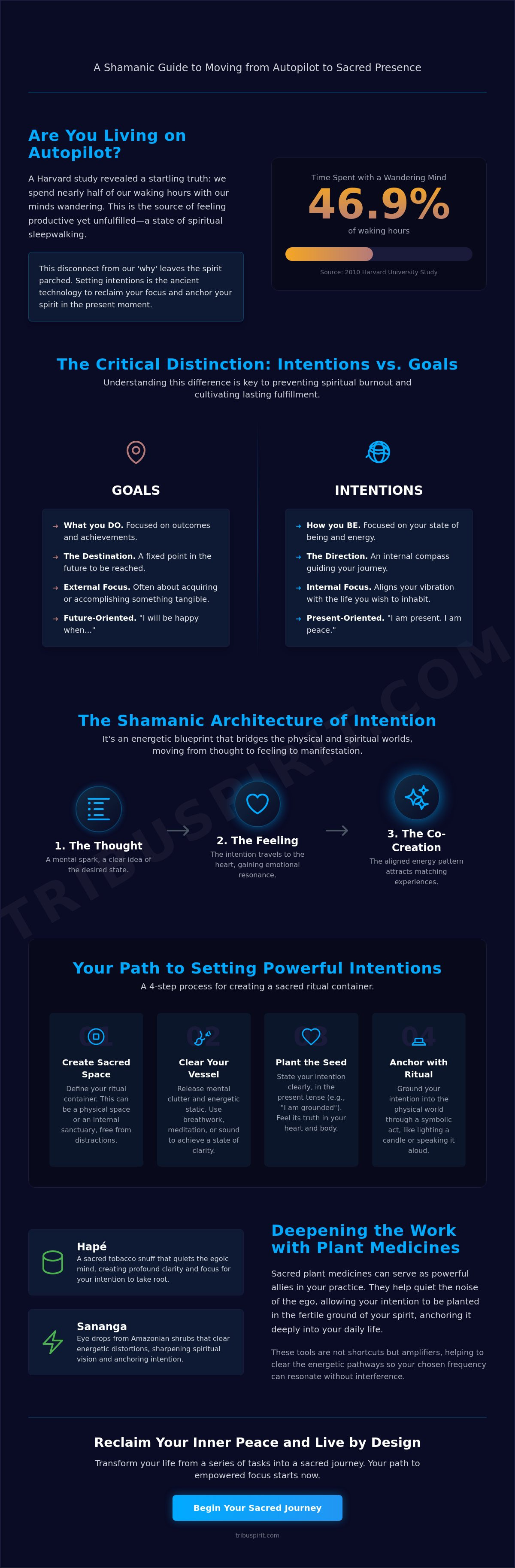
What if your constant busyness is actually a form of spiritual sleepwalking? A 2010 study by Harvard psychologists revealed that people spend 46.9 percent of their waking hours with their minds wandering, effectively living nearly half their lives on autopilot. You likely recognize this feeling; it's that subtle ache of being productive yet unfulfilled. We agree that it's exhausting to feel disconnected from the "why" behind your actions, especially when your spiritual practice lacks a clear, grounding pulse. By mastering the ancient, sacred technology of setting intentions, you can finally anchor your spirit in the present moment and reclaim your inner peace.
This guide will show you exactly how to transform your life from a series of tasks into a sacred journey of presence. You'll gain a clear method for daily alignment that moves you from a state of distraction to one of empowered focus. We'll explore how to deepen your connection to ritual and reclaim the soul-purpose that fuels your every step. You're about to discover a shamanic path that turns every mundane moment into an act of conscious devotion.
Key Takeaways
- Learn to transition from a life on autopilot to a path of sacred presence by defining your soul’s true direction.
- Master the ancient shamanic technology of setting intentions to bridge the gap between the physical and spiritual worlds.
- Understand the vital distinction between goals and intentions to prevent spiritual burnout and cultivate lasting fulfillment.
- Follow a step-by-step guide to creating a sacred ritual container and clearing your energetic vessel for profound clarity.
- Discover how sacred plant medicines like Hapé and Sananga can quiet the ego and anchor your intentions into your daily life.
What is Setting Intentions? Moving from Autopilot to Sacred Presence
Life often happens to us while we're looking elsewhere. We drift through routines, reacting to external demands like leaves caught in a river current. This state of autopilot feels efficient, yet it leaves the spirit parched. Shamanic wisdom invites us to reclaim our agency. To understand What is Setting Intentions? we must view it as a sacred direction rather than a fixed destination. It isn't a checklist of goals to conquer. It's the internal compass that aligns our vibration with the life we wish to inhabit. Living by design means choosing your frequency before you step into the world.
In the shamanic tradition, an intention is a seed planted within the vast, fertile field of universal consciousness. You don't just think it; you plant it with the weight of your entire being. This shift from living by default to living by design usually begins with a quiet, persistent ache. We call this "soul-hunger." It's a visceral signal from your deepest self that your current rhythm no longer nourishes your essence. It tells you that your roots are thirsty for a more meaningful connection to the present moment. When you recognize this hunger, setting intentions becomes the first step toward spiritual satiation.
The Difference Between a Wish and an Intention
Wishes are passive whispers sent into the void. They rely on luck or external forces to manifest. Setting intentions is an active, grounded commitment to a specific state of being. You stop "hoping" for peace and start "decreeing" your presence. It's a profound act of personal will. You take the reins of your own agency, deciding how you'll show up before the world demands anything of you. A wish says "I want," while an intention says "I am." This shift in language moves the energy from a distant future into the immediate now.
Why Your Spiritual Practice Starts with a 'Why'
Without a clear aim, even the most beautiful ceremony becomes empty movement. Your "why" acts as the North Star for every sacred ritual you perform. When you anchor your practice in a focused aim, you provide your nervous system with a map for clarity. You move from "doing" spirituality as a chore to "being" spiritual as a state of grace. This mental focus calms the frantic mind. It allows the soul to rest in the certainty of its own path. It's the difference between wandering in the woods and walking a path you've carved yourself with precision and love.
The Shamanic Architecture of Intention: Beyond Positive Thinking
Shamanic wisdom views the universe as a living, breathing tapestry of energy where nothing is static. In this sacred architecture, setting intentions isn't a mere exercise in goal-setting or a list of desires; it's the creation of an energetic blueprint. While modern positive thinking often stays trapped in the intellect, indigenous traditions teach that an intention is a seed planted in the fertile ground of the unseen world. It bridges the physical and spiritual realms by giving form to the formless, acting as a bridge between your current reality and your highest potential.
Intentions as Energetic Blueprints for the Spirit
When you focus your thought with clarity, you begin to organize the subtle energy within your light body. This luminous field, known in Andean traditions as the Poq’po, responds immediately to the frequency of your focus. High-vibrational intentions act as a scaffolding for your spirit, aligning your personal energy with the greater cosmic flow. Intention is the vector of the soul's movement. By consciously directing this movement, you stop being a passive observer and become an active co-creator of your reality. This process organizes the chaotic energy of the aura into a coherent pattern that attracts matching experiences.
The Role of the Heart-Mind Connection
A mental thought is like a spark without fuel. For an intention to manifest, it must travel the path from the head to the heart. This is where many practitioners struggle. Research into the science of setting intentions suggests that your nervous system needs more than a logical plan; it requires a felt sense of safety and resonance to move toward a new goal. Without emotional resonance, a mental intention remains a hollow wish.
Shamanic practice emphasizes "feeling as if" the desired state is already present. You don't just think about peace; you allow the sensation of peace to flood your chest. This emotional resonance acts as a magnet for the spirit. To drop into this space, try placing your hand over your heart during your sacred ritual and breathing until the thought transforms into a physical warmth. When the heart and mind vibrate at the same frequency, the intention becomes a command to the universe.
The final pillar of this architecture is the power of the spoken word, or the decree. In many tribal traditions, the breath is the carrier of life force, and the voice is the tool that shapes it. When you speak your intention aloud, you're anchoring an internal state into the physical world through vibration. You aren't just making a request. You're announcing a new reality. This sacred decree aligns your internal nervous system and your external environment, ensuring that your setting intentions practice moves beyond thought and into lived experience.
Intentions vs. Goals: Why Your Spiritual Practice Needs Both
A goal is a destination on a map; an intention is the quality of the light by which you travel. While goals focus on the "what" and "when," setting intentions centers on the "how" and "who." If your goal is to finish a creative project by a specific date, your intention might be to remain grounded and open to inspiration during the process. Goals provide the structural skeleton of our lives, but intentions are the breath that gives that skeleton life and movement.
Without this spiritual anchor, it's easy to fall into the outcome attachment trap. This is the belief that fulfillment only exists at the finish line, creating a binary state where you've either won or you're currently failing. Intentions liberate you from this cycle. They allow you to find deep satisfaction in the present moment, even if the external milestone is still months away. When you pair a professional target with a sacred intention, you transform a stressful deadline into a ritual of self-discovery.
Why Goals Fail Without a Soul-Aligned Intention
We've all experienced the "hollow victory." You reach the summit, check the box, but feel an unsettling emptiness. This happens when the achievement lacks a deeper, soul-aligned meaning. A 2023 report by Deloitte found that 77% of professionals experience burnout, often because they chase external milestones without an internal anchor. Intentions provide the spiritual fuel that prevents this exhaustion. They reframe success as a state of alignment rather than a collection of trophies. When you're aligned, the work itself becomes the reward.
Shifting from 'What I Want' to 'How I Want to Be'
To deepen your shamanic practice, you should audit your current ambitions. Look at your to-do list and ask: who am I being while I do this? A goal says, "I want a promotion." A soul-aligned intention declares, "I am a confident leader who empowers others." This shift utilizes the power of the "I Am" statement, a shamanic decree that vibrates through your entire energetic field. Consider these pairings for your next ritual:
- Professional Goal: Increase monthly revenue or client base.
- Spiritual Intention: I act from a place of abundance and service.
- Professional Goal: Launch a new project or brand by the spring equinox.
- Spiritual Intention: I trust the flow of my intuition and honor my unique voice.
By setting intentions that focus on your state of being, you ensure that every step you take is sacred. You aren't just moving toward a better life; you're living it right now. This approach replaces the frantic energy of "getting things done" with the rhythmic, meditative pace of a soul on a journey. It's the difference between running a race and performing a ceremony.
A Step-by-Step Guide to Setting Intentions for Your Sacred Ritual
The process of setting intentions is a delicate dance between the human heart and the cosmic field. It's not a mere wish; it's a directional force that shapes your reality. To begin, you must first create sacred space to act as a container for your energy. This physical and energetic boundary signals to your subconscious that you're stepping out of linear time and into a realm of infinite possibility. Once your space is prepared, use shamanic breathwork to clear the vessel of your body. This somatic practice quiets the ego's persistent chatter, allowing you to move from the thinking mind into the feeling heart.
After the breath has stilled your internal landscape, sit in the ensuing silence. This is where you listen for your soul-need. It's rarely a material desire; it's usually a state of being, such as clarity, courage, or forgiveness. Once this need surfaces, draft your decree. Write it down with a physical pen on paper to bridge the spiritual and material worlds. Finally, anchor the energy. You might use a deep, resonant exhale or a specific ritual tool to seal the frequency into your field. This five-step progression ensures that your practice isn't just a mental exercise, but a deep, cellular commitment.
Crafting the Decree: How to Write Intentions That Resonate
The language you use acts as a vibrational blueprint. Follow the "Present Tense" rule by choosing "I am" over "I will be." The universe doesn't recognize a distant future; it only responds to the frequency you embody right now. Saying "I will be brave" keeps bravery at a distance, while "I am courage" invites the energy into your current cells. Keep your decree concise. A 3-5 word mantra is more potent than a long paragraph because it's easier for the mind to hold and the spirit to chant. Avoid "no" and "not" at all costs. If you focus on "not being stressed," your mind remains fixed on stress. Instead, focus on what you're calling in, such as "I am deep peace."
Sealing the Intention in Your Sacred Space
Physical anchors provide a landing spot for spiritual energy. You can place a specific crystal on your altar or light a dedicated candle to represent the birth of your intention. For those seeking a deeper grounding, a solo hapé ceremony offers a powerful way to blow the intention into the heart and mind, anchoring it through the medicine's earthy stability. This physical act is the heartbeat of setting intentions. As you close the ritual, release the "how" to the universe. Trust that the path to fulfillment is already unfolding, even if it looks different than what you imagined. Your job is to hold the frequency; the universe's job is to handle the logistics.
Deepening the Work: Using Plant Medicines to Anchor Your Intentions
The final stage of your journey involves moving from the mental concept of a goal to a lived, embodied reality. While the mind can easily drift, plant medicines serve as powerful allies to ground your energy. When you work with these sacred tools, the process of setting intentions becomes a physical anchor in your nervous system. These medicines don't just clear the air; they forge a direct path to your inner truth, ensuring your decree isn't lost in the static of daily life.
Sananga eye drops offer a different kind of medicine for the soul. By clearing the physical and energetic "panema" or dense energy from the visual field, Sananga provides the piercing clarity needed to see your true intentions without the filters of ego. It's a brief, intense encounter with the present moment. This clarity allows you to witness the gap between where you are and where you wish to be, giving you the sight to navigate your path with unwavering honesty.
Hapé as a Tool for Grounding and Clarity
Hapé is the sacred wind that clears the path for intention. This fine, artisanal powder, often composed of Mapacho and sacred tree ashes like Tsunu, works by instantly quieting the prefrontal cortex and centering the spirit. When the blow of the pipe reaches you, the mental chatter stops. You're left with a profound silence. In this stillness, your intention can take root in fertile soil.
- Physiological Focus: Hapé stimulates the limbic system, encouraging a state of "relaxed alertness" that makes deep focus possible.
- Tsunu Blends: Utilizing Tsunu bark ash is particularly effective for grounding intentions related to stability and physical healing.
- The Clearing: It acts as a broom for the mind, sweeping away the 80,000 thoughts we process daily to leave room for one single, sacred decree.
Walking Your Truth in the Modern World
The true test of your practice occurs outside the ritual space. Bringing your sacred decree into a high-stress environment requires a bridge between the spirit and the mundane. The true essence of setting intentions lies in the quiet moments when you choose a response over a reaction. When stress rises, you can recall the scent of the Hapé or the clarity of the Sananga to return to your center. This is the "Intention-Action" bridge; it's the practice of making small, conscious choices that honor your original vow.
Transformation isn't a one-time event. It's a continuous unfolding. To keep the fire of your purpose burning, we invite you to explore shamanic tools that support your daily practice and help you maintain your sacred space at home. However, the medicine only does half the work. The rest depends on ceremony integration to ensure that the insights gained during your journey become permanent parts of your character.
You don't have to walk this path alone. We invite you to join the Tribu Spirit community, a gathering of modern seekers dedicated to the art of conscious living. Together, we can share the weight of our journeys and celebrate the beauty of our collective awakening. Let's walk this path with presence, one breath at a time.
Step Into the Power of Your Sacred Presence
The transition from a life on autopilot to a state of sacred presence begins with a single, conscious choice. You've discovered that setting intentions is the foundational architecture of shamanic practice; it distinguishes itself from standard goal-setting by focusing on the soul's alignment rather than just external outcomes. By moving beyond positive thinking and into the realm of ritual, you anchor your desires in the physical world. This process requires patience and the right support to flourish. It's a journey of returning to your true essence.
We invite you to deepen this transformation with tools that carry the vibration of the forest. Our offerings are 100% ethically sourced from indigenous tribes, ensuring that the wisdom of ancestral lineages remains respected. Through our Private Ministry and Academy, we provide the guidance necessary to navigate your inner landscapes with confidence. Every time you choose to invest in your spiritual growth, you're also healing the planet. We partner with reforestation initiatives to plant 1 tree for every purchase you make. Your ritual becomes a direct gift to the Earth.
Explore our curated selection of Hapé and Sacred Tools to anchor your practice
Trust the whispers of your soul. Your journey toward a more intentional life is a beautiful unfolding that honors both your spirit and the ancient traditions that guide us home.
Frequently Asked Questions
Is setting intentions the same as manifesting?
Setting intentions is the seed of presence, while manifesting is the harvest of a specific result. While manifesting focuses on bringing a future desire into reality, the art of setting intentions centers on how you wish to show up in the current moment. Shamanic traditions like the Q'ero of Peru teach Ayni, or sacred reciprocity, where the focus remains on the energetic quality of your internal state. This shift creates a 100 percent focus on the journey rather than the destination.
How often should I set new intentions?
You should anchor your focus through new intentions at least once every 29.5 days to align with the lunar cycle. Modern mindfulness studies from 2022 suggest that daily rituals can reduce cortisol levels by 25 percent. By refreshing your focus every 24 hours, you ensure your path remains true to your soul's evolving needs. This rhythm prevents stagnation and keeps your spiritual practice vibrant and responsive to your inner growth.
Can I set intentions for someone else?
You cannot set an intention for someone else's path, as every soul possesses its own sacred sovereignty. In shamanic ethics, attempting to shift another person's journey without their consent violates the principle of free will. Instead, you can set an intention for how you relate to that person or how you hold space for them. Focus on your own capacity for compassion, which 100 percent of the time remains within your control.
What if my intention doesn't seem to be 'working'?
If an intention feels stagnant, it often indicates an energetic blockage or an attachment to a rigid outcome. Shamanic practitioners suggest a 21 day period of observation to see how the energy settles within the body. Data from the 2021 Global Wellness Institute indicates that consistent ritual practices take approximately 66 days to form a new neural pathway. Revisit your ritual space and ask if your heart is truly open to the transformation required.
Do I need specific shamanic tools to set an intention?
You don't need physical objects to connect with your inner truth, but sacred tools act as powerful conduits for focus. Utilizing ethically sourced Palo Santo or a hand-poured candle can help transition your mind from the mundane to the ceremonial. These elements engage the senses, signaling to your subconscious that a ritual has begun. While the power resides in your heart, these 5 sensory anchors deepen the experience and ground your energy.
What is the best time of day to set an intention?
The most potent time for setting intentions is during the thin hours of dawn, specifically between 4:00 AM and 6:00 AM. During this window, the veil between the physical and spiritual realms is at its most permeable. Starting your day with this clarity allows the intention to permeate every action that follows. It sets a foundational frequency that informs your interactions for the next 16 hours of your waking life.
How do I know if my intention is coming from my heart or my ego?
A heart-centered intention feels expansive and calm, while an ego-driven one often carries a sense of urgency or lack. You can test this by noticing your physical response; a true soul-intention usually relaxes the nervous system and the 10th cranial nerve. If the thought of your intention makes you feel superior to others, it's likely coming from the ego. Research into somatic experiencing shows that authentic desires typically lower the heart rate by 5 to 10 beats per minute.
Can I have more than one intention at a time?
You can hold multiple intentions, but focusing on no more than 3 at a time ensures your energy isn't scattered. Shamanic traditions often honor the power of three, representing the lower, middle, and upper worlds. When you limit your focus, you pour more Prana or life force into each specific seed. This concentrated attention allows for deeper roots and more resilient growth within your spiritual landscape, ensuring none of your 3 goals are neglected.