
What if the most profound clarity you'll ever experience comes not from a digital detox, but from a 5,000 year old breath of forest medicine? You might be asking what is hape because you've felt that heavy, grey cloud of mental fog that modern life often leaves behind. It's natural to feel stuck in cycles of overthinking, and it's even more common to feel a deep hesitation about using sacred tools without the proper guidance. You want to honor the indigenous lineages of the Amazon, like the Huni Kuin and Yawanawá, rather than simply consuming a product. You're looking for a bridge between ancient wisdom and your current path.
This guide will help you navigate these sacred waters with reverence and clarity. You'll learn the true origins of this medicine, discover its spiritual benefits, and understand how to perform the rituals in a way that respects its traditional roots. We'll explore how to identify the specific blend that aligns with your energy and how to find a trusted source that supports ethical, tribal craftsmanship. It's time to move beyond the noise and step into a space of intentional presence and soul-deep connection.
Key Takeaways
- Understand the sacred composition of Mapacho and medicinal ashes to truly grasp what is hape and how it serves as a bridge to the spirit world.
- Honor the living wisdom of the Yawanawa and Huni Kuin tribes by exploring how this medicine acts as a spiritual pillar of their ancestral culture.
- Discover how the ritual "purge" clears spiritual heaviness and restores your energetic balance through deep grounding and intentional presence.
- Learn the essential etiquette of sacred tools like the Kuripe and Tepi to ensure your personal practice is approached with the correct ritual setting.
- Embrace the principle of sacred reciprocity by identifying ethically sourced medicine that supports tribal reforestation and indigenous communities.
Defining Hapé: The Sacred Breath and Spirit of the Amazon
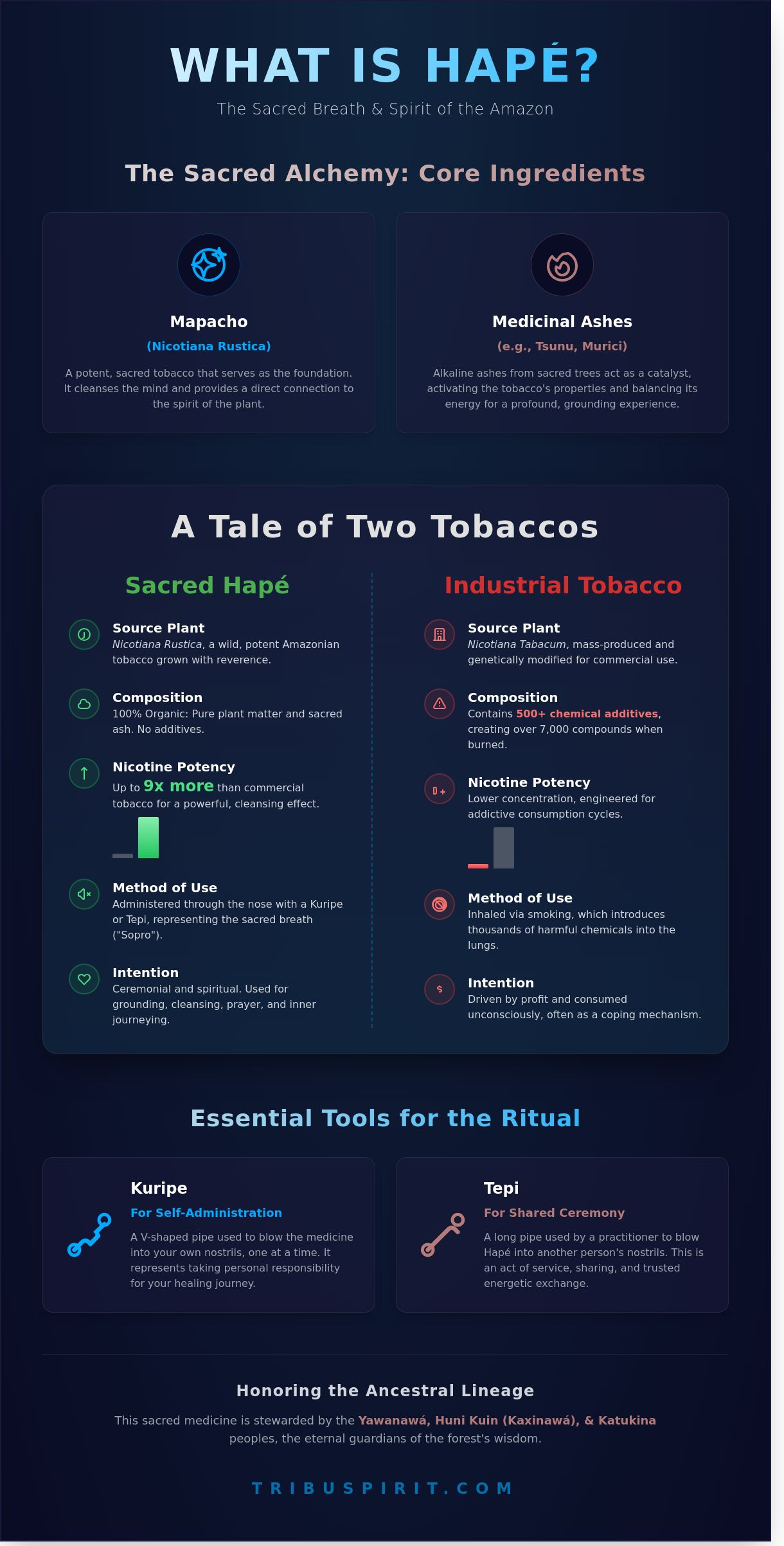
Hapé is an ancient, sacred shamanic snuff that serves as a bridge between the physical world and the spirit realm. For over 5,000 years, indigenous tribes of the Amazon basin, including the Huni Kuin, Yawanawá, and Katukina, have utilized this medicine to cleanse the mind and harmonize the energetic body. When people ask what is hape, they often look for a botanical definition, yet the answer lies deeper in the heart of the forest. It's a living prayer. This medicine isn't for recreational use; it requires a ceremonial presence and a heart filled with intention. It acts as a powerful tool for grounding, helping you find your center while opening the third eye to receive ancestral wisdom.
The Alchemy of Earth and Fire: How Hapé is Created
The creation of Hapé is a meditative ritual that often spans 14 days or more. Tribal makers begin by drying Nicotiana Rustica leaves over a low fire before grinding them into an incredibly fine dust. This powder is then sifted through silk or fine mesh multiple times to ensure a velvet-like consistency. The alchemy truly happens when the tobacco is blended with the alkaline ashes of sacred trees, such as the Tsunu or Murici. These ashes are vital. They act as a chemical catalyst that activates the medicinal properties of the tobacco, making the experience more profound and immediate. Every batch is unique because it carries the maker's intent. Prayers and specific songs are infused into the powder during the mixing process to seal the medicine's healing frequency.
Hapé vs. Commercial Tobacco: Understanding the Difference
It's a common mistake to equate Hapé with the industrial tobacco found in the modern West. The two exist in entirely different worlds of vibration and chemistry. Understanding what is hape means recognizing the purity of its source. Nicotiana Rustica, the wild tobacco used in these blends, contains up to nine times more nicotine than the Nicotiana Tabacum used in commercial cigarettes. This high concentration isn't for a "buzz" but for a deep, sudden clearing of the mental fog.
- Chemical Purity: While commercial cigarettes contain over 500 chemical additives and 7,000 compounds when burned, Hapé remains 100% organic. It consists only of plant matter and sacred ash.
- Method of Delivery: You don't smoke Hapé. It's administered through the nose using a blowpipe, either a Kuripe for self-administration or a Tepi for receiving from another.
- Spiritual Integrity: Industrial tobacco is grown for profit and consumed unconsciously. Hapé is grown with reverence, harvested with permission from the Earth, and used to facilitate a belső utazás, or inner journey.
The experience is a total sensory immersion. It's a moment where time slows down. The "Sopro," or the blow of the medicine, represents the breath of the Creator entering your field. It's a ritual of surrender that invites the soul to return to its natural state of peace.
The Ancestral Lineage: Indigenous Tribes and Their Living Wisdom
To truly grasp what is hape, you must look beyond the physical powder and into the eyes of the forest's eternal guardians. For the Yawanawa, Katukina, and Huni Kuin (Kaxinawa) peoples, this sacred snuff isn't a commodity; it's the very breath of the jungle. It serves as a social glue that binds the community together during long nights of storytelling and a medicinal pillar used to realign the spirit when the weight of the world feels too heavy. These tribes view the medicine as a living entity with its own consciousness and intentionality.
The Pajés, or Shamans, act as the traditional guardians of these specific blend recipes. They hold a library of botanical knowledge passed down through oral tradition for centuries. A Pajé doesn't just mix ingredients; they infuse the blend with a specific frequency through prayer and song. This is why a blend from the Huni Kuin might feel like a sharp lightning bolt of expansion, while a Yawanawa blend feels like a warm, protective embrace. Each tribe's medicine carries a unique spirit, a vibratory signature that reflects their specific relationship with the land.
The preparation is a ritual in itself. It requires a meditative state, as the ash of sacred trees is combined with finely ground mapacho. When you sit with these medicines, you're participating in a lineage that predates modern borders. It's an invitation to step out of linear time and into a space of deep presence. If you're ready to begin your own journey with these ancestral tools, you can explore our curated collection of authentic tribal blends.
The Yawanawa and the Gift of Tsunu
The Yawanawa tribe, whose name translates to "The People of the Wild Boar," shares an inseparable bond with the Tsunu tree. They use the alkaline ash of the Tsunu bark to create blends focused on spiritual "washing" and grounding. Practitioners often seek Hapé Tsunu as a gateway blend because it offers a profound sense of clarity without being overwhelming. It's a medicine of the heart, designed to clear the clouds of the mind and anchor the soul firmly into the Earth.
The Katukina and the Strength of the Forest
The Katukina lineage stands as one of the oldest recorded users of Hapé in the Acre region. Their blends are legendary for their potency and transformative power, often utilized in deep healing ceremonies to purge stagnant energy. They frequently integrate the use of other forest medicines, such as Kambo, to create a holistic path of purification. For the Katukina, what is hape if not a tool for total metamorphosis? Their recipes are built for those who seek to face their shadows and emerge with the strength of the ancient trees.
The Energetic Experience: How Hapé Works on the Subtle Body
The moment the medicine enters your system, the physical world undergoes a sudden, sharp recalibration. You'll notice an immediate clearing of the sinuses and a surge of alertness that cuts through mental fog. This isn't merely a chemical reaction; it's a profound grounding sensation that anchors your consciousness into the present. Practitioners within the Huni Kuin and Yawanawá traditions describe this as the removal of "panema." In these Amazonian cultures, panema represents a specific type of spiritual heaviness, bad luck, or energetic stagnation that accumulates through daily stress. By purging this density, the medicine restores your natural vibrance.
The experience functions as a bridge between the physical and the ethereal. As the powder settles, a deep meditativeness takes hold. Your breath, or Prana, begins to flow with newfound fluidity. This state of enhanced presence usually lasts between 15 and 30 minutes, leaving a lingering afterglow of clarity. To truly grasp what is hape, you have to view it as a tool for energetic hygiene. It's a ritual of letting go, allowing the spirit to breathe again without the weight of external expectations.
Aligning the Chakras and Nadis
The sacred blow, or Sopro, acts as a catalyst for energetic alignment. When the medicine is delivered, it travels through the nostrils to stimulate the pineal gland. This area, often associated with the Third Eye, is the seat of spiritual clarity and intuition. The medicine's heat clears the Nadis, the subtle channels through which our life force moves. While the Sopro awakens the higher centers, its heavy earth element simultaneously activates the Root Chakra (Muladhara). This dual action creates a pillar of light within the body, connecting the heavens to the earth through your central column.
The Power of the 'Sopro' (The Blow)
In the ritual space, the medicine's delivery is as vital as the blend itself. You don't sniff the powder; it's ceremonially blown into the nostrils using a pipe called a Tepi or a Kuripe. This Sopro is a direct transmission of intent from the giver to the receiver. Understanding what is hape involves honoring these specific blowing techniques, which are often modeled after animal spirits. The "Hummingbird" blow (Beija-flor) is short, sweet, and gentle, designed to lift the spirit. In contrast, the "Jaguar" blow (Jaguara) is strong, direct, and piercing, used to confront deep-seated blockages. Each breath carries a prayer, turning the administration into a profound act of shared healing and focused willpower.
- Grounding: Immediate connection to the physical body and the Earth.
- Purging: Release of "panema" or stagnant emotional energy.
- Clarity: Stimulation of the pineal gland for sharper intuition.
- Presence: A meditative afterglow that enhances mindfulness.
Approaching the Ritual: Tools, Etiquette, and Preparation
Engaging with this medicine isn't a casual act; it's an invitation to a deeper layer of existence. To truly grasp what is hape, one must see it as an energetic exchange that demands total presence. This begins with the physical vessels used to deliver the sacred ash and tobacco into the body. These aren't just pipes. They're bridges between the physical and spiritual planes, requiring a 5-minute window of silence before and after use to fully integrate the effects.
The environment you choose dictates the quality of your journey. Practitioners emphasize the importance of a sacred ritual space where distractions are eliminated. This means silencing phones, dimming lights, and ensuring you won't be interrupted for at least 30 minutes. Physical preparation is equally vital. Avoid heavy meals for 3 hours before the ceremony to prevent nausea. Hydrate with at least 500ml of water an hour prior to keep the body's channels open and receptive.
Kuripe vs. Tepi: Choosing Your Applicator
The Kuripe is a small, V-shaped pipe designed for self-administration. It represents personal sovereignty, allowing you to take full responsibility for your own healing. For those seeking sustainable options, bamboo kuripes are often preferred for their organic resonance and ethical, handcrafted quality. The Tepi, a much longer applicator, is used by a practitioner to blow the medicine into another person. This facilitates a master-student transmission or communal healing, requiring a deep level of trust between the two individuals.
Setting Intentions: The Heart of the Practice
Indigenous etiquette dictates that we must ask the medicine for permission before the blow. This isn't a mere formality; it's an acknowledgement of the plant's living consciousness. When you understand what is hape from a traditional perspective, you realize the "prayer" is the steering wheel of the experience. Without a clear focus, the medicine may clear the body's toxins without fully illuminating the mind's shadows.
- Clarity of Mind: Use this when you feel overwhelmed by 10 different competing thoughts.
- Release of Grief: Focus on this to move heavy emotional energy stored in the chest.
- Grounding: Ideal for those who feel "flighty" or disconnected from the physical world.
For those new to the path, following a Hapé ceremony checklist ensures every detail is accounted for. This includes having tissues, a bucket for potential purging, and a comfortable cushion to maintain a straight spine during the process.
Ready to begin your journey with the right tools? Explore our collection of handcrafted applicators to find the vessel that resonates with your spirit.
Sacred Reciprocity: Choosing Ethically Sourced Hapé
The global expansion of Amazonian traditions has led to a significant surge in demand, yet this popularity brings the risk of spiritual extraction. This happens when sacred tools are treated as mere commodities, stripped of their lineage and the prayers of their creators. When you ask what is hape, it's vital to recognize it as a living bridge between the human spirit and the forest. Commercialization often ignores the 10,000 year history of the tribes who protected this knowledge through centuries of hardship. Ethical sourcing is the only way to honor this history. It's about "Ayni," the ancient principle of sacred reciprocity, where every gift received is met with a gift returned.
In the context of the Amazon, "Fair Trade" goes beyond simple economics. It's a commitment to reforestation and the legal protection of indigenous territories. When medicine is harvested without these considerations, it depletes the very ecosystem it claims to represent. Choosing ethically means you're not just a consumer; you're a participant in the survival of the rainforest. Every bottle of medicine should carry the frequency of a balanced exchange, ensuring that the tribes remain the masters of their own destiny and resources.
The Importance of Indigenous Empowerment
The Tribu Spirit Ministry serves as a conscious bridge between ancient wisdom and the modern seeker. We currently partner with 18 indigenous communities across the Acre region of Brazil, focusing on tribal sovereignty rather than just commerce. These partnerships ensure that the artisans receive the full value they set for their craftsmanship, allowing them to fund schools and healthcare within their villages. Our reforestation initiatives have successfully funded the planting of 5,000 native trees since 2021, protecting the biodiversity of the medicinal plants used in these blends. Ethical sourcing ensures that the spiritual potency of the medicine remains intact by honoring the people and land from which it came. By choosing with awareness, you become a guardian of the forest yourself.
Finding Your First Blend
Choosing your first medicine is a ritual of intuition. You can explore different Hapé blends to see which energetic profile aligns with your current needs. Since each tribe has a unique way of preparing their ashes and tobacco, the effects can vary significantly.
- Tsunu: This is the most traditional foundation. It provides a balanced, grounding energy that's perfect for those new to the practice.
- Mulateiro: Known for its ability to clear mental clutter, it brings a sharp, laser like focus to the mind during meditation.
- Parica: This blend is intense and fast acting. It's typically used for deep energetic purging and clearing heavy emotional blockages.
For those just starting, we recommend a Starter Kit that includes a hand carved Kuripe. This ensures you have the correct tools to approach the medicine with the respect it deserves. Discover our curated selection of ethically sourced Hapé and begin your journey with a clear heart and a grounded spirit.
Embrace the Sacred Breath of the Amazon
Grasping what is hape requires a shift from curiosity to a state of profound reverence. This sacred medicine acts as a bridge to the ancient wisdom of the Yawanawá and Huni Kuin people, providing a refined path to clear mental fog and ground your energetic body. You've discovered that the ritual is just as essential as the medicine, demanding a prepared heart and a steady intention to navigate the forest's subtle spirits.
We ensure every breath honors the land. Our blends are sourced through 100% direct tribal partnerships that actively fund reforestation and protect indigenous sovereignty. With the educational backing of our Private Ministry and Academy, you're never alone in this exploration. It's an invitation to transform your quiet moments into a powerful ritual of presence. The spirit of the forest waits to meet you in the stillness of the breath.
Begin your journey with our ethically sourced Hapé collection
Frequently Asked Questions
Is Hapé legal to use and purchase?
Hapé is legal to purchase and use in the United States, United Kingdom, and throughout the European Union. This sacred snuff consists of Nicotiana rustica and organic plant ashes, which aren't regulated under the 1971 Convention on Psychotropic Substances. You can legally import it for personal ritual use. It's an ancient bridge to Amazonian traditions that remains fully accessible to the modern seeker today.
Can Hapé be addictive like cigarettes?
Hapé contains nicotine from the Nicotiana rustica leaf, which carries a physical risk of dependency if used without intention. However, a 2017 study on indigenous tobacco use suggests that ritualistic application differs significantly from the compulsive habit of smoking 20 cigarettes a day. The intent behind the medicine creates a sacred boundary. If you treat it as a tool for prayer rather than a quick fix, you respect its power without falling into cycles of craving.
What are the common side effects of using Hapé?
Common side effects include a running nose, watering eyes, and a brief period of intense sneezing immediately after the powder enters the nasal passages. You might also experience a "purge," which manifests as nausea or vomiting in about 15% of deep ceremonial sessions. These physical responses represent the body’s way of clearing stagnant energy and toxins. Keep tissues and a bucket nearby to honor these natural release cycles during your ritual.
How often should I sit with Hapé medicine?
Most practitioners find that sitting with the medicine 1 or 2 times per week provides a balanced rhythm for spiritual integration. Overusing any sacred tool can dull its impact on your spirit and lead to a diminished experience. Listen to your intuition. If you're asking what is hape's role in your daily life, remember that 10 minutes of silent meditation after a single session is more valuable than frequent, rushed applications.
Can I use Hapé while pregnant or breastfeeding?
You should avoid using Hapé while pregnant or breastfeeding due to the high nicotine content in the Mapacho leaf. Nicotine crosses the placental barrier and enters breast milk, which can affect a developing nervous system. Beyond the chemistry, the intense physical "purge" can stress the body during these sensitive 9 months. Wait until your weaning journey is complete before returning to this particular sacred practice to ensure total safety for your child.
Do I need a shaman to use Hapé for the first time?
You don't need a shaman to work with this medicine, as you can safely self-administer using a V-shaped pipe called a Kuripe. Approximately 70% of modern practitioners begin their journey at home with a clear, focused intention and a quiet space. While a guided ceremony offers deep holding, your personal ritual is a valid path to connection. Start with a pea-sized amount to learn how your body responds to the spirit of the plants.
What is the best way to store my Hapé to keep it fresh?
The best way to store your medicine is in an airtight glass vial kept in a cool, dark cupboard away from moisture. Humidity is the enemy of fine powder, so ensure the moisture levels in your storage area stay below 40%. If kept away from direct sunlight and damp air, your blend will maintain its potency for 12 to 18 months. Treat these vessels as sacred containers for the forest’s wisdom and they'll serve you well.
How do I know if my Hapé is high quality?
High-quality medicine appears as a very fine, silk-like powder that's been sieved through a 100-micron mesh for a smooth experience. It should smell earthy and fresh, never smoky, moldy, or burnt. When you understand what is hape's true origin, you look for blends sourced directly from Huni Kuin or Yawanawá tribes. Authentic batches are usually grey or light brown, indicating a high ratio of sacred tree ash to organic tobacco.