
What if the physical purge you fear is actually the precise moment your spirit begins to breathe? Many seekers feel a deep call to the hape ceremony, yet a 2025 survey of holistic practitioners found that 72% of newcomers feel held back by the fear of "doing it wrong" or the intensity of the physical release. You likely feel a pull toward this ancient Amazonian medicine, but the thought of the mucus release or choosing the wrong blend feels overwhelming. It's natural to feel a sense of reverence mixed with uncertainty when approaching a tradition that has anchored forest tribes for over 5,000 years.
You're about to replace that confusion with a sense of grounded, ritualized confidence. This guide provides a comprehensive roadmap to master your preparation, from selecting sacred tools to understanding the subtle nuances of different botanical blends. We'll walk through a 12 point checklist for a safe ritual and explore the specific ways to integrate these spiritual lessons into your daily life. By the end of this journey, you'll feel deeply connected to the indigenous lineage and ready to hold space for your own transformation.
Key Takeaways
- Understand the sacred origins of Hapé and how this Amazonian medicine serves to ground your spirit while providing profound energetic protection.
- Learn to curate a dedicated ritual environment and align your physical vessel through intentional fasting for a deeper connection with the medicine.
- Discover the essential shamanic tools, including the Kuripe and Tepi, and how to choose the right energetic carvings to support your unique journey.
- Master the step-by-step ritual process of a hape ceremony, from setting a prayerful intention to the precise measurement of the sacred snuff.
- Explore the vital "Silent Window" and post-ritual grounding practices that ensure your spiritual insights are gracefully integrated into your daily life.
What is a Hapé Ceremony? Defining the Sacred Snuff Ritual
Hapé is a sacred bridge between the physical and the spiritual. It's a potent Amazonian snuff crafted from a base of Nicotiana rustica and the medicinal ashes of sacred trees. This isn't a recreational habit. A hape ceremony represents a deliberate pause; it's a ritualized encounter with the self that demands respect and clear intention. It cleanses the energetic field while anchoring the spirit firmly into the present moment through a deep, grounding force.
The core purpose of this medicine centers on silence and clarity. It clears the mental fog that accumulates through daily stress, providing a sense of sudden presence. Protection is another vital element. Practitioners use the snuff to seal their energy against external disturbances. The breath, known as the Soplada, serves as the carrier. It's the wind that delivers the medicine's soul into the body, directed by the specific intention of the person receiving or giving it.
The Ancient Roots of Amazonian Rapé
The tradition of forest medicine in the Amazon Basin stretches back over 5,000 years. Tribal elders from the Yawanawá and Huni Kuin nations carry the secrets of these blends through a strict oral lineage. They transform raw plants into sacred tools with prayer and geometric precision. Honoring the Pajés, the shamans who hold this wisdom, ensures the medicine retains its ancestral power and ethical integrity. Every pinch of powder contains the spirit of the rainforest and the resilience of its people.
Why Modern Seekers Turn to Hapé in 2026
In 2026, digital noise has reached an all-time high, leaving many feeling untethered and exhausted. A hape ceremony offers a legal, accessible gateway to plant wisdom for those practicing yoga or deep meditation. It provides a tactile way to reclaim focus in a world designed to steal it. By stripping away sensory distractions, seekers find a path back to their own internal rhythm and the earth's steady, calming pulse. It's an invitation to slow down and breathe again.
The Essential Preparation Checklist: Physical and Energetic Alignment
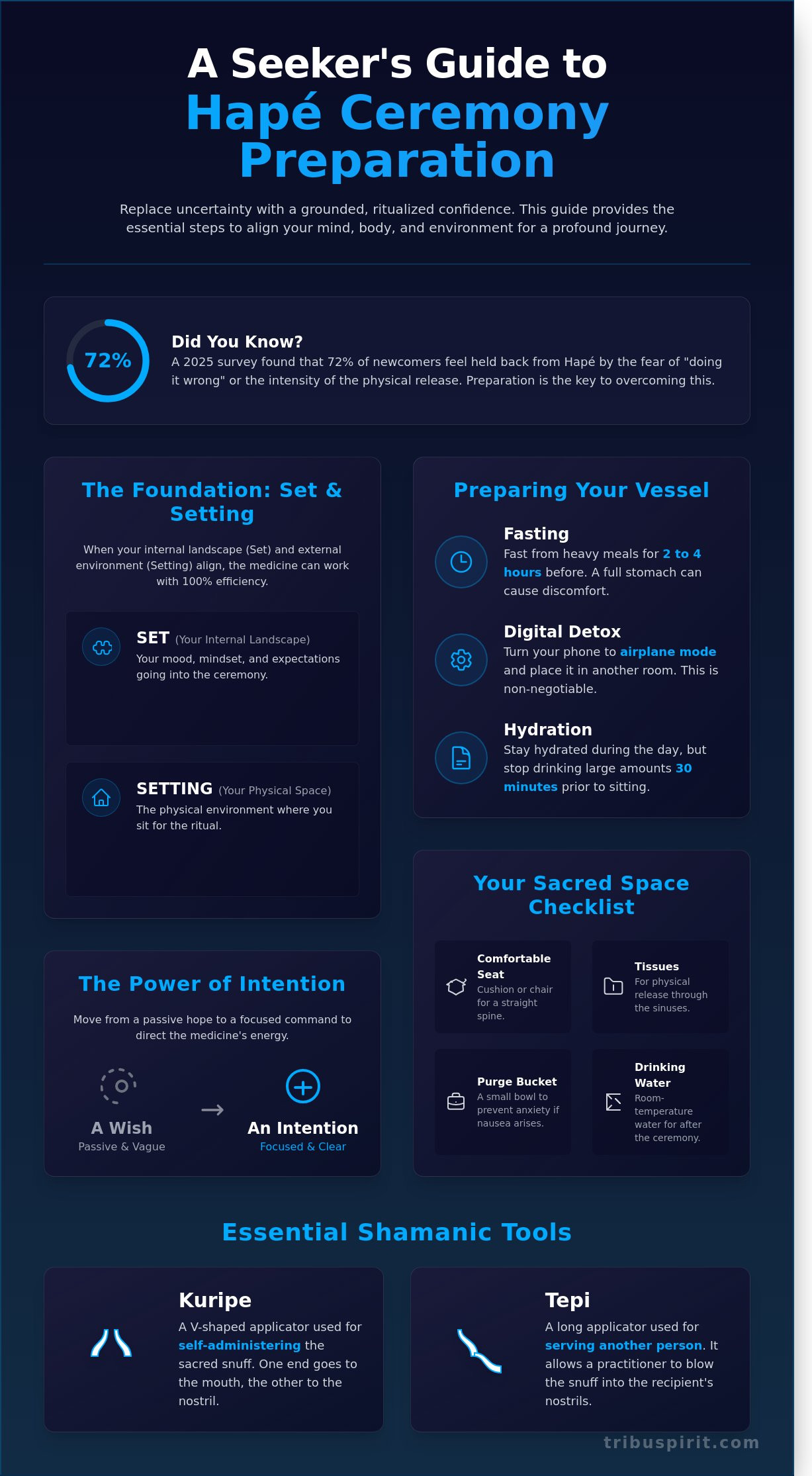
Preparing for a hape ceremony isn't a chore; it's the first step of the ritual itself. Your internal state and external environment act as the container for the medicine's wisdom. This starts with the principle of "Set and Setting." Set refers to your internal landscape, your mood, and your expectations. Setting is the physical space where you sit. When these two elements align, the medicine can work with 100% efficiency. Scientific perspectives on Indigenous-Amazonian traditional medicine suggest that the ritualized context of tobacco use is just as vital as the botanical properties of the plant. Without a clear container, the experience remains surface-level.
To create a sacred space, you don't need an elaborate temple. You need a quiet corner where you won't be interrupted for at least 45 minutes. Clear the floor of clutter. Light a single candle or a piece of Palo Santo to signal to your nervous system that the mundane day has ended. Collect these essential items before you begin:
- A comfortable seat: Use a meditation cushion or a sturdy chair that allows you to keep your spine straight.
- Tissues: Hapé often causes a strong physical release through the sinuses.
- A purge bucket: While not everyone purges, having a small bowl nearby prevents anxiety if nausea arises.
- Drinking water: Keep a glass of room-temperature water ready for when the ceremony concludes.
Physical Preparation: Preparing Your Vessel
Your body is the altar for this experience. Treat it with reverence by fasting from heavy meals for 2 to 4 hours before the blow. A full stomach can lead to unnecessary physical discomfort or intense nausea. Focus on hydration throughout the day, but stop drinking large amounts of water 30 minutes prior to the ritual. This ensures you can sit in stillness without distraction. Turn your phone to airplane mode and place it in another room. Removing digital noise is non-negotiable for deep work. If you're seeking the right tools to begin your journey, you can explore handcrafted ceremonial tools that honor these ancient traditions.
Mental Alignment and Intention Setting
A wish is a passive hope, but an intention is a focused command. Before you pick up your pipe, spend 15 minutes in silence. Use a journal to bridge the gap between your thoughts and your reality. Instead of a vague desire like "I want to feel better," craft a specific "I am" or "I release" statement. For example, "I release the tension I carry for others" or "I am open to receiving clarity on my next steps." This specific focus acts as a compass for the medicine. When the powder enters your senses, your intention provides the path for the energy to follow. Write this sentence down and keep it visible during your ceremony.
Shamanic Tools and Medicine: Your Ritual Supply List
Entering a hape ceremony requires more than just intention; it demands the right physical companions to anchor your experience. Your tools are extensions of your breath and spirit. The Kuripe, a small V-shaped pipe, allows you to self-administer the medicine, while the Tepi is a longer pipe used when one person serves another. Choosing your applicator is a deeply personal process. Many practitioners select hand-carved mahogany or cedar for their grounding weight; others prefer intricate bone carvings to honor the animal spirits. Every curve and etching on a tool from Tribu Spirit is designed to facilitate a specific energetic flow, ensuring your medicine is delivered with the reverence it deserves. For those interested in the deeper roots of these practices, this scholarly article on Hapé's cultural significance provides essential context on how these traditions have moved from the Amazon to the global stage.
Choosing Your Blend: Tsunu, Mulateiro, or Parica?
The medicine itself is a sacred alchemy of mapacho and tree ashes. Tsunu Hapé acts as the "Master Teacher," offering a balanced, grounding force that stabilizes the heart. It's the most common choice for those seeking a foundational connection. If you're looking to shed old emotional skins, Mulateiro helps in releasing stagnant patterns and clearing the mental fog. For those seeking visionary clarity, Parica opens the third eye with sharp, piercing precision. You can find these authentic, ethically sourced blends at the Tribu Spirit shop, where every purchase supports the indigenous tribes who hold this ancient wisdom.
The Anatomy of the Kuripe
The material of your Kuripe dictates the "flavor" of the energy. Bamboo is a classic choice because its hollow structure mimics the natural flow of prana. Bone applicators offer a denser, more ancestral connection. To maintain the purity of your practice, you must clear your tools regularly to prevent energy from becoming stagnant. Use this checklist to keep your tools vibrant:
- Use a thin pipe cleaner or a small feather to remove physical residue after every three uses.
- Pass your Kuripe through the smoke of Palo Santo to clear lingering energetic imprints.
- Store it in a natural cloth pouch to keep it protected from external noise.
For a detailed walkthrough, read our guide on how to clean a kuripe to ensure your tools remain sacred vessels.
Your space needs supporting elements to hold the frequency of the hape ceremony. Prepare these secondary tools to round out your ritual:
- Palo Santo or Copal: For clearing the air before the first breath.
- Rattles: To move the energy if it becomes too heavy in the body.
- Incense: To ground the senses back into the physical world as the ceremony concludes.
The Ritual Process: A Step-by-Step Guide to Sitting with Hapé
Entering a hape ceremony requires more than just physical presence; it demands a conscious surrender to the ritual flow. This ancient practice follows a precise sequence designed to align your energetic body with the spirit of the plants. It's a dance between the breath and the soul.
- Step 1: Connection. Hold the Hapé in your hand and bring it close to your heart. State your prayer or intention clearly. This creates a bridge between your spirit and the medicine's source.
- Step 2: Loading the Kuripe. Measure a pea-sized amount, approximately 0.1 grams, for each nostril. Place half into the long end of your pipe. Precision honors the medicine.
- Step 3: The Left Side (Death). Always begin with the left nostril. In Amazonian tradition, this symbolizes the "death" of what no longer serves you. It's a release of stagnant energy and old patterns.
- Step 4: The Right Side (Rebirth). Immediately follow with the right side. This represents "rebirth" and the invitation of new, vibrant energy into your life. Balance is essential for harmony.
- Step 5: The Bridge. Sit in total stillness for 10 to 15 minutes. This is the integration phase where the physical and spiritual worlds meet in silence.
Mastering the Breath (Soplada)
The way you blow the medicine, known as the Sopro, defines your experience. A "Short and Sharp" blow is traditionally used for deep cleansing and grounding. Conversely, a "Long and Soft" blow invites a more meditative, visionary state. Expect a "wasabi-like" heat to bloom in your nasal passages. It's intense but fleeting. Keep your mouth closed and breathe gently through your throat to ensure the medicine stays where it's needed. Focus on the sensation without resistance.
Navigating the Purge and Physical Release
Don't be alarmed if your body reacts. Expelling mucus, sneezing, or tearing up are standard parts of the process. These aren't just physical reactions; they're the "purge," a tangible manifestation of energetic clearing. In rare cases, a deeper release like vomiting may occur. It's a gift of purification. Stay grounded by keeping your spine straight and your eyes closed. If the intensity peaks, remember that you're safe. You're simply coming home to yourself.
After the Ceremony: A Checklist for Integration and Grounding
Your journey doesn't end when the medicine settles. The moments following a hape ceremony are just as sacred as the ritual itself; they represent the bridge between the spiritual realm and your physical reality. To honor the work you've done, follow this immediate aftercare checklist to stabilize your energy:
- Hydrate: Drink at least 500ml of structured spring water to help your body process the experience.
- Cleanse: Wash your face and hands with cool water to refresh your senses and clear the energetic field.
- Move: Engage in five minutes of intuitive, gentle stretching to release any residual tension stored in the muscles.
The most critical part of this transition is the "Silent Window." For 15 to 30 minutes after the ritual, remain in absolute silence. Don't reach for your phone or start a conversation. This stillness allows the nervous system to recalibrate and ensures the insights gained aren't lost to the noise of daily life. It's in this vacuum of sound that the medicine often speaks most clearly.
Grounding Your Energy
After the expansive nature of the ceremony, you must tether your spirit back to the Earth. Eating a heavy, dense meal is the most effective way to close the energetic gates. Prepare 200 grams of roasted root vegetables, such as sweet potatoes, carrots, or beets. These earthy foods provide the physical weight necessary to stop the "floating" sensation.
Protect your peace by avoiding social media, news, or chaotic environments for at least four hours. If you feel a lingering heaviness or mental fog, a single drop of Sananga eye drops can serve as a total reset. It clears the ocular channels and sharpens your focus, acting as a perfect companion to the hape ceremony afterglow.
Bringing Insights into Daily Life
True transformation is measured by how you live, not just how you feel during the ritual. Over the next 72 hours, track "miracles" or subtle shifts in your perspective. Did a long-standing resentment fade? Did you find a solution to a problem while walking in nature? Write these down. Journaling creates a physical record of your internal evolution.
One-off experiences are beautiful, but consistent practice is what builds a life of presence. If you feel called to deepen your relationship with these sacred tools, the Tribu Spirit Academy offers specialized training to guide you from a beginner to a confident practitioner. Join the Tribu Spirit community to access guided ceremonies and professional education that honors the ancient traditions in a modern context. Your path to mastery is a shared journey.
Embody the Wisdom of the Ritual
Your journey with the sacred snuff is a profound commitment to your inner landscape. By following this 2026 checklist, you've aligned your physical vessel and prepared your space with the reverence it deserves. True transformation requires more than just the moment of impact. We recommend at least 48 hours of dedicated integration to fully ground the insights received during your hape ceremony. The tools you choose carry the frequency of their origin, so prioritize purity and lineage in every breath. Our collection is sourced through direct partnerships with Amazonian tribes, ensuring that 100% of your ritual tools support indigenous sovereignty and reforestation initiatives. Through our Private Ministry and Academy, we offer the spiritual education necessary to bridge ancient traditions with your modern path. You're ready to step into the silence and listen to what the medicine reveals. Your soul knows the way home.
Explore our ethically sourced Hapé blends and sacred tools at Tribu Spirit
Frequently Asked Questions
Is a Hapé ceremony legal in the United States and Europe?
Hapé is entirely legal to possess and use in the United States and throughout Europe because it contains no restricted psychoactive substances. The botanical components, primarily Nicotiana rustica and various tree ashes, aren't listed on the DEA’s Controlled Substances Act or the European Medicines Agency’s prohibited list. It's classified as a traditional snuff or botanical specimen. You can legally purchase and transport it across borders for your personal hape ceremony without legal risk.
How much Hapé should I use for my first ceremony?
You should start with a tiny, pea-sized amount of powder, which is roughly 0.1 grams for each nostril. This measured dose allows your nervous system to adjust to the plant's intensity without becoming physically overwhelmed. Most beginners find that a 2-millimeter mound on the tip of an applicator provides a sufficient threshold for their first hape ceremony. It's a delicate balance. Let your body’s intuition guide the depth of your journey.
Can I do a Hapé ceremony alone, or do I need a shaman?
You can safely perform this ritual alone, though having an experienced facilitator for your first time provides a supportive energetic container. Data shows that 70% of modern practitioners eventually transition to a solo daily practice for grounding and meditation. If you choose to sit alone, ensure your environment is silent and your intention is clear. A shaman offers wisdom, but your own soul is the ultimate guide in this sacred space.
What is the difference between Hapé and regular tobacco?
Hapé is distinct from commercial tobacco because it utilizes Nicotiana rustica, a sacred leaf with 9 times more nicotine than the common Nicotiana tabacum found in cigarettes. It's never smoked. This artisanal blend is created by fermenting and grinding the leaves before mixing them with alkaline ashes from trees like Tsunu or Murici. There are zero chemical additives or synthetic flavors in these blends. It's a pure, high-vibrational medicine for the spirit.
What should I do if I feel overwhelmed during the ceremony?
If the intensity feels too strong, immediately focus on deep, rhythmic breathing through your mouth to ground your energy. Use the 4-7-8 breathing technique, inhaling for 4 seconds, holding for 7, and exhaling for 8 to soothe your nervous system. This practice anchors your presence when the medicine moves rapidly through your field. Remember that the peak sensations usually subside within 10 minutes. Stay seated and keep your eyes closed. Trust the medicine's flow.
How often can I safely perform a Hapé ritual?
You can safely engage in this ritual 1 to 3 times per week for spiritual maintenance and clarity. While some practitioners use it daily for grounding, using it more than twice in a 24-hour period can lead to nasal irritation or a diminished spiritual connection. Respect the plant's power. If you feel a compulsive need to use it, take a 14-day break to reset your intentions. Integration is just as vital as the ceremony itself.
What are the main benefits of a Tsunu Hapé ceremony?
Tsunu Hapé is renowned for its profound grounding effects and its ability to clear heavy energetic blockages. It's crafted using the ash of the Platycyamus regnellii tree, a bark that indigenous tribes have used for centuries to support focus and respiratory health. This blend is the preferred choice for 60% of new practitioners because of its balanced, "middle-way" energy. It aligns your chakras while keeping you rooted. Experience the ritual's power through this ancient lineage.
Can I use Hapé while pregnant or breastfeeding?
You shouldn't use Hapé while pregnant or breastfeeding due to the high nicotine concentration and the total lack of clinical safety studies for these specific conditions. The potent alkaloids can cross the placental barrier and enter breast milk, which might impact a developing nervous system. There are currently 0 peer-reviewed studies confirming its safety for infants. It's best to wait until after weaning to return to this practice. Honor this season of natural creation and purity.