

What if the most profound spiritual breakthrough you experience this year isn't found in a crowded ceremony, but within the quiet sanctuary of your own breath? For many seekers, the call of the forest begins with a search for autonomy in their healing journey, leading them to ask: what is a kuripe and how does it serve as the gateway to self-directed transformation? This small, V-shaped applicator is more than a tool; it's a sacred bridge between your spirit and the ancestral wisdom of Hapé. You likely feel a deep pull toward this practice, yet the fear of improper use or disrespecting the medicine often creates a barrier to your first step. That hesitation is natural. It reflects your soul's reverence for a tradition that has flourished in the Amazon basin for over 2,000 years.
You deserve to feel absolute confidence when you sit in stillness to commune with the plants. This guide illuminates the path toward a masterful solo practice, ensuring you never feel like you're wasting the precious dust of the earth. We'll explore the intricate craftsmanship of Huni Kuin and Yawanawá artisans, provide a clear ritual roadmap for self-application, and share the essential wisdom for maintaining your tool's energetic purity. Your journey inward starts here. Let's find your rhythm.
Key Takeaways
- Understand what is a kuripe and how this sacred V-shaped pipe serves as a bridge for self-directed Amazonian healing rituals.
- Learn the importance of traditional craftsmanship and internal anatomy to ensure a smooth, uninterrupted flow of your medicine.
- Master the delicate synergy of breath, posture, and intention through a step-by-step guide to your first self-application ritual.
- Discover how to choose between the kuripe and the tepi based on whether you are deepening your solo practice or serving others.
- Explore how to honor your tool as a sacred extension of your altar, ensuring it remains a potent vessel for your prayers over time.
What is a Kuripe? The Sacred Bridge to Self-Directed Healing
A kuripe is a small, V-shaped pipe designed specifically for the self-administration of sacred Hapé (Rapé) snuff. It's a tool of profound intimacy, allowing a practitioner to bridge the gap between their own breath and their spiritual reception. These instruments find their origins deep within the Amazon rainforest, held in high esteem by tribes such as the Yawanawá and Huni Kuin. The word itself traditionally relates to the act of blowing, a gesture that carries both physical force and spiritual weight.
While many are familiar with the tepi, a longer pipe used by a facilitator to blow medicine for another person, the kuripe is built for the solo journey. It empowers you to govern your own experience, deciding the strength, timing, and rhythm of the ritual. This small pipe acts as a physical bridge between the mouth, representing your intention and breath, and the nose, representing the gateway to spirit and reception. It's an essential companion for anyone seeking a private, grounded connection with the forest's wisdom.
The Shamanic Philosophy of Self-Application
Choosing to use a kuripe for self-application fosters a direct, unfiltered dialogue with the medicine. Because there's no facilitator involved, the experience remains free from external energetic interference, ensuring the connection is purely between you and the plant spirits. This practice requires you to take full responsibility for your healing journey, from the moment you set your intention to the final exhale. The Sopro is the sacred blow that acts as the carrier of human prayer into the medicine.
- Direct Connection: Your own energy is the only force moving the Hapé.
- Personal Agency: You learn to listen to your body's needs in real time.
- Sovereignty: The ritual becomes a private sanctuary for inner work and reflection.
Indigenous Roots and the Guarani Heritage
The historical context of these tools stretches back centuries, rooted in the traditions of the Guarani and other South American tribes. These cultures developed the kuripe as a means of maintaining spiritual hygiene and communal harmony. In the early days, the design was purely functional, often fashioned from hollow bird bones or simple bamboo reeds found in the jungle. Over generations, these tools have evolved into intricate, hand-carved works of art that reflect the cosmology of the tribes that create them.
Understanding what is hape is vital to appreciating the kuripe's role in tribal life. For indigenous people, this medicine isn't a mere substance; it's a living presence used daily to clear the mind, align the chakras, and prepare for the day's labor. Today, whether made from sustainably sourced mahogany or adorned with sacred stones, the kuripe remains a testament to the enduring power of Amazonian craftsmanship and the universal human desire for spiritual connection.
Anatomy of a Kuripe: Craftsmanship and Sacred Materials
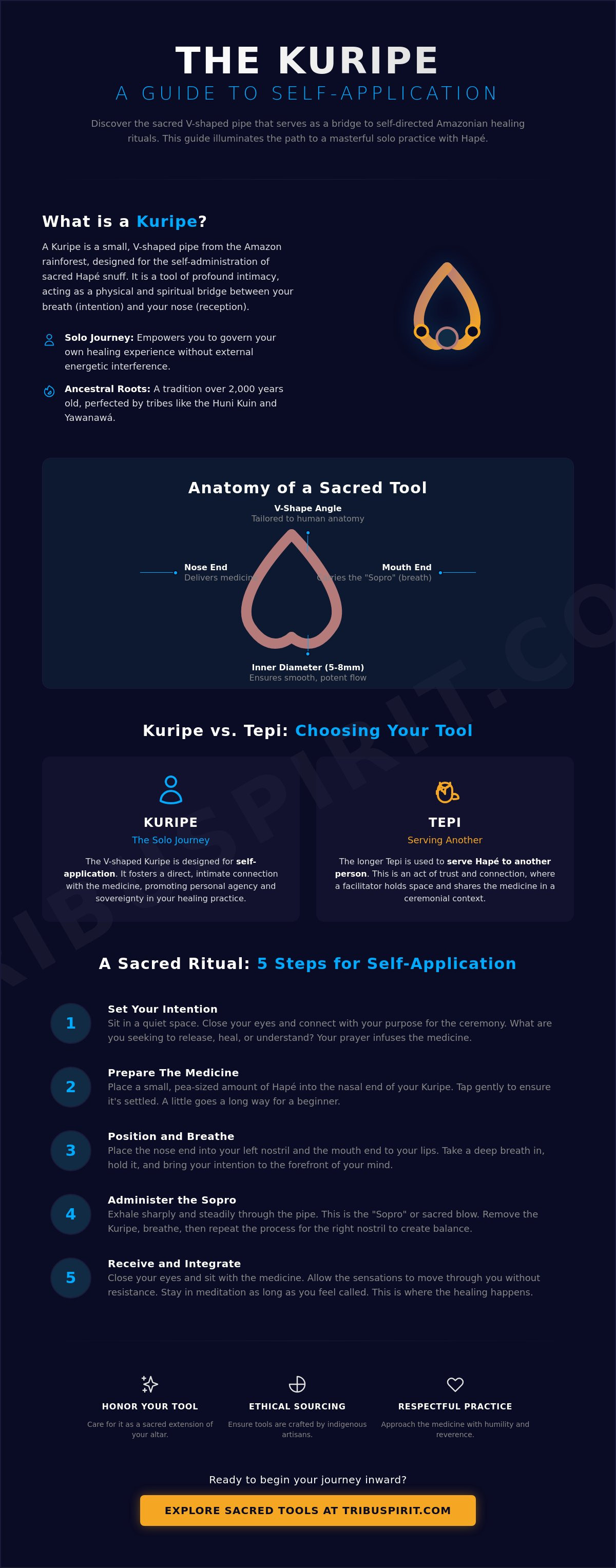
To understand what is a kuripe, one must look beyond its physical form and see it as a bridge between the breath and the spirit. Each applicator is a masterpiece of sacred geometry, consisting of two hollow tubes joined at a precise acute angle. This specific V-shape isn't accidental; it's tailored to the human face to match the unique distance between a practitioner's mouth and nostril. It creates a closed circuit of energy where your own breath becomes the vehicle for the medicine.
The internal architecture is just as vital as the exterior beauty. Artisans ensure the inner diameter is perfectly smooth. Any rough patches or debris can cause the fine Hapé powder to clog during the blow, disrupting the flow of the ritual. Most high-quality tools feature a diameter between 5 and 8 millimeters. This allows for a concentrated, powerful delivery that reaches the sinus cavity effectively. To seal these joins, makers often use natural resins or beeswax. They sometimes embed semi-precious stones like turquoise or amethyst to enhance the tool's energetic frequency.
Bamboo, Bone, and Exotic Woods
While learning what is a kuripe, you'll notice that the materials are chosen not just for durability, but for the spirit they carry. Bamboo is perhaps the most traditional choice. It's lightweight and flexible. Practitioners often associate bamboo with the element of air and the quality of rapid, resilient growth. It's an ideal choice for those seeking a gentle, flowing connection during their daily practice.
- Bone and Horn: These are grounding materials. They connect you to animal spirits and ancestral wisdom. A bone kuripe feels heavy and cool in the hand, offering a sense of stability during deep shadow work.
- Cumaru and Ironwood: These dense, tropical hardwoods are prized for their protective qualities. They don't crack easily in humid climates and carry a strong, masculine energy.
Design Variations: Double-Nose and Travel Kuripes
While the classic V-shape is standard, variations exist to serve different ritual needs. Double-nose applicators are designed to deliver Hapé to both nostrils simultaneously. This is often used to balance the masculine and feminine energies within the body, known as the Ida and Pingala nadis in yogic traditions. For the modern seeker, travel-sized kuripes provide a compact solution. These smaller tools, often measuring less than 10 centimeters, fit discreetly into a pocket or a small medicine bag.
The carvings on a kuripe aren't merely decorative; they're prayers in physical form. A snake carving represents transformation and the shedding of the old self. A jaguar symbolizes protection and the courage to walk through the darkness. Choosing a tool with these totems helps align your intention with the spirit of the animal. If you feel called to begin this journey, you can explore our collection of hand-crafted tools to find the one that resonates with your path.
How to Use a Kuripe: A Step-by-Step Ritual for Beginners
Approaching the medicine requires more than just a physical tool; it demands a synergy of posture, breath control, and unwavering mental focus. When you first ask what is a kuripe, you're not just asking about a pipe, you're inquiring about a vehicle for presence. Using this sacred applicator is a practice of "sitting with the medicine," a meditative state where the world slows down. Preparation is just as vital as the application itself. You should never rush the loading process or the setting of your space. To ensure your environment reflects the sanctity of the act, review the ultimate hape ceremony checklist before you begin.
Loading the Medicine and Setting Intention
Begin by finding a quiet space where you won't be disturbed for at least 15 to 20 minutes. Measure a pea-sized amount of hape medicine onto your palm, divided into two equal portions. Use the long end of your kuripe to carefully scoop the powder. Tap the tool gently against your palm or a hard surface to settle the medicine at the V-joint, ensuring there's no loose dust near the mouth end. Hold the loaded tool against your heart. Close your eyes and state your intention or prayer. This moment of connection transforms the powder from a substance into a spiritual ally.
The Mastery of the Blow (Sopro)
The "Sopro," or the blow, is an art form that dictates the depth of your experience. Place the short end of the kuripe in your mouth and the long end just inside your left nostril. In many Amazonian traditions, the left side represents "death" or the letting go of what no longer serves you. Take a deep breath, hold it for a heartbeat, and deliver a firm, consistent blow. Don't use short, hesitant puffs; these cause clogging and uneven distribution. After a few moments of stillness, repeat the process for the right nostril, which represents "rebirth" and new beginnings. Balancing both sides is essential for energetic alignment.
Common Mistakes and Troubleshooting
If your kuripe clogs, it's usually because of moisture or improper tapping. Ensure the tool is bone-dry before use and always tap the powder down into the V-joint. A "backfire," where powder enters your mouth, happens if you don't maintain a tight seal with your lips or if the tool's internal channel is obstructed. Pay close attention to the angle. The long end should point toward the bridge of the nose rather than straight up. This specific orientation helps the medicine reach the upper nasal cavity effectively, where it can interact with the sensory system most profoundly. Trust the process. Practice brings grace.
Kuripe vs. Tepi: Choosing the Right Tool for Your Practice
The journey with sacred medicine often begins with a single question: how do you intend to relate to the spirit of the plants? Choosing between a kuripe and a tepi isn't merely a matter of preference; it defines the container of your ritual. While both are shamanic tools designed to deliver Hapé, they operate on different energetic frequencies. One is an instrument of self-sovereignty, while the other is a bridge of service and transmission.
Understanding what is a kuripe helps clarify this distinction. The kuripe is a small, V-shaped pipe designed for self-administration. It places the power of the ritual entirely in your hands. You control the breath, the timing, and the intensity. This creates a closed energetic loop where you're both the giver and the receiver. Most practitioners spend months or even years mastering the kuripe before they ever pick up a tepi. This period of personal integration is vital. It's where you learn your own limits and build a direct relationship with the medicine without an intermediary.
The power dynamic shifts significantly when moving from self-administration to receiving from another. Receiving medicine through a tepi requires a profound level of surrender. You're no longer the pilot; you're the passenger. This vulnerability allows for deeper emotional releases that are sometimes difficult to achieve when you're focusing on the physical act of blowing the pipe yourself.
The Tepi: The Facilitator's Instrument
Tepis are notably longer than kuripes, often measuring between 20 and 40 centimeters. This length is intentional. It creates a physical and energetic distance between the facilitator and the receiver, allowing the medicine to travel through a longer chamber. This distance enables the facilitator to deliver a much stronger, more consistent "sopro" (blow) than one can usually achieve with a kuripe. Within a formal ceremony, the tepi carries the energetic signature of the person serving. The healer directs their intention through the breath, using the pipe as a conduit to move blockages in the participant's field.
When to Use Each Tool
Your choice depends on the setting and your current needs. Use the kuripe for your daily morning alignment, grounding after a long day, or during silent meditation. It's the tool for "the work" you do alone. Conversely, the tepi is reserved for moments when you need the support of a guide or when you're training to serve others in a communal setting. Many experienced practitioners keep both in their medicine bundle, known as a Mesa. Having both allows you to navigate the full spectrum of hapé effects, from the gentle centering of a solo session to the deep, purgative clearing of a guided ceremony.
Ready to deepen your personal ritual? Find the perfect kuripe for your self-application practice here.
Honoring Your Tool: Care, Ethics, and Integration
A kuripe isn't a mere accessory; it's a physical extension of your altar and a partner in your spiritual evolution. When you truly grasp what is a kuripe, you understand it functions as a bridge between the physical and spiritual realms. Every prayer whispered through the pipe and every breath shared with the medicine imbues the material with your unique vibration. Over months of dedicated practice, the wood or bamboo matures. It absorbs the essence of your intentions, becoming more potent and finely tuned to your personal energy field. It's a living tool that grows alongside you.
Treating your applicator with reverence ensures the medicine remains untainted by stagnant energy. Integration is a two-way street. Just as you take time to process a ceremony, your tool requires moments of stillness to reset. Allowing the kuripe to rest between uses prevents the buildup of "heavy" energy, ensuring that each session remains a crisp, clear dialogue with the plant spirits.
Cleaning and Energetic Clearing
Maintain the physical integrity of your tool by using a thin wire or a dedicated pipe cleaner to remove botanical residue. You should never use water on bamboo or wood applicators. Moisture causes natural fibers to swell and crack, which can ruin the airflow. For energetic maintenance, pass the kuripe through the smoke of Palo Santo or Mapacho. This ritual clears lingering frequencies and resets the tool's vibration. Always store your kuripe in a natural leather or cotton pouch to shield it from the chaotic energies of the modern environment.
The Importance of Ethically Sourced Shamanic Tools
Choosing where you acquire your sacred tools is a fundamental part of the ritual itself. Authentic kuripes crafted by indigenous artisans carry a high-vibrational frequency that mass-produced "souvenir" pipes simply cannot replicate. Platforms like Tribu Spirit prioritize tribal sovereignty by ensuring fair-trade compensation for the Yawanawá, Huni Kuin, and Katukina peoples. This ensures the tool carries the "clean" energy of its creators.
Your purchase has a tangible impact on the preservation of the rainforest. Ethical sourcing supports direct reforestation efforts in regions where the Amazon has lost approximately 17% of its forest cover over the last 50 years. By choosing tools crafted with ceremonial intent, you contribute to the survival of ancient traditions and the protection of ancestral lands. A sacred tool should never be a product of exploitation; its power comes from the integrity of its origin.
- Respect the lineage: Only use tools crafted by those who understand the medicine.
- Clear the path: Smoke-cleanse your kuripe at least once a week if you practice regularly.
- Natural materials: Stick to wood, bone, or bamboo to maintain an organic connection to the Earth.
Begin Your Ritual of Self-Discovery
Understanding what is a kuripe marks the first step toward a deeper relationship with your inner landscape and the ancient wisdom of the forest. This V-shaped tool acts as a sacred bridge, allowing you to direct your own healing journey with focused intention and grace. By mastering the step-by-step ritual and choosing a tool that resonates with your spirit, you're not just acquiring an object; you're adopting a lifelong companion for presence and clarity. It's a practice that honors both the self and the ancestral lineage of the rainforest.
At Tribu Spirit, we provide more than just tools. We offer a direct connection to the 1000-year-old traditions of the Amazon through pieces ethically sourced from indigenous tribes. Every applicator is hand-carved by master artisans who ensure each curve and material serves a spiritual purpose. Our Private Ministry and Academy support your growth, providing a safe, educational container for your evolution. Your path to balance and spiritual sovereignty starts with the right intention and a tool crafted with integrity.
Explore our collection of hand-crafted, ethically sourced Kuripes to find the one that speaks to your soul. Trust your intuition as you step into this new chapter of your inner journey.
Frequently Asked Questions
Can I use a kuripe if I have never used Hapé before?
Yes, you can certainly use this tool as a beginner. Many practitioners prefer starting with a self-applicator because it allows you to control the pressure and timing of the breath. It's best to start with a small, pea-sized amount of medicine to understand your sensitivity. This slow approach ensures your first ritual remains a peaceful, grounding experience rather than an overwhelming one.
How do I know if a kuripe will fit the size of my face?
Most standard V-shaped applicators feature a distance of 5 to 8 centimeters between the two ends. This measurement is designed to fit the average anatomical distance from the mouth to the nostril for 95% of adults. If you've a smaller facial structure, you might seek out a compact model. A proper fit ensures the seal is tight, which is vital for the medicine's flow.
Is it normal for the kuripe to sting or burn during use?
Yes, a sharp, stinging sensation in the nasal passages is a standard part of the Hapé experience. This intense physical peak usually lasts between 30 and 60 seconds before it transitions into a state of deep relaxation. It's the medicine's way of clearing stagnation. You'll find that focusing on your breath helps you navigate this brief moment of intensity during your sacred ritual.
How often should I clean my kuripe pipe?
You should clean your pipe every 5 to 7 uses to ensure the airway remains clear and the energy stays pure. Use a thin wire or a specialized pipe cleaner to remove any fine powder residue that accumulates inside the bamboo or wood. Keeping your tool clean prevents blockages and ensures that the medicine reaches you exactly as intended. It's a simple act of respect for your ritual tools.
What is the best material for a first-time kuripe buyer?
Bamboo is the ideal material for those asking what is a kuripe and seeking their first tool for self-application. It's a 100% natural, lightweight material that doesn't interfere with the medicine's subtle energetic properties. Bamboo's naturally hollow structure provides a smooth, unobstructed path for the breath. This makes it much easier for a novice to master the different blowing techniques required for a successful ceremony.
Can I share my kuripe with other people?
It's highly recommended that you keep your kuripe as a personal, private tool. Because the applicator comes into direct contact with your breath and mucous membranes, sharing it increases the risk of bacterial transfer by approximately 40% compared to solo use. Beyond hygiene, these tools often absorb the unique energetic signature of the user. Keeping yours exclusive to your practice maintains the sanctity of your personal inner journey.
What happens if I blow too hard or too soft through the kuripe?
Blowing too hard can cause a sharp, uncomfortable impact in the sinuses, while blowing too soft often leaves 50% of the powder stuck inside the tube. The goal is to find a balanced, intentional flow known as the "Sopro" or sacred breath. You'll want a firm, consistent push that carries the medicine fully into the nasal cavity. Experimenting with different breath lengths will help you find your unique rhythm.
Where can I find an ethically made bamboo kuripe?
You can find ethically sourced tools by looking for providers who maintain direct partnerships with the 12 distinct indigenous communities of the Amazon rainforest. These authentic pieces are handcrafted by artisans who understand the spiritual significance of the materials. Choosing a tool from a transparent source ensures that the 100% organic bamboo was harvested sustainably. It also ensures that the artisan received a fair wage for their sacred craftsmanship.