
What if the heavy "numbness" you're carrying isn't a mental problem to be solved, but a spiritual blockage waiting for release? We often try to think our way out of pain, yet a true shamanic approach to emotional healing recognizes that the mind is only one layer of our existence. You might feel stuck in cycles of logic that never lead to peace. You crave a connection to something deeper, something ancient that speaks to your soul rather than just your intellect. It's a common feeling in a world that prioritizes the head over the heart. True healing isn't found in more thoughts; it's found in the sacred space between them.
In this article, you'll discover how ancient Amazonian wisdom and sacred plant medicines can dissolve these stagnant energies to restore your soul’s natural vibrance. We'll explore a clear framework for emotional release that moves beyond the limits of logic. You'll learn about the grounding role of medicines like Hapé and how sacred tools like the Kuripe serve as bridges to your inner self. This is your invitation to step into a personal healing practice that empowers you to reconnect with nature and your own true essence. Let's begin the journey home to your most authentic, vibrant self.
Key Takeaways
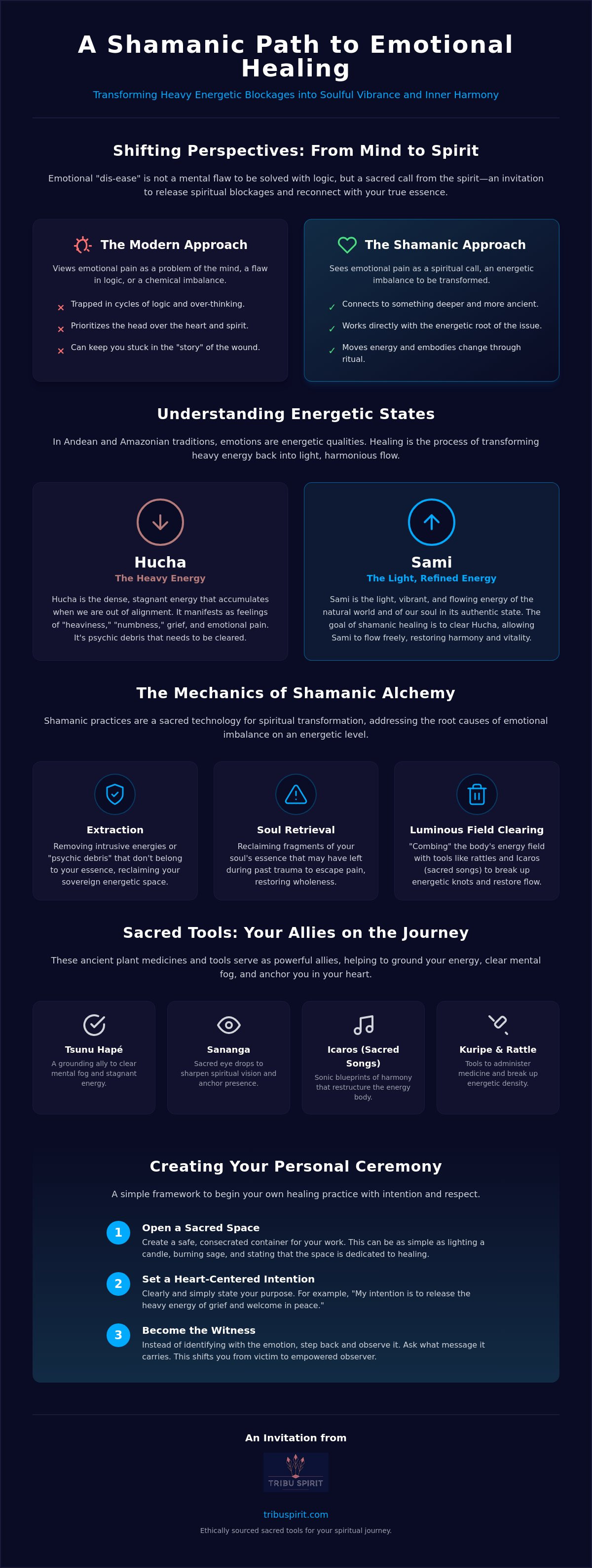
- Learn to view emotional "dis-ease" as a sacred call from the spirit, shifting your energetic state from heavy Hucha to the light, vibrant flow of Sami.
- Understand the transformative mechanics of a shamanic approach to emotional healing, including how soul retrieval can help you reclaim fragments of yourself lost to past trauma.
- Discover how sacred tools like Tsunu Hapé and Sananga serve as grounding allies to clear mental fog and anchor your presence in the heart.
- Master the essential steps for opening a sacred space and setting a heart-centered intention to begin your own personal healing ceremonies.
- Explore the principle of Ayni (Sacred Reciprocity) and why the ethical sourcing of your medicine is vital for the energetic integrity of your journey.
Understanding the Shamanic View of Emotional Imbalance
In the modern world, we're often taught to view emotional pain as a flaw in our psychological machinery, a chemical glitch to be managed or a logic puzzle to be solved. A shamanic approach to emotional healing offers a different, more ancient perspective. It invites us to see emotional "dis-ease" not as a failure, but as a profound call from the spirit. It's an invitation to look beyond the surface of our thoughts and connect with the subtle currents of our inner world. To understand this deeper perspective, one might ask, What is Shamanism? At its core, it's a way of relating to the unseen forces that shape our reality. In the Andean and Amazonian traditions, emotions are understood as energetic qualities. There's Hucha, the heavy, dense energy that accumulates when we're out of alignment, and Sami, the light, refined energy of the natural world. When we feel "heavy," we're literally carrying Hucha that needs to be cleared. The shamanic approach is a path of returning to original harmony with the All.
The Heart as an Energetic Portal
Our emotions don't just exist in our heads. They live in our Luminous Energy Field, an invisible cocoon of light that surrounds and informs our physical body. When we experience deep trauma, the shamanic view suggests we may suffer from "Soul Loss." This is a survival mechanism where a part of our essence leaves to escape the pain. Instead of being a victim to these recurring shadows, we learn to become a witness. We step back. We observe the message the emotion carries. By doing so, we begin to track the energy back to its source, allowing the heart to act as a portal for transformation rather than a storage unit for grief.
Why Traditional Therapy Often Stops at the Mind
Talking about a wound can sometimes keep us trapped in the story of the wound. While verbal processing has its place, it often fails to reach the somatic imprints stored in our very cells. Shamanism engages the mythic and energetic levels of our being, where symbols and rituals speak louder than words. The rational mind is a gatekeeper. It's designed to protect the ego's status quo. Sacred ceremony bypasses these defenses. It allows us to work directly with the energetic root of an issue. Through ritual, we don't just discuss change; we embody it. We move the energy. We transform the Hucha. This holistic engagement is what makes the shamanic approach to emotional healing so potent for those who feel they've reached a plateau in their growth.
The Mechanics of Shamanic Emotional Alchemy
Alchemy is the sacred art of turning lead into gold. In the landscape of the spirit, this means transforming heavy, stagnant emotions into the luminous fuel for your own evolution. A shamanic approach to emotional healing doesn't just soothe the surface of your discomfort. It dives into the energetic architecture of your being to address the root. One of the primary mechanics is extraction, the delicate process of removing energies that don't belong to your essence. We often pick up "psychic debris" from our environments, ancestors, or others. These intrusive energies feel like a weight you can't explain. By clearing them, you reclaim your sovereign space. You breathe again.
Sound is the bridge that facilitates this transformation. Icaros, or sacred songs, carry specific frequencies that re-order the energy body. They are like sonic blueprints for harmony. When a practitioner sings, they aren't just performing. They're vibrating the very fabric of your field to shake loose what is stuck. It's a precise technology of frequency that shifts your internal state from discord to resonance.
Clearing the Luminous Field
Your energy body is a living tapestry. Over time, repetitive emotional patterns create knots in this field that restrict your vitality. Practitioners use specific techniques to "comb" and "cleanse" this light. A shamanic rattle is essential in this process. Its sharp, rhythmic sound breaks up the density of old grief or anger. Think of the sound waves as a gentle broom, sweeping through your chakras, or nustas, to restore a clear, vibrant flow. It's a physical sensation of lightness that returns you to yourself.
Soul Retrieval and Emotional Wholeness
True healing often requires more than just clearing. It requires returning. Soul loss is a common result of emotional trauma, leaving you feeling "not all here" or struggling with a chronic fatigue that no amount of rest can fix. In the shamanic journey, the practitioner enters the "Lower World," a realm of subconscious archetypes, to find the parts of your essence that hid away to survive. Bringing these fragments back is like finding the missing piece of a spiritual puzzle. This shamanic approach to emotional healing provides the deep stability needed for long-term peace. It's a homecoming for your spirit.
Integrating the shadow is the final, most courageous step of this alchemy. We don't push the darkness away; we look into it with compassion. In the dark, we find the hidden gold of our own power. If you feel called to begin this journey of self-discovery, exploring the sacred tools and education at Tribu Spirit can help you anchor your practice in ancient wisdom.
Sacred Tools for Processing Emotions: Hapé and Sananga
While understanding the energetic field is vital, the physical body often requires a tangible anchor to move through deep-seated blockages. In the Amazonian tradition, specific plant allies are called upon to facilitate this release. These aren't just substances; they're living spirits that offer a direct, somatic experience of clearing. A shamanic approach to emotional healing integrates these tools to help you step out of the mind and into the heart's wisdom. By engaging the senses, we bypass the ego's tendency to over-analyze, allowing for a more profound and immediate transformation.
Hapé: The Sacred Breath of the Forest
Hapé is often described as a "Soplada," a blowing away of heavy thoughts that cloud our judgment. When you use a kuripe for self-administration, you're engaging in a personal act of sovereignty. You direct the medicine with your own breath, focusing your intention on the specific emotional knots you wish to untangle. Tsunu Hapé is particularly revered for its ability to provide spiritual clarity and emotional centering. It acts as a gentle but firm hand that pulls you back to the present moment. In contrast, Mulateiro Hapé is often chosen when a more thorough clearing of the energy field is needed. Sometimes, this process involves a "purge." Whether this manifests as physical clearing or a sudden wave of tears, it's a celebrated part of the healing process. It means the body is finally letting go of what no longer serves it.
Sananga and the Emotional Vision
Sananga eye drops work on a different layer of the human experience. They're known for clearing "Panema," a kind of spiritual grey cloud that can manifest as stagnation, heaviness, or a lack of motivation. The physical sting of the medicine is intense but brief. It serves as a gateway. In that moment of heat, you're forced to drop all stories and simply be with the sensation. This practice teaches you to sit with discomfort without running away, allowing deep-seated anger or sorrow to rise to the surface and dissipate. These Amazonian plants act as mirrors, showing you exactly where you're holding onto resistance. By breathing through the intensity, you open your inner vision and see your emotional landscape with newfound clarity. A shamanic approach to emotional healing through Sananga is a courageous path of radical presence.
The true magic happens in the synergy between the medicine and your breath. Breathwork acts as the vehicle, carrying the spirit of the plants into the deepest corners of your psyche. It's a rhythmic, meditative process that ensures the emotional shifts aren't just temporary, but integrated into your very cells. This is how we move from temporary relief to lasting vibrance.
Creating a Personal Shamanic Ceremony for Healing
Healing is not a passive event; it's an active dialogue between your soul and the spirits of the natural world. While visiting a practitioner offers deep support, a true shamanic approach to emotional healing empowers you to create your own sanctuary. Ceremony provides the sacred container where the heavy energy of the past can be safely unraveled. It's a bridge between your modern life and the timeless wisdom of the forest. By stepping into ritual, you signal to the universe that you're ready to transform. You become the alchemist of your own heart.
To begin your personal journey, follow these foundational steps to ensure your practice is grounded and respectful:
- Step 1: The Sankalpa. Begin by setting a clear, heart-centered intention. This is the seed from which your healing grows.
- Step 2: Calling the Directions. You must open sacred space by calling in the four directions. This invites the archetypal energies of the South, West, North, and East to hold and protect your process.
- Step 3: Limpieza. Use Mapacho or Sage to perform a ritual cleansing. The smoke carries away the surface "dust" of the day, preparing your field for deeper work.
- Step 4: The Work. This is the core of your ceremony. Sit in profound silence, perhaps working with your rattle or a chosen medicine like Hapé to move the energy.
- Step 5: Closing. Always close the space. Express your gratitude to the spirits and consciously ground the energy back into the Earth.
The Art of Setting Intentions
The quality of your intention dictates the depth of your release. We often approach healing with a desire to "stop" something, such as "I want to stop feeling sad." In a shamanic approach to emotional healing, we pivot toward empowerment. Try saying, "I am ready to release this grief." This subtle shift moves you from a state of resistance to one of active surrender. Using sacred tobacco, or Mapacho, is a powerful way to anchor this. As you blow the smoke, it carries your prayers to the Creator, making your word a living force. An intention acts as a map for the spirit world, guiding the energy exactly where it's needed most.
Grounding and Integration
The 24 hours following a ceremony are a sacred window where your emotional body is "setting" into its new vibration. This is the time for gentleness. Practical grounding is essential to ensure the insights you've gained don't simply evaporate. Take a salt bath to draw out any remaining Hucha. Walk barefoot on the grass to reconnect with the heartbeat of the Earth. Journaling allows you to capture the "lessons of the forest" before the noise of modern life returns. To fully anchor these practices and find the tools you need for your altar, explore our collection of ethically sourced shamanic tools and begin your practice today.
Reciprocity: Healing Yourself While Healing the Earth
In the heart of the Amazonian tradition lies a principle so fundamental it governs the very breath of the forest: Ayni. Often translated as Sacred Reciprocity, Ayni teaches us that life is a constant, rhythmic exchange of energy. A shamanic approach to emotional healing is never a solitary act. It's a dialogue with the spirits, the ancestors, and the Earth herself. When we seek to release our own heavy energy, we must ask ourselves what we're giving back in return. True healing isn't just about personal relief; it's about restoring a balance that extends far beyond our own luminous field. Your emotional freedom is inextricably linked to the health of the soil and the sovereignty of the cultures that carry this wisdom.
This connection is why the vibration of your medicine is so deeply affected by its source. If a plant medicine is harvested through exploitation or mass production, it carries the frequency of that disharmony. By choosing tools that are ethically and traditionally prepared, you ensure that your healing process is built on a foundation of integrity. Tribu Spirit operates as a bridge for this sacred exchange, directly supporting the Yawanawá and Katukina tribes through fair trade practices. Every time you sit with the medicine, you're contributing to the reforestation of the Amazon and the preservation of indigenous lineages. You're not just a seeker; you're a participant in a global process of restoration.
Choosing Ethically Sourced Medicine
The "Panema" we discussed earlier, that spiritual grey cloud of stagnation, can often be found in spiritual tools that lack a sacred origin. Mass-produced imitations of Hapé or factory-made Kuripes may look the part, but they lack the energetic "spark" of hand-crafted items made with prayer. Authentic shamanic tools are birthed in ceremony. When you hold a hand-carved shamanic rattle or use Hapé blended by a tribal elder, you're holding a lineage. Supporting indigenous sovereignty ensures that these master teachers remain in the hands of their rightful guardians, keeping the medicine's vibration pure and potent for your own journey.
Becoming a Guardian of the Wisdom
As you deepen your practice, you naturally move from being a consumer of spiritual services to a steward of ancient traditions. Your personal transformation becomes a gift to the collective. Every knot of grief you untangle and every fragment of soul you retrieve lightens the load for the entire human family. This is the path of the modern esztéta and the conscious student. For those who feel a calling to step further into this role, the Tribu Spirit Academy offers a space for deep education and practitioner training. It's an invitation to move beyond the self and learn how a shamanic approach to emotional healing can become a way of life that honors the sacredness of all things. Your healing is the Earth's healing. Let us walk this path together with humility and grace.
Step Into Your Luminous Transformation
We've journeyed through the understanding that emotional "dis-ease" is a sacred call from the spirit, a signal that it's time to return to your original harmony. By moving beyond the limitations of the rational mind, you've seen how a shamanic approach to emotional healing allows you to clear heavy energy and reclaim lost fragments of your essence. Whether through the grounding breath of Hapé or the clarifying sting of Sananga, these sacred tools act as mirrors for your internal state. They guide you back to a heart-centered presence where true alchemy occurs.
As a Private Member Association, Tribu Spirit is dedicated to preserving these traditions with the highest integrity. Our medicines are ethically sourced directly from indigenous tribes, ensuring that your personal growth directly supports Amazonian reforestation and tribal sovereignty. This is the essence of Ayni; as you heal yourself, you contribute to the healing of the Earth. Your journey toward emotional freedom is a vital part of the collective awakening. Trust the wisdom of the forest and the natural vibrance of your own soul.
Begin your journey of emotional alchemy with our ethically sourced Hapé collection
Frequently Asked Questions
Can a shaman help overcome deep-seated emotional trauma?
A shamanic practitioner facilitates healing by tracking trauma to its energetic root in the Luminous Energy Field. While traditional methods focus on the narrative, this approach clears the heavy imprint left by the event. By removing these blockages, the practitioner helps restore your original vibrance. This allows you to move forward without the weight of the past constantly pulling you back into old shadows.
What is the difference between shamanic healing and psychotherapy?
Psychotherapy primarily engages the rational mind and emotional processing through verbal communication. A shamanic approach to emotional healing works at the mythic and energetic levels of the human experience. It bypasses the ego's defenses using ritual, sound, and sacred tools to shift your frequency. While therapy helps you understand your patterns, shamanism aims to transform the underlying energy that fuels them.
Is it safe to use Hapé for emotional healing at home?
Using Hapé at home is safe and transformative when approached as a sacred ritual rather than a casual activity. It's essential to set a clear intention and use a kuripe to maintain focus. We recommend seeking guidance through the Tribu Spirit Academy to understand the spiritual nuances of the medicine. Proper education ensures you respect the tradition and maximize the grounding benefits of the forest spirits.
What does soul loss feel like in daily life?
Soul loss often manifests as a persistent sense of being "numb" or disconnected from your own life. You might experience chronic fatigue that sleep doesn't fix or feel like you're observing your life from a distance. These are signs that a part of your essence has retreated for protection. Shamanic work helps you retrieve these fragments, returning you to a state of wholeness and emotional vitality.
How long does a shamanic emotional healing session take to work?
Energetic shifts often occur immediately during a session, but full integration is a gradual process. You might feel a sudden lightness or a "click" in your perspective right away. However, the emotional body typically needs several days or weeks to fully anchor these changes into your daily reality. Grounding practices like salt baths and time in nature are vital during this window to ensure the healing takes root.
Do I need to be 'spiritual' for shamanic healing to be effective?
You don't need to subscribe to a specific belief system for shamanic techniques to be effective. The work is energetic and somatic; it interacts with your field regardless of your intellectual labels. However, a sense of openness and curiosity allows the medicine to work more deeply. Approaching the practice with a quiet mind and a willing heart is often more important than being "spiritual" in a traditional sense.
What is the role of sacred tobacco in emotional processing?
Sacred tobacco, or Mapacho, serves as a powerful ally for clearing Hucha and carrying your prayers to the Creator. It acts as a bridge between the physical and spirit worlds, grounding your energy while opening a channel for communication. In emotional work, it's used to blow away mental fog and protect your sacred space. This ensures your intentions are heard and your energy field remains clear of intrusive thoughts.
How can I tell if I have an energetic blockage?
Energetic blockages often feel like a physical heaviness or a recurring emotional pattern that logic cannot resolve. You might feel a specific tension in your chest or solar plexus that arises during stress. If you find yourself stuck in the same cyclical thoughts despite your best efforts to change, it's likely that Hucha has accumulated in your field. This density requires a shamanic approach to emotional healing to be fully released.