
What if the most profound wisdom for our modern disconnection isn't found in a digital algorithm, but in the ancient, green consciousness of amazonian plants that have flourished for over 50 million years? You likely feel a deep, intuitive call to sit with these sacred teachers, yet you're hesitant. You might worry about the ethics of online sourcing or feel overwhelmed by the 80,000 different species found within the Amazon basin. It's natural to seek a path that honors these traditions without overstepping. The forest speaks. We only need to listen.
We understand that your journey toward healing requires more than just a product; it demands a ritual of respect. This guide illuminates the spiritual lineage and profound healing properties of the most revered master plants. You'll discover the traditional hierarchy of these botanical spirits and learn how to identify which teacher resonates with your current needs. We'll show you how to build a practice that honors the indigenous guardians of the forest while supporting your own inner evolution.
Key Takeaways
- Deepen your connection to the rainforest by understanding "Plantas Maestras" as sentient spiritual guides capable of profound emotional and energetic healing.
- Discover the unique lineages of amazonian plants, such as the heart-opening Bobinsana, and learn how to select the right teacher for your current path.
- Learn how sacred medicines of presence, including Hapé and Sananga, can be integrated into your rituals to clear negative energies and sharpen your spiritual sight.
- Uncover the requirements of the traditional Master Plant Dieta, a sacred contract of discipline that bridges the gap between the human and plant spirit worlds.
- Explore how to practice ethical reciprocity, ensuring your personal growth honors indigenous wisdom and actively contributes to the preservation of the Amazon.
The Living Pharmacy: Understanding Amazonian Plants as Master Teachers
The Amazon rainforest breathes as a single, vast organism. It's a living pharmacy where every leaf and root holds a secret. For the indigenous lineages of the Basin, amazonian plants aren't merely biological specimens or chemical storehouses. They're Plantas Maestras, or Master Plants, sentient beings possessing distinct spiritual personalities and ancient wisdom. While modern science catalogs the 16,000 tree species found here, the forest's true power lies in its role as a spiritual resource. Indigenous tribes view these plants as protectors and ancestors. They're the elders of the forest. They're the guardians of a sacred balance that has existed for millennia.
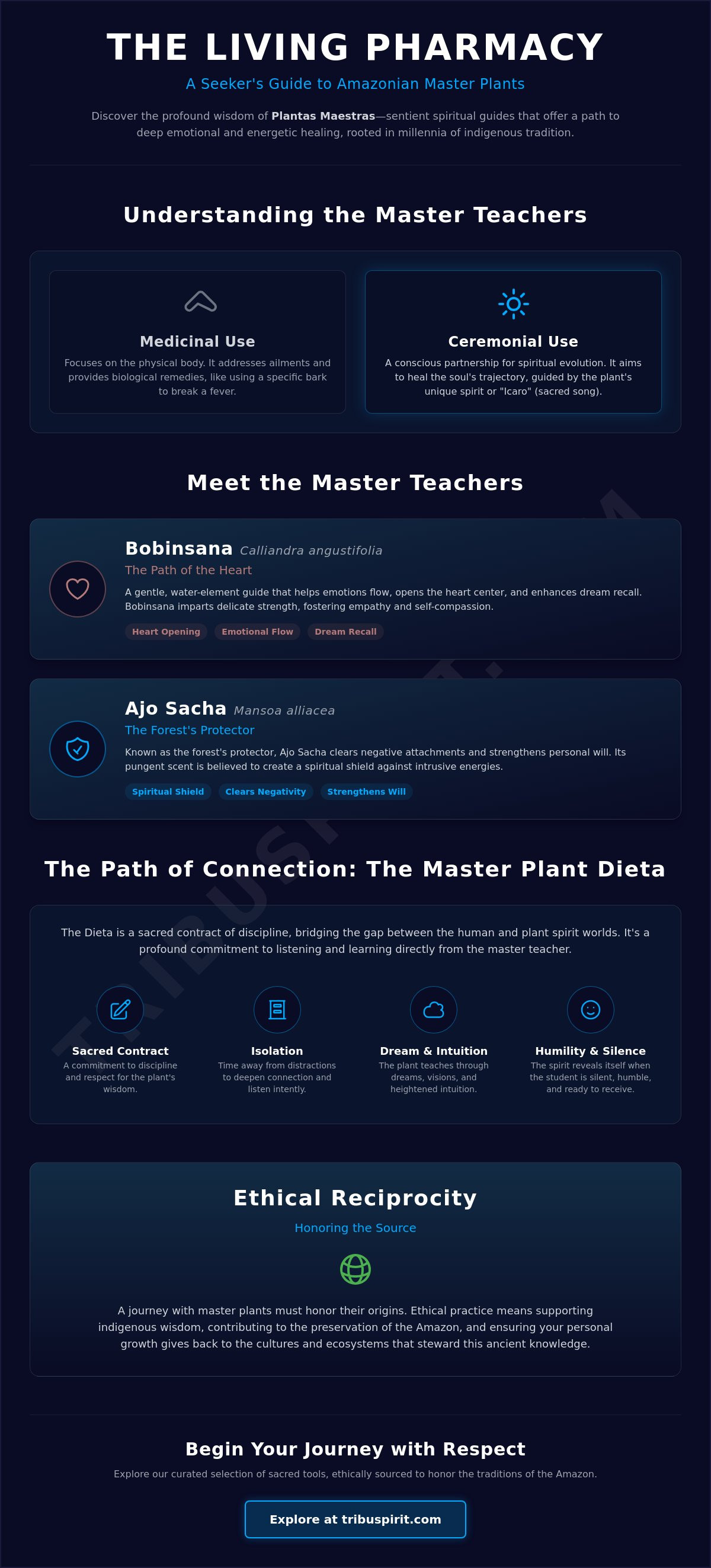
There's a vital distinction between medicinal use and ceremonial use. Physical healing addresses the body's ailments, such as using bark to break a fever. Ceremonial use, however, focuses on spiritual evolution. It's a conscious partnership aimed at healing the soul's trajectory. This is the path of the seeker. It's a journey beyond the physical. It's an invitation to listen to the whispers of the jungle.
The Concept of Plant Spirits and Animism
In the heart of the jungle, animism isn't a theory; it's a lived reality. Every plant possesses an "Icaro," a sacred song that represents its essence and healing frequency. During a traditional "Dieta," practitioners isolate themselves to communicate with these spirits through dreams and heightened intuition. The plant becomes the professor. A Master Plant is a botanical entity that teaches through energetic transmission. This process requires humility and silence. The plant's spirit reveals itself only when the student is ready to listen. Truth flows through the silence of the trees.
The Synergy of Biodiversity and Ethnobotany
The Amazonian ecosystem produces unique chemical compounds found nowhere else on Earth. This chemical complexity is driven by intense competition and symbiotic relationships within the canopy. Understanding these secrets requires more than a microscope. It demands a deep dive into Ethnobotany, the study of how people and plants interact. This field honors Traditional Ecological Knowledge (TEK), the ancestral database that allows tribes to identify which specific amazonian plants hold the key to the unseen.
Modern seekers are now turning back to these ancient roots. Exploring plant medicine serves as a bridge. It's a path to reconnection. It invites us to step out of the digital noise and into the rhythmic pulse of the earth. By honoring these master teachers, we find our way back to our own internal landscape. We find the ritual in the everyday. We find the spirit in the green.
The Master Teachers: Exploring Key Amazonian Plant Lineages
The rainforest isn't just a collection of flora; it's a sentient classroom where each species offers a specific frequency of wisdom. Traditional healers, or curanderos, recognize certain amazonian plants as Master Teachers because they possess a distinct spirit capable of instructing humans through dreams, visions, and energetic shifts. These botanical allies provide more than physical relief. They offer a map for the soul's evolution, guiding us back to a state of primal harmony.
Bobinsana and the Path of the Heart
Calliandra angustifolia, known affectionately as Bobinsana, acts as a gentle guide through the emotional landscape. This water-element plant thrives along the riverbanks, mirroring its ability to help emotions flow rather than stagnate. Practitioners often use Bobinsana in tinctures to enhance dream recall and facilitate a deeper connection to the heart center. It doesn't force an experience. Instead, it invites a soft opening, making it a favorite for those seeking empathy and self-compassion. Its pink, feathery blossoms symbolize the delicate strength it imparts to the spirit, helping us stay soft in a world that often demands we stay hard.
While Bobinsana opens the heart, Ajo Sacha (Mansoa alliacea) focuses on the external boundaries. It's the forest's protector. Healers use it to clear negative attachments and strengthen the individual's will. Its pungent, garlic-like scent is believed to repel intrusive energies, creating a spiritual shield for the practitioner during times of transition. You can explore how these protective energies manifest in our sacred ritual tools, crafted to support your personal sanctuary.
Chuchuhuasi (Maytenus krukovii) serves as the "backbone" of the forest. This massive tree provides grounding and physical resilience. Ethnobotanists, including researchers who have documented the useful plants of the Amazon Valley, highlight its traditional use for joint support and vitality. It anchors the seeker, providing the stability needed to integrate high-frequency spiritual work into a physical body. It's the steady pulse that keeps us connected to the Earth.
The Visionary Teachers: Ayahuasca and Beyond
At the center of this botanical cosmology sits the ayahuasca plant, often called the Vine of the Soul. This master cleanser works by stripping away the ego's layers to reveal the underlying truth of existence. The vine itself provides the structure and the map for the journey, while the Chacruna leaf (Psychotria viridis) brings the light. Without Chacruna, the visions remain dark; without the vine, the light has no direction.
These amazonian plants aren't recreational tools. They're powerful catalysts that require strict ceremonial containers and expert facilitation. The spirits of these plants demand respect and a prepared vessel. The dieta, or traditional plant diet, is the bridge that allows a human to communicate with these ancient lineages, ensuring the teacher's wisdom is received with clarity and humility.
The Sacred Medicines of Presence: Hapé, Sananga, and Mambe
While the deep journeys of the vine often take center stage, other amazonian plants serve as the essential anchors of daily spiritual life. These medicines don't transport you to other dimensions; instead, they pull you deeply into this one. They're the guardians of presence. In the traditional context of the rainforest, these tools provide the clarity needed to navigate both the physical jungle and the complexities of the human soul.
Hapé and the Power of Sacred Tobacco
To truly understand what is hape, you have to look at the tribal social structure of the Huni Kuin and Yawanawá. Hapé is a sacred snuff, a fine powder created from a base of Mapacho (Nicotiana rustica). This isn't the industrial tobacco found in the West. Mapacho contains up to nine times more nicotine than commercial varieties, yet it's used for prayer and grounding rather than habit. It's the "Grandfather" spirit that clears the mind of chatter.
The energy of the blend changes based on the sacred ashes mixed with the tobacco. Tsunu ash, coming from the Platycyamus regnellii tree, is the most common for its balanced, grounding properties. Mulateiro ash, sourced from the "tree of youth," offers a more intense, focused experience often used to release deep-seated tension. Each blow of the pipe is a renewal of the breath.
Sananga and Mambe: Sight and Speech
The transition from internal focus to external clarity often involves sananga. These potent eye drops, made from the roots of the Tabernaemontana shrub, are famous for their intense, temporary sting. This "fire" serves a specific purpose: removing Panema. In Amazonian tradition, Panema is a heavy, grey energy that causes lethargy and bad luck. Once the sting subsides, the visual field expands. Colors appear more vivid, and the spiritual "third eye" feels wide open.
While Sananga clears the vision, the combination of Mambe and Ambil focuses the voice. Exploring mambe introduces us to the "Medicine of the Word." It's a green powder made from toasted coca leaves and the ash of Yarumo leaves. When paired with ambil, a dark tobacco paste, it facilitates heart-centered dialogue. These amazonian plants work in a beautiful synergy:
- Hapé: Aligns the energetic centers and stills the ego.
- Sananga: Purges emotional blockages and sharpens perception.
- Mambe and Ambil: Turns communication into a sacred act of truth-telling.
These medicines are vital for daily spiritual maintenance. They don't require a week-long retreat; they require a moment of intention. They remind us that the most profound spiritual work often happens in the quiet spaces between our words and the clarity of our gaze.
How to Work with Amazonian Plants: The Master Plant Dieta
To truly receive the wisdom of amazonian plants, you don't simply consume them; you enter into a sacred contract known as the dieta. This ancestral practice creates a bridge between human consciousness and the plant's spirit. It's a commitment of the soul. In the Shipibo tradition, this contract is viewed as a marriage. You offer your discipline, and the plant offers its medicine, protection, and knowledge.
The physical requirements are rigorous because the body must become a clean vessel. For periods typically lasting 7, 14, or 30 days, practitioners remove all stimulating or dulling substances. This means no salt, no sugar, no oils, and no sexual activity. These elements are thought to "cloud" the energetic field. Without them, your sensitivity heightens. You become resonant enough to hear the plant's whisper. It's a process of vibrational purification.
Isolation acts as the crucible for this transformation. In the silence of a dedicated retreat, meditation becomes your primary language. Intentionality is the compass that guides the journey. You aren't just waiting; you're actively listening. The plant spirit requires space to move through your dreams and thoughts. If the mind is cluttered with social media or conversation, the subtle frequencies of the master teachers are easily lost.
The Stages of a Traditional Plant Dieta
The journey begins with preparation. This phase involves cleaning the physical temple through a light, clean diet and setting a clear, unwavering intention. You must know why you're calling upon the teacher. Once the body is ready, the immersion begins. You consume the plant preparation and enter the "dream space." This is a state where boundaries between self and nature dissolve, allowing the plant to rewrite internal patterns. Finally, the closing ritual is vital. Often involving the consumption of salt and lime, this ceremony "locks in" the medicine, ensuring the plant's essence remains within your energetic structure as you return to modern life.
Creating a Sacred Space for Connection
You can support your deep work by using shamanic tools like mapacho, feathers, or sacred resins. These items act as anchors for your focus. They help clear the space and invite the presence of the forest into your immediate environment. Silence is your greatest ally during this time. A 100% digital detox allows your nervous system to recalibrate to the frequency of the Earth. Even at home, you can honor amazonian plants through simple rituals. Lighting a candle, offering a prayer of gratitude, or keeping a dedicated altar creates a sanctuary for ongoing communication.
Integration is the final, ongoing step. Bringing the plant’s wisdom into modern life requires patience. The insights gained in the silence must be practiced in the noise. It's about living the medicine every day.
Discover our artisan-crafted tools to elevate your sacred plant rituals.
Ethical Reciprocity: Protecting the Amazon and Its Wisdom
The relationship between humanity and amazonian plants is a sacred contract. It's a bond built on thousands of years of whispered prayers and deep forest silence. Today, this bond faces a critical threshold. With the Amazon rainforest having lost 17% of its original tree cover since 1970, the call for ethical reciprocity has never been louder. We don't just consume these medicines; we become their guardians.
Tribu Spirit functions as a Private Ministry to ensure that every leaf and seed remains within a framework of spiritual integrity. This structure protects the ancient lineages from the cold mechanics of mass production. It ensures that the focus remains on the preservation of tradition rather than mere commerce. When you choose a tool for your altar, you're supporting indigenous sovereignty and the right of tribes to govern their own ancestral wisdom. Your purchase becomes a vote for the survival of the forest.
Sourcing with Integrity
The global demand for rainforest medicine has led to a 25% increase in spiritual tourism in certain regions over the last decade. This surge often results in the commodification of the sacred, where plants are harvested without regard for their spirit or the soil. Before bringing amazonian plants into your home, ask these essential questions:
- Was the plant harvested during the correct moon cycle by someone who knows its spirit?
- Does the purchase price directly empower the indigenous family who prepared it?
- Is there a reforestation plan in place to replace what was taken?
Your medicine should be prayerfully prepared. This means the energy of the maker is just as vital as the physical properties of the plant. Ethical sourcing isn't a luxury; it's a prerequisite for true healing. Without respect for the source, the connection remains incomplete.
The Tribu Spirit Mission: Reforestation and Empowerment
Our commitment goes beyond fair trade. We actively support reforestation initiatives that have seen thousands of native saplings returned to the soil in the Amazon basin since 2021. These projects don't just plant trees; they restore the lungs of our planet and the pharmacy of the soul. Every ritual tool you hold is a bridge to a living culture that we must protect together.
By choosing consciously, you help preserve the cultural heritage of over 400 distinct indigenous groups. We invite you to join our community and deepen your connection to these ancient teachers. Explore the sacred ritual with awareness. Let your practice be an act of love for the forest that sustains us all. The path of the student is one of humility, and together, we can ensure the master teachers remain for the generations that follow us.
Embracing the Ancient Wisdom of the Sacred Green
The whispers of the rainforest canopy aren't just sounds; they're invitations to remember who you're at your core. Integrating the lessons of amazonian plants into your life is a commitment to the soul's evolution. It's a bridge between the ancestral traditions of the Huni Kuin and Katukina tribes and your personal ritual space. You've explored how the master plant dieta demands discipline and how medicines like Hapé and Sananga ground your awareness in the present moment. True spiritual growth requires a foundation of integrity. This means moving beyond consumption to a state of sacred reciprocity. We believe this connection must be built on a bedrock of honor. Our private spiritual ministry curates every tool with deep reverence for its origin. Every purchase you make directly supports these indigenous communities and funds the planting of native trees in the Amazon basin. Your journey is part of a larger cycle of healing and protection. The forest is calling you to listen deeper.
Explore our ethically sourced collection of sacred Amazonian medicines
Step forward with an open heart and let the teachers guide your way home.
Frequently Asked Questions
Are Amazonian plants legal to own and use in the United States?
Most Amazonian plants are legal to own in the United States, though specific species containing DMT fall under the Controlled Substances Act of 1970. You can freely purchase and use botanical tools like Hapé or Sananga in all 50 states. However, the Supreme Court's 2006 ruling in Gonzales v. O Centro Espírita Beneficente União do Vegetal provides very specific religious exemptions for only a few sanctioned organizations. Always check your local state statutes before acquiring raw botanical materials for personal rituals.
Can I work with Amazonian master plants without a shaman?
You can work with certain master plants independently for grounding and clarity, but deep ceremonial work often requires the guidance of a trained practitioner. While daily rituals with Hapé are common for individual practice, 90 percent of traditional lineages insist that intense dietas require a seasoned mentor. This ensures your safety and helps you navigate the complex energetic shifts that occur. A guide acts as a vital anchor during your internal exploration and spiritual processing.
What is the difference between a master plant and a regular medicinal herb?
Master plants possess a distinct spiritual consciousness that offers guidance, whereas regular medicinal herbs primarily target physical symptoms. These amazonian plants act as teachers that communicate through dreams, visions, and intuition. While a standard herb might soothe a cough, a master plant initiates a transformative psychological journey. Practitioners often spend 30 days in isolation to build a deep, personal relationship with these powerful botanical spirits.
How do I know if a plant medicine is ethically sourced?
You know a plant medicine is ethically sourced when the provider demonstrates direct trade relationships with indigenous communities. Look for 100 percent transparency regarding the harvesting location and the specific tribe involved in the process. Ethical suppliers often reinvest a portion of profits, typically 10 percent or more, back into rainforest conservation or community infrastructure. True sacred tools carry the vibration of respect for the land and its original guardians.
Is it safe to combine different Amazonian plants like Hapé and Sananga?
It's safe and common to combine Hapé and Sananga during a single ritual session to deepen your presence and focus. Many practitioners apply Sananga eye drops first to clear ocular tension, followed by Hapé 5 minutes later to ground the energy. This specific sequence helps align your vision and your breath. Using these amazonian plants together creates a synergistic effect that sharpens your awareness and clears the entire energetic field.
What are the most common side effects of starting a plant dieta?
The most common side effects include digestive shifts, vivid dreams, and temporary emotional sensitivity. During the first 72 hours of a traditional dieta, 70 percent of participants report a healing crisis where the body releases stored toxins. You might experience fatigue or slight headaches as your system recalibrates to a higher frequency. These physical responses are simply signs that the plant's vibration is beginning to harmonize with your own soul.
How long does a typical master plant dieta last?
A typical master plant dieta lasts between 7 and 30 days depending on your intention and the specific plant teacher. Short initiations often span 10 days, while deep apprenticeship dietas can extend for 6 months or longer. This period of dietary restriction and isolation allows the plant's essence to fully integrate into your consciousness. Consistency in your practice is the key to unlocking the ancient wisdom held within the rainforest's sacred architecture.