
What if the very ritual meant to clear your energetic field is quietly introducing heavy metals or mold into your physical temple? When you sit with sacred medicine, you open your spirit to the profound wisdom of the forest, yet the modern world often complicates this ancestral connection with synthetic additives and contaminated ash. Understanding the importance of third-party lab testing for hapé is no longer just a clinical preference; it's a vital act of self-care and spiritual integrity. You deserve to know that your breath remains untainted by the shadows of industrial shortcuts.
We understand that your journey toward inner balance requires absolute trust in the tools you choose. You seek a connection that's both deep and safe. This guide reveals how modern laboratory rigor protects the purity of ancient shamanic medicines, ensuring your practice remains safe and resonant. We'll provide a clear framework to identify high-quality vendors and verify ethical sourcing. By bridging the gap between ancient traditions and scientific verification, you can finally find true peace of mind during your next ceremony.
Key Takeaways
- Understand how the transition from the rainforest to the global market creates a purity gap that only modern verification can close.
- Identify the physical risks of heavy metals and microbial contaminants that can compromise the sanctity of your ritual tools.
- Recognize the importance of third-party lab testing for hapé as a form of reverence that protects your body while your spirit soars.
- Gain a practical framework for verifying medicine by checking batch dates and requesting a formal Certificate of Analysis from your provider.
- Discover how aligning ancient wisdom with modern safety standards creates a foundation for deeper, more focused spiritual exploration.
The Purity Gap: Why Sacred Hapé Requires Modern Verification
Hapé is a living prayer, a sacred alchemy of the forest that carries the whispers of the Amazonian tribes. For centuries, this medicine has been prepared with deep reverence, combining the spirit of Mapacho with the crystalline energy of sacred tree ashes. It's a ritual tool designed to ground the mind and open the heart. However, as these ancient traditions travel from the dense canopy of the rainforest to the digital shelves of the modern world, a significant gap has emerged. The path from the jungle to your home is long, and the environment the plants grow in is no longer the pristine paradise it once was.
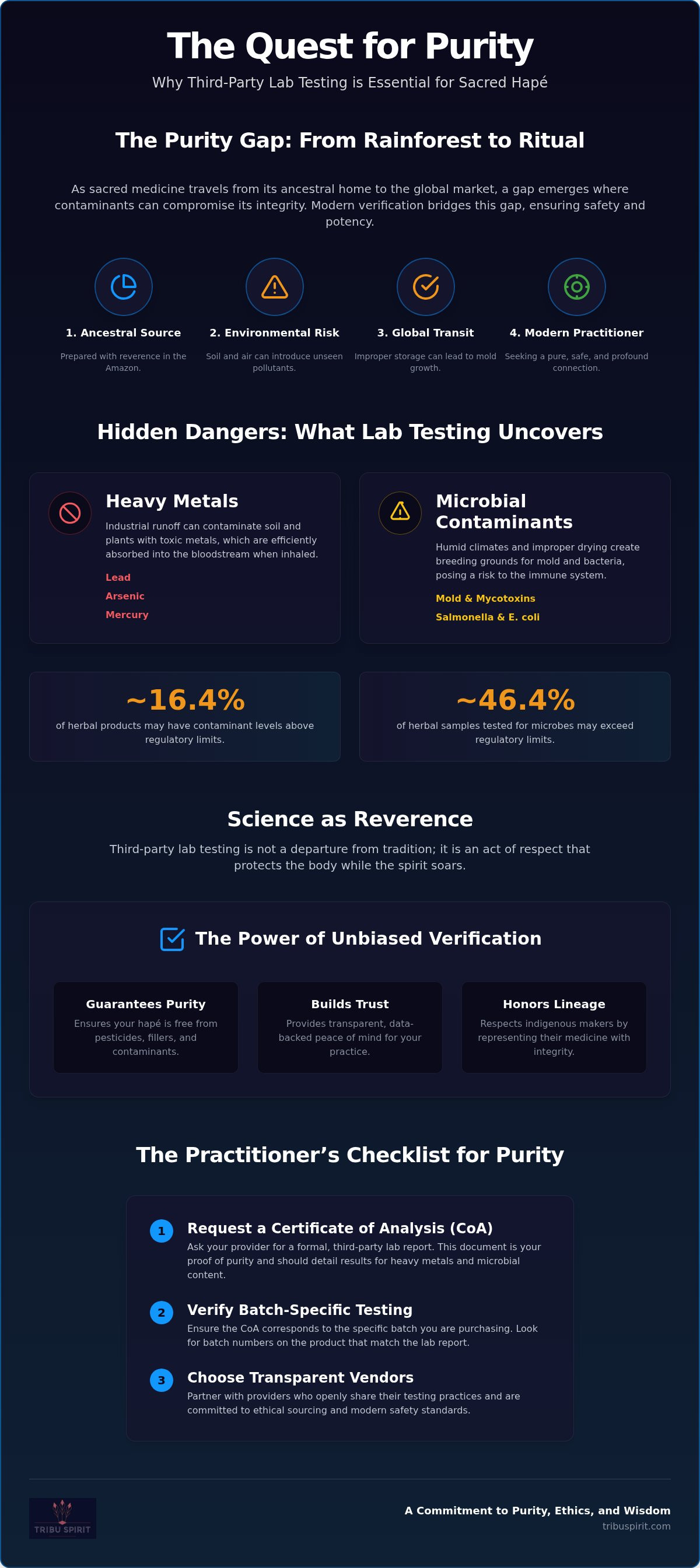
We must acknowledge a difficult truth: traditional doesn't always mean clean. Global environmental shifts have introduced pollutants even into remote areas. A systematic review of herbal medicinal products found that approximately 16.4% of samples had contaminant levels above regulatory limits, highlighting the invisible risks in unregulated markets. Soil can hold heavy metals, and the air carries traces of industrial activity. This reality makes the importance of third-party lab testing for hapé a cornerstone of modern shamanic practice. Without verification, we're asking our bodies to process the very toxins we seek to clear through ceremony. An independent seal of integrity acts as a bridge, ensuring the medicine remains a vessel for healing rather than a source of harm.
The Journey from the Amazon to the Modern Practitioner
The creation of Hapé - Tsunu or Mulateiro begins with the careful selection of plants and the rhythmic pounding of the mortar. While often categorized broadly as a form of snuff, sacred Hapé is distinguished by its ritual intent and the specific alkaline ashes used to activate its properties. The journey doesn't end in the village. This fine powder travels through humid climates and across vast distances. During this transit, improper storage can lead to moisture buildup, which creates a breeding ground for mold. Maintaining the "energetic signature" of the medicine requires us to also protect its physical purity. We honor the tribes by ensuring their medicine arrives in your hands exactly as intended: vibrant, potent, and untainted by the journey.
What "Third-Party Tested" Actually Means for Your Practice
When a vendor performs internal quality checks, they're essentially grading their own work. Independent laboratory verification is different. It's an unbiased, scientific gaze that looks for what the eye cannot see. For the practitioner, this means peace of mind. It means knowing that your Hapé - Parica is free from pesticides or synthetic fillers. Unbiased data builds a foundation of trust that allows the shamanic community to grow with integrity. By demanding these standards, we protect the lineage of the indigenous makers. We ensure that their sacred tools are represented with the highest level of transparency and respect in a crowded global marketplace.
Hidden Dangers: What Lab Testing Reveals in Sacred Medicines
Even the most sacred intention cannot shield the physical body from the reality of environmental toxins. While we often focus on the energetic clearing provided by these plants, we must also look closer at the physical matter we invite into our systems. The Amazon is a complex ecosystem. Industrial runoff from mining and agriculture travels through groundwater, reaching the roots of the very trees used for sacred ash. This physical reality underscores the importance of third-party lab testing for hapé. Without scientific oversight, we risk inhaling lead, arsenic, or mercury alongside our prayers. Research indicates that approximately 16.4% of herbal medicinal products contain contaminant levels above safe limits; a risk no practitioner should take lightly.
Beyond heavy metals, the rainforest's intense humidity presents a constant struggle for microbial purity. When traditional medicines are prepared, the drying process is critical. If moisture remains trapped in the fine powder, it becomes a silent breeding ground for mold and salmonella. Statistics show that 46.4% of herbal samples tested for microbes exceeded regulatory limits. These invisible threats can turn a moment of healing into a burden for the immune system. Finding a partner like Tribu Spirit ensures your tools are screened for these biological hazards before they ever reach your altar.
The Heavy Metal Risk in Inhaled Medicines
The lungs are delicate gateways. Unlike the digestive system, which has multiple filtration layers, the respiratory tract allows substances to enter the bloodstream with startling efficiency. This makes inhaled medicines particularly sensitive to the presence of heavy metals. Lead can accumulate in the body over time through ritual use, potentially impacting the nervous system and clouding the very mental clarity you seek. Using low-quality ash from trees grown in contaminated soil isn't just a matter of poor craft; it's a direct threat to your physical temple. Lab testing identifies these elements at parts-per-billion levels, offering a level of safety that traditional methods simply cannot detect.
Mold and Mycotoxins: The Silent Ritual Killers
In the deep jungle, the air is thick with life and moisture. If the Mapacho or the sacred ashes aren't dried using precise techniques, fungal growth begins almost immediately. Inhaling mycotoxins during a ceremony can lead to respiratory distress, fatigue, and persistent inflammation. You cannot see these microscopic spores with the naked eye. A vibrant green or deep brown powder might look perfect under a ritual lamp, yet it could be dangerously contaminated with toxins that bypass your natural defenses. Scientific verification is the only way to ensure that your breath remains as pure as your heart's intent.
Potency is another vital factor. Some "black market" blends are spiked with synthetic alkaloids to mimic the strength of authentic medicine. Testing ensures that the Hapé - Tsunu or Mulateiro you use possesses the natural, balanced chemical profile intended by the indigenous makers. It protects the lineage and your health simultaneously.
Science as Reverence: Balancing Tradition with Chemical Purity
Some practitioners worry that bringing sacred medicine into a sterile lab environment somehow diminishes its spirit. They fear that analytical data might "kill" the magic. In truth, the opposite is true. Science, when used with intention, becomes a form of reverence. It's a way to honor the physical vessel that houses your consciousness. By acknowledging the importance of third-party lab testing for hapé, we're not clinical; we're careful. We ensure the bridge between the forest and the soul is built on a foundation of safety. Modern analytical tools don't replace indigenous mastery; they validate it.
Your body is the altar upon which every spiritual breakthrough occurs. If that altar is cluttered with the physical stress of processing contaminants, the energy of the medicine cannot flow freely. Engaging in sacred ritual requires a state of profound surrender. This surrender is only possible when you've removed the nagging distraction of physical worry. Knowing your medicine is pure acts as a modern blessing, clearing the space for your spirit to soar without biological anchors.
Protecting the Spiritual Vessel
Deep meditation requires a quiet mind. If you're constantly questioning the origin or safety of your tools, that silence remains out of reach. Clean medicine is a prerequisite for depth. When you see a lab report, don't view it as cold data. View it as a certification of purity that allows your nervous system to relax. This relaxation is the gateway to the deep, transformative states that Hapé is meant to facilitate. It turns a simple act into a focused journey of inner growth. When the mind is certain, the spirit is free to wander.
Indigenous Sovereignty and Quality Control
The global demand for Amazonian medicines has unfortunately opened doors for exploitation. Counterfeit "tribal" blends often flood the market, using synthetic additives or filler plants to cut costs. Third-party testing serves as a powerful tool for indigenous sovereignty. It verifies that the Amazonian plants listed on the label are exactly what's inside the bottle. This transparency ensures that the lineage of the tribes is respected and that their mastery isn't diluted by bad actors. It creates a direct link between the wisdom of the forest and the ethics of fair trade, ensuring that your practice supports the people who have guarded this knowledge for millennia. Highlighting the importance of third-party lab testing for hapé is how we protect both the seeker and the source.
The Practitioner’s Checklist: How to Verify Your Hapé’s Purity
True discernment is a spiritual skill. As you refine your relationship with these medicines, you must also refine your ability to recognize purity in a crowded market. The importance of third-party lab testing for hapé becomes clear when you realize that trust is earned through transparency, not just stories. A reputable vendor won't just tell you their medicine is clean; they'll show you the proof. This proof lives in the Certificate of Analysis (COA), a document that serves as the physical verification of the medicine's integrity. If a shop hesitates to provide this, it's a sign to pause and reflect on where you're placing your trust.
Reading a Certificate of Analysis (COA)
A COA might look like a wall of numbers, but it tells a story of care. Look for the "Purity" section first. This is where you'll find results for heavy metals like lead and mercury. You want to see "ND" (Non-Detectable) or "Below LOQ" (Limit of Quantitation). These labels mean the lab's sensitive equipment couldn't find harmful levels. Next, check the batch number. It must match the number on your bottle. A test from two years ago doesn't guarantee the safety of today's harvest. If the report lacks a clear date or an accredited laboratory's name, consider it a red flag. Reputable labs are independent entities; they have no stake in the sale, which ensures the data is unbiased and honest.
Questions to Ask Your Hapé Vendor
Don't be afraid to engage with your provider. A true steward of the medicine welcomes your questions. Ask how often they test new batches and if they screen for both heavy metals and microbial life like mold. It's also vital to know how they handle their shamanic tools and medicines after the lab results come back. Is the Hapé stored in a temperature-controlled, airtight environment to prevent new mold growth? Purity is a continuous process that begins in the forest and ends at your altar. Each step must be handled with the same level of reverence and scientific rigor. If you're ready to experience medicine backed by this level of transparency, you can view our lab-verified hapé collection and begin your journey with total confidence.
Understanding these technical details isn't about being clinical. It's about being a conscious participant in your own healing. When you verify the lab is accredited, such as having ISO/IEC 17025 certification, you're ensuring that the standards used to test your medicine are globally recognized. This level of scrutiny is what separates a casual seller from a dedicated ministry. It ensures that the sacred standard is upheld at every level of the process.
Tribu Spirit: A Commitment to Purity, Ethics, and Wisdom
At Tribu Spirit, we believe that the most profound spiritual experiences are rooted in a foundation of safety and respect. We don't see a conflict between the laboratory and the ceremonial space. Instead, we recognize the importance of third-party lab testing for hapé as a necessary evolution of our stewardship. Our mission is to serve as a bridge, bringing the untainted essence of the forest to those who seek it with a modern understanding of physical health. We protect the sanctity of the medicine by ensuring its physical container is as pure as its energetic frequency.
Every batch we curate is treated with the same reverence as the prayers that created it. By verifying the absence of toxins and contaminants, we aren't just checking boxes; we're protecting our community. We understand that your body is a temple, and any ritual tool you introduce to it must meet the highest standards of integrity. This commitment allows you to release the burden of worry and focus entirely on your inner expansion. When the physical vessel is safe, the spirit is free to explore the deepest reaches of consciousness.
Sourcing with Integrity
Our work begins deep within the heart of the Amazon, through reciprocal relationships with the indigenous families who craft these medicines. Truly understanding what is hape requires an appreciation for the soil, the water, and the intent of the maker. We take exhaustive steps to ensure every gram of medicine is free from the industrial runoff and environmental pollutants that plague unregulated markets. This is why we prioritize master blends like hape tsunu, ensuring its grounding clarity is never compromised by hidden heavy metals or mold.
Your choice to work with lab-verified medicine has a ripple effect that reaches far beyond your personal practice. As a Private Membership Association (PMA), we ensure that our sourcing supports reforestation and indigenous empowerment. We invest in the sovereignty of the tribes, ensuring they have the resources to protect their lands and their traditions. This ethical loop ensures that the medicine you receive is not only chemically pure but also energetically aligned with the principle of reciprocity.
Inviting You into a Safer Spiritual Journey
Choosing Tribu Spirit means choosing a curated path of peace and transparency. Our selection, including Hapé - Mulateiro and Hapé - Parica, is batch-verified to ensure that what you inhale is exactly what nature intended. This level of rigor removes the "black market" anxieties of synthetic additives, allowing you to settle into your ceremony with total confidence. We invite you to join our academy, where we explore the beautiful intersection of ancient shamanic science and modern analytical safety.
We believe that your spiritual growth should never come at the cost of your physical health. By demanding verified purity, you honor yourself and the ancient lineage of the forest. Let your practice be a testament to the harmony of ancestral wisdom and modern protective rigor. Together, we can uphold a sacred standard that keeps these traditions vibrant and safe for generations to come.
Elevate Your Practice with Verified Purity
Embracing the importance of third-party lab testing for hapé is a profound act of self-reverence. You've seen how the purity gap between the forest and the modern world is bridged by scientific rigor. By choosing batch-verified medicine, you ensure that your physical temple remains clear of heavy metals and microbial hazards. This clarity isn't just about safety; it's about creating the space for true surrender and deep spiritual connection. When your mind is at peace regarding the purity of your tools, your spirit is finally free to explore the vast landscapes of the inner world.
Tribu Spirit stands as a dedicated Private Ministry and Academy, committed to preserving sacred wisdom while upholding the highest modern standards. Our offerings are ethically sourced from indigenous tribes and directly support Amazonian reforestation efforts. You don't have to compromise your health for your growth. Experience the purity of batch-tested Hapé at Tribu Spirit and honor your journey with medicine that is as clean as your intention. Walk the path of the modern seeker with clarity, integrity, and absolute peace of mind.
Frequently Asked Questions
Is all Hapé third-party lab tested?
No, the vast majority of Hapé available today is not tested by independent laboratories. Because it's an artisanal medicine made in remote rainforest regions, standardized safety checks aren't part of the traditional process. Reputable modern providers choose to test voluntarily to ensure safety in a globalized market. Understanding the importance of third-party lab testing for hapé helps you distinguish between vendors who prioritize your health and those who merely sell a product.
What are the most common contaminants found in untested Hapé?
Untested medicines often contain invisible threats like lead, arsenic, and mercury absorbed from contaminated soil. In the high humidity of the Amazon, microbial growth is another significant risk, leading to mold, yeast, or salmonella. You might also find traces of pesticides or herbicides if the plants were gathered near industrial runoff. These substances can be inhaled directly into your system, turning a healing ritual into a burden for your delicate respiratory tract.
Can I test my own Hapé at home?
Home testing is not currently possible for the complex chemical profile of shamanic medicines. Detecting heavy metals or specific mycotoxins requires sophisticated equipment like mass spectrometers and specialized microbial incubators. While you can visually inspect for clumps or off-smells, microscopic spores and chemical elements remain hidden to the naked eye. Professional laboratory analysis is the only way to ensure your ritual tools are truly safe for use in your spiritual practice.
Does lab testing affect the spiritual potency of the medicine?
Lab testing doesn't diminish the spiritual essence or vibration of the medicine in any way. The process involves taking a small sample from a batch and analyzing its physical components without altering the remaining powder. In fact, many practitioners find that knowing their medicine is pure enhances their ceremony. It removes the subconscious barrier of physical anxiety, allowing for a deeper state of surrender and a more profound connection with the master plants.
How do I know if a vendor is faking their lab results?
Authentic results will always include the name of an accredited laboratory, a specific batch number, and a recent date. You can verify the legitimacy by contacting the lab directly to confirm they performed the test. Look for inconsistencies in fonts or blurred logos, which can be signs of a tampered document. A transparent vendor will be happy to discuss their testing process and provide clear, high-resolution documents that match the medicine you've purchased.
Why is heavy metal testing particularly important for Hapé users?
Heavy metal testing is vital because the lungs are a direct gateway to your bloodstream. Unlike the digestive system, which has multiple layers of filtration, the respiratory tract allows fine particles to be absorbed with startling efficiency. The importance of third-party lab testing for hapé is centered on preventing the long-term accumulation of toxins like lead in your tissues. Ensuring your medicine is non-detectable for these elements protects your nervous system and your overall longevity.
What is a COA and why should I care about it?
A COA, or Certificate of Analysis, is an official document issued by an independent lab that lists the specific test results for a batch. You should care about it because it's the only objective proof that your medicine is free from harmful contaminants. It provides a detailed breakdown of heavy metals, microbial life, and sometimes alkaloid content. Reviewing this document ensures that the sacred standard of your practice is backed by verifiable, scientific truth.
Is ethically sourced Hapé always lab tested?
Ethically sourced medicine isn't always lab tested, as these are two different standards of care. Ethical sourcing focuses on fair pay for indigenous tribes and the sustainability of harvesting practices. Lab testing focuses on the chemical and biological safety of the final product. While a vendor might have a beautiful relationship with a tribe, the soil or storage conditions could still introduce contaminants. For total peace of mind, seek providers who prioritize both ethics and safety.