What if the most disorienting moment of a Hapé ceremony is exactly where the healing begins? Most people approach this sacred ritual bracing for the physical intensity, quietly wondering if they'll do it wrong, offend a tradition they deeply respect, or simply lose themselves in the smoke and sensation. Those fears are real. And they're worth honouring.
You already sense that a hape ceremony is something far greater than a wellness trend. It's a living prayer, a breath-woven bridge between your scattered modern mind and the ancient wisdom of the Amazonian lineage that carefully tended this medicine for generations. That instinct to approach it with reverence isn't anxiety; it's the beginning of true preparation.
This guide will walk you through everything you need to know: how to set a grounded intention, what to expect from the ritual flow, how to move through the physical intensity with presence rather than resistance, and how to choose ethically sourced medicine that honours the communities who created it. Step by step, breath by breath, you'll arrive ready.
Key Takeaways
- A hape ceremony is far more than a ritual act — it is a living bridge between your intention and the ancestral wisdom of the Amazon, and the depth of your experience begins long before the medicine is received.
- The quality of your intention shapes the quality of your healing; learn how to set a grounded, prayer-like intention that invites the medicine to work at its deepest level.
- Whether you choose a facilitator-led Tepi experience or a self-administered Kuripe practice, understanding the difference is essential — especially for those approaching ceremony for the first time.
- Physical and energetic preparation — from fasting and breath-clearing to understanding the left and right nostril's symbolic roles — can transform an overwhelming experience into a profound one.
- True ceremony does not end with the blow; discover how ethical sourcing, integration practices, and support for indigenous sovereignty turn a single ritual into a lifelong path.
Understanding the Hapé Ceremony: A Gateway to Ancestral Presence
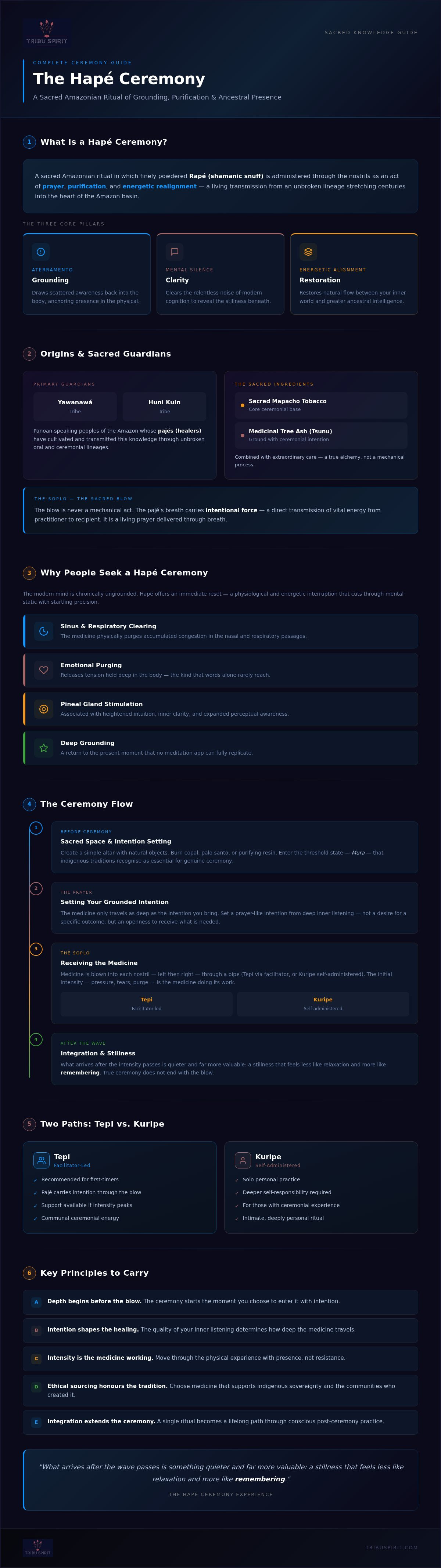
Before a single grain of medicine touches your breath, something ancient is already in motion. A hape ceremony is a sacred Amazonian ritual in which finely powdered Rapé, often called 'shamanic snuff', is administered through the nostrils as an act of prayer, purification, and energetic realignment. But to call it merely a ritual undersells what it actually is: a living transmission, a conversation between your nervous system and a lineage of wisdom that stretches back centuries into the heart of the Amazon basin.
The core purpose of the ceremony rests on three pillars. Aterramento, or grounding, draws scattered awareness back into the body. Mental silence clears the relentless noise of modern cognition. And energetic alignment restores the natural flow between your inner world and the greater intelligence that indigenous traditions have always recognised as present in the forest, the breath, and the medicine itself. To understand what is Hapé at its root is to understand that this is a master teacher plant, not a recreational substance. It asks something of you. It requires presence.
The Origins and the Spirit of the Medicine
The guardians of Hapé are primarily the Panoan-speaking peoples of the Amazon, most notably the Yawanawá and the Huni Kuin tribes, whose healers, known as pajés, have cultivated, refined, and transmitted this knowledge through unbroken oral and ceremonial lineages. At the heart of the practice is the Soplo, the blow itself, which is never considered a mechanical act. The pajé's breath carries intentional force, a direct transmission of vital energy from practitioner to recipient. Hapé itself is an alchemy of sacred Mapacho tobacco and the ashes of medicinal trees such as Tsunu, ground together with extraordinary care and ceremonial intention.
Why Seek a Hapé Ceremony Today?
The modern mind is chronically ungrounded. Fractured attention, digital overstimulation, and emotional suppression have become a kind of collective default. Hapé offers an immediate reset, a physiological and energetic interruption that cuts through mental static with startling precision.
People are drawn to ceremony for a range of reasons:
- Sinus and respiratory clearing, as the medicine physically purges accumulated congestion
- Emotional purging, releasing tension held in the body that words alone rarely reach
- Pineal gland stimulation, which many practitioners associate with heightened intuition and inner clarity
- Deep grounding, a return to the present moment that no meditation app can fully replicate
It's worth distinguishing between the physical 'kick' and what follows. The initial intensity, the pressure, the tears, the purge, is the medicine doing its work. What arrives after that wave passes is something quieter and far more valuable: a stillness that feels less like relaxation and more like remembering.
The Sacred Alchemy: Intentions, Prayer, and the Medicine's Breath
There's a quiet truth that experienced practitioners rarely state plainly: the medicine only travels as deep as the intention you bring to it. Hapé is not passive. It responds. And what it responds to, above all else, is the quality of your inner listening before a single breath is drawn.
This is where most preparation guides fall short. They tell you to "set an intention" without ever explaining what that actually means in practice, or why the space around you matters as much as the medicine itself. So let's go deeper.
Before the ceremony begins, the physical environment becomes a living participant. A simple altar, a cloth laid with care, a candle, a few natural objects that hold personal or ancestral meaning, shifts the atmosphere from ordinary room to sacred container. Incense, whether copal, palo santo, or another purifying resin, clears the energetic residue of daily life and signals to your nervous system that something different is beginning. Stillness follows. Not the absence of sound, but the presence of readiness. Indigenous traditions across the Amazon recognise this threshold state, sometimes called Mura, as the essential precondition for any genuine ceremonial work. You cannot receive what you haven't made space to hold.
The shamanic tools used to facilitate the blow are themselves part of this alchemy. A well-crafted Kuripe or Tepi pipe is not merely a delivery mechanism. It's an object that has been held, breathed through, and intentioned by the hands that made it. Every element of the ceremony, the vessel, the breath, the space, carries weight.
Setting Your Intention (Sankalpa)
The Sanskrit word Sankalpa translates loosely as "a solemn vow formed in the heart." That distinction matters. An intention for ceremony isn't a wish list or a goal statement. It's a movement from wanting to inviting: from "I want to feel less anxious" to "I invite clarity where fear has been living." From "I want to process this grief" to "I open to whatever the medicine knows about this loss."
Concrete examples help ground this shift:
- Seeking mental clarity: "I invite stillness into the parts of my mind that have forgotten how to rest."
- Releasing grief: "I open to what my body has been carrying that my words haven't been able to reach."
- Grounding after travel or transition: "I ask to be returned to myself, to this breath, to this earth."
- Energetic renewal: "I invite the medicine to clear what no longer belongs to me."
Silence is the best companion for this process. Not music, not journaling, not conversation. Sit with your intention for several minutes before the ceremony opens. Let it settle from thought into felt sense. That's when it becomes real.
The Role of Prayer and Sound
Sound is medicine in its own right. A shamanic rattle used before or during ceremony doesn't merely create atmosphere; its rhythmic vibration helps shift brainwave states, loosens held tension in the body, and calls the practitioner's full attention into the present moment. Icaros, the sacred songs of Amazonian healers, serve a similar function: they're not performances but prayers made audible, maps of the energetic terrain the medicine will travel.
Central to this prayer-space is the spirit of Grandfather Tobacco, the living intelligence within the Mapacho that forms the sacred backbone of Hapé. Amazonian tradition holds that tobacco, when approached with respect, is a profound communicator and protector, a bridge between human awareness and the deeper intelligence of the forest. To receive Hapé is, in this sense, to enter into conversation with that spirit directly.
Approaching the ritual this way, as a conversation rather than a consumption, transforms the entire experience. You're not taking a substance. You're speaking to a lineage. The Amazonian plants at the heart of this tradition have been in dialogue with human consciousness for centuries; your ceremony is simply the newest verse in a very old song.
If you're preparing for your first hape ceremony and want to ensure your tools carry the same intentional quality as your practice, the hand-carved shamanic rattle and bamboo Kuripe available through Tribu Spirit are crafted with exactly this ceremonial lineage in mind.
Finding Your Path: Solo Rituals vs. Facilitated Communal Ceremonies
Two paths lead into a hape ceremony, and they ask different things of you. One invites you to surrender into the care of another's breath and lineage. The other asks you to become your own steady witness. Neither is superior. They serve different seasons of a practitioner's life, and understanding that distinction before you begin is one of the most grounding choices you can make.
The Facilitated Experience: The Tepi and the Pajé
When a trained facilitator administers Hapé through a Tepi pipe, something shifts that self-application simply cannot replicate. The blow carries another person's breath, intention, and energetic presence directly into your field. For beginners especially, this isn't a luxury; it's a form of safety. A skilled facilitator reads your nervous system in real time, adjusting force, timing, and post-blow support in ways that a first encounter with the medicine genuinely calls for.
Choosing a facilitator wisely matters enormously. Look for three things: demonstrated connection to an authentic indigenous lineage, transparency about where their medicine originates, and what practitioners sometimes call energetic hygiene, the ability to hold a clean, boundaried ceremonial space without projecting their own process onto yours. A facilitator who speaks more about the medicine than about themselves is usually a good sign.
In a group setting, something else becomes available: shared resonance. When several people receive the medicine in the same space and the same breath-cycle, the collective field can amplify individual healing in ways that are difficult to articulate and surprisingly consistent across traditions. Community ceremony isn't just logistics. It's its own kind of medicine.
The Personal Ritual: Mastering the Kuripe
The Kuripe is the tool of daily practice and self-sovereignty. Shaped to connect mouth to nostril in a single arc, it places the full responsibility of the ceremony in your own hands. That's not a limitation. It's a teaching.
Regular solo practice, sometimes called sitting the Dieta with the medicine, builds an intimate relationship with Hapé's subtler layers that group ceremonies alone won't reveal. You learn your own resistance. You notice which nostril feels heavier on which mornings. You develop the breath control and inner stillness that transforms the ritual from an event into a discipline.
For those beginning this solo path, medicine selection matters. Hapé Tsunu is widely regarded as an ideal starting point: its grounding, clarifying quality is gentle enough for daily use while remaining genuinely potent. It teaches without overwhelming.
Practical tips for self-application:
- Seat yourself firmly before you begin; kneeling or cross-legged positions help anchor the body during the intensity
- Exhale fully through the mouth immediately after each blow to prevent the medicine from pooling and intensifying beyond your threshold
- Stay with closed eyes for at least five minutes after both nostrils are received; this is where the medicine does its quietest and deepest work
- Keep the space phone-free; the Kuripe demands the same ceremonial container as any facilitated experience
The solo ceremony doesn't ask less of you than a retreat. In some ways, it asks more. But what it returns, that deepening self-trust and daily rootedness, is something no single ceremony can give you. Only practice does.
Preparing Your Temple: A Step-by-Step Guide to a Powerful Ceremony
The ceremony doesn't begin when the medicine reaches your nostrils. It begins the moment you decide to treat the space around you as sacred. Most guides skip this part entirely, jumping straight to dosage and technique. But the quality of your container determines the quality of your experience. Always.
Physical preparation matters more than most newcomers expect. Fasting for at least four hours before a hape ceremony reduces the likelihood of nausea and allows the medicine to move through a cleaner energetic field. Hydration is equally important, but drink water well before the ceremony, not immediately prior. A full stomach and a full bladder are distractions the medicine shouldn't have to work around. Blow your nose gently beforehand to clear the nasal passages, and avoid dairy on the day of ceremony; it thickens mucus and dulls the medicine's passage.
The Physical Protocol
Three steps form the ritual spine of any well-held ceremony:
- Step 1: Cleanse the space. Light Mapacho or Palo Santo and move the smoke through the room with slow, deliberate intention. This isn't decorative. Smoke has been used across indigenous traditions as a physical and energetic purifier, and your nervous system responds to it as a genuine transition signal. The ordinary world recedes. Something else begins.
- Step 2: Measure the medicine. A pea-sized amount per nostril is the standard starting point for most Hapé varieties, including Hapé Tsunu. Less is often more. You can always deepen a practice; you can't undo an overwhelming first encounter.
- Step 3: The breath. Before the blow, inhale deeply through the mouth, filling the belly. As the medicine is administered, hold the breath briefly, then exhale slowly through the mouth. Don't inhale sharply through the nose immediately after. Let the medicine settle before the body responds.
The Left and Right: Death and Rebirth
In Amazonian tradition, the left nostril connects to the feminine, the lunar, the realm of release and letting go. The right carries masculine energy, solar force, renewal and intention. Receiving the medicine in the left side first invites the body to surrender what it no longer needs. The right side then calls in what wants to arrive. This isn't metaphor. Practitioners who work with this polarity consistently report a qualitatively different experience from those who treat both nostrils as interchangeable.
Navigating the Intensity
The burn, the pressure, the sudden rush of tears or sneezing, these aren't signs that something is going wrong. They're the medicine working. Suppressing the urge to purge, whether through tears, sweat, or a sharp exhale, interrupts the clearing process at exactly the moment it's most alive. Let it move.
When the intensity peaks, bring your awareness to the space between your eyebrows. The third eye point acts as an anchor; focusing there gently redirects sensation from overwhelm into presence. Breathe slowly through the nose to manage the drip rather than fighting it, and keep your spine upright. Collapsing the posture collapses the ceremony.
After both nostrils have received the medicine, do nothing. Sit with closed eyes for at least five minutes. Don't reach for your phone. Don't speak. The post-blow stillness isn't the end of the ritual; it's the deepest part of it. This is when the medicine completes its work, when the noise finally clears and something quieter, truer, rises into the space you've made.
If you're building a home practice and want tools crafted with genuine ceremonial lineage, the Bamboo Kuripe available through Tribu Spirit is designed to support exactly this kind of intentional, solo hape ceremony, from first breath to final stillness.
Beyond the Blow: Integration and Honoring Indigenous Sovereignty
The medicine doesn't stop working when you open your eyes. What arrives in the stillness after a hape ceremony is only the beginning of a longer conversation, one that continues in the hours, days, and choices that follow. Integration is the bridge between the sacred ritual and the ordinary moments of your life. Without it, even the most profound ceremony becomes a beautiful memory that slowly fades. With it, the medicine keeps moving.
Integrating the Wisdom
The 48 hours after ceremony deserve the same quality of attention as the preparation before it. Stay in a state of gentle observation. Don't rush to explain what happened or translate it into conclusions. Insights from ceremony are often more fragile than they feel; they need quiet to root.
Journaling is one of the most reliable integration tools available. These prompts can help:
- "What did my body know that my mind didn't?" Write without editing for ten minutes.
- "What did I resist during the ceremony, and what does that resistance point to?"
- "What would it look like to carry this stillness into one relationship or one daily habit?"
That last question matters most. The Hapé state, that quality of grounded, unhurried presence, isn't exclusive to ceremony. It's a frequency you can return to. Slow your breath before a difficult conversation. Pause before reacting. Let the medicine teach you not just in ceremony, but through the texture of how you live.
Walking the Path of Reciprocity
Here's something most guides won't say plainly: cheap Hapé often comes at a high human cost. When medicine is sourced without direct relationships with indigenous communities, without fair compensation, without care for the forests being harvested, the extraction mirrors the same disconnection the ceremony is meant to heal. The sacred exchange isn't just spiritual. It's economic and ecological.
Tribu Spirit sources its Hapé, including Tsunu, Mulateiro, and Parica, directly from Amazonian tribes, with a commitment to fair trade principles and active contributions to reforestation and indigenous empowerment. Choosing ethically sourced medicine isn't a premium add-on. It's the foundation of a practice that honours the lineage it draws from.
Your purchase carries weight beyond your own healing. It helps preserve the cultural heritage, the land, and the living knowledge of the communities who have tended this medicine for generations. That's reciprocity made real.
If you feel called to deepen your practice further, the Tribu Spirit Academy offers structured education for those drawn to facilitate with integrity and lineage-rooted knowledge. And if you're ready to begin, the Bamboo Kuripe and ethically sourced Hapé available in the Tribu Spirit shop are waiting. The ceremony continues. So does your path.
Your Ceremony Begins With the Next Breath You Choose to Take
A hape ceremony is not a destination you arrive at once and leave behind. It's a practice that deepens with every intentional breath, every grounded preparation, every choice to honour the lineage that made this medicine possible. You've now walked through the full arc: from setting a heart-rooted intention, to understanding the difference between Tepi and Kuripe, to moving through intensity with presence, to integrating what the medicine reveals long after the stillness fades.
What you carry forward matters most. Ceremony without reciprocity is incomplete. That's why the tools and medicines you choose deserve the same care as the ritual itself.
Tribu Spirit sources its Hapé directly from the Yawanawá and Huni Kuin tribes, supports reforestation initiatives that protect the forests these medicines come from, and offers Academy-vetted training for those called to facilitate with integrity. Every purchase extends the circle of care.
You don't need to wait for the perfect moment. The medicine is ready. Elevate your ritual with ethically sourced Hapé and hand-crafted tools at Tribu Spirit and let the path unfold, one breath at a time.
Frequently Asked Questions About the Hapé Ceremony
What does Hapé feel like during a ceremony?
The first sensation is usually a sharp, focused pressure in the nasal passages, followed by a spreading warmth and a sudden, grounding heaviness in the body. Tears, sneezing, and a temporary rush of discomfort are common and entirely normal. What follows that initial wave is harder to describe: a deep quieting, a sense of arriving somewhere you didn't know you'd left. Many practitioners describe it as feeling profoundly present in their own body for the first time in years.
Is it safe to do a Hapé ceremony alone?
For most healthy adults, self-administered ceremony using a Kuripe is considered safe when approached with care and preparation. The key factors are starting with a small dose, choosing a gentle variety like Hapé Tsunu, and ensuring your physical space is secure and undisturbed. Those with cardiovascular conditions, high blood pressure, or a history of severe anxiety should consult a healthcare provider before beginning solo practice. If you're completely new to the medicine, a facilitated experience with a trained practitioner first is a wise foundation.
How often should I participate in a Hapé ritual?
There's no single answer, because frequency depends entirely on your intention and constitution. Some practitioners sit with the medicine daily as a grounding discipline; others work with it weekly or only during specific ceremonial seasons. What indigenous traditions consistently caution against is using Hapé to escape rather than to arrive. A useful signal: if you feel drawn to ceremony to numb something rather than to meet it, that's worth pausing to examine before reaching for the pipe.
Will I throw up during the ceremony?
Purging is possible, particularly with higher doses or stronger blends, and it's considered a cleansing response rather than a sign that something went wrong. Fasting for at least four hours before a hape ceremony significantly reduces the likelihood of nausea. Avoiding dairy and heavy foods on the day of ceremony also helps. If purging does occur, the tradition asks you to let it move without resistance; it's the medicine completing its work, not interrupting it.
What is the difference between Hapé and regular tobacco?
Hapé is not cigarette tobacco and shares almost nothing with it beyond a botanical family connection. It's made from Mapacho, a wild, sacred Amazonian tobacco that contains significantly higher levels of naturally occurring compounds than commercial tobacco. It's blended with the ash of medicinal trees such as Tsunu and prepared through a slow, ceremonial process. Mapacho in this context is understood as a master plant and protector, used for prayer and healing rather than recreation or habit.
Can I use Hapé while pregnant or breastfeeding?
Hapé is not recommended during pregnancy or breastfeeding. Mapacho tobacco contains alkaloids that can affect circulation and neurological development, and there is no research establishing safe thresholds for these populations. This isn't a boundary the tradition imposes reluctantly; many indigenous communities actively honour pregnancy as its own sacred state that requires a different kind of medicine: rest, nourishment, and closeness to nature rather than purging or energetic intensity.
How do I know if my Hapé is ethically sourced?
Ethical sourcing means a direct, documented relationship with the indigenous community that prepared the medicine, fair financial compensation to those communities, and care for the forest ecosystems being harvested. Ask your supplier specifically which tribe prepared the medicine and how that relationship is maintained. Tribu Spirit sources its Hapé, including Tsunu, Mulateiro, and Parica, directly from Amazonian tribes and actively supports reforestation and indigenous empowerment initiatives. Vague answers about "South American suppliers" are a red flag worth taking seriously.
What should I wear or bring to a Hapé ceremony?
Wear loose, comfortable, natural-fibre clothing in muted or earthy tones; constricting waistbands or synthetic fabrics can become surprisingly distracting during the intensity of the medicine. Bring a small personal object that holds meaning for you to place on the altar, a journal for post-ceremony reflection, and a light blanket for the stillness that follows. Leave your phone in another room. If attending a facilitated group ceremony, arrive with an empty stomach, clean sinuses, and your intention already formed. The medicine notices what you carry in.