
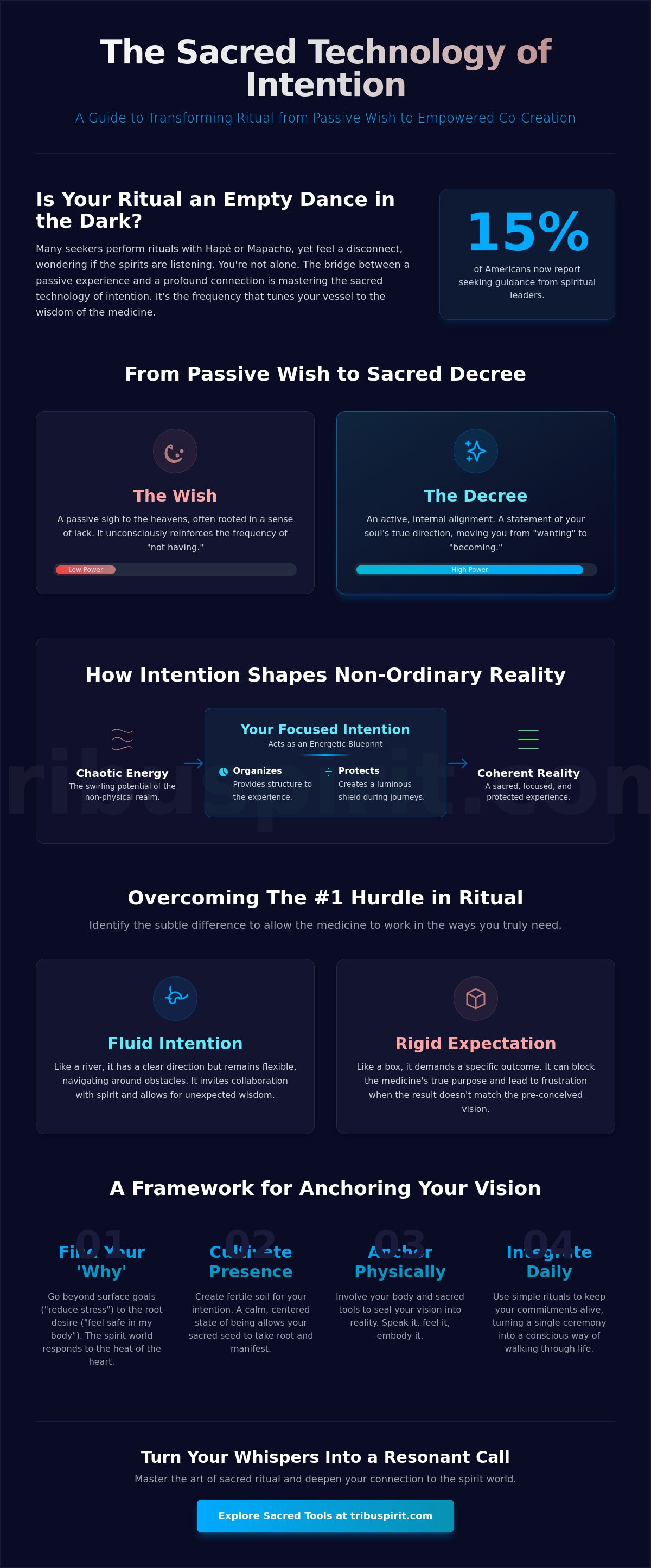
What if your spiritual practice isn't failing because you lack a special gift, but because you've been treating your rituals like a grocery list instead of a sacred conversation? It's a quiet, heavy frustration. You sit with your Hapé or light your Mapacho, yet the air remains silent. You wonder if the spirits are truly listening or if you're just performing an empty dance in the dark. With 15% of Americans now reporting they seek guidance from spiritual leaders, according to 2022 data, many are searching for that elusive spark. Understanding the role of intention in shamanic practice is the bridge between a passive experience and a profound, visceral connection with the unseen. Intention isn't a wish for a specific outcome; it's the sacred frequency that tunes your energetic vessel to the wisdom of the medicine.
You're not alone in wanting more than just results. You want a relationship. This article helps you transform your spiritual rituals from passive observation into empowered co-creation by mastering the sacred technology of intention. We'll explore a clear framework for setting these energetic anchors, helping you find confidence in your journeys and a deeper connection to sacred tools like Sananga and Mambe. Let's begin the process of turning your whispers into a resonant call the spirit world cannot ignore.
Key Takeaways
- Learn to view intention as a sacred decree rather than a mental wish, allowing you to speak directly to the responsive, living field of the spirit world.
- Discover the role of intention in shamanic practice as an energetic blueprint that organizes chaotic energy and provides a protective shield during your journeys.
- Identify the subtle differences between rigid expectations and fluid intentions to allow the medicine to work in the unexpected ways you truly need.
- Master the art of physical anchoring by involving your body and sacred tools to seal your vision into your current reality.
- Explore simple integration rituals that keep your sacred commitments alive, turning a single ceremony into a conscious way of walking through your modern life.
What is Shamanic Intention? The Seed of Sacred Manifestation
Imagine standing in a dense, ancient forest where every leaf, every stone, and every sudden gust of wind is listening. In the indigenous worldview, the universe isn't a collection of silent objects; it's a responsive, living field of energy that pulses with a deep, ancient intelligence. To truly understand What is Shamanism? in its most practical sense, we have to view it as a continuous dialogue between the human soul and the spirit of all things. Within this conversation, the role of intention in shamanic practice acts as the primary language. It's the specific vibration you send out into the web of life. Without a clear intention, your ritual is like a boat without a rudder, drifting aimlessly through the vast, swirling currents of the spirit world.
Think of your intention as a seed. A seed holds the entire blueprint of a mighty tree, yet its growth depends entirely on the quality of the soil it's planted in. In your spiritual work, the soil is your state of being, or what we call Sacred Presence. If you approach a ceremony with a mind cluttered by digital noise or a heart closed by modern skepticism, the soil is dry and rocky. Cultivating a calm, centered presence ensures that your intention has the spiritual nourishment it needs to take root and manifest. It's the difference between merely performing a ritual and truly living it.
The Difference Between a Wish and a Decree
Many seekers fall into the trap of wishing. A wish is a passive sigh toward the heavens, often rooted in a sense of lack or a faint hope that something external will fix an internal wound. In contrast, a shamanic decree is an active, internal alignment. When you decree, you aren't asking for permission; you're stating a truth of your soul's direction. Hoping for healing often unconsciously reinforces the frequency of "not having," which the spirits may simply mirror back to you. Shamanic intention is a navigational tool for the soul. It moves you from a state of "wanting" to a state of "becoming," signaling to the universe that you're ready for the transformation you seek.
Why Your Spiritual Practice Starts with a 'Why'
Before you ever lift a Bamboo Kuripe or sound a Hand-Carved Shamanic Rattle, you've got to peel back the layers of your own motivation. A surface-level goal might be "to reduce stress," but the root desire is often "to feel safe in my own body" or "to reconnect with my joy." The spirit world responds to the heat of the heart, not just the logic of the mind. This deep, raw honesty creates a resonance that validates your path to the spirits. Mastering this clarity of purpose is the first essential step in the art of sacred ritual, ensuring your energy is focused and your path is clear before the journey even begins. When your "why" is firm, the role of intention in shamanic practice becomes the bridge that carries you across the threshold of the ordinary into the extraordinary.
The Mechanics of Spirit: How Intention Shapes Non-Ordinary Reality
Beyond the initial seed of your decree lies the intricate architecture of the spirit world. If the universe is a responsive field of energy, then your focused mind is the architect that provides the form. The role of intention in shamanic practice is to serve as an energetic blueprint, taking the swirling, chaotic potential of the non-physical realm and organizing it into a coherent experience. It's not mere imagination. It's a spiritual application of the observer effect; by the very act of witnessing your path with clarity, you collapse infinite possibilities into a single, sacred reality. This focused gaze provides a protective boundary. When you walk between worlds, a well-forged intention acts as a luminous shield, ensuring that only the energies aligned with your highest purpose can enter your field.
Scholarship from the University of Arkansas provides a window into How Intention Shapes Non-Ordinary Reality, demonstrating how ritualized performance and deep focus are the mechanisms that allow a practitioner to navigate altered states with precision. These aren't just psychological tricks. They're the ancient physics of the soul. When you approach your altar, the spirits of the plants and the elements don't just see your physical actions; they feel the weight and texture of your intent. Deepening your relationship with these spiritual mechanics often begins with understanding the master teachers that guide us. You can explore the wisdom of Amazonian plants to see how they respond to your inner clarity.
Intention as a Navigational Rudder
Whether you are descending into the Lower World for soul retrieval or ascending to the Upper World for wisdom, your intention is the rudder. Without it, the vastness of the spirit world can lead to distraction or energetic fatigue. One-pointed focus is essential. You must also honor the principle of Ayni, or sacred reciprocity. You don't just take from the spirits; you offer your clarity and commitment in return. This mutual exchange ensures that your journey remains balanced and respectful. By staying anchored in your "why," you prevent spiritual "window shopping" and ensure that every interaction has meaning and depth.
The Role of the Subconscious in Ritual
Your spoken words carry weight, but your subconscious beliefs carry the tide. If you decree healing while secretly clinging to the identity of the victim, the spirit world hears the louder, unspoken frequency. You've got to clear the energetic vessel. Use deep, rhythmic breathwork to bridge the gap between your conscious thought and the deep waters of your spirit. This alignment ensures your whole being is saying "yes" to the transformation. When the conscious mind and the subconscious heart beat as one, your intention becomes an unstoppable force. It moves through the spirit world with the grace of a jaguar, certain and swift.
Intention vs. Expectation: Overcoming the #1 Hurdle in Ritual
The most common barrier to a profound spiritual experience isn't a lack of focus; it's the heavy weight of expectation masquerading as a sacred goal. While we've discussed how intention acts as a navigational blueprint, many practitioners unknowingly replace that blueprint with a rigid demand for a specific result. Expectation is a contract with the ego. It insists that the spirits must show up in a certain way, perhaps as a vivid visual or a sudden emotional purge. When we do this, we narrow the field of possibility. The role of intention in shamanic practice is to open doors, not to dictate exactly what we find behind them. If you approach a Mapacho ritual expecting a specific vision, you might miss the subtle, healing whisper of the wind against your skin.
Holding an intention requires a delicate balance. It's like holding a wild bird; if you grip too tight, you crush the life out of it, but if you open your hand too wide, it flies away before you can feel its heartbeat. This is the surrender paradox. You must be firm in your "why" while remaining completely fluid about the "how." Expectations create spiritual resistance because they are rooted in a desire to control the uncontrollable. The medicine knows what you need far better than your conscious mind does. By letting go of the result, you allow the sacred technology of the spirits to work in ways that are often unexpected but deeply necessary for your growth.
The Comparison Framework: Intention vs. Expectation
To navigate your next ritual with more clarity, use this simple framework to audit your internal state. Intention focuses on the internal landscape, while expectation fixates on the external world. Expectation creates a narrow, demanding energy that often repels the very wisdom you seek.
- Intention is expansive: It focuses on "How I want to feel" (e.g., "I intend to feel grounded").
- Expectation is narrow: It fixates on "What I want to happen" (e.g., "I expect to see my spirit animal").
- Intention is a commitment: It's a dedication to a specific state of being.
- Expectation is an attachment: It's a rigid demand for a specific outcome.
Refining Your Decree: From 'Fix Me' to 'Open Me'
Shifting your language can fundamentally change the frequency of your ritual. Many beginners start with a "Fix Me" mentality, which inadvertently places them in a position of powerlessness. Instead, try moving toward an "Open Me" approach. Use powerful "I am" statements to anchor your presence. For example, instead of saying "I want to stop being anxious," try "I am open to the peace that already resides within me." This shift validates your inherent wholeness. Audit your decrees regularly for hidden expectations. If your intention feels heavy or stressful, it's likely an expectation in disguise. True the role of intention in shamanic practice feels like a deep, resonant breath; it's a release into the wisdom of the medicine.
Anchoring the Vision: Practical Tools to Seal Your Intention
Intention is a spirit, but ritual is its body. To ensure your decree doesn't simply evaporate into the ether, you've got to anchor it in the physical world. The spirit world responds to action as much as it does to thought. When you involve your senses, you signal to your subconscious and the spirits that your commitment is absolute. The role of intention in shamanic practice is strengthened when you give your soul's desire a physical home, a focal point that the mind can return to when the journey becomes intense. Using shamanic tools isn't just about tradition; it's about using sacred technology to bridge the gap between the seen and unseen. Medicines like Hapé act as a 'Holy Fire,' burning through the static of daily life to reveal the crystalline truth of your heart's desire. Similarly, Sananga - Strong Strength clears the 'inner vision,' stripping away the energetic debris that prevents you from seeing the path your intention is carving through the spirit world.
The Hapé Ritual: A 5-Step Process for Sealing Intention
Hapé is a powerful ally for grounding your decree into the present moment. This process ensures that the role of intention in shamanic practice moves from an abstract concept into a visceral experience:
- Step 1: Preparation. Measure your Hapé and hold your Bamboo Kuripe with total presence. Treat every movement as a sacred act.
- Step 2: The Silent Prayer. Hold the medicine in your hand. Whisper your intention into the ash, letting your breath and energy infuse the powder.
- Step 3: The Blow. As you receive the sopro (the blow), visualize your intention being transmitted through your breath and into every cell of your body.
- Step 4: The Stillness. Don't rush to move. Sit in the silence and allow the medicine to ground the decree into your physical being.
- Step 5: Integration. Link the ritual to a physical action later in the day, like planting a seed or drinking water with gratitude, to seal the work.
Using Sound and Smoke as Carriers
Sound and smoke are the ancient messengers of the shamanic path. A Hand-Carved Shamanic Rattle isn't just an instrument; its rhythmic vibration breaks up energetic stagnation, clearing the air so your intention can move freely without resistance. Mapacho serves a different purpose, acting as a physical carrier. Its smoke is a messenger, rising toward the heavens to deliver your decree to the Spirit realm. When your intention requires deep stability, using Tsunu Hapé can provide the necessary grounding frequency to keep your vision steady. You can explore our collection of sacred medicines to find the right anchor for your next ceremony, ensuring your tools are as pure as your intent.
Walking the Path: Integrating Intention into Your Modern Life
The closing of a ceremony isn't the end of the work; it's the beginning of the application. The role of intention in shamanic practice only truly matures when you carry that sacred frequency into the noise and haste of your daily existence. If your ritual decree was to embody peace, that commitment is tested not in the silence of your altar, but in the friction of a crowded street or the pressure of a demanding deadline. This is where the path becomes real. Integration is the art of keeping the bridge open between the ordinary and the non-ordinary. It ensures that the insights you gained under the medicine don't fade like a half-remembered dream. You are the vessel through which the spirit world speaks to the physical realm.
Living your decree in the mundane requires a conscious pivot. When a stressful email arrives, don't react immediately. Take a single, deep breath. Recall the stillness you felt during your last Hapé ritual. This is your 'Check-in' ritual. You can place symbols in your physical environment, such as a specific stone or a piece of hand-carved wood, to act as visual anchors. These reminders pull you back to your center when life seems to contradict your intention. If your path feels blocked, don't abandon the decree. Instead, ask the spirits for the wisdom to see the obstacle as a teacher. Every challenge is an opportunity to refine the role of intention in shamanic practice within your own life.
Living the Decree in the Mundane
Translating spiritual clarity into modern action is a skill that requires patience. If your intention was "clarity," use that frequency to handle difficult conversations with honesty and grace. Your physical environment should reflect your inner state. Small altars or sacred objects in your workspace can serve as constant, quiet reminders of your path. When you feel yourself slipping into old patterns, use the breath to bridge the gap. A single moment of mindfulness can redirect your entire day toward your sacred decree.
Empowering Your Practice with Tribu Spirit
Empowering your practice means honoring the law of Ayni, or reciprocity. Your intentions carry more weight when they are backed by integrity. This starts with the tools you use. Choosing high-vibrational, ethically sourced Hapé ensures that the energy of the medicine is pure and respectful of the indigenous lineages that birthed it. When you use medicine that supports the forest and its people, your own spiritual work is amplified by that collective harmony. You don't have to walk this path alone. Joining a community of practitioners allows you to amplify your intentions through shared focus and wisdom. Start your journey today with a clear heart and the right tools. Explore our selection of Mambe, Ambil, and Mapacho, and step into a life of empowered co-creation.
Embodying Your Sacred Decree
Mastering the art of focus moves your practice from a series of isolated events into a coherent, lifelong journey of transformation. By understanding the role of intention in shamanic practice, you've learned to distinguish the rigid demands of the ego from the expansive calls of the soul. You now have the framework to anchor your visions through sacred tools and carry that clarity into the quiet moments of your daily life. Every breath you take in ceremony becomes a seed planted in the fertile soil of a responsive, living universe.
Your path deserves tools that carry the same integrity as your intent. At Tribu Spirit, we provide direct-from-tribe, ethically sourced medicines that honor ancient lineages. When you elevate your ritual with our ethically sourced Hapé and Shamanic Tools, you're joining a Private Ministry and Academy dedicated to deep spiritual training. Your journey also ripples outward, as every purchase supports vital Amazonian reforestation efforts. Walk forward with confidence, knowing that your empowered co-creation is supported by the very spirits you seek to honor. The forest is listening, and your voice is finally clear.
Frequently Asked Questions
What is the best way to word a shamanic intention?
The most effective way to word an intention is through present-tense, heart-centered "I am" statements. Instead of asking for a future change, you declare your current alignment with a specific state of being. For example, "I am open to receiving ancestral wisdom" carries more resonance than "I want to hear from my ancestors." This linguistic shift anchors your decree in the now, signaling to the spirit world that you're ready for immediate transformation.
Can I have more than one intention for a single ceremony?
While you can hold multiple intentions, maintaining a one-pointed focus often leads to a far deeper and more visceral experience. The role of intention in shamanic practice is to act as a spiritual laser, cutting through the noise of the ego. If your focus is scattered, your energy is spread thin across many portals. If you must have more than one, ensure they share a common root desire to keep your energetic vessel stable during the journey.
What should I do if I can't think of an intention?
If a specific intention doesn't emerge, you can use the universal decree of "show me what I need to see for my highest good." This is a powerful act of surrender that demonstrates trust in the medicine and the spirits. Often, the mind's inability to find a "goal" is an invitation to let go of control. By offering a blank canvas, you allow the spirits to paint the exact experience your soul requires at that moment.
How do I know if the spirits have accepted my intention?
You'll often feel a resonant "click" or a sudden sense of peace in your heart when an intention is accepted. This energetic confirmation can also manifest as a shift in the room's atmosphere or a change in the rhythm of your breath. Spirits don't always respond with words; they respond with a change in frequency. Pay close attention to the subtle physical sensations in your body immediately after you make your decree.
Is it okay to change my intention halfway through a ritual?
Yes, it's perfectly acceptable to pivot if the medicine reveals a deeper truth that overrides your initial goal. Shamanic work is a living dialogue, and sometimes the spirits show you that your stated intention was just a mask for a more profound need. However, be careful not to change your focus simply because the experience has become challenging. Distinguish between a genuine spiritual redirection and the ego's attempt to escape discomfort.
What is the difference between an intention and a prayer?
An intention is an internal alignment and a decree of your own will, while a prayer is an external appeal and a dialogue with the Divine. Intention is the blueprint you bring to the altar; prayer is the breath that carries that blueprint to the spirits. In many traditions, the two work in harmony. You set the intention to define your path, and you use prayer to ask for the strength and guidance to walk it.
Can plant medicines like Hapé help me find my intention?
Sacred medicines are exceptional tools for clearing the mental static that hides your true purpose. Using Hapé - Tsunu or Mulateiro before your main ritual can ground your energy and sharpen your focus, allowing your authentic "why" to rise to the surface. By clearing the energetic debris from your field, these allies help you see past surface-level desires. They ensure the role of intention in shamanic practice is rooted in your soul's truth rather than your mind's whims.
How long does it take for a shamanic intention to manifest?
Manifestation follows spiritual timing, which rarely aligns with our linear, human clocks. Some intentions manifest as a sudden "aha" moment during the ritual, while others unfold slowly through the process of integration over weeks or months. The speed of manifestation often depends on your willingness to take physical action in the ordinary world. Spirits provide the map and the energy, but you must still take the steps to walk the path.