

What if the transcendent peace you feel during meditation isn't actually a breakthrough, but a very elegant form of escape? It’s a quiet, uncomfortable truth that many of us face on the path of awakening. You might find yourself feeling stuck despite hours on the cushion, or perhaps you feel a nagging sense of guilt whenever a "negative" emotion dares to surface. When we use sacred concepts to avoid our human pain, we encounter the subtle signs of spiritual bypassing. This isn't a failure of your practice; it's a call to bridge your spirit with your soil.
We understand the desire to dwell only in the light, yet true transformation requires us to meet our shadows with the same grace we give our joys. You deserve a spiritual life that feels real, messy, and vibrantly alive. In this article, you'll learn how to identify the traps of spiritual avoidance and discover how to transmute them into a path of radical, grounded integration. We'll walk through a sacred checklist for authentic growth, exploring how to anchor your spirit back into your body through honest shadow work and the stabilizing wisdom of earth medicines like Hapé.
Key Takeaways
- Discover the origins of spiritual bypassing and why even the most devoted seekers sometimes use the light to hide from their human depth.
- Navigate the sacred checklist of ten signs of spiritual bypassing to discern whether your practice is fostering true growth or subtle avoidance.
- Unmask the "spiritual ego," learning how to move beyond intellectualized peace and into the raw, authentic vulnerability required for healing.
- Master the art of radical integration through shadow work and somatic experiencing, bringing your highest insights down into your nervous system.
- Learn how grounded shamanic traditions and sacred earth medicines can anchor your spirit, ensuring your evolution remains connected to the Earth.
What is Spiritual Bypassing? The Shadow of the Light
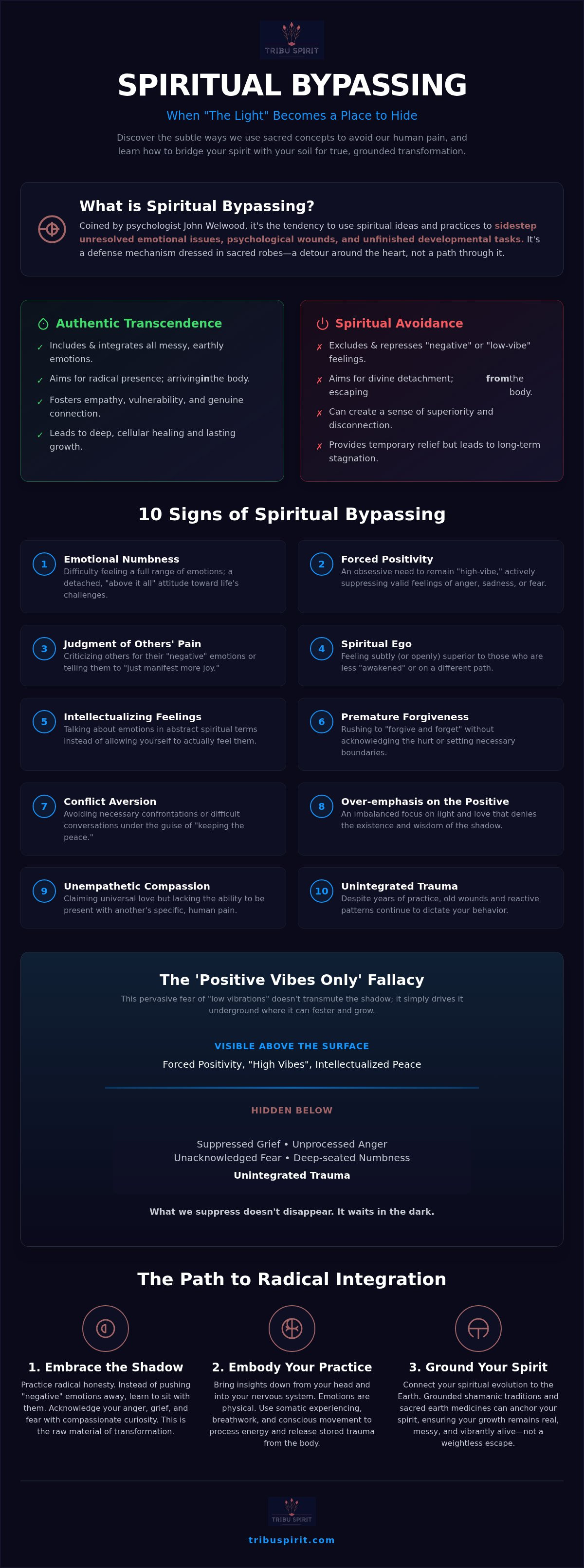
In the early 1980s, psychologist and Buddhist practitioner John Welwood observed a curious phenomenon within his community. He saw people using the ethereal "high" of spiritual practice to avoid the heavy "low" of their human psychology. In his seminal work, Toward a Psychology of Awakening, he coined a term for this elegant escape. He called it spiritual bypassing. It describes the tendency to use spiritual ideas and practices to sidestep unresolved emotional issues, psychological wounds, and unfinished developmental tasks. At its core, spiritual bypassing is a detour around the heart rather than a path through it.
This mechanism is incredibly seductive because it feels like a shortcut to peace. When the weight of grief or the sting of old trauma becomes too heavy to carry, the promise of "divine detachment" offers an immediate sanctuary. It’s a psychological defense mechanism dressed in sacred robes. While it provides temporary relief, the long-term cost is a quiet stagnation. You might find yourself feeling emotionally numb, lacking empathy for others, or carrying a deep sense of unintegrated trauma that no amount of meditation seems to reach. You aren't growing; you're just hovering.
The Difference Between Transcendence and Avoidance
True growth isn't about escaping the human condition. It's about infusing it with awareness. Transcendence is an expansive state that includes all your messy, earthly emotions. Avoidance is a contraction that excludes them. When you engage in a sacred ritual, the goal is radical presence. You aren't trying to leave your body. You're finally arriving in it. If your practice makes you feel superior to others or strangely disconnected from your own pain, you might be running away. Authentic spirituality requires the courage to look at the shadows you'd rather ignore. It's about being fully human, not becoming a ghost.
Why Spiritual Communities are Vulnerable
Our modern "high-vibe" culture often creates an invisible pressure to be perpetually positive. This environment makes it incredibly easy to miss the signs of spiritual bypassing in ourselves and those around us. We often hear absolute truths like "all is one" or "it's all just an illusion" used as weapons to silence relative human suffering. When someone is in deep pain, telling them to "just manifest more joy" isn't wisdom; it's a lack of empathy. By over-valuing the light while shaming the dark, we create an emotional phobia. This prevents the deep, cellular healing that only happens when we allow ourselves to feel everything. We must learn to honor the soil as much as the stars.
The Psychology of the 'Light' Defense Mechanism
The human mind is a brilliant architect of survival. When we encounter pain that feels too vast to contain, our psyche seeks a sanctuary. For many, this sanctuary is built from the ethereal materials of spiritual identity. We wrap ourselves in the velvet of sacred concepts, using them as a shield against the raw vulnerability of being human. This isn't a flaw in our character; it's a sophisticated defense mechanism. By dwelling in the "light," we create a psychological distance from the heavy, complex emotions that feel threatening to our stability.
This process often takes root long before we ever pick up a meditation cushion. For those who experienced childhood trauma or emotional neglect, the physical world may have felt inherently unsafe. Seeking the spiritual realm becomes a way to find the security that was missing. It's a weightless exit from a heavy reality. However, when we use the spirit to escape the body, we create a profound state of cognitive dissonance. We might speak of universal love while harboring deep, unacknowledged resentment. We might preach presence while being completely disconnected from our own physical sensations. These are the subtle signs of spiritual bypassing that suggest our practice has become a fortress rather than a bridge.
The 'Positive Vibes Only' Fallacy
Modern spiritual culture often encourages a form of emotional phobia. There's a pervasive fear that "low vibrations" like grief, anger, or fear will ruin our manifestation or stall our evolution. This forced positivity doesn't actually transmute the shadow; it simply drives it underground. Emotions are biological imperatives. They're sacred messengers that require movement and expression through the nervous system. When we suppress them, they don't disappear. They wait in the dark, often erupting later as physical illness, sudden anxiety, or deep-seated numbness. True spiritual maturity means having the capacity to hold both the joy and the sorrow without needing to "fix" either.
Spiritual Narcissism and Superiority
The ego is a master of disguise. It doesn't vanish on the spiritual path; it simply adopts a more refined wardrobe. Instead of seeking validation through material wealth, it may seek it through being "more conscious" or "more evolved" than others. This spiritual narcissism creates a hierarchy that isolates us. We might use spiritual jargon to dismiss the pain of others or to judge those we deem "unawakened." This persona of the Enlightened Master is often a mask for a deep-seated fear of being seen as ordinary or flawed. If your practice makes you feel separate from humanity rather than more deeply connected to it, it's time to anchor your awareness back into the humble reality of the present moment.
The Ultimate Checklist: 10 Signs of Spiritual Bypassing
Self-honesty is a sacred fire. It burns away the illusions we've built to stay safe, allowing our true essence to emerge from the ashes. As we explore these signs of spiritual bypassing, remember that awareness is the medicine. We don't look at these patterns to shame ourselves. We look at them to find where we're still hiding from our own power. Recognizing these traps is the first step toward a practice that is actually transformative rather than merely comforting.
One of the most common indicators is an over-emphasis on the positive. This isn't true optimism; it's a desperate attempt to ignore the shadow. When we use spiritual jargon like "it's just your karma" or "it's all for your highest good" to dismiss another person's suffering, we aren't being wise. We're being emotionally unavailable. This detachment often extends to our own lives, where we might ignore physical health, financial responsibilities, or the needs of our loved ones under the guise of "not being attached to the material world." True spirituality doesn't ask you to leave the world. It asks you to be more present in it.
Emotional and Interpersonal Signs
In our relationships, bypassing often looks like "blind compassion." We forgive far too quickly because we think anger is "low vibe." We use the concept of unconditional love as a justification to tolerate abuse or boundary-crossing. This isn't holiness; it's a lack of self-worth. You might also find yourself judging others for being "too emotional" or "unconscious." If you feel "above" basic human needs like physical intimacy, financial stability, or the healthy expression of anger, your spirit isn't integrated. It's floating. Authentic growth requires us to have the courage to set boundaries and speak our truth, even when it feels uncomfortable.
Practice-Based Signs of Avoidance
Even our most sacred practices can become cages. If you use meditation to go numb rather than to feel more deeply, you're bypassing. There's often a frantic "seeking" energy here. You might jump from one ceremony to the next, hoping the next teacher or the next vision will fix you. Integration takes time and stillness. For instance, understanding what is hape involves recognizing it as a grounding tool rather than a "quick fix" for deep emotional work. Without a clear, grounded intention, even the most potent medicines can be used to avoid the very work they're meant to facilitate. True medicine reveals the truth; it doesn't help you hide from it.
Transmuting the Bypass: The Path to Radical Integration
Once you've identified the signs of spiritual bypassing in your own life, the real journey begins. It's not enough to simply recognize that you're escaping; you have to learn the art of staying. Transmutation is the process of turning the lead of avoidance into the gold of presence. This requires a radical shift in how we view the spiritual path. We must stop trying to "spirit away" the parts of ourselves that feel unholy. Instead, we invite them into the center of our practice. Integration isn't about reaching a state where you no longer feel pain. It's about reaching a state where you're no longer afraid of it.
Shadow work is the essential bridge between the crown and the root. It’s the process of reclaiming the exiled parts of your psyche that you've deemed too loud, too dark, or too human. When you stop suppressing your anger, grief, or shame, you unlock the massive amount of life force that was trapped within those emotions. This isn't a one-time event. It’s a daily commitment to emotional honesty. By bringing these shadows into the light of awareness, they lose their power to control you from the background.
Integrating the Shadow into Ritual
Your altar shouldn't just be a place for crystals and light. It must be a place for your "demons" too. In the shamanic tradition, we understand that every energy has a place in the circle. You can use specific shamanic tools like rattles or mapacho to anchor your awareness when emotional storms arise. These tools act as lightning rods; they help you stay grounded in the physical body while the energy of suppressed trauma moves through you. Breathwork also plays a vital role here. By breathing into the tension, you allow the nervous system to process what the mind has been avoiding.
The Power of Radical Responsibility
Integration requires us to own our human messiness with the same pride we take in our divine light. This is radical responsibility. It’s the shift from asking "Why is this happening to me?" to "How can I grow through this?" It means setting intentions that prioritize truth over comfort. If you're ready to deepen this journey, you can explore our grounding medicines to help anchor your spirit during this intense process. Owning your journey means accepting that you're both a spiritual being and a biological one, with a nervous system that needs care and a heart that needs to feel.
Somatic experiencing is the final piece of the puzzle. If your spirituality only exists in your head or your heart, it’s incomplete. It must reach your belly, your legs, and your feet. Grounding isn't just a concept; it's a physiological state. It’s the ability to stay present in your body even when things get difficult. When the root is strong, the crown can open safely. This is how we move from a fragile, escapist peace to a resilient, grounded presence that can withstand any storm.
Grounded Wisdom: Cultivating Authenticity in Shamanic Practice
Indigenous wisdom offers a profound remedy for the modern tendency to drift into the ethereal at the expense of the earthly. In many traditional lineages, there's no word for spiritual bypassing because spirituality is inseparable from survival, community, and the soil beneath one's feet. To these cultures, the spirit is like the wind; it's powerful and essential, but it requires the sturdy trunk of the body to be felt. When we lose this connection, we begin to show the signs of spiritual bypassing, floating away from our responsibilities and our raw human truth. Authenticity in practice means having the courage to be as deeply rooted as you are highly reached.
The sacred Amazonian plants are often misunderstood in the West as tools for "tripping" or escaping reality. In their original context, they're master teachers of integrity. They don't provide a vacation from your problems; they provide a mirror. These medicines are designed to strip away the very illusions that bypassing seeks to build. They demand that you look at your shadow, your history, and your character with unblinking honesty. Grounding is the ultimate antidote to spiritual avoidance because it forces us to integrate our insights into our physical, daily lives. If a vision doesn't make you a kinder, more present human being, it hasn't been fully integrated.
Hapé as a Tool for Grounding
Within the shamanic toolkit, certain medicines are specifically designed to anchor a wandering spirit. Using hape tsunu is a powerful way to clear mental fog and return instantly to the sensations of the body. While bypassing often feels like "floating" or a disconnected high, true medicine work feels like "rooting." It's a sharp, clear return to the present moment. Tsunu hape helps to settle the nervous system, allowing you to face emotional discomfort rather than hovering above it. We must approach these plant teachers with the intention of seeking truth, not just relief. They're technologies of presence, not escape hatches.
The Tribu Spirit Academy: Learning to Walk Between Worlds
True transformation rarely happens in isolation. The Tribu Spirit Academy was created to provide a structured, grounded environment for those ready to move beyond the signs of spiritual bypassing and into radical integration. Our programs emphasize that healing is a somatic, earthly process as much as a spiritual one. Community plays a vital role here; we often need the compassionate mirror of others to spot the places where we're still hiding in the light. By joining a circle of dedicated seekers, you learn to walk between worlds with grace, honoring your divine essence without ever abandoning your human heart. The path to the stars always begins with a firm step upon the Earth.
Walking the Path of Grounded Integration
Awakening is a journey of both ascent and descent. You've learned that true growth isn't about escaping your human messiness but about meeting it with radical, loving presence. By recognizing the subtle signs of spiritual bypassing, you've taken the first step toward a practice that is authentically alive. You don't need to hide behind the light anymore. Instead, you can use your spiritual insights to illuminate the dark corners of your experience, bringing every part of yourself back into the circle of belonging.
Real medicine lives in the integration. It's the moment your highest visions meet the soles of your feet. To support this deep, somatic transformation, we offer tools that honor the ancient wisdom of the Earth. Our offerings are ethically sourced from indigenous tribes and supported by the structured guidance of our Spiritual Academy. They're crafted specifically for those ready for grounded, honest evolution. Explore our Grounding Hapé Collection to anchor your practice and begin the work of walking between worlds with integrity. Your shadow isn't an obstacle; it's a gateway. Trust the beautiful, messy process of your own unfolding.
Frequently Asked Questions
Is spiritual bypassing the same as being a positive person?
No, spiritual bypassing is a defense mechanism, while healthy positivity is a resilient mindset. Bypassing involves using "high vibes" to actively ignore or suppress human pain. It creates a form of emotional phobia. True positivity includes the capacity to hold space for sorrow and shadow without the desperate need to "fix" or transcend them immediately.
Can I still meditate if I'm trying to avoid spiritual bypassing?
Meditation remains a vital tool if you shift your intention from detachment to radical embodiment. Instead of trying to leave your body or quiet your mind into numbness, use your practice to feel your heartbeat and your breath. Focus on somatic sensations. This ensures you aren't using the cushion as a place to hide from the messiness of your human life.
How do I tell someone else they are spiritually bypassing without being judgmental?
Approach the conversation with humility and use "I" statements to describe your own megélés. Instead of intellectual labeling, ask curious questions like "I feel a bit of a disconnect here, can we explore what's really happening?" Focus on the signs of spiritual bypassing you've noticed in your own journey first to create a safe, empathetic space for them to reflect.
Is it possible to use plant medicines like Hapé for spiritual bypassing?
Yes, any sacred tool can be misused as an escape hatch if you approach it without a clear, grounded intention. If you use Hapé to "blast away" an uncomfortable emotion rather than rooting into it, you're bypassing. Authentic medicine work requires you to stay present with whatever the plant reveals. It's a technology of presence, not a shortcut to avoid inner work.
Does shadow work mean I have to focus on the negative all the time?
Shadow work isn't about dwelling on the dark; it's about making the unconscious conscious to reclaim your power. It’s the process of integrating lost energy so you can be more whole. When you stop "spiriting away" your difficult parts, you actually find more capacity for genuine joy. You aren't focusing on the negative; you're focusing on the truth.
What happens if I ignore my spiritual bypass for too long?
Ignoring these patterns leads to a profound sense of stagnation and emotional numbness. Suppressed trauma often manifests as physical tension, chronic anxiety, or a sudden collapse of your belief system when reality finally breaks through. Recognizing the signs of spiritual bypassing early prevents your practice from becoming a brittle shell that can't support your actual life.
How can I tell the difference between intuition and a bypass?
Intuition typically feels quiet, steady, and deeply rooted in the sensations of the body. A bypass usually feels like a "flight" response, often accompanied by a sense of urgency or intellectual superiority. If the "guidance" you're receiving helps you avoid a difficult conversation or a painful feeling, it's likely a bypass rather than true, grounded intuition.
Can therapy and spiritual practice work together to solve this?
Therapy and spiritual practice are most effective when they work in a harmonious, integrated way. While spirituality offers connection to the divine and the "why" of existence, therapy provides the tools to navigate the "how" of your human psychology. Together, they create a path of radical integration that honors both your eternal soul and your physical nervous system.