
Authentic Hapé is not a product you buy; it is a vibration of lineage held within a fine, sacred dust. As the U.S. enforces a 2026 tobacco import quota of 80,200,000 kilograms for Brazil, the market is increasingly flooded with industrial snuff that mimics tribal medicine. You might feel a deep pull toward this Amazonian ritual, yet worry that what you hold is merely a commercial imitation laced with synthetic additives. Understanding the specific signs of authentic hapé is the first step in honoring the plant spirits and protecting your own energetic field.
We know you seek more than a physical sensation. You're looking for a bridge to the divine that respects the indigenous hands that crafted it. This guide reveals the sensory, physical, and energetic markers that distinguish sacred, tribal-made Rapé from the mass-produced alternatives appearing in 2026. You'll learn how to evaluate the texture of fine-milled ash, identify the scent of Nicotiana rustica, and recognize the "pajé’s" prayer in the medicine's finish. By the end, you'll possess the clarity to choose your tools with confidence and reverence. The ritual begins with discernment.
Key Takeaways
- Recognize the physical markers of sacred medicine, focusing on the ultra-fine, silk-like texture and natural color palettes that define true artisanal craftsmanship.
- Shift your focus from a simple physical response to the profound energetic signature that anchors your spirit into the heart and root.
- Identify the crucial signs of authentic hapé by verifying the specific tribal lineage and the purity of the organic, wild-grown Mapacho base.
- Learn how to vet suppliers with integrity, ensuring your ritual tools are ethically sourced and carry the true prayer of the forest.
- Prepare your sanctuary for a higher vibration by integrating cleansing practices that honor the sanctity and heritage of Amazonian Rapé.
Why Authenticity Matters: The Sacred vs. The Commercial
Authentic Hapé is not a commodity; it is a transmission of ancient wisdom. When you engage with sacred Amazonian Rapé, you participate in a lineage that stretches back centuries through the deep green heart of the jungle. Using medicine without a clear lineage or a grounded intention carries a spiritual risk. It's like trying to navigate a vast ocean without a compass. Without the protective energy and specific prayers of the tribe, the experience can become hollow, or worse, energetically disruptive. One of the clearest signs of authentic hapé is its vibration, which is anchored by the maker's soplo, or sacred breath.
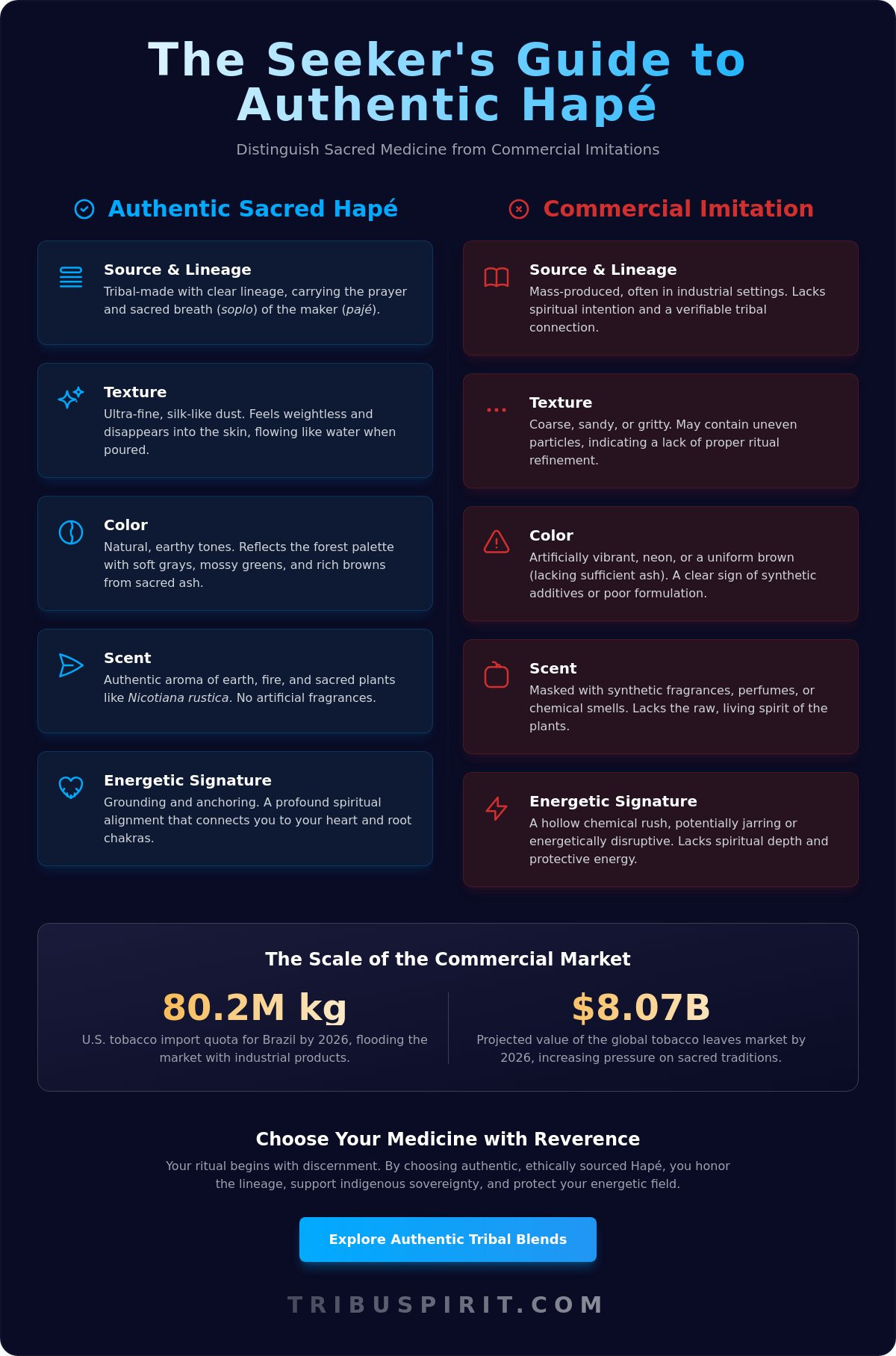
The difference between industrial "tobacco snuff" and sacred Hapé is the presence of spirit. Industrial products are born from mass production, where tobacco is treated as a crop for profit. In the Amazon, the Pajé (shaman) treats the plants as master teachers. Every batch is a prayer. Choosing authentic sourcing isn't just about your personal journey; it's an act of solidarity. It supports indigenous sovereignty and provides the financial resources necessary for rainforest preservation. By 2026, as the global tobacco leaves market is projected to reach 8.07 billion dollars, the pressure on these sacred traditions has never been greater. Recognizing the signs of authentic hapé allows you to distinguish between a hollow chemical rush and a profound spiritual alignment.
The Rise of 'Grey Market' Hapé
Large e-commerce platforms are increasingly flooded with "grey market" blends that mimic the appearance of tribal medicine. These mass-produced imitations often contain synthetic fragrances or chemical enhancers to create a more "pleasant" scent for the modern consumer. Such industrial processing strips the medicine of its living spirit. As of January 15, 2026, new TTB permits are required for business imports in the United States, yet many unregulated sellers bypass these standards, offering products that lack the energetic integrity of a true tribal craft. True medicine doesn't hide behind artificial perfumes. It smells of earth, fire, and ancient trees.
Hapé as a Living Tradition
The preparation of real Hapé is a labor of love that can take weeks of ritualized work. It involves the careful selection of Amazonian plants, which are dried, prayed over, and transformed into sacred ash. Each blend is intimately connected to a specific forest ecosystem. The ash of the Cumaru tree or the bark of the Mulateiro is not just an ingredient; it is the physical manifestation of the forest’s intelligence. This connection to the land ensures that the medicine remains a living tradition, rather than a stagnant product on a shelf. The spirit of the forest is present in every grain. It is a gift from the Earth, prepared with the patience that only the jungle can teach.
Physical Markers: The Sensory Fingerprint of Real Rapé
To truly understand the medicine, you must engage your senses with total presence. Authentic Hapé is not a coarse or sandy powder; it is a refined, silk-like dust that feels almost weightless. When you rub a small pinch between your thumb and forefinger, it should disappear into the lines of your skin, leaving behind only a faint, earthy stain. This extreme fineness is the result of hours of patient pounding and sifting through fine mesh, a physical manifestation of the maker's dedication to the craft. If the texture feels gritty or uneven, it likely bypassed the traditional ritual of refinement. These sensory details are among the most reliable signs of authentic hapé available to the modern seeker.
The palette of the forest is reflected directly in the dust. You'll see earthy grays, soft mossy greens, and deep, rich browns. A vibrant, neon, or artificial-looking color is a clear warning sign of synthetic additives. Moisture also tells a story of integrity. While Hapé must be kept dry to remain active, excessive clumping often indicates poor storage or a failure in the curing process. In the humid Amazon, keeping the medicine "alive" yet dry is a master’s skill. If the powder feels damp or smells of mildew, the spirit of the plants has likely been compromised by improper handling. High-quality medicine should flow like water when poured.
The Ash-to-Tobacco Ratio
The characteristic gray hue of tribal blends comes from the high concentration of alkaline wood ashes, such as Tsunu or Murici. These ashes are not fillers; they serve a vital purpose. By raising the pH of the medicine, the ash facilitates the rapid absorption of the sacred Mapacho into the system. A powder that is purely brown often lacks this critical alkaline component, resulting in a heavier, less "lifting" experience. The ash provides the spiritual structure, while the tobacco provides the grounding force. This balance is one of the essential signs of authentic hapé that distinguishes it from common snuff.
Scent Profiles of the Forest
Your nose is a powerful tool for discernment. Authentic blends carry the "green" scent of fresh, wild-harvested herbs and the smoky, grounding aroma of burnt bark. When you experience Hapé Tsunu, you should detect a clean, woody fragrance that connects you instantly to the earth. Avoid products that smell of synthetic perfumes or heavy, industrial chemicals. Real medicine breathes with the forest. It smells of life, fire, and ancient roots. As you begin to trust your senses, you may feel called to explore our collection of sacred tools, each one vetted for its sensory and spiritual integrity.
The Energetic Signature: How Authentic Hapé Feels
Beyond the physical appearance of the dust lies its most profound validator: the energetic signature. When you receive a soplo of sacred medicine, the initial hit should be a flash of sharp, crystalline clarity. It's a sudden, quiet stillness. In contrast, low-quality or industrial tobacco often produces a heavy, dizzying rush that leaves the head spinning and the stomach uneasy. One of the subtle but powerful signs of authentic hapé is how the energy travels through the body. It doesn't stay trapped in the head; it quickly drops into the heart and root, anchoring your consciousness into the present moment. This grounding effect is a hallmark of tribal craft, where the medicine is intended to align rather than agitate.
The experience of authentic Hapé lingers as a gentle presence. It isn't a fleeting "buzz" that vanishes as quickly as it arrived. Instead, it invites a meditative state that can last long after the physical sensation has faded. You may also encounter the "purge." While often misunderstood as merely physical, a true release can manifest as a deep yawn, tears, or a profound emotional shift. This is the medicine working through layers of stagnant energy, a process that synthetic or poorly made blends simply cannot replicate. Real medicine respects the body's boundaries while firmly clearing the path for healing.
Clarity vs. Stimulation
Real Hapé silences the "monkey mind" almost instantly. It doesn't create the jittery stimulation associated with high-nicotine commercial snuff. While a nicotine headache is a sign of industrial imbalance, the pressure felt from authentic blends often signals a third-eye opening or a clearing of the mental field. It interacts with your nervous system to induce a deep, centered calm. This allows you to observe your thoughts without being swept away by them. It is a tool for presence, not a stimulant for distraction.
Somatic Feedback in Ritual
Using a Kuripe allows you to gauge the medicine's "force" through your own breath. With pure blends, you'll feel a sense of expansion in the sinuses and throat, as if the forest itself is breathing through you. Pay close attention to the "afterglow" during your meditation. If you feel a lingering sense of peace and a heightened connection to your surroundings, you have likely found a true source. These somatic responses are the body's way of confirming the medicine's integrity. Trust the wisdom of your own physical and spiritual feedback when looking for signs of authentic hapé.
Sourcing with Integrity: Vetting Your Supplier
The journey of sacred medicine from the deep forest to your ritual space is a delicate bridge that must be held with absolute integrity. Identifying the signs of authentic hapé begins long before you open the jar; it starts with the transparency and intention of the supplier. A trustworthy source acts as a guardian of the lineage, not just a vendor of a product. When you evaluate a source, look for the specific story behind the medicine. Does the supplier name the Pajé or the family who prepared the blend? Authentic Hapé is never "anonymous." It carries the name of its people, the prayer of its maker, and the specific vibration of the land it calls home.
Purity is the second pillar of integrity. You must verify that the base of the medicine is wild-grown Nicotiana rustica, known as Mapacho, rather than industrial tobacco. Industrial tobacco is often treated with pesticides and chemical fertilizers that disrupt the plant's natural spirit. In contrast, sacred Mapacho is grown in harmony with the forest's cycles, preserving its high-vibrational frequency. A supplier with integrity will be proud to share these details, providing a clear list of botanical additions and the specific types of alkaline ashes used in the sifting process. This level of transparency is one of the most reliable signs of authentic hapé in a crowded market.
Red Flags to Avoid
As the interest in Amazonian traditions grows, so does the presence of commercial imitations. To protect your practice, stay alert for these warning signs:
- Vague Origins: Avoid any product labeled simply as "Amazonian" or "Tribal" without naming a specific tribe like the Yawanawá or Huni Kuin.
- Plastic Packaging: Authentic medicine is a living entity that should be stored in glass or high-quality airtight containers. Plastic is a sign of industrial handling and can leach chemicals into the fine dust.
- Suspicious Pricing: Sacred craft requires weeks of ritual labor. As of May 2026, authentic Yawanawa Hapé is typically priced around $29.00, while specialized blends like Nukini Onca start at $31.00. If you find "various blends" priced as low as $5.00, they are likely mass-produced industrial snuff with no spiritual lineage.
The Importance of Lineage
Understanding what is Hapé requires recognizing that the medicine is inseparable from the hands that craft it. Tribes such as the Huni Kuin, Yawanawá, and Nukini are the ancient guardians of this technology. Their preparation methods are not merely recipes but ceremonies that involve fasting, chanting, and deep communion with the forest spirits. This lineage ensures the medicine is "alive" and carries the necessary protection for your inner journey. When you are ready to connect with medicine that honors these sacred standards, you can explore our ethically sourced tribal collection to find a blend that resonates with your path.
Integrating Authentic Medicine into Your Ritual Space
Once you've learned to identify the physical and energetic signs of authentic hapé, the next step is to create a container worthy of its high vibration. This medicine is a living teacher. It doesn't just sit in a jar; it carries the frequency of the Amazonian soil and the prayers of the Pajé. To honor this, your ritual space should be a sanctuary of stillness. Before the medicine even touches your palm, take a moment to cleanse your environment with sacred smoke or sound. Setting a clear, heart-centered intention is vital. When your internal frequency matches the purity of the medicine, the connection becomes a profound bridge to the divine. It's a partnership between your soul and the spirit of the forest.
The synergy between your medicine and your tools is part of the sacred ritual experience. Using a hand-carved Kuripe or Tepi made from natural materials further grounds the energy. Proper storage is equally essential to preserve the medicine's spirit. As the global botanical supplements market grows toward an estimated 61.39 billion dollars in 2026, the influx of mass-produced goods often leads to poor packaging. Authentic Hapé should always be kept in glass or airtight containers, away from direct sunlight and moisture. This ensures the fine, silk-like dust remains active and its vibration stays sharp. Treat your medicine with the same reverence you would a holy relic.
Honoring the Medicine
Receiving Hapé is an art of presence. It requires a straight spine, open lungs, and a quiet mind. Developing a relationship with the plant spirit takes time. Don't rush the process. Authentic medicine demands a slower, more mindful approach than industrial alternatives. Observe your breath before and after the soplo. Notice how the silence expands within you. By practicing this mindful etiquette, you're not just using a product; you're participating in a living tradition that spans generations. You're becoming part of the tribe.
Your Journey with Tribu Spirit
At Tribu Spirit, we understand that your path is unique and sacred. Our commitment to direct, ethical sourcing means we go beyond the surface to ensure every blend we offer carries the true signs of authentic hapé. We vet every batch for its energetic purity and tribal integrity, ensuring the Huni Kuin, Yawanawá, and Nukini traditions are respected and supported. We invite you to explore our curated apothecary of sacred teacher plants. Here, you'll find tools and medicines that aren't just premium in quality, but are deeply rooted in the prayer of the forest. Your inner journey deserves nothing less than the purest source.
Embrace the Wisdom of the Forest
The path to spiritual clarity begins with the integrity of the tools you choose. As you've discovered, identifying the signs of authentic hapé requires a blend of sensory awareness and somatic intuition. You now know that true medicine is defined by its ultra-fine texture, its earthy forest aroma, and a grounding force that silences the mind. These markers aren't just quality checks; they're the language of the forest itself. By choosing medicine with a verified lineage, you protect the sanctity of your ritual and the sovereignty of the tribes who guard these traditions.
We invite you to Experience the Purity of Authentic Tribal Hapé. Our collection is directly sourced from the Huni Kuin and Yawanawá peoples, ensuring every grain carries the vibration of its original prayer. Through our Private Ministry Association (PMA), we provide sacred access to these teacher plants while supporting indigenous reforestation efforts through ethical trade. Trust your senses and honor your journey with medicine that's as pure as your intention. The jungle is calling; it's time to answer with reverence.
Frequently Asked Questions
Is authentic Hapé supposed to be very dark in color?
Authentic Hapé is rarely pitch black or very dark. Most tribal blends lean toward earthy grays, soft greens, or light browns due to the high concentration of medicinal wood ashes that lighten the powder. If a powder is exceptionally dark, it may indicate a lack of alkaline ash or the use of fermented industrial tobacco. One of the signs of authentic hapé is this muted, natural palette that reflects the specific trees used in the preparation.
How can I tell if my Hapé contains synthetic fragrances?
Your nose will detect synthetic additives through scents that mimic perfumes, soaps, or artificial fruits. Real medicine carries a grounding, smoky aroma of burnt bark and wild-harvested herbs. If the fragrance reminds you of a commercial product rather than a forest floor, it likely contains chemical enhancers. These additives are often used to mask the low quality of industrial tobacco leaves or poor curing processes.
Does authentic Hapé expire or lose its potency over time?
Hapé doesn't rot like food, but its spiritual and physical potency can decline significantly within 6 to 12 months if exposed to moisture or air. In the humid conditions of 2026, improper storage can lead to a 30% loss in the medicine's "force." To preserve its vibration, always keep your blends in airtight glass jars. This prevents the delicate botanical oils from oxidizing and keeps the medicine alive for your rituals.
Why is some Hapé much more expensive than others?
Higher prices reflect the weeks of ritualized labor and ceremonial fasting required by tribal makers. Industrial snuff is mass-produced in hours, but authentic medicine involves sifting through mesh as fine as 100 microns to achieve its silk-like texture. With the global tobacco leaves market growing at a rate of 4.76% annually, the cost of wild-grown, organic Mapacho remains higher than chemical-laden commercial crops grown for profit.
Can I test the authenticity of Hapé by its taste?
You can identify authenticity through the "drip" that naturally reaches the back of the throat during a ritual. Authentic blends taste woody, alkaline, and clean. If you notice a bitter, chemical, or metallic aftertaste, the blend likely contains industrial additives or heavy metals. The flavor should be a direct reflection of the Amazonian plants and sacred ashes used in the recipe, never an artificial sweetness or harsh chemical bite.
What happens if I use Hapé that isn't authentic or ethically sourced?
Using non-authentic medicine can lead to persistent headaches, nausea, or a sense of energetic "heaviness" that lingers after the ritual. Beyond personal health, buying unverified products undermines the 80,200,000 kilogram export quota for Brazilian tobacco that supports tribal sovereignty. Ethically sourced medicine ensures that your practice contributes to rainforest preservation rather than industrial exploitation, keeping the spiritual lineage intact and protected.
Is the presence of ash a sign of high-quality Hapé?
Yes, the presence of sacred wood ash is a fundamental marker of quality and traditional craft. This ash acts as an alkaline catalyst that allows the medicine to be absorbed efficiently into the system. High-quality blends often utilize a 50% ash-to-tobacco ratio, which creates the characteristic "lift" and mental clarity. Without this balance, the experience remains heavy and fails to reach the higher energetic centers of the body.
How do I know if the tribe mentioned on the label actually made the Hapé?
Verification comes through the supplier's transparency and their direct, documented connection to the lineage. Trustworthy sources will name the specific village or family and often operate under a Private Ministry Association to ensure sacred access. Recognizing the signs of authentic hapé involves vetting these relationships. If a vendor cannot provide details about the maker's community or the specific forest region, the tribal name is likely being used for marketing purposes only.