
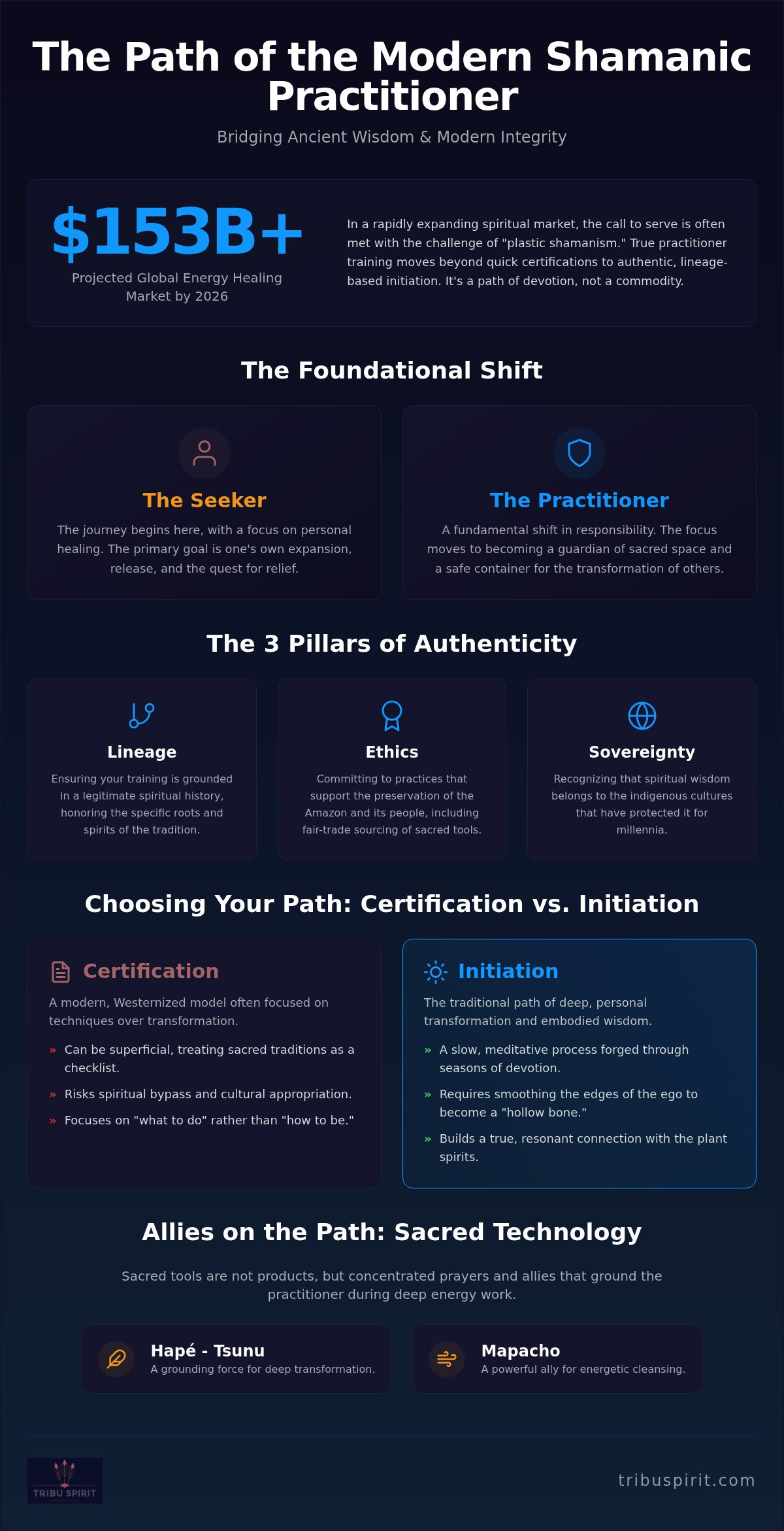
A certificate can be printed in seconds, but a true spiritual lineage is forged through seasons of devotion and the humble recognition of the plants themselves. You've likely felt the call to serve, yet perhaps you hesitate, wary of the shallow "plastic shamanism" that treats sacred traditions as mere commodities. It's a valid concern. In an era where the global energy healing market is projected to reach over 153 billion dollars by 2026, finding authentic shamanic practitioner training requires more than a search engine; it demands a deep resonance with the source. You seek a connection that feels as old as the forest and as clear as a mountain stream.
We understand the quiet fear of cultural appropriation and the confusion between modern core techniques and the raw power of Amazonian traditions. You want to hold space safely, grounded in a legitimate spiritual lineage rather than just a collection of borrowed rituals. This guide explores the sacred path of the practitioner in 2026, bridging ancient wisdom with the needs of a modern world. We'll look at how to move beyond certification into true initiation. You'll discover how the sacred technology of medicines like Hapé - Tsunu and Mapacho can become your allies in deep transformation. The path is open. It's time to step forward.
Key Takeaways
- Understand the fundamental shift from being a seeker of healing to becoming a guardian of sacred space for others.
- Learn how to evaluate shamanic practitioner training through the lens of indigenous sovereignty and ethical lineage to avoid cultural appropriation.
- Discover how sacred technology like Hapé - Tsunu and Mapacho serves as a grounding force for practitioners during deep energy work.
- Distinguish between Westernized certification models and the profound depth of traditional initiation that requires personal transformation.
- Explore how to bridge ancient Amazonian wisdom with modern life through the lineage-based curriculum offered at Tribu Spirit Academy.
The Call to the Path: What is Shamanic Practitioner Training?
The whisper of the forest or a sudden, unexplainable pull toward the sacred often marks the beginning of a deep internal shift. This is the "call" to the path. While many start as seekers looking for personal relief, shamanic practitioner training serves as the bridge between that initial curiosity and the disciplined ability to facilitate healing for others. It's a structured education in bridging the physical and spiritual realms; a process of refining raw intuition into a professional, grounded skill. In 2026, we're seeing a decisive movement away from generic, "pick-and-mix" spiritualism. Modern students are seeking lineage-based learning that honors the specific roots and spirits of the traditions they study.
Moving from seeker to practitioner requires a fundamental change in how you carry your energy. When you're receiving healing, the focus is on your own expansion and release. When you hold space, your primary responsibility is the safety and integrity of the container. This transition isn't just about learning techniques; it's about becoming a "hollow bone," a clear channel through which spirit can move without being distorted by the practitioner's ego or unhealed shadows. Authentic shamanic practitioner training provides the necessary friction to smooth these edges, ensuring you're prepared for the weight of another person's transformation.
The Difference Between Shamanism and Shamanic Practice
Words carry medicine, and using them with precision is a mark of respect. In the modern world, we distinguish between a "Shaman" and a "Shamanic Practitioner." A Shaman is traditionally a title bestowed by an indigenous community upon someone who has undergone extreme trials or inherited a specific bloodline. By contrast, a practitioner is a modern vocational role. You're a bridge-builder who applies ancient technologies to contemporary holistic healing. Respecting this distinction isn't just about semantics; it's vital for maintaining cultural integrity and avoiding the pitfalls of spiritual bypass. It allows you to serve your community with humility while honoring the indigenous sovereignty of the lineages that provide these tools.
Why Seek Formal Training in 2026?
Walking this path alone can be precarious. Without a dedicated container or the guidance of experienced mentors, solo practice often lacks the "psychic hygiene" needed to stay safe. Training offers a foundation in ethics and energetic safety that protects both the practitioner and the client. Within the structure of a Private Membership Association, like Tribu Spirit, you find a community that values slow, meditative growth over quick fixes. This formal mentorship ensures you aren't just performing rituals, but truly understanding the "sacred technology" behind them. You'll learn to navigate the spiritual landscape with a map provided by those who have walked it for generations.
The Pillars of Authenticity: Lineage, Ethics, and Indigenous Sovereignty
Authenticity in shamanic practitioner training is rooted in the concept of Indigenous Sovereignty. This principle recognizes that spiritual wisdom belongs to the cultures that have protected it for millennia. When you step onto this path, you aren't just learning a set of skills; you're entering into a relationship with the land and the people of the Amazon. True education must include a deep study of the cultural context where the medicine originates. Without this, the practice becomes hollow, a form of spiritual extraction that mirrors the physical exploitation of the rainforest. It's a commitment to honor the guardians of the forest as much as the spirits themselves.
At Tribu Spirit, our philosophy centers on bridging this ancient wisdom with modern integrity. This means ensuring that every aspect of the training supports the preservation of the Amazon and the empowerment of its tribes. It's about moving beyond the "what" of a ritual to understand the "why" and the "who." We believe that a practitioner's power is directly linked to their integrity in these relationships. When the foundation is built on respect, the healing work carries a weight that can't be replicated through books or generic workshops.
The Ethics of Sacred Plant Medicine
Ethical practitioner training must address the sourcing of sacred tools like Hapé and Sananga. These aren't mere products; they're concentrated prayers. Fair-trade practices are essential to spiritual mastery because the energy of the medicine is affected by how it was harvested and traded. If the lineage is broken by exploitation, the medicine loses its clarity. Every purchase made through our community contributes directly to reforestation initiatives and tribal sovereignty. This ensures that as you grow in your practice, the forest grows with you. It's a beautiful, reciprocal cycle of healing that begins with the very first grain of medicine you use.
Lineage vs. Appropriation in Modern Ritual
Lineage is the golden thread of transmission. It's the process of receiving wisdom directly from those who carry the authority to pass it on. In contrast, cultural theft occurs when rituals are stripped of their context and sold as "generic" spiritual products. To avoid spiritual bypassing, a practitioner must remain humble and acknowledge the source of their knowledge. Cultivating this kind of presence is a lifelong journey. You can explore these nuances further in our guide on The Art of Sacred Ritual. Understanding these foundations is what separates a true student from someone merely mimicking a tradition. If you feel called to deepen your connection to these lineages, exploring our ethically sourced shamanic practitioner training resources is a beautiful first step toward a path of true integrity.
Mastering Sacred Technology: Tools and Medicines of the Practitioner
In the context of authentic shamanic practitioner training, the instruments on your altar aren't merely decorative objects. They represent "sacred technology," sophisticated tools designed to focus your intent and move energy with precision. Just as a modern surgeon requires sterilized instruments, a spiritual practitioner needs high-vibration tools that are clear of stagnant imprints. Using mass-produced, factory-made items often disconnects the work from the living spirit of the forest. Instead, seeking out handcrafted pieces ensures that the prayer of the maker is woven into the very fabric of the tool, enhancing its ability to serve as an extension of your own healing field.
Hapé serves as a vital anchor in this process. Before a session begins, it aligns your energetic field, centering your mind so you can listen to the subtle whispers of spirit. After the work is done, it acts as a powerful clearing agent, helping you release any residual energy you may have picked up while holding space for others. Mastering these transitions is a hallmark of professional development. It's how you maintain your own vitality while serving the collective. For those building a sacred altar in 2026, consider these essentials:
- Mapacho for protection and setting the initial container.
- A Hand-Carved Shamanic Rattle to break up dense or stagnant energy.
- A dedicated Bamboo Kuripe that has been seasoned through your own personal practice.
- Sananga - Strong Strength for clearing the "inner vision" before deep journeying.
- Hapé - Tsunu or Mulateiro for grounding and post-session integration.
The Role of Hapé and Sananga in Training
Mastering Hapé - Tsunu is often one of the first steps in deepening your spiritual clarity. This specific medicine is renowned for its grounding properties, providing a steady foundation when the energetic waters get choppy. Sananga complements this by clearing the "inner vision," a key skill for those learning to journey between worlds. It's vital to learn how to self-administer these medicines with reverence before ever attempting to facilitate for others. You must know the landscape of the medicine within your own body to guide someone else through it safely.
Working with the Kuripe and Shamanic Rattle
A Bamboo Kuripe serves as a direct bridge for your breath, the primary carrier of your intent. When you blow medicine through a kuripe, you're projecting a prayer into your own field. Similarly, the Hand-Carved Shamanic Rattle is used to clear the energetic field around a client, using sound to vibrate and loosen blockages. Caring for these tools is a reflection of your commitment to the path. Keep them wrapped in natural fibers and clear them regularly with Mapacho smoke to ensure they remain potent allies in your shamanic practitioner training journey.
Choosing the Right Training: Certification vs. Initiation
In the expansive landscape of modern spirituality, a vital distinction exists between receiving a certificate and undergoing a true initiation. Many Western models of shamanic practitioner training focus on the accumulation of data, providing a piece of paper that signifies completion of a curriculum. While these programs offer valuable structure, they sometimes lack the energetic weight of traditional initiation. Initiation is a process of being "seen" and recognized by the spirits and the lineage itself. It's a death and rebirth process that transforms the student's very essence, ensuring they don't just know the techniques, but embody the medicine they carry.
The 2026 learner faces a unique choice between online and in-person formats. While physical presence in the rainforest or a dedicated temple offers an undeniable depth of transmission, modern technology now allows for powerful virtual mentorship. The key is finding a program that balances these worlds. Look for a container that offers live, interactive sessions rather than just pre-recorded videos. This ensures that the energetic thread between teacher and student remains vibrant and responsive, allowing for the "spiritual fluidity" necessary for authentic growth. Integration is the final, crucial step; your training must teach you how to weave this ancient wisdom into your modern career and daily life without losing its sacred spark.
What to Expect from a Comprehensive Curriculum
A robust curriculum should provide a map for both the light and the dark. Core competencies like shamanic journeying, power animal retrieval, and space clearing form the essential foundation. However, advanced shamanic practitioner training must go deeper into psychopomp work, ancestral healing, and the delicate art of extraction. Perhaps most importantly, a legitimate program will require intensive shadow work as a prerequisite. You cannot safely lead a client through their own darkness if you haven't first navigated the depths of your own soul. This internal clearing ensures you remain a "hollow bone," free from the projections that can cloud a healing session.
The Value of a Private Ministry Academy
Choosing to study within a Private Membership Association (PMA) or a Private Ministry Academy offers a level of protection and community that generic schools cannot match. This structure creates a "safer container" where sacred work is respected and shielded from the informs of the secular world. Within such an academy, learning becomes a shared journey with a "Tribu" or community of like-minded souls. This collective energy supports your individual growth, providing a mirror and a safety net as you step into your power. Finding your tribe is often the moment the path truly begins to open. If you feel ready to align with a community that honors these ancient roots with modern integrity, we invite you to explore the Academy at Tribu Spirit and discover your place in the lineage.
Walking the Path with Tribu Spirit Academy
Tribu Spirit Academy acts as a sanctuary for those ready to move beyond the superficial and step into true service. It's a living bridge where ancient Amazonian wisdom meets the complexities of 2026. This shamanic practitioner training doesn't just hand you a manual; it invites you into a vibrant, living lineage. You become part of a global movement toward spiritual awakening, where each practitioner serves as a beacon of grounded light in their own community. The focus is on deep, experiential learning with master teachers like Hapé and Sananga. These medicines are not just tools. They are living spirits that guide your hand and clear your sight.
Transitioning from a student to a community member within the Tribu Spirit Ministry is a sacred evolution. It's about finding your place in the "Tribu," the tribe. Here, you aren't walking alone. You're supported by a collective that understands the weight and the profound beauty of this responsibility. This is where the training becomes a lifestyle rather than a course. Every breath blown through a kuripe and every prayer whispered over Mapacho smoke strengthens the bond between you and the forest. You learn to carry the silence of the jungle within the noise of the modern world.
From Education to Ceremony
Knowledge stays in the head until it's moved into the body through ritual. The Academy prepares you for the profound intensity of in-person ceremonies and retreats. It's about building the "energetic muscle" needed to hold space for others safely and effectively. By integrating physical tools from our Amazonian Plants collection into your daily practice, you create a consistent, high-vibration environment. This daily devotion is what makes the difference during a deep ceremony. The community remains by your side, offering ongoing support and shared wisdom long after the initial training ends.
Your Next Steps: Enrollment and Membership
To begin this journey, you must first join our Private Membership Association (PMA). This structure ensures that our work remains sacred, private, and protected from secular interference. Enrollment is more than a simple transaction; it's a commitment to your own soul's growth and the healing of the collective. Prepare your heart by quieting the noise of the outside world. Create a dedicated space for your studies and your altar. If you hear the call to serve, listen closely. The path of shamanic practitioner training is a journey of a thousand lifetimes, yet it begins with a single, courageous step. Your tribe is waiting. Step into the light.
Embracing Your Role in the Global Awakening
The path of the practitioner is a sacred journey from the self to the service of the whole. You've seen that authentic shamanic practitioner training is built on the pillars of lineage, indigenous sovereignty, and the mastery of sacred technology. It's not about a paper on the wall. It's about the resonance in your heart. By choosing a path that respects Amazonian tribes and works with ethically sourced medicines, you ensure your practice is grounded in truth. The integrity of your tools reflects the integrity of your spirit.
Within our Private Ministry Association, you'll find more than just education; you'll find a tribe. This community supports your evolution as you integrate medicines like Hapé - Tsunu and Sananga into your daily ritual. Your development as a bridge between worlds is essential for the collective shift we're experiencing in 2026. The forest is calling. Your lineage is waiting to be claimed. Trust the medicine. Trust your heart. The world needs your light.
Enroll in the Tribu Spirit Academy and Begin Your Sacred Journey
Frequently Asked Questions
Can I become a certified shamanic practitioner through an online course?
You can certainly complete the foundational requirements of shamanic practitioner training through an online format, provided the program emphasizes live mentorship over pre-recorded videos. While virtual learning offers global accessibility, it's vital to distinguish between a certificate of completion and a true spiritual initiation. Many practitioners in 2026 combine online theory with in-person retreats to ensure their energetic transmission is grounded and fully integrated into their physical lives.
What is the difference between a shaman and a shamanic practitioner?
A "Shaman" is a title traditionally bestowed by an indigenous community upon a chosen individual within their own lineage, often following intense trials. Conversely, a "Shamanic Practitioner" is a modern vocational role for those who act as bridges between ancient wisdom and contemporary life. Respecting this distinction is essential for cultural integrity. It allows you to serve as a humble facilitator of holistic healing while honoring the indigenous sovereignty of the original traditions.
Do I need to use plant medicines like Hapé during my training?
While requirements vary by school, our academy views medicines like Hapé - Tsunu and Sananga as essential "sacred technology" for the modern practitioner. These plant teachers help you ground your energy and clear your inner vision before and after sessions. Learning to self-administer these medicines with deep reverence is a core skill. It ensures you can maintain your own psychic hygiene while holding a safe, clear container for others.
How long does shamanic practitioner training usually take to complete?
The timeline for completion depends on the depth of the curriculum, typically ranging from six months to over a year. Some verified programs in 2026 offer eight-month apprenticeships, while others require a full year of study to master advanced techniques like soul retrieval. Authentic training shouldn't be rushed; it's a meditative process of personal transformation that requires time for the teachings to move from the head into the heart.
Is shamanic training suitable for beginners with no prior experience?
Yes, most programs are designed to welcome those who are just beginning to hear the internal call to serve. You don't need a background in energy work to start, as the curriculum guides you through basic journeying and connecting with your intuition. The most important requirement is a sincere heart and a willingness to engage in the shadow work necessary to become a clear channel for healing energy.
What kind of tools do I need to start my shamanic training?
You'll begin by building a sacred altar with a few essential tools of focused intent. A Bamboo Kuripe for self-applying Hapé and a Hand-Carved Shamanic Rattle for clearing stagnant energy are foundational. We recommend choosing handcrafted instruments over mass-produced items to ensure your tools carry a high vibration. As you progress, you might add Mapacho for protection and Sananga - Strong Strength to help refine your spiritual sight.
Are there ethical concerns with learning shamanism as a non-indigenous person?
Ethical concerns are valid, which is why choosing lineage-based shamanic practitioner training is so important. To avoid cultural appropriation, your education must support indigenous sovereignty and the preservation of the Amazon. By aligning with a community that practices fair trade and reforestation, you move into a state of sacred reciprocity. This ensures your practice honors the original guardians of the medicine rather than simply extracting their wisdom.
What can I do professionally once I complete my shamanic training?
Graduates often weave these ancient skills into existing careers in holistic wellness, coaching, or bodywork. You might offer dedicated sessions for space clearing, power animal retrieval, or ancestral healing. As the global energy healing market continues to expand toward a projected 153 billion dollars by 2026, the demand for practitioners who can hold a grounded, ethical, and safe spiritual container is higher than ever before.