
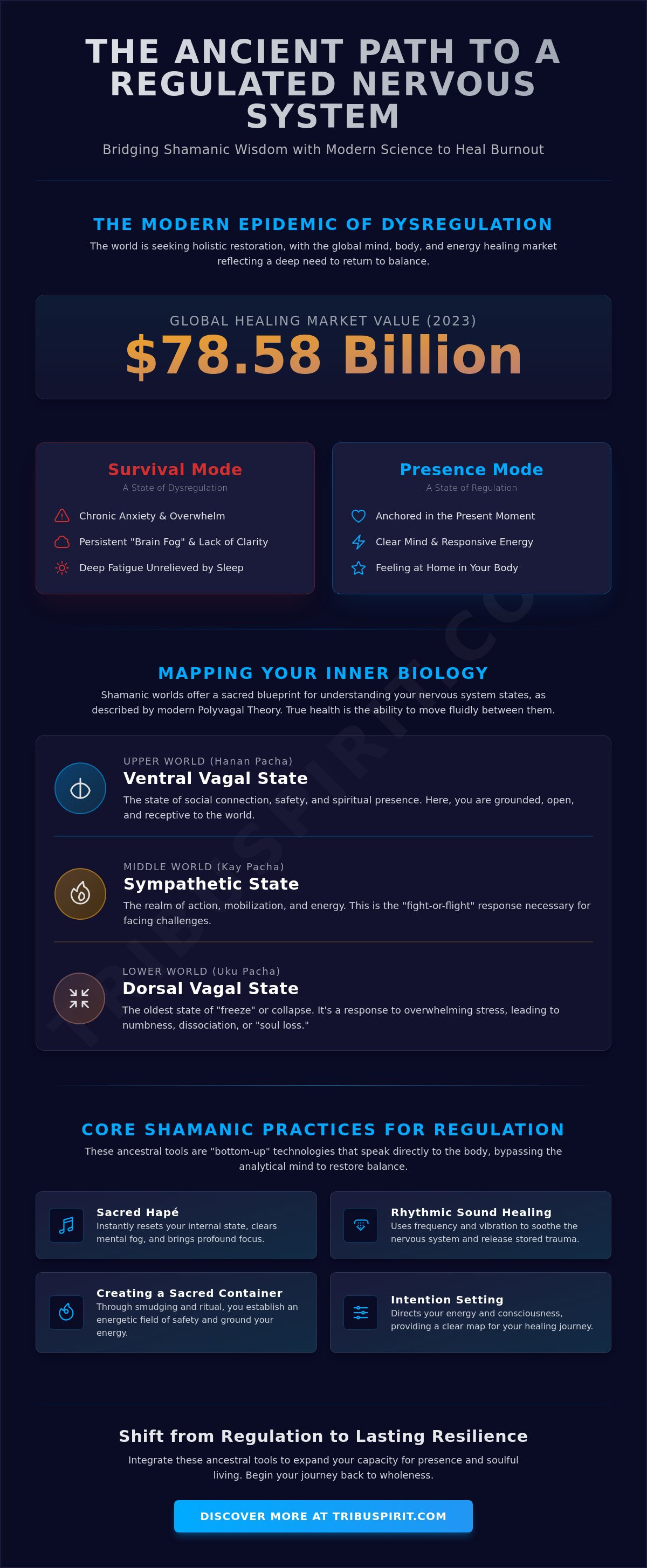
What if the most sophisticated technology for healing your modern burnout isn't found in a laboratory, but within the rhythmic pulse of an ancient ceremony? You've likely felt the exhaustion of living in a chronic fight-or-flight state, where your mind feels severed from the wisdom of your physical body. It's a heavy burden to carry, and you're not alone in seeking a deeper way out. With the global body, mind, and energy healing market valued at USD 78.58 billion in 2023, the world is clearly waking up to the need for holistic restoration. Integrating shamanic practices for nervous system regulation isn't just a spiritual trend; it's a return to our biological roots.
In this guide, you'll discover how indigenous rituals and sacred plant teachers provide a powerful, science-backed framework for calming your internal storm. We'll explore how the original somatic technology of the jungle intersects with modern concepts like Polyvagal Theory to restore your emotional balance. You'll gain practical tools to ground your energy instantly, moving from a state of survival into a sanctuary of deep, soul-level presence. Let's begin this inner journey together and bridge the gap between spirit and biology.
Key Takeaways
- Learn to bridge the gap between ancient ritual and modern biology by using "bottom-up" somatic techniques that speak directly to your body's innate wisdom.
- Discover how the shamanic maps of the Lower and Middle Worlds provide a sacred blueprint for understanding your vagus nerve and its states of deep rest or conscious action.
- Explore specific shamanic practices for nervous system regulation, including how sacred Hapé and rhythmic sound healing can instantly reset your internal state and focus.
- Master the essential steps for creating a "Sacred Container" through smudging and intention-setting to ground your energy and protect your emotional peace.
- Shift from temporary regulation to lasting resilience by integrating ancestral tools that expand your capacity for presence and soulful living.
The Bridge Between Ancient Wisdom and Modern Polyvagal Theory
For millennia, indigenous wisdom has whispered a truth that modern science is only now beginning to validate through clinical research. While we often attempt to "think" our way out of stress, our biology requires a different language. Shamanic practices for nervous system regulation offer a profound "bottom-up" approach to healing. This means we don't start with the analytical mind. Instead, we begin with the body's raw sensations and the rhythmic pulses of the earth. By engaging the senses through scent, sound, and sacred plants, we bypass the chatter of the prefrontal cortex to speak directly to the ancient parts of our brain.
This path is what we call Somatic Shamanism. It's the art of healing through the flesh and the bone, recognizing that the body isn't just a vehicle for the mind, but a living library of our experiences. Within this framework, the Vagus nerve serves as a physical conduit for the Spirit to communicate with our biology. It's the longest nerve in the autonomic nervous system, stretching from the brainstem to the abdomen, acting as a sacred bridge. When we engage in Shamanism, we're essentially tuning this biological instrument. We acknowledge that trauma and "stuck" energy often reside in the Lower World of our subconscious, mirrored physically in our pelvic floor, gut, and deep tissues.
What is a Dysregulated Nervous System?
Living in a state of dysregulation feels like being a ghost in your own life. You might experience chronic anxiety, a persistent "brain fog" that clouds your vision, or a heavy fatigue that sleep cannot touch. In our modern world, we've become habituated to "survival mode," a state where the body constantly scans for threats that never arrive. This contrasts sharply with the indigenous "presence mode," where the individual remains anchored in the current moment, open and receptive. Dysregulation is a loss of rhythmic harmony between the self and the environment. It's a discordance that prevents us from feeling truly at home in our own skin.
The Shamanic Lens on Stress and Soul Loss
When stress becomes too great, the shamanic tradition speaks of "soul loss." In modern psychology, we call this dissociation; a tactical retreat where a part of our essence leaves the body to survive a perceived threat. Shamanic ritual acts as a sacred container, providing the precise energetic frequency of safety needed for these fragmented parts to return. Regulation is more than just "calming down." It's a form of spiritual re-membering. Through the ritual of presence, we invite the scattered pieces of our vitality back into the somatic temple, restoring the wholeness that is our birthright.
Mapping the Shamanic Worlds to Your Internal Biology
In the Andean tradition, the cosmos is divided into three sacred realms. Far from being mere myths, these worlds provide a precise map of our internal landscape. When we engage in shamanic practices for nervous system regulation, we are essentially navigating the different branches of the vagal system. The Lower World, or Uku Pacha, corresponds to our most ancient biological foundations. The Middle World, Kay Pacha, represents our daily lived experience and the fire of action. Finally, the Upper World, Hanan Pacha, mirrors the state of social safety and spiritual expansion. This neurobiological basis of shamanism suggests that journeying isn't an escape from reality; it's a guided return to biological balance.
Shamanic journeying is the practice of moving between these states with intention. It's not about escaping to the Upper World. True health is found in the ability to move fluidly between all three. We must be able to descend into the roots for rest, act with power in the middle, and rise to the canopy for vision. This biological navigation allows us to process stored trauma and return to a state of rhythmic grace.
Lower World: Healing the Freeze Response
The Lower World is the realm of the roots, the gut, and the oldest parts of our brainstem. Biologically, this is the domain of the Dorsal Vagal state. When we are overwhelmed by chronic stress, we don't just feel tired; we "freeze." We become numb, heavy, and disconnected from our surroundings. This is the physiological equivalent of soul loss. Healing this response requires deep, visceral grounding. By utilizing specific medicines like Tsunu Hapé, we send a physical signal of safety to the brainstem. This "thaws" the freeze response, allowing the life force to flow upward from the soil of our subconscious into our conscious awareness.
Middle World: Balancing the Fire of Action
The Middle World is where we encounter the fire of daily existence. It's the realm of the jaguar, symbolizing the Sympathetic nervous system. In this state, we are primed for movement, whether it's the healthy pursuit of goals or the exhausting cycle of fight or flight. Modern life often keeps us trapped here, our inner fire burning without restraint. Shamanic practices for nervous system regulation act as a vital brake for this sympathetic drive. By focusing on the "trunk" of our being, our spine and posture, we create a stable axis for our energy. This alignment allows us to witness the chaos of the world without being consumed by it. When you explore our sacred tools, you find the instruments needed to maintain this delicate equilibrium in the heart of the modern storm.
Core Shamanic Practices for Somatic Regulation
To move beyond the intellectual understanding of our biology, we must engage with ancestral technologies that act directly upon the senses. These tools aren't mere symbols; they're precise instruments designed to shift our internal state from chaos to coherence. By integrating shamanic practices for nervous system regulation into our lives, we utilize the earth's medicine to recalibrate our physiological responses. Whether through the sacred blow of Hapé or the rhythmic pulse of a rattle, these rituals offer a manual override for the autonomic nervous system, inviting a state of profound presence and spiritual protection.
The Power of Hapé for Instant Grounding
Hapé is a sacred Amazonian snuff that offers one of the most immediate ways to reset a dysregulated system. The primary ingredient is often Mapacho, a potent jungle tobacco. The nicotine found in this sacred plant interacts with nicotinic receptors in the brain, which helps to sharpen focus and quiet the "monkey mind" of the prefrontal cortex. This isn't about a chemical high; it's about a spiritual and biological alignment. To understand the depth of this medicine, it's helpful to explore What is Hapé? and how it has been used for generations to ground the soul. The tactile sensation of the kuripe, the small pipe used for self-administration, serves as a physical anchor. It requires a conscious breath and a steady hand, forcing the body to exit the survival loop and enter the ritual of the present moment.
Rhythm and Vibration: The Shamanic Rattle
Sound is a bridge between the seen and unseen worlds, and the rattle is perhaps the most versatile tool for somatic clearing. The high-frequency sound produced by a shamanic rattle works to break up stagnant energy, known in some traditions as "Panema." From a biological perspective, this is called "sonic driving." The repetitive, high-frequency vibrations can entrain the heart rate and brain waves, signaling the Vagus nerve to move the body into a state of social engagement and safety. It's a gentle but firm way to shake off the "gray energy" of a long day.
A practical tip for daily regulation is to use the rattle around the periphery of your body. By sounding the rattle from your feet to your head and along your arms, you're essentially defining your personal boundaries. This ritual creates a "sacred container" for your nervous system, helping you feel where you end and the world begins. This sense of boundary is essential for those who feel "stuck" in the emotions of others, providing a clear energetic shield that supports long-term emotional balance.
Beyond sound and scent, practices like Sananga and shamanic breathwork offer further layers of clearing. Sananga eye drops are often used to sharpen perception, clearing the mental fog that accompanies a dorsal vagal "freeze" state. Meanwhile, the "shamanic breath"—a deep, rhythmic inhalation and exhalation—serves as a manual control for the heart rate. These combined shamanic practices for nervous system regulation ensure that we aren't just surviving our experiences, but actively participating in our own restoration.
Grounding the Flight: Creating a Daily Ritual for Long-term Resilience
To move from temporary relief into true transformation, we must invite consistency into our lives. While we've explored the biology of the three worlds and the power of individual tools, the real magic happens when these elements are woven into a daily structure. Creating a personal ceremony isn't just a spiritual exercise; it's a profound commitment to your somatic health. By dedicating time to shamanic practices for nervous system regulation, you're teaching your body that safety isn't an accident. It's a choice you make every single day. This rhythmic repetition builds what we call a "wider window of tolerance," allowing you to handle life's stressors without falling into a trauma loop.
A structured solo ceremony follows five essential movements designed to guide you back to center:
- Step 1: Creating a Sacred Container. Begin by smudging with Mapacho or opening the four directions. This defines the energetic boundaries of your work and signals to your mind that you're entering a protected space.
- Step 2: Setting a Somatic Intention. Instead of a purely mental goal, focus on a "felt sense" in the body. Identify where you feel tight or empty and offer your practice to that specific area.
- Step 3: The Application. Administer your chosen medicine, such as Hapé or Sananga, or engage in rhythmic shamanic breathing. Use your breath as a manual override for your heart rate.
- Step 4: The Integration. Sit in absolute silence for at least five to ten minutes. This allows the nervous system to settle and the medicine to communicate with your cells on a biological level.
- Step 5: Closing the Space. Express gratitude to the plant teachers and the lineage of wisdom that supports you. This act of appreciation closes the energetic loop and grounds you back in the physical world.
The Importance of Intentionality
There's a vast difference between simply "using a tool" and sitting in ritual. When we perform repetitive, sacred actions, our brain shifts from the chaotic frequency of the Beta state into the more receptive Alpha or Theta waves. This isn't just a feeling; it's a neurological shift that happens when the brain recognizes a predictable, safe pattern. Ritual signals to the subconscious that we're safe enough to drop our guard and heal. To deepen your understanding of this presence, you can explore The Art of Sacred Ritual.
Setting Up Your Sacred Space
Your environment is a mirror of your internal state. A dedicated space signals "safety" to the amygdala, the brain's alarm system, which can process threats in as little as 20 milliseconds. By including elements like stones for Earth, a bowl for Water, incense for Air, and a candle for Fire, you create a microcosm of the natural world. Within this space, your kuripe pipe or rattle becomes more than an object. It's a physical anchor that grounds your flight and returns you to the center of your being. Explore our curated collection of shamanic tools to begin building your own altar today.
Cultivating Presence: Shamanic Tools for a Regulated Life
The true power of shamanic practices for nervous system regulation lies in their ability to move us beyond temporary relief and into a state of lasting resilience. While an individual ceremony offers a vital reset, the cumulative effect of these rituals expands our "window of tolerance." This is the physiological space where we can experience intense emotions or stress without spiraling into a total shutdown or an explosive fight-or-flight response. By consistently engaging with sacred tools, we don't just regulate; we evolve. Our biology becomes more flexible, more grounded, and more capable of holding the complexities of modern life with grace. You aren't just surviving the day. You're cultivating a temple of presence within yourself.
This journey is rarely one we take alone. The Tribu Spirit community exists to support this individual unfolding, offering a sense of tribal belonging that is often missing in our digital age. True regulation is also relational. When we know we are part of a collective that values the same sacred path, our nervous system feels a deep, ancestral sense of safety. This connection extends to the Earth itself. By choosing ethically sourced tools, we practice "relational regulation." We ensure that the medicines we use are harvested with respect, maintaining the "Ayni" or sacred reciprocity between our needs and the forest's health. This integrity is felt in the medicine itself, providing a cleaner, more potent energetic frequency for your healing.
Beyond the Ceremony: Shamanic Living
Shamanic awareness doesn't end when you blow out the candle on your altar. It's a way of moving through a stressful office or a chaotic home environment with a centered heart. You can "micro-dose" presence throughout your day with 30-second grounding techniques. Simply pause, feel the weight of your feet on the floor, and take one conscious, rhythmic breath. This small act of reciprocity with your body signals to your brain that you are safe in the present moment. It's a way of bringing the silence of the jungle into the noise of the city, ensuring that your internal harmony remains unbroken.
Choosing Your Sacred Teachers
Selecting the right medicine is a personal dialogue between your needs and the spirit of the plant. If you feel scattered or ungrounded, a blend like Tsunu Hapé offers a firm, earthy anchor to return you to your roots. If you're carrying heavy emotional burdens or feeling "stuck" in a sympathetic fire, Mulateiro Hapé is often used to support deep release and calm. Each blend has its own signature and its own way of speaking to your nervous system. Don't feel the need to master everything at once. Start small with a single daily ritual and listen to how your body responds. When you're ready to begin your journey or deepen your practice, explore the Tribu Spirit collection to find the sacred tool that resonates with your soul's current season.
Embrace the Rhythm of Your Own Restoration
You've discovered how the ancient maps of the three worlds align perfectly with your internal biology. These aren't just stories; they're somatic keys to unlocking your body's innate ability to heal. By integrating shamanic practices for nervous system regulation, you move from a state of constant survival into a life of deep, soulful presence. This transition requires more than just knowledge. It demands the right tools and a dedicated community to anchor your practice and protect your growth.
Tribu Spirit provides a bridge to these ancestral traditions through medicines ethically sourced from Amazonian tribes. Our PMA-protected spiritual community and hand-crafted ritual tools ensure that your journey is supported by integrity and sacred reciprocity. You don't have to navigate this path alone. Every small, intentional ritual you perform is a vote for your future resilience and peace. The earth is waiting to hold you in its steady embrace. Begin your journey with our Sacred Hapé Collection and reclaim the rhythmic harmony that is your birthright.
Frequently Asked Questions
How do shamanic practices help with anxiety?
Shamanic practices for nervous system regulation work by providing a direct, somatic signal of safety to the brainstem. Unlike talk therapy, which focuses on the mind, these rituals use scent, sound, and breath to bypass the analytical brain. By engaging the senses, you shift the body out of a high-alert sympathetic state and into a grounded presence. This "bottom-up" approach addresses the physical roots of anxiety before the mind has a chance to spiral.
Can I use Hapé alone for nervous system regulation?
You can certainly use Hapé as a standalone tool, though it's most effective when held within a brief ritual container. The act of using a kuripe for self-administration requires a conscious, focused breath, which naturally slows your heart rate. This physical anchor helps you exit a survival loop instantly. While the medicine works on a biological level, your intention provides the direction for that energy to settle and ground your spirit.
What is the best shamanic tool for a beginner?
A hand-carved shamanic rattle or a mild Hapé blend like Tsunu are the most accessible starting points for newcomers. Rattles offer a gentle way to clear stagnant energy through high-frequency sound vibration without the intensity of internal plant medicines. These tools are perfect for building a foundational sense of personal boundaries. They allow you to experiment with shifting your internal state in a way that feels safe, manageable, and deeply supportive.
Is shamanic nervous system regulation scientifically proven?
Modern science explores the efficacy of these ancient traditions through the lens of Polyvagal Theory and neurotheology. Research into "sonic driving" has shown that rhythmic drumming at specific frequencies can entrain brain waves into the Alpha and Theta ranges. This biological shift confirms that shamanic practices for nervous system regulation directly impact our autonomic states. By measuring heart rate variability and cortisol levels, researchers continue to validate how ritual restores physiological harmony.
How often should I perform a shamanic grounding ritual?
Consistency is far more vital than the length of the ceremony, so aim for a daily 10-minute practice. Regularity is what builds a wider window of tolerance in your nervous system over time. By showing up for yourself every day, you're training your biology to return to a state of safety more quickly after a stressful event. Think of it as a daily recalibration that keeps your internal compass pointed toward peace.
What happens if I feel more overwhelmed during a ritual?
If you feel overwhelmed, it's a sign to stop the active practice and return to simple grounding. Place your hands on the earth or your own chest and focus on the weight of your body. Shamanic work can sometimes surface stored somatic memories that have been suppressed. This isn't a failure of the ritual, but rather an invitation to slow down and offer yourself more silence and compassion as the energy moves through.
Do I need special training to use a kuripe or tepi?
You don't need formal certification, but you must approach these tools with deep respect and clear intentionality. Learning the proper physical technique for a kuripe ensures that the medicine is delivered effectively and safely to the nasal passages. It's about developing a personal, intuitive relationship with the tool through mindful use. Over time, the kuripe becomes an extension of your own breath and a trusted ally in your healing journey.
What is the difference between shamanic breathwork and standard meditation?
Shamanic breathwork is typically more active and rhythmic, designed to induce a specific somatic shift rather than just observing thoughts. While standard meditation often focuses on witnessing the mind, shamanic breathing acts as a manual override for the autonomic system. It's a dynamic tool for moving stagnant energy and clearing the subconscious. This practice requires you to engage your body fully, making it an excellent choice for those who find silent sitting difficult.