

What if the profound wisdom you seek isn't hidden in a far-off temple, but within a landscape you already possess the map to? Many seekers today feel a quiet, persistent tug toward something deeper, yet they often feel spiritually stuck or wary of empty trends that lack true substance. You might worry about doing it wrong or getting lost in the vastness of your own mind. It's a valid concern in an era where wellness tourism has grown by over 30% annually since 2020, often leaving people overwhelmed by choices. shamanic journeying for beginners is not a mere exercise in imagination. It's a disciplined, sacred ritual of shifting consciousness to connect with a larger spiritual lineage.
You can discover how to navigate these invisible realms and meet your power animal without relying on synthetic substances. Whether you're considering a $170 online introductory workshop or simply want to ground your practice at home, this guide offers a path to genuine clarity. We'll explore how to use sacred tools like the hand-carved rattle to anchor your presence. You'll learn the exact steps to initiate your first voyage, find your spirit guides, and gain the life-altering insights that come from a true inner connection. Let's begin this sacred transition from the physical to the ethereal.
Key Takeaways
- Understand the essence of direct revelation and how to transition gracefully from ordinary reality into the expansive Shamanic State of Consciousness.
- Learn to create a physical and energetic temple at home, setting a sacred container that ensures safety and depth during your voyage.
- Master the foundational techniques of shamanic journeying for beginners, including heart-centered grounding and visualizing your natural entry portal.
- Discover the ritual of integration, using the post-journey Golden Hour to transcribe your visions and anchor ethereal wisdom into your daily life.
- Cultivate a path of integrity by honoring indigenous roots and choosing ethically sourced, handcrafted tools to support your spiritual evolution.
Entering the Invisible Realm: What is Shamanic Journeying?
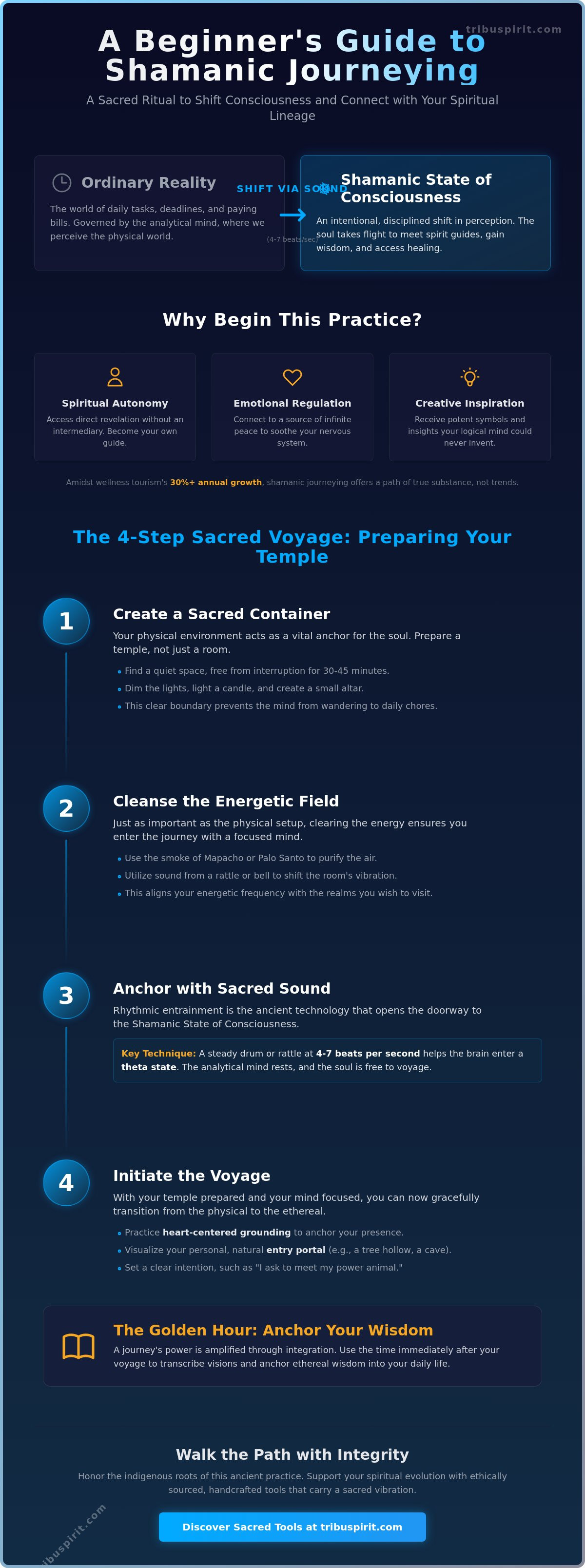
At its heart, shamanic journeying is the art of direct revelation. It's a sacred practice where you don't need a priest, a guru, or an intermediary to access the wisdom of the universe. Instead, you become your own guide. In this state, you step out of ordinary reality and enter the Shamanic State of Consciousness (SSC). This isn't a drug-induced hallucination. It's a disciplined shift in perception achieved through rhythmic entrainment, often the steady beat of a drum or the crisp, clearing sound of a Hand-Carved Shamanic Rattle. Shamanic journeying for beginners focuses on this intentional bridge-building between our physical world and the invisible realms where spirit teachers reside. The goal is simple yet profound: to seek healing, gain wisdom, and remember who you truly are.
Ordinary reality is where we pay bills and drink our morning coffee. The Shamanic State of Consciousness is the hidden layer beneath the surface. To access it, we rely on the ancient technology of sound. Rhythmic drumming at approximately four to seven beats per second helps the brain enter a theta state. This is the doorway. It allows the analytical mind to rest while the soul takes flight. You remain fully conscious and in control, yet your internal vision opens to a landscape of symbols and spirit guides.
The History and Lineage of the Journey
The roots of this practice are as old as humanity itself. To understand What is Shamanism? is to recognize a global heritage that spans from the snowy tundras of Siberia to the lush Amazon rainforest. While specific rituals vary, the core remains consistent across cultures. Traditional shamans served as the doctors and advisors for their communities. Today, we carry this lineage forward through personal practice. We learn to become a "hollow bone." This beautiful metaphor describes a practitioner who has cleared their ego and personal baggage to become a clean vessel for spirit. You aren't "making things up." You're allowing the universe to speak through you.
Why Start a Journeying Practice Today?
We live in a time often described as a crisis of meaning. With wellness tourism growing by over 30% annually as of 2022, it's clear that people are hungry for more than just physical health. They want spiritual autonomy. Shamanic journeying for beginners provides a way to reclaim that power. It offers emotional regulation by connecting you to a source of infinite peace. It sparks creative inspiration by showing you symbols your logical mind could never invent. Perhaps most importantly, it facilitates ancestral healing by allowing you to resolve old patterns that have lived in your lineage for generations. This path beautifully complements your existing sacred ritual or meditation routine. It adds a layer of active exploration to the stillness of your practice. You aren't just sitting; you're voyaging.
Preparing Your Temple: Setting the Stage for a Sacred Voyage
Creating a sacred container is the first vital act of the ritual. For those exploring shamanic journeying for beginners, the physical environment acts as a necessary anchor for the soul. Without a clear boundary, the mind naturally wanders back to daily chores or digital distractions. You aren't just sitting in a room; you're preparing a temple. This involves choosing a space where you won't be interrupted for at least 30 to 45 minutes. Dim the lights, light a candle, and perhaps place a few stones or feathers on a small cloth to serve as a temporary altar. These physical objects represent the elements and help ground your energy in the present moment.
When we look at an anthropological perspective on shamanism, we see that these physical preparations have served as psychological and spiritual cues for millennia. Cleansing the energetic environment is just as important as the physical setup. You can use the smoke of Mapacho or Palo Santo to clear the air, or use sound to shift the room's vibration. This process of "clearing the field" ensures that you enter the invisible realms with a light heart and a focused mind. Using shamanic tools isn't about aesthetics; it's about shifting your energetic frequency to match the realms you wish to visit.
Tools of the Trade: Rattles, Drums, and Hapé
A shamanic rattle is particularly effective for breaking up stagnant energy that accumulates in our personal space. A few sharp shakes around your body can clear mental fog before you even close your eyes. If you find your mind is especially noisy, understanding what is hape can be transformative for your practice. This sacred Amazonian snuff, such as Tsunu or Mulateiro, helps ground your energy into the earth while sharpening your internal focus. It essentially prepares the "hollow bone" by silencing the ego's chatter. Finally, ensure your audio track features a steady drum beat of 4 to 7 beats per second to facilitate the theta brainwave state required for deep immersion.
The Art of the Petition: Setting Your Intention
Vague journeys often lead to vague experiences. Your intention is the compass that directs your soul through the three worlds. Crafting a specific, positive, and present-tense mission statement is essential for success. Instead of a broad question, try a focused petition. For example, "I meet my power animal" or "I receive clarity on my current transition." This tells the spirit world you're ready for a specific conversation. If you feel called to begin this path, you might find that a hand-carved kuripe serves as a beautiful physical reminder of your commitment to this inner work.
The Shamanic Map: Navigating the Three Worlds
Entering the invisible realms requires a reliable map to ensure you don't feel lost or unguided. While Shamanism across cultures reveals a vast tapestry of local variations, the fundamental structure of the spirit world is remarkably consistent. For those practicing shamanic journeying for beginners, understanding this geography is the key to a safe and fruitful voyage. The journey begins with deep relaxation and heart-centered grounding, allowing your pulse to sync with the rhythm of the earth. Once settled, you've to visualize your entry point. This shouldn't be an imagined fantasy; it must be a real-world portal you've physically visited in nature, such as a hollow tree stump, a cave entrance, or a deep pool of water.
From this portal, you'll travel through a tunnel. This passage represents the transition from ordinary reality to the non-ordinary realms. Upon exiting, you'll find yourself in one of the three worlds. Interaction with spirits here is a sacred dialogue, not a passive observation. To ensure clarity, use the "test of the three questions." Ask your guide: "Are you my teacher?", "Do you come for my highest good?", and "What wisdom do you have for my intention?". This discernment keeps the experience grounded and purposeful. When you hear the rapid "callback" drumbeat, it's time to retrace your steps exactly. Return through the tunnel and back into your physical body with a deep, grounding breath.
The Lower World: The Realm of Power Animals
The Lower World is often the first destination for those exploring shamanic journeying for beginners. It's a landscape of primal beauty, characterized by lush forests, vast oceans, and earthy caves. This is where you meet your power animal. These aren't just symbols; they're energetic allies that offer protection and strength. You'll recognize a true power animal because it will usually show itself to you from three different angles or appear three times. Don't be deterred if an animal seems "scary" or humble. A spider or a snake often carries more transformative medicine than a lion or an eagle. These allies help you feel a sense of belonging to a larger spiritual lineage that transcends the human experience.
The Upper World: The Realm of Teachers and Ancestors
If the Lower World is earthy, the Upper World is crystalline and ethereal. It's a realm of celestial light and vast, airy landscapes where you encounter "Teachers in Human Form" or compassionate ancestors. These guides offer metaphorical wisdom and high-level guidance on life decisions. In contrast, the Middle World is the "hidden" version of our physical reality. It's the spiritual essence of the trees, mountains, and places we inhabit daily. While fascinating, beginners are often encouraged to master the Lower and Upper Worlds first. The Middle World can be more complex to navigate without a seasoned perspective.
From Vision to Reality: Integrating the Wisdom of Your Journey
The drumbeat fades, your eyes open, and you return to the weight of your physical body. For many, this is where the work truly begins. The moments immediately following your voyage are known as the "Golden Hour." During this sacred window, your consciousness remains porous and receptive. Resist the urge to check your phone or dive back into the digital noise. Instead, stay in your prepared temple. This stillness allows the ethereal insights to settle into your marrow. Integration is the bridge that transforms a fleeting vision into a lived reality. Without it, the wisdom remains a distant dream. With it, your life begins to shift in alignment with the spirit world.
Transcribing your experience is the most effective way to lock in the memory. Use a dedicated journal and write in the present tense. Instead of saying "I saw a wolf," write "I am standing before a great wolf." This linguistic shift keeps the energy of the journey alive and accessible. When deciphering the symbols you encountered, avoid generic dream dictionaries. A crow might symbolize death in a book, but for you, it might represent a playful messenger from your childhood. Trust your personal resonance. Finally, commit to one "inspired action" within 24 hours. If a guide suggested you need more rest, clear your evening schedule. Physical action honors the spirit's advice and signals your readiness for deeper work.
Developing a Relationship with Your Allies
A power animal is a living energetic companion, not a temporary visitor. To deepen this bond, you must "feed" the relationship through creative expression. This might involve dancing the movements of your animal or painting its likeness in your journal. Returning to the same guide repeatedly builds a foundation of trust. Over time, the conversations become more nuanced and the guidance more direct. Many practitioners find that using hape tsunu after a journey provides the perfect grounding frequency. Its earthy properties help anchor high-vibration insights into the physical plane, ensuring you remain present and clear as you resume your day. To support your integration ritual, explore our collection of sacred shamanic tools designed for deep soul work.
Common Pitfalls for Beginners
The most frequent hurdle in shamanic journeying for beginners is the "I made it all up" doubt. It's natural for the ego to feel threatened by direct revelation. Remember that imagination is the canvas, but the spirit provides the paint. If you feel stuck in the tunnel or see nothing but darkness, don't despair. Sometimes the "medicine" is simply the act of showing up in silence. Journeying is a muscle. It requires consistent training and immense patience. If a session feels "quiet," treat it as a period of energetic clearing. You're preparing the ground for future harvests. Trust the process. The spirit world rewards those who return to the altar with humility and persistence.
Walking the Path: Ethics, Ancestry, and Your Spiritual Evolution
Approaching this path requires more than just a drum and an intention. It demands a deep, abiding humility. We're guests in a tradition guarded by indigenous communities for thousands of years. As you explore shamanic journeying for beginners, remember you aren't "becoming a shaman." That title is a heavy responsibility earned through decades of community service. You're a modern practitioner seeking personal revelation. This distinction is vital. It prevents the trap of spiritual tourism and grounds your practice in integrity. We honor the ancestors by acknowledging this wisdom is a gift, not a commodity. True spiritual evolution begins when we stop trying to "play shaman" and start listening with the ears of a student.
Every tool you hold carries the vibration of its origin. When you use amazonian plants or a hand-carved rattle, you connect to the hands that shaped them. Spiritual integrity is impossible without ethical sourcing. At Tribu Spirit, we know the ritual's power is tied to the forest's health and the empowerment of its guardians. We actively support reforestation and indigenous tribes to ensure the cycle of reciprocity remains unbroken. By choosing tools from a pure source, you're not just buying an object. You're participating in a private ministry that protects these sacred traditions from being commodified or lost. This energetic link ensures your tools support your growth rather than hindering it with the weight of unethical trade.
Ethical Sourcing and Cultural Reciprocity
Reciprocity is the heartbeat of shamanic practice. It's not enough to take wisdom; we must give back to the source. This means supporting the cultures that have preserved these techniques through centuries of hardship. When you invest in ethically sourced tools, you're funding the protection of the Amazon and the sovereignty of its people. This creates a circle of light that benefits everyone involved. Your personal healing becomes part of a larger global healing. It's a beautiful way to ensure that your spiritual journey contributes to the preservation of the very traditions that inspire you.
Next Steps in Your Shamanic Education
After you've built a foundation with solo work, your evolution might lead toward community. Solo practice is essential, but there's a unique resonance in a shared circle. By 2026, structured education has become widely accessible. You can find a 7-hour online workshop for roughly $170 or invest in a 3-day in-person intensive for around $495. These environments offer a safe space to deepen your skills with an experienced mentor. Whether you're navigating the Lower World or seeking ancestral healing, remember that the journey is the destination. There's no final graduation in the spirit world. There's only the continuous deepening of your presence and the sharpening of your soul's vision.
Awaken Your Inner Vision
The path of the soul is a lifelong voyage that begins with a single, intentional step into the unknown. You've learned how to prepare your physical temple and navigate the three worlds with the "test of the three questions" as your guide. shamanic journeying for beginners is more than a technique; it's a return to a way of being that honors both the seen and unseen. By integrating your visions through inspired action, you transform ethereal wisdom into a grounded, purposeful life. Every ritual you perform strengthens your connection to the spirit world and clarifies your unique place within the larger spiritual lineage.
To support your practice, it's essential to use tools that carry a pure energetic frequency. Our collection features items hand-carved by indigenous artisans, ensuring that your ritual tools are as authentic as your intention. We are committed to reciprocity, supporting Amazonian reforestation projects that have expanded in impact since 2020. Begin your ritual with our ethically sourced Shamanic Tools and anchor your spiritual evolution in integrity through our ministry-backed spiritual academy. Your allies are waiting. Trust the rhythm of the drum and let your journey unfold with grace.
Frequently Asked Questions
Is shamanic journeying safe for everyone?
Yes, shamanic journeying is safe for most people, provided you're in a stable mental state and approach the practice with respect. It's a natural shift in consciousness, much like a deep meditation or a lucid dream. Since there are no governing bodies setting official standards as of 2026, you've to trust your own intuition and research practitioners thoroughly if you're seeking external guidance. Always ground yourself after a session to ensure your energy returns fully to ordinary reality.
Do I need to take drugs or plants like Ayahuasca to journey?
You don't need any plants or substances to access the spirit world. While some traditions use master teachers, shamanic journeying for beginners relies on rhythmic entrainment through sound. A steady drumbeat at 4 to 7 beats per second naturally guides your brain into a theta state. This method is safe, legal, and provides you with complete autonomy over your experience without the intensity or physical purging often associated with psychedelics.
What if I can't visualize anything during the drum beat?
Not everyone "sees" images like a movie, and that's perfectly normal. Some people experience "clairsentience," which is a deep sense of knowing or feeling a presence. Others might hear messages or even smell the scent of the forest. If your internal screen is dark, focus on the sensations in your body or the emotional quality of the space. Your spirit guides will communicate in the way you're best able to receive their wisdom.
How do I know the difference between a journey and a daydream?
A journey feels distinct because you're not the one directing the action. In a daydream, you're the scriptwriter and the star. In a true journey, the spirits you meet have their own autonomy and often say things that surprise or challenge your ego. You'll find that the landscapes have a vividness and a "weight" that simple imagination lacks. Trust the unexpected details. They're the markers of a genuine spiritual encounter.
Can I journey to help other people, or just myself?
It's best to focus on your own healing and guidance when you're starting out. Journeying for others requires a high level of energetic integrity and clear permission from the person you're helping. By building your own "hollow bone" first, you ensure that you aren't projecting your own shadows onto someone else's path. Once you've mastered 12 to 24 months of personal practice, you can explore the ethics of journeying for your community.
How often should a beginner practice shamanic journeying?
Practicing once or twice a week is ideal for building your spiritual muscle without becoming ungrounded. Consistency is more valuable than long, infrequent sessions. A 20-minute journey every Sunday can be more transformative than a three-hour intensive once a year. This rhythm allows you enough time to integrate the wisdom from your allies into your physical life before seeking more guidance. Listen to your soul's capacity for these deep voyages.
What is the best type of drum or rattle for starting out?
A Hand-Carved Shamanic Rattle or a simple frame drum is the perfect starting point. The crisp sound of a rattle is excellent for clearing stagnant energy and signaling the start of your ritual. If you don't have a physical instrument, high-quality audio recordings featuring the 4 to 7 beats per second theta rhythm are a verified and effective alternative. These recordings help you maintain the necessary focus without needing to worry about your own drumming technique.
What happens if I meet a spirit that feels negative or scary?
Use the "test of the three questions" to verify the spirit's intent and origin. If a spirit feels heavy or unsettling, simply ask it to leave or call upon your power animal for protection. You're always in control of your journey and your energetic boundaries. You can choose to open your eyes and return to your physical body at any moment if you feel uncomfortable. Trust that your allies are there to ensure your safety throughout the voyage.