
Could the very tools you buy to quiet your ego actually be feeding it? It is a heavy question that many modern seekers face as they scroll through endless digital shelves of sacred items. You might feel a lingering sense of guilt or confusion while navigating spiritual materialism in online shops, wondering if your purchase honors ancient traditions or simply adds to a collection of spiritual trophies. It is natural to feel this tension; it shows that your heart is seeking a deeper alignment with the medicines you use.
You don't have to choose between your practice and your ethics. This article provides a clear path toward intentionality, helping you distinguish between shallow consumption and true sacred exchange. We will explore a framework for mindful purchasing that ensures your tools, from hand-carved rattles to potent Hapé blends, support indigenous empowerment and reforestation. You'll gain the clarity needed to transform your shopping experience into a meaningful ritual of reciprocity, ensuring every tool you hold is a bridge to the divine rather than a weight on your spirit.
Key Takeaways
- Recognize the subtle shift from intentional practice to ego-driven acquisition by identifying the signs of "spiritual aesthetics" over true internal growth.
- Master the art of navigating spiritual materialism in online shops by applying the principle of Sacred Reciprocity to every sacred exchange.
- Distinguish between a spiritual "trophy" and a true practitioner’s tool using a mindful five-question checklist designed for the modern seeker.
- Ensure your ritual tools, such as Hapé Tsunu or Mambe, are ethically sourced by verifying direct support for indigenous empowerment and Amazonian reforestation.
- Learn how choosing fair-trade, traditional medicines transforms a simple transaction into a powerful act of global healing and cultural preservation.
What is Spiritual Materialism in the Digital Age?
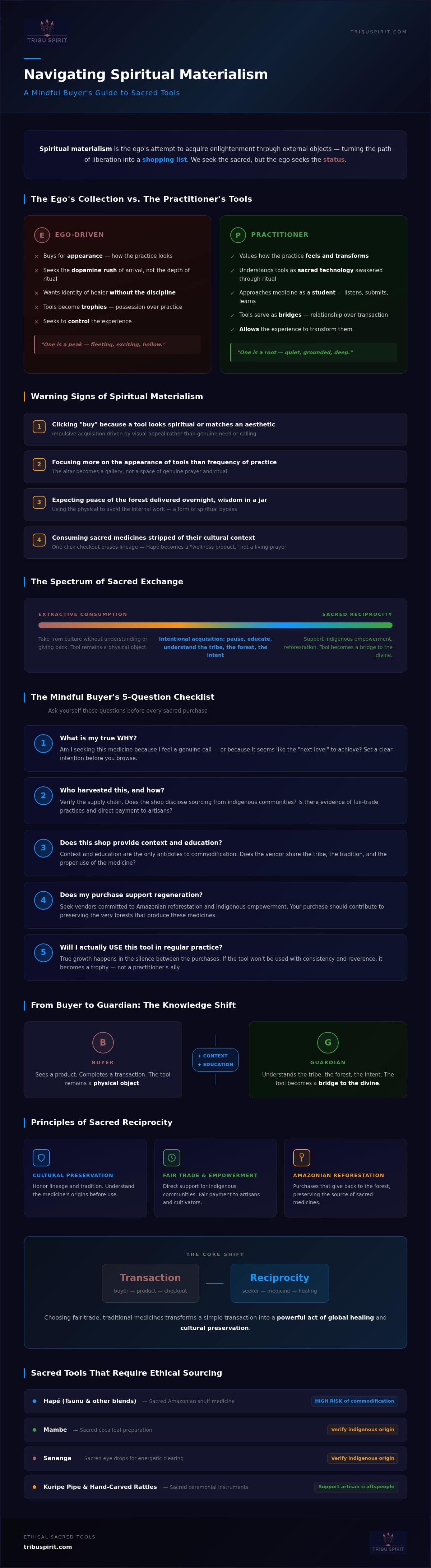
In the quiet space where our digital lives meet our spiritual aspirations, a subtle shadow often lingers. It is the shadow of spiritual materialism. This concept has found new, fertile ground in our swipe and buy culture. At its core, spiritual materialism is the ego’s attempt to acquire enlightenment through external objects, turning the path of liberation into a simple shopping list. We seek the sacred, but the ego seeks the status.
When navigating spiritual materialism in online shops, we often encounter a sea of spiritual aesthetics that prioritize how a practice looks over how it feels. A beautifully lit photo of a rattle or a perfectly staged altar can mask a lack of true internal practice. It is easy to fall into the trap of extractive consumption, where we take from a culture or a plant without giving back or understanding the depth. In contrast, intentional acquisition requires a pause. It asks us to look beyond the screen and into our own hearts. Spiritual materialism is the process of treating sacred tools as trophies rather than catalysts for transformation.
The Ego's Search for a Spiritual Identity
We often use products to signal our awakened status to the world. It is a way of saying, "Look at my collection, look at my depth." But the ego is clever. It convinces us that a new tool will provide the breakthrough that only consistent, often difficult practice can achieve. There is a fleeting high when a package arrives, a rush of dopamine that feels like progress. Yet, this excitement is distinct from the quiet, grounded depth of a ritual. One is a peak; the other is a root. True growth happens in the silence between the purchases.
The Commodification of Ancient Wisdom
When sacred medicines like Hapé become mere wellness products stripped of their context, we lose something vital. In a one click checkout world, the danger of losing the lineage and tradition is real. We risk turning a living prayer into a consumer commodity. Context and education are the only antidotes to this commodification. Understanding the tribe, the forest, and the intent behind the medicine changes the relationship from buyer to guardian. Without this knowledge, the tool remains a physical object. With it, the tool becomes a bridge to the divine.
The digital marketplace is a mirror. It reflects our deepest desires for healing and connection, but it also reflects our impatience. We want the peace of the forest delivered in two days. We want the wisdom of the elders contained in a small glass jar. When we treat these items as mere products, we are practicing a form of spiritual bypass. We are using the physical to avoid the internal work. True sacred tools are not meant to be collected. They are meant to be used, respected, and eventually, integrated into the soul.
The Ego’s Collection vs. The Practitioner’s Tools
The ego loves to gather. It sees an altar not as a space for prayer, but as a gallery for display. When navigating spiritual materialism in online shops, you might notice an inner urge to click buy simply because a tool looks spiritual or matches a certain aesthetic. This impulsivity is a hallmark of the ego. It seeks the quick fix. It wants the identity of a healer without the discipline of the path. A practitioner knows that a kuripe pipe or a hand-carved shamanic rattle is not an accessory. It is sacred technology. These items remain dormant until they are awakened through sacred ritual. There is a profound difference between owning a medicine and sitting with it as a student. One is a transaction; the other is a relationship.
Owning a medicine is a matter of possession. Sitting with a teacher, even if that teacher is the spirit of the plant itself, is a matter of submission. The ego wants to control the experience, while the practitioner allows the experience to transform them. If you find yourself focusing more on the appearance of your tools than the frequency of your practice, it might be time to pause and realign your intent.
Intentionality: The Heart of Shamanic Practice
Before you browse any online shamanic shop, set a clear why. Are you seeking Sananga because you feel a genuine call to clear your energetic vision, or because it feels like the next level to achieve? When you approach the question of what is hape with a student’s mindset, you realize the medicine is the guide. You don't master it; you listen to it. This humility is the foundation of any meaningful practice. It ensures that every tool you bring into your space is invited with purpose and respect.
The Power of Limited, High-Quality Tools
Depth is found in focus, not accumulation. A single, well-sourced bamboo kuripe carries the energetic weight of the maker's prayer and the forest's vibration. It is far more powerful than a collection of mass-produced items that carry no story and no soul. Every tool should have its place and its time. Mastery comes from using one tool until it becomes an extension of your own breath and intent. When we limit our tools to those of the highest quality and integrity, we honor the traditions they represent. You can begin this journey of depth by choosing tools crafted with sacred intent that support your growth rather than just your collection.
Consider the energy you bring to your tools. Do they sit gathering dust, or are they active participants in your daily life? A practitioner’s tools are worn, used, and loved. They carry the patina of many prayers. This is the difference between a trophy and a tool. One is meant to be looked at; the other is meant to be lived with. Choose the path of the practitioner, and let your tools be the humble servants of your transformation.
Evaluating Online Shops: Ethics, Sourcing, and Reciprocity
Sacred commerce is not an oxymoron; it is an opportunity for Ayni. This ancient Andean concept of reciprocity teaches us that every taking must be met with a giving. When you are navigating spiritual materialism in online shops, look for this balance. A transaction should never be a one way street. It should be a circle of support that reaches back to the hands that harvested the leaves and the soil that nurtured the roots. Without this flow, the tools we buy lose their spiritual weight and become mere objects of consumption.
Price is a poor measure of value but a great indicator of ethics. The cheapest option usually means that someone, somewhere, is paying the difference. Often, it is the indigenous communities who are underpaid or the land that is over harvested to meet high demand. Choosing ethically sourced amazonian plants ensures that the medicine's integrity remains intact. Integrity isn't just about the chemical composition of the plant; it's about the energy of the exchange. When the harvester is respected and the forest is honored, the medicine carries a frequency of harmony that supports your healing.
Vetting the Source: 3 Red Flags to Watch For
Discernment is a spiritual practice. As you browse, stay alert for these signs of a disconnected source:
- Hidden Origins: If a shop cannot name the tribe or the region where their Hapé or Sananga comes from, they likely don't know themselves. Transparency is the bedrock of trust.
- Commercial Hype: Watch out for language that promises instant awakening or treats sacred tools like trendy gadgets. Sacred medicines require patience and humility, not a marketing pitch.
- Mixed Inventories: Be cautious of shops that sell traditional medicines alongside synthetic substances. A true guardian of the tradition respects the boundary between the natural master teachers and the lab made.
The Marks of an Authentic Shamanic Partner
An authentic partner views themselves as a bridge, not just a storefront. They prioritize the health of the forest and the sovereignty of its people. Look for shops that actively participate in reforestation initiatives. This is a direct way to practice Ayni in the modern world. When a business supports indigenous tribe empowerment, they are ensuring that the wisdom they share continues to thrive for generations. Authentic partners also offer deep educational resources. They want you to understand the medicine, not just buy it. This focus on community, often through a Private Membership Association, creates a space where commerce serves the spirit. It transforms a simple purchase into a commitment to global healing.
The Mindful Buyer’s Checklist: 5 Questions for 2026
Before you commit to a purchase, take a moment to breathe. The digital world is designed for speed, but the spiritual path is paved with stillness. When you are navigating spiritual materialism in online shops, having a personal code of conduct is essential. Use these five questions as your compass for 2026 to ensure your actions align with your soul's highest intent.
- Is this tool for my practice or for my 'image'? Be honest about whether you want the tool to deepen your meditation or to decorate your digital presence.
- Do I know exactly where this hape tsunu came from? Trace the lineage. If the story of the tribe and the forest is missing, the medicine is incomplete.
- Does the shop I am supporting give back to the land and the people? Look for concrete actions, like reforestation or direct tribal support, that prove the shop values life over profit.
- Am I prepared to do the work that this tool requires? Sacred tools aren't magic pills; they are demanding teachers that require your presence and effort.
- Is this purchase an act of devotion or a distraction from my inner state? Sometimes we buy things to avoid the very silence we claim to be seeking.
Practicing the 'Pause' Before Checkout
The impulse to buy often stems from a temporary energetic void. We feel a lack and hope a new rattle or kuripe will fill it. Try waiting 24 hours before completing your transaction. This simple pause allows the initial wave of consumer boredom to pass. During this time, meditate on the tool. Ask for permission to bring it into your field. If the desire remains steady and quiet after a day of reflection, it's likely spirit led rather than ego driven. Recognize the difference between a spiritual hunger for growth and simple boredom.
Investing in Education Over Objects
There are moments when the most powerful tool you can acquire isn't physical. It's wisdom. Choosing a course or an academy over a new object can often lead to a greater breakthrough. Before you purchase sacred substances like Mambe or Ambil, learn their lineage. Understand the prayers and the history that breathe through them. Knowledge is the only spiritual possession that doesn't feed the ego because it requires integration, not just ownership. When you prioritize education, you transform from a collector into a true student of the path. You can deepen your understanding and ensure your practice remains grounded by exploring the educational resources and ethical tools available at Tribu Spirit.
Cultivating Reciprocity with Tribu Spirit
Choosing where to place your energy is the final step in the ritual of acquisition. When you're navigating spiritual materialism in online shops, the choice of a partner becomes an extension of your prayer. Tribu Spirit was born from a desire to bridge the gap between ancient Amazonian wisdom and the needs of modern seekers. Our mission is rooted in ethical action rather than mere commerce. We operate as a private ministry and academy, ensuring that every tool we offer is part of a larger educational path. By moving beyond anonymous retail, you find clarity while navigating spiritual materialism in online shops, turning a simple transaction into a sacred bond.
Every time you choose a blend of Hapé or a bottle of Sananga through our community, you participate in a cycle of life. A portion of every purchase directly supports reforestation initiatives in the Amazon. This isn't a vague promise; it's a commitment to the earth that provides these master teachers. By supporting us, you help restore the very lungs of our planet. We believe that a tool only carries true power when it's obtained through fair trade practices that empower the indigenous tribes who hold this knowledge. This is Ayni in action.
From Consumer to Guardian
Mindful shopping transforms your role in the global spiritual community. You're no longer just a consumer; you become a guardian of indigenous heritage. This shift has a profound ripple effect on tribal sovereignty. When you prioritize shops that respect the lineage of their offerings, you help protect these traditions from the diluting force of mass production. You're an active participant in the cycle of sacred reciprocity. Your choice ensures that the forest and its people remain strong and sovereign for generations to come. It's a quiet, powerful form of activism.
Next Steps: Embarking on a Conscious Journey
We invite you to approach your practice with a renewed sense of integrity. Instead of seeking the next breakthrough through accumulation, try the path of depth. Commit to one tool and one consistent practice for the next moon cycle. Allow the medicine to speak to you in the silence of your daily ritual. You can begin this journey by exploring our curated selection of shamanic tools with a fresh perspective. Let your heart guide you toward what's truly needed for your growth.
Join our community of dedicated practitioners who value depth over display. We're here to support your evolution through the Tribu Spirit Academy, providing the guidance and context necessary to use these medicines safely and with respect. Your journey is unique, and your tools should reflect the honor you hold for the path. Browse our ethically sourced medicines and tools to find the companions for your next stage of transformation.
Walking the Path of Sacred Reciprocity
Your journey toward deeper alignment begins with a single, conscious choice. We've explored how the ego seeks to collect while the soul seeks to connect. True mastery lies in recognizing that a tool is only as powerful as the intent behind it. By navigating spiritual materialism in online shops with discernment, you ensure that your practice remains rooted in respect rather than image. You now have the framework to distinguish between a spiritual trophy and a genuine catalyst for transformation.
As a Private Ministry, we're dedicated to preserving the sacred focus of these ancient traditions. Every step you take with us supports direct indigenous tribe empowerment and vital Amazonian reforestation initiatives. It's time to let your tools reflect the integrity of your heart. Join our community and shop with intention at Tribu Spirit. Trust in the wisdom of the forest and the steady rhythm of your own growth. You're not just a seeker; you're a guardian of the sacred flame.
Frequently Asked Questions
Is it bad to buy spiritual tools online?
Buying spiritual tools online isn't inherently negative; it's the intent that defines the experience. Digital platforms offer a unique bridge to sacred medicines like Mapacho or Mambe that were once inaccessible to many seekers. The challenge lies in finding a partner that prioritizes the spirit of the medicine over the speed of the transaction. Focus on shops that act as educators and guardians rather than just retail outlets.
How can I tell if an online shamanic shop is ethical?
Ethical shops prioritize transparency and community impact over profit margins. You can identify them by their willingness to share tribal origins and their involvement in projects like Amazonian reforestation. Check if they operate as a Private Membership Association or offer deep educational resources. These structures often signal a commitment to the sacredness of the tools rather than a purely commercial drive.
What does Chogyam Trungpa say about spiritual materialism?
Chogyam Trungpa describes spiritual materialism as the ego’s most sophisticated trap. It occurs when we use spiritual concepts or tools to decorate our ego instead of dismantling it. Instead of seeking transformation, the seeker "collects" experiences or sacred items to feel more enlightened than others. This turns the path into a new form of consumerism that reinforces the very self it's meant to transcend.
How do I avoid cultural appropriation when buying shamanic tools?
Avoid appropriation by centering your purchase on appreciation and reciprocity. This means buying from sources that directly support indigenous tribe empowerment and provide historical context for the tools. Research the lineage of the items you use. When you approach a tool as a student of a specific culture, you honor the tradition rather than simply consuming its symbols for personal aesthetic.
Why is ethically sourced Hapé more expensive?
The higher price of ethically sourced Hapé covers fair compensation for indigenous makers and sustainable land management. When plants are harvested with respect for the forest's cycle, the process is slower and more labor intensive. Cheap alternatives often rely on extractive practices that harm the environment and underpay the people who hold the wisdom. Integrity in your medicine begins with a fair exchange.
Can ritual tools like Kuripes actually help my practice, or are they just accessories?
Ritual tools like kuripes or rattles act as sacred technology to direct your focus and energy. They aren't mere accessories; they're functional extensions of your intent during a ceremony. A well crafted bamboo kuripe, for instance, ensures the correct delivery of Hapé while carrying the energetic prayer of its maker. These tools help create a container for your practice, grounding your spiritual work in the physical realm.
What is the role of 'Sacred Reciprocity' in online shopping?
Sacred Reciprocity, or Ayni, ensures that every spiritual transaction gives back more than it takes. While navigating spiritual materialism in online shops, look for evidence that your money flows back to the source through direct tribal support or environmental restoration. This balance maintains the medicine's integrity and ensures that your tools are free from the heavy energy of exploitation or imbalance.
How do I know if I'm buying a tool out of ego or genuine need?
Distinguish between ego and need by checking your emotional state before you finalize a purchase. If you're seeking a spiritual high or a way to signal your status to others, the ego is likely in charge. Navigating spiritual materialism in online shops requires you to pause and ask if the tool will be used in consistent practice or if it's simply filling a temporary void of boredom.