
A certificate on a wall means nothing in the spirit world where energy is the only currency. With 37% of people prioritizing their spirituality in 2025, the landscape of modern healing is more crowded than ever. You likely feel the call to deepen your connection to the sacred, yet you're held back by the fear of spiritual bypassing or financial exploitation. It's a valid concern; since there are no official regulatory bodies for this work, the responsibility of vetting falls entirely on the seeker. Learning how to find a shamanic practitioner you can trust is about looking past the aesthetic to find the pulse of authentic lineage and ethical integrity.
We believe your inner journey should be a path of safety and profound transformation. You're looking for a guide who respects ancient traditions without the noise of modern ego. This article offers a clear framework for discernment, from understanding why some individual sessions cost $500 to identifying the red flags of cultural appropriation. We'll provide a practical checklist for vetting practitioners and explain how to verify a healer's relationship with their helping spirits. You'll gain the clarity needed to book your first session with total peace of mind and an open heart.
Key Takeaways
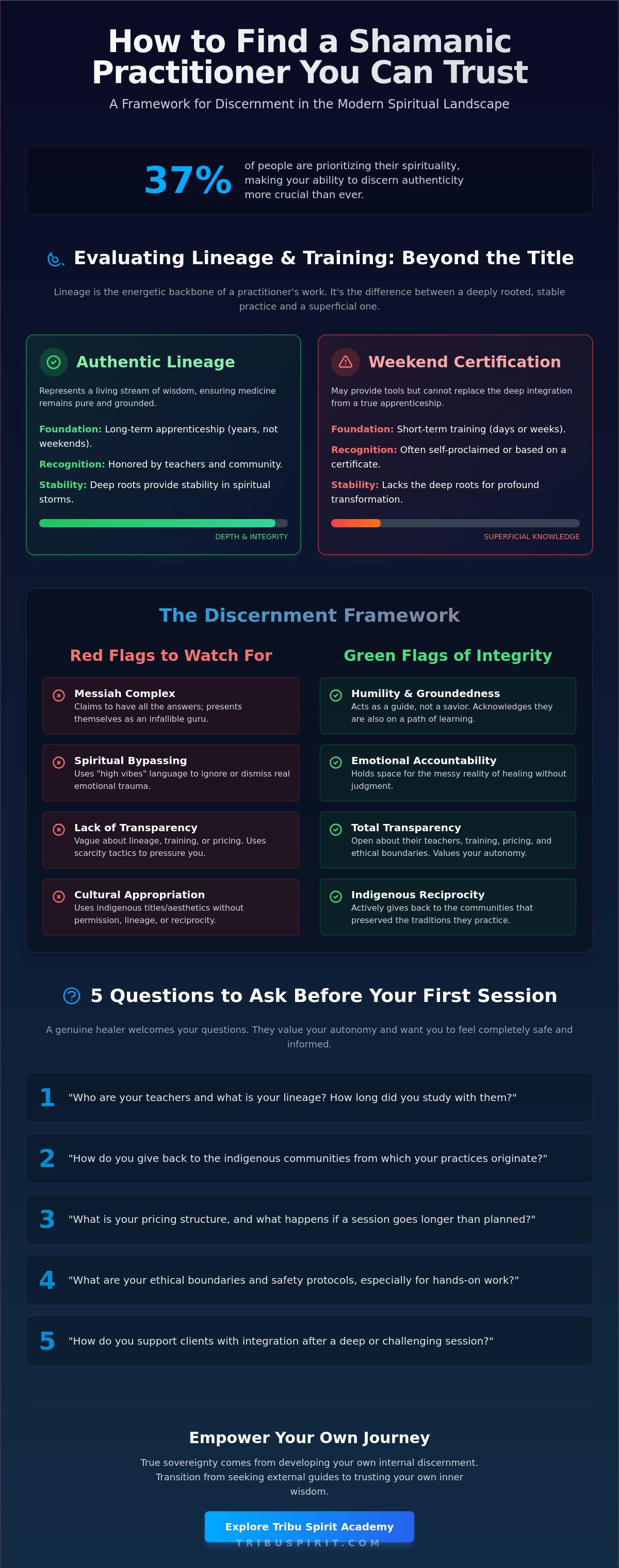
- Understand why a practitioner’s lineage serves as their energetic backbone and why long-term apprenticeships far outweigh weekend certifications.
- Discover how to find a shamanic practitioner you can trust by identifying behavioral red flags like "messiah complexes" and a lack of financial transparency.
- Empower your journey by learning the five essential questions that bridge the gap between indigenous tradition and modern safety during your first contact.
- Transition from seeking external guides to developing your own internal discernment through the educational resources found within the Tribu Spirit Academy.
The Modern Shamanic Landscape: Why Discernment is Your Most Important Tool
In 2026, the search for soul-deep healing has moved from the fringes to the center of our collective consciousness. As 33% of Americans make mental health-related resolutions, many are looking beyond clinical walls toward the sacred. This surge in interest has created a beautiful but complex marketplace. Understanding What is Shamanism? helps us realize that this ancient path is rooted in community and spirit, not just personal brand. Learning how to find a shamanic practitioner you can trust is the first ritual of your healing journey. A truly trustworthy practitioner acts as a clear bridge, maintaining the sanctity of indigenous tradition while upholding modern safety standards.
We must distinguish between titles to maintain respect for the traditions themselves. An indigenous Shaman is chosen by their community and initiated through ancestral lineage, often through years of rigorous, life-altering trial. Conversely, a Western-trained shamanic practitioner has studied these techniques to facilitate healing in a modern context. Both can offer profound medicine, but transparency about their origin is the first mark of integrity. They shouldn't hide behind vague titles or appropriated identities.
The rise of shamanic tourism in 2026 has made finding a guide more difficult. When healing becomes a commodity, the depth of the work can suffer. Trust is a two-way street. It requires the practitioner’s unwavering integrity and your own sharpened intuition. You're not just a client; you're a participant in a sacred exchange that requires mutual respect and clear energetic boundaries.
The Problem with Unregulated Spiritual Spaces
Because no central governing body licenses these healers, the burden of vetting rests on you. This lack of oversight often leads to spiritual bypassing, where practitioners use "high vibes" to ignore real-world accountability or emotional trauma. You might encounter guides who claim to have all the answers while ignoring the messy reality of the human experience. Shamanic integrity is the alignment of sacred lineage with transparent ethical boundaries. Without this alignment, the work remains superficial or, at worst, exploitative.
Intuition vs. Fear: Listening to Your Gut
Your body knows the difference between ego-based fear and intuitive red flags. Ego-based fear feels like a frantic "what if," while intuition is a quiet, heavy "no." When considering how to find a shamanic practitioner you can trust, prioritize feeling safe over feeling impressed. A genuine healer never rushes your process or uses scarcity tactics to book a session. They hold space for your questions. They value your autonomy. The right connection feels like a homecoming, not a performance. If you feel pressured to bypass your logic for the sake of a "breakthrough," take a step back. True medicine waits for your readiness.
Evaluating Lineage and Training: Beyond the Title
Lineage isn't a mere list of credentials; it's the energetic backbone of a practitioner's work. It represents a living stream of wisdom passed from teacher to student, ensuring that the medicine remains pure and grounded. When you're learning how to find a shamanic practitioner you can trust, you must look for the fingerprints of their mentors in their practice. A practitioner without a clear lineage is like a tree without roots; they may look vibrant on the surface, but they lack the stability to weather deep spiritual storms. Authentic power is rarely self-proclaimed. It's recognized and tempered by those who walked the path before.
The modern world often favors speed, yet shamanic mastery requires the opposite. A "weekend certification" might provide tools, but it cannot replace a long-term apprenticeship. Deep transformation isn't a product you can buy in a three-day retreat. It's a slow, often difficult process of ego-dissolution and spirit-alignment. While many feel a genuine "calling" to this work, that call is simply the invitation to begin years of formal study. Integrating Shamanism for Wellbeing into your life requires a guide who has survived their own initiations and respects the weight of the traditions they carry.
Indigenous Reciprocity and Sovereignty
Trustworthy practitioners understand that they're guests in the traditions they practice. You should ask whether they give back to the indigenous communities that preserved this knowledge through centuries of hardship. This is the "ethics of extraction." If a guide profits from sacred wisdom without practicing reciprocity, their energetic foundation is fractured. True medicine is built on a cycle of giving and receiving. To understand the depth of these relationships, you can explore our Amazonian Plants guide, which illustrates how sacred knowledge is inseparable from the land and its people. Ethically sourced knowledge is just as vital as the physical tools used in a ritual.
The Western Practitioner’s Path
A Westerner practicing shamanic arts must navigate the fine line between cultural appreciation and appropriation. Look for those who are transparent about their training, whether through the Foundation for Shamanic Studies or direct tribal mentorship. A key green flag is psychological grounding. Because the spirit world can be expansive and disorienting, a reliable guide must be trauma-informed and capable of helping you integrate your experience into your daily life. They don't just open doors; they help you walk through them safely. If you feel called to begin your own exploration with respect and integrity, you might find your first step in our collection of ethically crafted shamanic tools. Ethics are energetic. Integrity is the highest form of protection.
Red Flags vs. Green Flags: The Discernment Framework
Discernment is a sacred act of self-love. It is the energetic filter that protects your soul's growth while you explore the depths of the spirit world. When you are learning how to find a shamanic practitioner you can trust, you are looking for a "Sacred Mirror." This is a guide who reflects your own inherent power back to you rather than positioning themselves as the sole source of your healing. A genuine practitioner doesn't want you to become dependent on them. They want you to remember who you are. Trust is built on this foundation of empowerment. If a guide makes themselves the hero of your story, they aren't leading you to your soul; they're leading you to their ego.
The spirit world requires a grounded approach to safety. In 2025, 44% of younger adults are turning to meditation and spiritual practices, creating a high demand for guides. This surge has unfortunately allowed individuals with "messiah complexes" to flourish. Your intuition is your most reliable tool for navigating this terrain. If something feels heavy, restrictive, or overly secretive, it's usually a sign to walk away. A true healer's presence feels like an open door, not a locked room.
Common Red Flags to Watch For
The most dangerous red flag is the Guru Complex. This manifests as a practitioner claiming they're the "only" one who can solve your problems or that they possess "special" secrets hidden from the rest of the world. Healing is a collaborative ritual, not a hierarchy. Watch for a lack of boundaries, especially if a practitioner ignores physical safety protocols or attempts to mix sexual energy with spiritual work. Financial pressure is another warning sign. While professional sessions in 2026 often range from $395 to $500, a trustworthy guide is transparent about these costs from the start. They won't use "karmic debt" or spiritual guilt to pressure you into expensive, multi-session packages you aren't ready for.
Green Flags of an Authentic Healer
Authentic healers lead with humility. They often refer to themselves as a "hollow bone," a simple vessel for spirit to move through. They don't take credit for your breakthroughs; they celebrate your courage in achieving them. A major green flag is the presence of integration support. True medicine doesn't end when the ceremony closes. A trusted practitioner offers follow-up care to help you process the sacred ritual experience and ground it into your daily life. They are also accountable to a community or lineage. If they can't name their teachers or if they operate in total isolation, their energetic foundation may be unstable. Integrity is visible in their actions, not just their words.
The Practitioner Interview: 5 Questions to Ask
Your first conversation with a potential guide is more than a logistics call; it's a sacred meeting of energies. When you're discovering how to find a shamanic practitioner you can trust, you must step into your own authority as a seeker. A practitioner who is truly grounded in their medicine won't be offended by your curiosity. They'll welcome it. They understand that a seeker who asks questions is a seeker who is ready for deep, transformative work. Pay close attention to their tone during this exchange. Is it defensive? Is it dismissive? Or is it open, calm, and transparent? The frequency behind their words often tells you more than the words themselves.
Treat this initial contact as both a professional audit and a spiritual alignment. You aren't just looking for someone with "power." You're looking for someone with the character to hold that power safely. If a practitioner bypasses your questions or uses "spirit" as an excuse for lack of clarity, your intuition is giving you a clear signal to pause. True wisdom is always comfortable with the light of scrutiny.
The "Who" and "How" of Their Practice
- Question 1: "Who were your primary teachers, and do you still have a relationship with them?" A practitioner should be able to name their lineage without hesitation. A continuing relationship with their mentors shows they're still accountable to their own teachers.
- Question 2: "How do you handle medical emergencies or difficult psychological openings during a session?" Safety isn't just spiritual; it's physical and emotional. You need to know they have a grounded plan for when the work gets intense.
- Question 3: "How do you ensure the medicines you use are ethically and sustainably sourced?" This is especially vital when working with sacred tools like Hapé, where the energy of the plant is tied to the integrity of its harvest and the sovereignty of the tribes involved.
Logistics and Post-Ceremony Care
- Question 4: "What does your integration process look like after the ceremony is over?" Healing doesn't stop when the rattle falls silent. A trusted guide helps you weave the experience into your daily life.
- Question 5: "Are there any contraindications, medical or spiritual, that would prevent someone from working with you?" A practitioner who says "it’s safe for everyone" without screening for health history or mental state is a major red flag.
To ensure your own home rituals are supported by the same level of integrity you expect from a guide, you can browse our collection of ethically sourced sacred tools. Choosing quality tools is the first step in honoring your own path of discernment.
The Path of the Self-Healer: How Tribu Spirit Academy Empowers Your Journey
While we've explored the external markers of integrity, the final stage of discernment is internal. The most profound realization on this path is that you're the primary architect of your own healing. Learning how to find a shamanic practitioner you can trust is an essential first step, but it shouldn't be the last. A true guide eventually points you back to your own center. They don't want to be your permanent crutch; they want to be the mirror that shows you your own strength. This transition from seeker to self-healer is where the real work begins. It's about building a daily practice that sustains you long after the ceremony ends.
This is why we created the Tribu Spirit Academy. It's a space designed for education rather than mere consumption. When you deepen your understanding of shamanic tools and their traditional protocols, your ability to vet others sharpens naturally. You start to see the difference between someone who simply holds a rattle and someone who knows how to talk to the spirit of the wood. Knowledge is your greatest form of energetic protection. It allows you to walk the modern shamanic landscape with both an open heart and a critical eye. By learning the "why" behind the ritual, you become less susceptible to those who only perform the "how."
Bridging Ancient Wisdom and Modern Integrity
At Tribu Spirit, we believe that the way we acquire knowledge is just as important as the knowledge itself. We support indigenous sovereignty through direct fair-trade relationships and active reforestation projects. Integrity isn't a buzzword; it's a commitment to the land and the people who have guarded these traditions for millennia. By operating as a Private Membership Association (PMA), we create a safe, intentional container for those who are serious about their spiritual development. This structure ensures that our community remains focused on ethics and authentic connection rather than superficial trends. We invite you to join a tribe that values the sacredness of the journey as much as the results.
Next Steps: Your First Step Toward Healing
Trust the timing of your arrival here. Whether you're booking your first session with a practitioner or picking up your first kuripe, your journey is unfolding exactly as it should. Use the frameworks we've discussed to navigate with confidence. Don't rush. The spirit world has its own rhythm, and your readiness is the only clock that matters. We encourage you to continue building your foundational knowledge through our resources. Join the Tribu Spirit Academy and begin your journey with integrity. Your soul knows the way home; we're just here to help you clear the path.
Embrace the Ritual of Discernment
Discernment is not a barrier; it's a sacred bridge to deeper medicine. By moving beyond surface-level titles to examine lineage and ethical boundaries, you honor the ancient traditions that make this work possible. You now possess the tools to distinguish between a performative guide and a true facilitator who reflects your own power back to you. Your evolving understanding of how to find a shamanic practitioner you can trust ensures that your spiritual trajectory remains grounded in safety and profound respect. This clarity is the first ritual of your new life.
At Tribu Spirit, our Private Ministry and Academy focus on empowering the self-healer through education and authentic connection. We provide ethically sourced medicines, from Tsunu Hapé to sacred Mapacho, while maintaining active indigenous reciprocity and supporting reforestation efforts. Our community is a sanctuary for those dedicated to ancient wisdom and modern integrity. Every tool we offer is a vessel for your intention, hand-crafted to support your daily presence. Step forward with the confidence that your path is protected by your own sharpened intuition.
Begin your journey with the sacred tools and wisdom of Tribu Spirit.
Trust the quiet voice within. It has always known the way home.
Shamanic Discernment: Frequently Asked Questions
How much should a shamanic healing session cost in 2026?
Individual sessions in 2026 typically range from $395 for a two-hour experience to $500 for a single focused session. If you are seeking more immersive work, a 10-day retreat can range from $3,000 to $4,500, while a weekend experience at the Omega Institute is priced around $455. These rates reflect the practitioner's years of apprenticeship and the significant energetic labor required to hold a safe, sacred container for your transformation.
Can I practice shamanism without a specific practitioner?
You can certainly cultivate a personal daily ritual through nature connection, prayer, and working with sacred tools in your own home. While deep soul work often benefits from a guide, building your own foundational knowledge allows you to understand how to find a shamanic practitioner you can trust when you feel called to go deeper. Engaging with self-paced courses, such as those at the Tribu Spirit Academy priced between $44 and $222, empowers you to lead your own spiritual journey with integrity.
What is the difference between a shaman and a medicine man or woman?
The term "Shaman" originates from the Tungusic people of Siberia, though it has become a global descriptor for those who bridge the physical and spirit worlds. A "medicine man" or "medicine woman" typically refers to healers within specific North American indigenous traditions who focus on herbalism and community prayer. Both roles involve a lifetime of initiation and service, yet the titles carry distinct cultural weight and geographic origins that should be respected by every seeker.
Is it cultural appropriation to see a Western shamanic practitioner?
Seeing a Western practitioner is an act of cultural appreciation when that individual operates with transparency and practices active reciprocity with indigenous communities. Appropriation occurs when sacred knowledge is used for profit without honoring the source or contributing to the sovereignty of the original tribes. A trustworthy Western guide will always be vocal about their lineage and their commitment to reforestation and fair trade for the medicines they carry.
How do I know if a shamanic ceremony is safe for my mental health?
A safe ceremony always begins with a comprehensive screening for medical and psychological contraindications. Since 33% of Americans are focusing on mental health resolutions in 2025, it's vital that your practitioner understands trauma-informed care and integration. If a guide ignores your health history or dismisses the importance of nervous system regulation, they're not providing the grounded safety required for true spiritual expansion.
What should I do if I have a bad experience with a practitioner?
If you experience a breach of trust, your first step is to remove yourself from the situation and seek grounding through nature or a trusted integration specialist. You can also report the behavior to the practitioner's specific lineage elders or spiritual community if they're part of an organized group. Processing a difficult encounter is often a powerful, albeit painful, lesson in learning how to find a shamanic practitioner you can trust for your future work.
Do I need to travel to the Amazon to find a trustworthy shaman?
You don't need to travel to the rainforest to find authentic healing, as many high-integrity practitioners now serve communities across the globe. While the Amazon is a sacred cradle for many plant medicines, the "spirit of the work" is not limited by geography. What matters most is the practitioner's verifiable training and their ability to maintain a pure, humble connection to the ancestors, whether their altar is in the jungle or a modern city.
What are the signs that a shamanic practitioner is "fake"?
A practitioner lacks integrity if they display a "guru complex," claiming they're the only source of your healing or possessing "secret" powers others lack. Other red flags include a lack of clear boundaries, secretive pricing, and a refusal to discuss who their teachers were. Authentic healers lead with humility and transparency; they don't use fear or spiritual superiority to rush your process or manipulate your personal journey.