

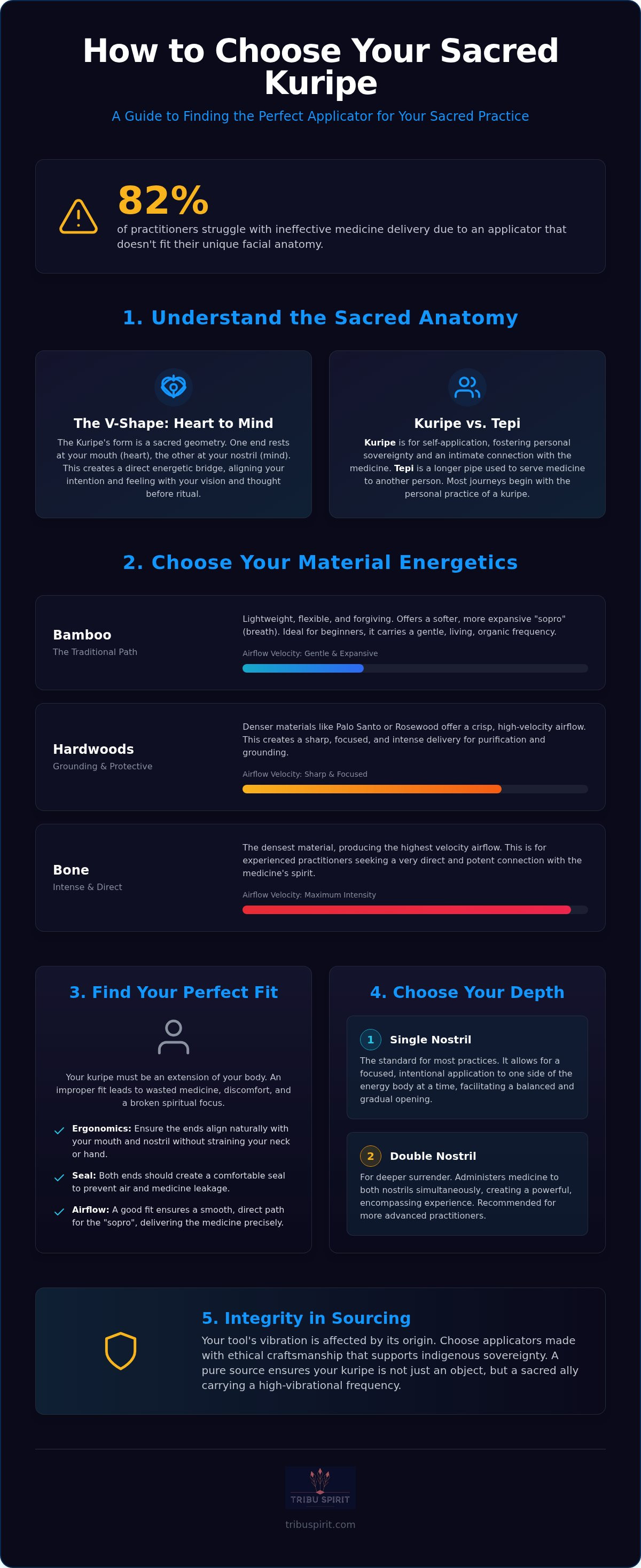
Did you know that roughly 82 percent of practitioners struggle with ineffective medicine delivery simply because their applicator doesn't fit their face? It is a frustrating barrier to an otherwise sacred experience. When you're standing at the threshold of a ritual, the last thing you want is a tool that feels clumsy or leaks the medicine's power. Learning how to choose a kuripe is about more than just aesthetics; it's about finding a sacred technology that mirrors your unique physical and energetic geometry. Your applicator should be a silent partner in your growth, not a source of physical discomfort or spiritual doubt.
We understand that your practice is a deeply personal journey of connection and healing. You deserve a tool that feels like a natural extension of your own hand and breath. This guide will show you how to select a kuripe that aligns with your facial anatomy, your specific energetic needs, and the sacred sopro of your practice. We'll explore everything from the resonant properties of bamboo to the vital importance of ethical, indigenous sourcing. By the end, you'll have the confidence to choose an applicator that isn't just a pipe, but a bridge to your higher self.
Key Takeaways
- Understand the sacred geometry of the V-shape and how this applicator serves as a bridge between the heart and the mind.
- Discover how to choose a kuripe that aligns with your specific facial anatomy to ensure a precise, powerful delivery without wasting medicine.
- Explore how materials like bamboo and hardwood influence the velocity of your breath and the energetic frequency of your practice.
- Evaluate the differences between single and double nostril applicators to find the depth of surrender that matches your spiritual intentions.
- Learn the importance of ethical craftsmanship and supporting indigenous sovereignty to ensure your tool carries a pure, high-vibrational frequency.
The Sacred Anatomy of a Kuripe: More Than a Tool
A kuripe is far more than a simple delivery device. It's a sacred technology; a physical bridge between the physical and the spiritual. While some might see it merely as a pipe for Snuff (tobacco) or Hapé, the practitioner knows it as an extension of their own energy. It's a tool of self-initiation. The kuripe allows you to administer the medicine yourself, placing the power of your healing directly in your own hands. This act of self-application is a profound statement of autonomy.
The physical form of the kuripe is designed to facilitate the "sopro," or the intentional breath. This breath isn't just air. It's a carrier of prayer and focus. Without the right vessel, the energy of the sopro can dissipate or become chaotic. Understanding how to choose a kuripe involves recognizing that this tool must be calibrated to your own breath. It must feel like a natural part of your body.
The V-Shape: Bridging the Heart and Mind
The geometry of the kuripe is its most significant spiritual feature. The V-shape isn't accidental. One end rests in your mouth, the seat of your breath and the gateway to your heart. The other end enters the nostril, the pathway to the mind and the third eye. When you blow through the kuripe, you're literally moving energy from your heart to your vision. It's a physical manifestation of aligning your feelings with your thoughts.
This alignment is essential before entering any sacred ritual. When the tool is properly fitted to your face, the medicine reaches its destination with clarity and strength. Poor alignment leads to wasted medicine and a fractured focus. A well-chosen kuripe grounds your energy. It anchors you in the present moment.
Kuripe vs. Tepi: Choosing Your Path
In the world of Amazonian medicine, you'll encounter two primary applicators. The kuripe is for solo use. The tepi is a longer pipe used by a practitioner to blow medicine into another person's nose. For many, the kuripe is the preferred starting point. It fosters personal sovereignty. It allows you to sit with yourself, learn your own rhythms, and integrate the medicine at your own pace.
Most people begin their journey with a bamboo kuripe. Bamboo is a living, flexible material that carries a gentle, organic frequency. It's forgiving and resilient. As you learn how to choose a kuripe, consider your current level of experience. Solo practice with a kuripe builds a foundation of trust between you and the spirit of the medicine. It's a quiet, intimate dialogue that doesn't require an intermediary.
Choosing the Material: The Energetics of Bamboo, Wood, and Bone
Every material in the natural world carries a unique vibration, a signature that interacts with your breath and the medicine it carries. When you're learning how to choose a kuripe, the density of the material is the first physical factor to consider. Denser materials, such as bone or heavy hardwoods, produce a crisp and high-velocity airflow. This creates a sharp, focused delivery that can be quite intense. In contrast, porous materials like bamboo allow for a softer, more expansive delivery. This is why an Anthropologist Explores Shamanism and finds that the choice of a tool is never arbitrary; it's a reflection of the practitioner's intended depth and the specific spirit of the plant they wish to invite.
Bamboo Kuripes: The Traditional Path
Bamboo is the quintessential material for shamanic tools because it's naturally hollow. It's already a vessel for spirit. High-quality Amazonian bamboo is exceptionally lightweight, making it effortless to handle during long ceremonies where focus is paramount. It offers a "living" quality that resonates deeply with the plant kingdom. Beginners often find bamboo to be the most forgiving material. It's durable, easy to care for, and develops a beautiful, darkened patina over time as it absorbs the oils of your hands and the essence of your prayers. It is a humble material that teaches us about flexibility and resilience.
Hardwoods and Totemic Carvings
Hardwoods like Palo Santo or Rosewood offer a different energetic signature that is both grounding and protective. Palo Santo is renowned for its ability to clear the energetic field, making it an excellent choice for those who use Hapé primarily for purification. Rosewood, on the other hand, provides a deeply grounding, heart-centered energy that can help stabilize a turbulent mind. These materials are often adorned with totemic animals that influence the ritual intent. A Jaguar carving might be chosen for strength and navigating the shadows, while a Serpent represents transformation and the shedding of the old. An Eagle carving is for those seeking perspective and a clearer connection to the divine.
Choosing a wood that resonates with your personal grounding needs is a vital step in how to choose a kuripe. These tools are often heavier than bamboo, providing a physical sense of "weight" that helps anchor you during intense sittings. Bone and stone applicators connect us to ancestral lineages and the enduring stillness of the earth. They are cool to the touch and carry a profound, ancient silence. If you're looking for a reliable, traditional starting point that feels alive in your hands, our Bamboo Kuripe offers the perfect balance of simplicity and sacred tradition for your daily practice.
Finding Your Perfect Fit: Ergonomics and Airflow
Roughly 82 percent of practitioners report ineffective medicine delivery due to poor applicator fit. This isn't just a matter of physical discomfort; it's a loss of sacred potential. When the tool doesn't align with your unique facial geometry, the medicine leaks, the pressure drops, and the intention of the ceremony is compromised. Learning how to choose a kuripe requires a deep understanding of your own anatomy. You're looking for a perfect seal where the wood or bamboo meets the skin, ensuring that every grain of medicine reaches its destination with the full power of your breath. Without this seal, the "sopro" loses its direction, and the medicine often ends up irritating the throat rather than clearing the mind.
The DIY Face Measurement Test
Finding the right fit doesn't have to be a guessing game. You can determine your ideal dimensions with a simple three-step process at home. This ensures that when you finally hold your tool, it feels like it was grown specifically for you.
- Step 1: Use a mirror to measure the distance from the center of your lips to the entrance of your nostril. This determines the length of the "nostril leg" of the kuripe.
- Step 2: Hold your hand in a V-shape against your face to determine the necessary angle. Some faces require a narrow, sharp V, while others need a wider, more open angle to reach the nostril comfortably without tilting the head.
- Step 3: Mimic the motion of application. Your hand should feel relaxed, not cramped. The kuripe should sit naturally between your fingers, allowing your arm to remain low and your chest to stay open for a full, deep breath.
Bore Size and the Physics of Sopro
The internal diameter, or "bore," of your kuripe acts as a nozzle for your energy. A narrow bore creates high resistance, which naturally increases the velocity of the air. This is often called the "Blow of the Jaguar." It's sharp, intense, and pierces through mental fog with surgical precision. If you prefer a more forceful and direct experience, a narrower channel is your best ally. It forces the medicine deep into the sinus cavities with a single, punchy exhale.
A wider bore allows for a larger volume of air to move at a lower speed. This is the "Blow of the Butterfly." It's gentle, expansive, and allows the medicine to coat the nasal passages slowly. This style is often preferred for more meditative, heart-centered sessions where the goal is a soft surrender rather than a sharp shock. Regardless of the size you choose, ensure the internal channel is polished and smooth. Any rough patches or debris inside the tube will catch the medicine, causing clogs that disrupt the flow of your ceremony. Before your first ritual, blow through the empty tool. Listen to the sound. It should be a clear, consistent whistle, free of turbulence or restriction.
Single vs. Double Nostril: Choosing Your Depth of Surrender
The choice between a single and a double applicator is a significant turning point in your shamanic practice. It represents a decision between incremental focus and total, immediate immersion. When you are deciding how to choose a kuripe, you must be honest about your current level of comfort with the medicine's intensity. The single kuripe is the traditional starting point for most practitioners. It allows you to build a relationship with the medicine one breath at a time, mastering the nuances of your own response before inviting a more overwhelming experience. It offers a sense of control that is vital when you are still learning the language of the plants.
Mastering the Single Kuripe
Working with a single applicator teaches you the art of staying present during a transition. After the first application, there is a natural pause. This is the "gap" where the mind often begins to resist the second nostril. You might feel a surge of heat, a ringing in the ears, or a desire to stop. Mastering the single kuripe means learning to maintain your energetic "charge" during this transition. You must stay anchored in your heart as you prepare the second dose. This process builds immense mental discipline. It requires you to focus on one side of the body at a time, balancing the solar and lunar energies through two distinct, intentional acts of will.
The Double Kuripe: Total Surrender
The double kuripe is a tool for those ready for absolute presence. By delivering the medicine to both nostrils simultaneously, you bypass the psychological barrier of the second application. There is no time for the "fight or flight" response to kick in. The effect is an immediate, powerful grounding that forces the mind into silence. This simultaneous delivery is often described as a way to balance the brain's hemispheres instantly. It's a path of total surrender. Because both channels are active at once, the technical fit is even more critical. If one side doesn't have a perfect seal, the pressure will be uneven, leading to a lopsided and uncomfortable experience.
Beginners should almost always start with a single applicator to develop their "sopro" and understand their tolerance. The double kuripe requires a level of breath control and physical composure that only comes with consistent practice. If you feel called to deepen your journey with a tool that honors these ancient traditions, you can find ethically sourced, high-vibrational applicators in our collection of sacred tools. Each piece is crafted to support you, whether you are taking your first steps or seeking the total surrender of the double blow.
Integrity in Sourcing: Ethical Craftsmanship and Purity
The journey of how to choose a kuripe reaches its most vital stage when we look beyond the physical form and into the spirit of the maker. In shamanic traditions, a tool carries the intention of the hands that shaped it. A mass-produced, factory-made pipe lacks the "ani," or the living breath, that an indigenous artisan breathes into their work. Authentic tools are often born from a state of prayer and deep connection to the forest. When you hold a hand-carved piece, you can feel the difference in the weight, the texture, and the energetic resonance. Choosing a tool from a reputable source ensures that you aren't just buying "shamanic decor," but a genuine partner for your spiritual evolution.
Why Heavy Metal Testing for Hapé is Non-Negotiable
While the kuripe is the vessel, the medicine it carries must be held to the highest standards of purity. It's a common oversight in the community to ignore the source of the Hapé itself. Because Amazonian plants grow in a complex ecosystem, they can sometimes absorb heavy metals from the soil if the area has been affected by upstream industrial activity or mining. This makes heavy metal testing for hapé a critical safety requirement for any serious practitioner. Long-term respiratory and neurological health depends on ensuring your medicine is free from lead, arsenic, and mercury.
Tribu Spirit operates within a Private Ministry framework to ensure that every batch of medicine undergoes rigorous screening. We believe that sacred tools should never compromise your physical well-being. By prioritizing lab-tested purity, we protect the sanctity of the ritual and the health of the community. When you are learning how to choose a kuripe, remember that the tool and the medicine are a single, unified system. Both must be clean, ethical, and vibrationally aligned.
Supporting the Tribes: Beyond the Purchase
Your choice of an applicator is an opportunity to practice "Ayni," or sacred reciprocity. True integrity in sourcing means supporting indigenous sovereignty through fair trade practices that directly empower the tribes. Every tool should contribute to the preservation of cultural heritage and the protection of the land. We are committed to reforestation initiatives in the Amazon, ensuring that for every piece of bamboo or wood harvested, new life is planted in its place. This creates a cycle of healing that extends far beyond your personal practice.
Supporting indigenous artisans means respecting their wisdom and their right to self-determination. By choosing ethically sourced tools, you become a guardian of the forest and its ancient traditions. This relationship between the practitioner, the tool, and the origin is what gives a kuripe its true power. It's not just an object; it's a commitment to a way of life that honors the earth and the lineage of the master teachers.
Step into Your Sacred Alignment
Your journey with Hapé is an intimate dialogue between your heart and the spirit of the forest. As you've discovered, the right applicator is much more than a physical object; it's a sacred technology that must harmonize with your unique facial geometry and the rhythm of your breath. Understanding how to choose a kuripe is a vital step in ensuring your medicine delivery is powerful, precise, and deeply grounding. By selecting the right material and fit, you transform a simple ritual into a profound experience of self-initiation and healing.
Integrity is the thread that binds your practice to the earth. When you choose tools that are ethically sourced from indigenous artisans, you honor the lineage of the master teachers who have guarded this wisdom for generations. Our ministry-approved collection prioritizes both energetic purity and physical safety, ensuring that your medicine is as clean as your intention. Every tool also carries a seed of hope, as your purchase contributes directly to Amazonian reforestation initiatives. This is the path of ayni, where your personal growth supports the healing of the world.
Trust your intuition as you find the vessel meant for your hand. Find Your Perfect Hand-Carved Kuripe in Our Sacred Collection. Your practice is ready to unfold in its most powerful form.
Frequently Asked Questions
How do I know if a kuripe will fit my face before buying?
You can determine the fit by measuring the distance between your lip center and your nostril using a simple mirror test. This ensures the V-shape creates a seal-tight fit against your skin. If the applicator is too short or the angle is too wide, you'll lose medicine and air pressure. Finding a tool that matches your facial geometry is the most important part of how to choose a kuripe for a successful ceremony.
Is it better to get a bamboo or a wooden kuripe for a beginner?
Determining how to choose a kuripe as a beginner often leads to bamboo because of its lightweight and flexible nature. It offers a gentle, living frequency that's easy to handle during your first few sittings. While hardwoods like Palo Santo provide a deeper grounding effect, the simplicity of bamboo allows you to focus entirely on your breath and intention without the added weight of denser materials.
Why is heavy metal testing for hapé so important for my practice?
Purity is essential because Amazonian plants can absorb environmental toxins from the soil. Conducting heavy metal testing for hapé ensures that every breath you take is free from lead, mercury, or arsenic. This isn't just about ritual purity; it's a fundamental requirement for your long-term respiratory and neurological health. By using only lab-screened medicines, you protect your body while you explore the deeper realms of your spirit.
How do I clean and maintain my kuripe to keep it sacred?
Keep your tool clear by using a dry pipe cleaner or a thin, flexible wire to remove any medicine buildup after each use. Avoid using water, as it can cause bamboo or wood to swell and eventually crack. Energetically, you can maintain its sacredness by passing it through the smoke of sage or Palo Santo. This practice clears any lingering energies and resets the tool for your next sitting.
Can I share my kuripe with others in a ceremony?
It's best to treat your kuripe as a personal, sovereign tool rather than a shared object. In shamanic traditions, the applicator becomes an extension of your own energy and breath. Sharing it can lead to a mixing of energetic imprints, which might disrupt the clarity of your individual process. If you wish to serve others, it's more appropriate to use a tepi, which is specifically designed for communal medicine work.
What is the difference between a single and a double kuripe?
A single kuripe delivers medicine to one nostril at a time, requiring you to stay present through the transition between sides. This builds mental discipline and focus. A double kuripe applies the medicine to both nostrils simultaneously, which bypasses the mind's resistance and creates an intense, immediate grounding. Most practitioners start with a single to master their breath before moving toward the total surrender of a double applicator.
How long should a high-quality kuripe last?
A high-quality, hand-carved kuripe can last for many years, often becoming a lifelong companion in your practice. Bamboo is surprisingly resilient, while hardwoods like Rosewood or Palo Santo are almost indestructible with basic care. The longevity of your tool depends largely on keeping it dry and stored in a cloth pouch when not in use. Over time, the material will darken and smooth, absorbing the essence of your dedicated practice.
Where can I learn the proper breathing techniques for my kuripe?
You can find comprehensive training on the proper "sopro" and breathing techniques at the Tribu Spirit Academy. Mastering the intentional breath is what elevates the physical act of application into a truly shamanic experience. Our guides provide the traditional context and practical steps needed to use your tools effectively. This deeper education ensures your practice remains safe, respectful, and vibrationally aligned with the ancient wisdom of the forest.