

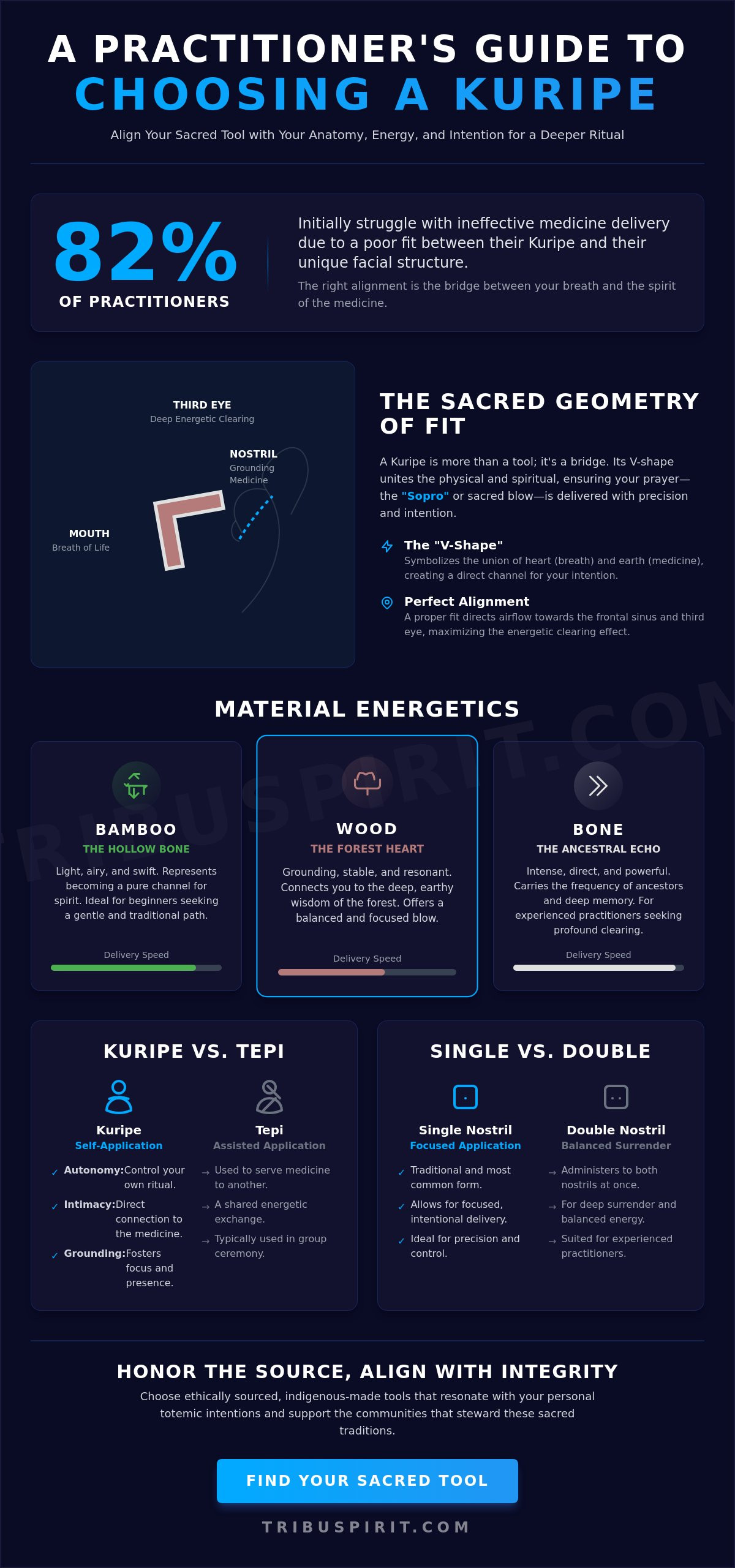
What if the bridge between your physical body and the spirit of the forest is simply a matter of a few millimeters? You already understand that Hapé is far more than a botanical powder; it's a sacred prayer carried on the "sopro," the intentional breath that connects the heart to the mind. However, 82 percent of practitioners initially struggle with ineffective medicine delivery because their tool lacks the proper "V-shape" alignment for their facial structure. Understanding how to choose a kuripe is the vital first step in ensuring your prayer is clear, powerful, and resonant. It's about finding a tool that honors the specific geometry of your face so the spirit of the plants can flow without resistance.
You deserve a sacred tool that feels like a natural extension of your own hand and spirit. In this guide, you'll discover how to select a self-applicator that perfectly aligns with your physical anatomy, energetic needs, and spiritual intentions. We'll explore the essential measurements for a comfortable ergonomic fit, the physics of airflow for deep medicine delivery, and how to identify ethical craftsmanship from the 2024 indigenous artisan collections. Your ritual is a journey inward. Let's ensure you have the right companion for the path.
Key Takeaways
- Understand the sacred geometry of the V-shape as a bridge that unites your breath with the grounding essence of the earth.
- Explore how the vibrational qualities of bamboo, wood, and bone influence the speed and intensity of your medicinal delivery.
- Learn how to choose a kuripe that perfectly fits your unique facial anatomy to ensure seamless airflow and a comfortable ritual experience.
- Evaluate the benefits of single versus double applicators to determine which tool best supports your desired depth of surrender and focus.
- Align your practice with integrity by selecting ethically sourced, indigenous-made tools that resonate with your personal totemic intentions.
The Sacred Anatomy of a Kuripe: More Than an Applicator
The kuripe is a small, V-shaped pipe designed for the self-administration of sacred medicine. While it may appear simple, this hand-crafted tool serves as a bridge between the physical and spiritual planes. In the Brazilian indigenous tradition, these pipes are essential for the use of Snuff (tobacco), known locally as Hapé. Understanding its sacred geometry is the first step in learning how to choose a kuripe that aligns with your personal practice and energetic needs. It's not just a delivery system; it's a partner in your ritual.
The V-Shape: Connecting Heart and Spirit
The V-shape isn't merely functional. It's a symbolic union of two worlds. One end of the pipe rests in the mouth, representing the breath of life and the human spirit. The other end fits into the nostril, representing the earth and the medicine. When you blow through the pipe, you're performing the "Sopro," or the sacred blow. This blow is an extension of your prayer, a focused intention that carries the medicine into your system with purpose and grace.
The angle of the kuripe is vital for a successful ritual. A well-crafted pipe directs the flow toward the frontal sinus and the third eye, facilitating a deep energetic clearing. The specific angle, often tailored to the distance between a person's mouth and nose, dictates how the powder enters the nasal cavity. For those new to this practice, exploring our Pillar Guide on Hapé provides the necessary context for the medicine this tool carries and the traditions it honors.
Kuripe vs. Tepi: Why Self-Application Matters
While a Tepi is a long pipe used by a practitioner to administer medicine to another person, the kuripe is designed for the individual. This distinction is profound. Using a kuripe allows for complete autonomy and intimacy in your ritual. You aren't relying on the energy of another; you're taking full responsibility for your healing journey. These shamanic tools act as extensions of your own energy field, mirroring your internal state and intention.
Self-application fosters a unique grounding experience. You must find the balance between your breath and your presence, ensuring the blow is consistent and mindful. When you understand how to choose a kuripe, you're selecting a partner for your most private meditative moments. It's a commitment to your own growth and a way to anchor yourself in the present moment. The kuripe empowers you to step into your own medicine space whenever the soul calls for clarity.
- Autonomy: You control the intensity and timing of the ritual.
- Intimacy: The practice becomes a direct conversation between you and the medicine.
- Grounding: The act of self-application requires focus, which naturally centers the mind.
Comparing Materials: The Energetics of Bamboo, Wood, and Bone
Every sacred tool carries a signature frequency that interacts with your own energy field during ceremony. When you are learning how to choose a kuripe, you aren't just selecting a physical object; you're choosing the medium through which your breath translates into spirit. The material of your applicator acts as a bridge between the botanical medicine and your consciousness. Whether you seek the airy lightness of the heights or the deep, anchoring roots of the forest, the material you hold will define the texture of your journey.
Bamboo Kuripes: The Traditional Path
Bamboo is the most common and accessible material for those beginning their path with Hapé. It's naturally light, carryable, and resonant with the element of air. In many indigenous traditions, bamboo represents the concept of the "hollow bone." This is a spiritual state where the practitioner clears their ego and internal noise to become a pure channel for divine energy. By using a bamboo tool, you're physically enacting this ritual of becoming an open vessel.
Because bamboo is naturally hollow, it requires minimal intervention from the maker, preserving its organic flow. It offers a soft, swift, and airy blow that's gentle on the nasal passages. If you feel called to this traditional simplicity, exploring a curated Bamboo Kuripe collection is an ideal way to start your practice. It's a humble material that honors the origins of the medicine.
Hardwood and Palo Santo: Grounding and Protection
Hardwoods like Tsunu, Rosewood, and Mahogany offer a different energetic weight. These materials are grounding, dense, and durable, providing a deep connection to the ancient forest floor. Tsunu wood, often used by the Yawanawá tribe, is particularly prized for its healing and protective qualities. It feels substantial in the hand, offering a sense of stability when the medicine begins to take hold. The higher density of hardwood creates a smoother internal surface that increases the velocity and directness of the Hapé during delivery.
Palo Santo kuripes add an extra layer of energetic cleansing to the ritual. Known as "Holy Wood," Palo Santo naturally clears negative attachments and seals your field with protection during the application. It's an excellent choice if your ceremonies focus on clearing heavy energy or "panema."
- Tsunu: Intense, grounding, and traditional.
- Rosewood: Heart-opening and aesthetically refined.
- Palo Santo: Purifying and protective.
Bone and Stone: Ancient Earth Connections
For those engaged in intense ancestral work, bone and stone applicators offer the most profound connection to the earth's history. Bone kuripes often represent the cycle of life and death, serving as a powerful reminder of our lineage and the temporary nature of the physical form. They provide a very "cold" and sharp delivery that's highly effective for deep meditative states. Stone, while rarer, offers an immovable, eternal energy that helps keep the practitioner centered during high-intensity ceremonies. Understanding these nuances is essential when deciding how to choose a kuripe that aligns with your specific spiritual intentions.
Finding Your Perfect Fit: Ergonomics and Airflow
The physical bridge between your breath and the sacred medicine must be precise. Many practitioners select an applicator based solely on its carvings or crystals, yet the most frequent error is ignoring facial geometry. If the pipe is too short or too long, the ritual loses its grace. You might find yourself straining your neck or failing to reach the nostril entirely. Understanding how to choose a kuripe requires an honest look in the mirror to acknowledge your unique anatomy.
A seamless connection creates the vacuum necessary for a transformative experience. If the mouthpiece doesn't sit flush against your lips, or the nose-end leaves a gap, the air pressure escapes. This loss of tension weakens the sopro, the sacred blow, leaving the medicine trapped in the pipe rather than delivered to the spirit. Your kuripe should feel like a natural extension of your hand and breath; it is a tool of intention that demands a perfect seal.
Measuring for Your Anatomy
Finding the right dimensions ensures your ritual remains focused and comfortable. You don't need complex tools to find your fit. Follow these three steps to determine your ideal size:
- The String Test: Hold a piece of soft string from the center of your lips to the entrance of your nostril while your face is in a relaxed, neutral position.
- Mark the Distance: Pinch the string at both points and lay it against a ruler. Most standard kuripes measure between 5 and 8 centimeters between the two ends.
- Check the Angle: Observe the "V" shape. A narrow angle suits a shorter distance, while a wider "V" is necessary if your facial structure requires more reach.
A pipe that is too wide for your face causes "leaks," where air escapes sideways. This can waste up to 20 percent of your medicine in a single application. The ideal "V" angle allows you to keep your elbow low and your shoulders relaxed. This prevents physical tension from interrupting your meditative state.
Bore Size and the Sopro Technique
The internal hole size, known as the bore diameter, dictates the velocity of the medicine. Most traditional pipes feature a bore between 3 and 6 millimeters. This small difference fundamentally changes the delivery. When you're learning how to choose a kuripe, consider your preferred intensity. A small bore, around 3 to 4 millimeters, is perfect for precision and micro-dosing. It allows for a gentle, focused blow that reaches the higher sinuses slowly.
Experienced practitioners often prefer a large bore of 5 to 7 millimeters. This creates a "volcano" effect, delivering a powerful, instantaneous hit that can be more grounding during deep ceremonies. The internal finish is just as vital as the width. High-quality kuripes feature a sanded, smooth internal path. If the interior is rough or has splinters, the powder gets stuck. A smooth bore ensures that 100 percent of the medicine moves with your breath, leaving nothing behind but the resonance of the ritual.
Single vs. Double Nostril: Choosing Your Depth of Surrender
The physical form of your applicator dictates the flow of your ceremony. When you're learning how to choose a kuripe, you'll eventually face the choice between the traditional single pipe and the powerful double applicator. This isn't merely a matter of convenience; it's a decision about how you wish to meet the medicine. The single pipe offers a sequential journey, while the double pipe demands an immediate, total surrender of the ego. Each path serves a different energetic purpose within your personal practice.
The Single Kuripe: Mastery of the Breath
Most practitioners begin their journey with a single kuripe. This tool focuses on the "sopro," or the sacred breath, allowing you to direct your intention with surgical precision. In many Amazonian traditions, the ritual follows a specific order. You apply the medicine to the left nostril first to symbolize the death of the old self or the release of the past. After a period of integration, you "re-charge" and apply it to the right side to welcome life and the future. This deliberate pause between sides creates a space for reflection that many find grounding and manageable.
- Precision: You can adjust the strength and duration of the blow for each side independently.
- Control: It's easier to manage the physical sensation and the "purge" when only one channel is active at a time.
- Focus: This is ideal for specific intentions, such as those found when working with Tsunu Hapé for deep grounding and spiritual clarity.
The single pipe is about building a relationship with the medicine. It's a conversation. You listen to how the left side responds before proceeding to the right. This builds the patience and breath control necessary for deeper work.
The Double Kuripe: The Path of Total Presence
The double kuripe is designed to deliver Hapé to both nostrils simultaneously. This creates a sudden "shock" to the nervous system that effectively bypasses the analytical mind. There's no time for the ego to negotiate or dread the second blow because the experience is unified. It balances the masculine and feminine hemispheres of the brain in one singular moment of impact. While some worry that a double pipe is "too much" for a beginner, the challenge is often more physical than spiritual.
A double blow requires roughly 40% more lung capacity to ensure the medicine reaches its destination effectively in both channels. If your breath is shallow, the medicine may not clear the pipes properly. However, if your breath is strong, the double kuripe offers a shortcut to deep meditative silence. In tribal observations, practitioners often transition to a double pipe after 6 to 12 months of consistent practice once they've mastered their internal rhythm. It's the choice for those seeking a total reset of their energetic field without the distraction of a two-step process.
Deciding how to choose a kuripe ultimately depends on your willingness to sit with the intensity of the "now." Whether you prefer the rhythmic dance of the single pipe or the lightning-strike clarity of the double, your applicator is the bridge to your inner landscape.
Honoring the Source: Selecting a Kuripe with Intention
The ritual begins long before the Hapé touches your nose. It starts with the moment you decide to bring a sacred tool into your life. Understanding how to choose a kuripe requires listening to your intuition rather than just your eyes. Your applicator is a bridge between the physical world and the spirit of the medicine; it's an extension of your own breath and intention.
Choosing a tool crafted with integrity ensures the energetic circuit remains pure. When you hold a pipe that was carved in a state of prayer, you're holding the frequency of the forest itself. Authentic tools carry a weight and a resonance that mass-produced alternatives can't replicate. They're born from a lineage of wisdom, not a factory line.
Totemic Alignment: Which Spirit Animal Calls You?
The carvings on a kuripe aren't merely decorative. They represent the "medicine" or the specific energy you wish to invite into your practice. A Jaguar carving serves those seeking grounded strength and the courage to face shadow work. The Eagle offers the gift of high-perspective vision, helping you see beyond the mundane. If you're in a period of deep shedding, the Serpent represents the transformative power of rebirth. These designs are deeply rooted in the ecosystem of the jungle, where Amazonian plants and animals coexist in a sacred symphony of survival and spirit.
Artisans often spend days in contemplation before carving a single piece. Their prayers are whispered into the wood, infusing the tool with a specific vibration. When you feel a sudden, unexplained pull toward a specific animal totem, trust that connection. It's often the spirit of the animal reaching out to support your current healing journey.
Supporting Indigenous Sovereignty
The rise in global interest for Hapé has led to an influx of "cheap" pipes that lack energetic integrity. These items often exploit tribal aesthetics without giving back to the source. Choosing an ethically sourced tool is an act of reciprocity. Tribu Spirit works directly with Amazonian tribes to ensure that every purchase supports the preservation of cultural heritage and traditional craftsmanship. This partnership provides a sustainable income for tribal families, allowing them to remain on their ancestral lands as protectors of the rainforest.
Your choice has a ripple effect. By prioritizing indigenous-made tools, you contribute to reforestation efforts and the sovereignty of the people who have guarded this medicine for millennia. It's a conscious step toward decolonizing your spiritual practice. When the tool is made with respect, the medicine speaks more clearly. It's about honoring the hands that carved the wood as much as the breath that moves through it.
Final Checklist for Your Selection:
- Material: Does the warmth of wood, the sturdiness of bamboo, or the tradition of bone resonate with you?
- Fit: Ensure the V-shape aligns with your unique facial structure for a seamless air seal.
- Totem: Identify the spirit animal that matches the "medicine" your soul currently needs.
- Source: Verify that the tool was created through ethical, direct-trade partnerships with indigenous artisans.
Finding the right applicator is a personal milestone. It marks your commitment to a deeper path of self-discovery and ancestral connection. If you're ready to find the tool that speaks to your soul, Explore the Tribu Spirit Kuripe Collection and discover a piece crafted in the heart of the Amazon. Trust your breath. Trust the process. Your perfect kuripe is already waiting for you.
Deepening Your Connection Through Conscious Selection
Selecting your first or next applicator is a pivotal step in your spiritual practice. It's the bridge between your breath and the profound wisdom of the plant kingdom. You've explored how the density of hand-carved wood or the lightness of bamboo alters the energetic flow of your ceremony. You've also learned that the physical fit against your nostril determines the depth of your surrender during the blow. Mastering how to choose a kuripe requires a balance of technical understanding and intuitive listening. Trust the tool that resonates with your heart's current frequency.
At Tribu Spirit, we bridge the gap between ancient tradition and your personal altar. Our collection features pieces ethically sourced from 12+ indigenous tribes, each one hand-carved by master artisans who infuse their heritage into every curve. When you choose a companion for your journey, you're also giving back to the earth. Every purchase supports Amazonian reforestation initiatives to protect the sacred lands where these traditions began. Your path to inner clarity starts with an intentional choice.
Find your sacred companion in our Kuripe Collection
Step into your next ritual with confidence and grace. The forest is calling you home.
Frequently Asked Questions
How do I know if a kuripe will fit my face before buying it?
Measure the distance between your nostril and the center of your mouth; most standard kuripes feature a 5 to 7 centimeter gap to accommodate the average adult face. Use a simple string or a ruler to check your own anatomy before purchasing. A kuripe with a classic V-shape allows for slight adjustments in the angle during your sacred ritual. If your measurement is less than 4 centimeters, look for compact or adjustable designs to ensure a snug fit.
What is the best material for a first-time kuripe buyer?
Bamboo is the ideal material for beginners because its natural hollow structure provides a smooth, consistent airflow for the Hapé. Learning how to choose a kuripe often starts with this lightweight material, as it's durable and incredibly easy to maintain. 90% of practitioners recommend bamboo for its neutral energetic profile and physical resilience. It's a reliable, grounded companion for your first steps into the world of sacred snuffs.
How often should I clean my kuripe, and what is the best method?
Clean your applicator after every 3 to 5 uses to prevent physical clogs and energetic buildup. Use a thin pipe cleaner or a small brush to remove residual powder from the interior of the tubes. For a deeper spiritual clearing, pass the kuripe through the smoke of Palo Santo or white sage. This practice keeps the tool vibrating at a high frequency, ensuring your connection remains pure and unobstructed during every session.
Can I share my kuripe with others, or should it be for personal use only?
Keep your kuripe for personal use only to maintain the purity of your own energy field and hygiene. Since these tools interact with your breath and mucous membranes, sharing can transfer bacteria or disrupt your unique spiritual connection. Treat it as a sacred extension of your own body and intention. If you must share, sterilize the tips with high-proof alcohol and clear the energy with smoke immediately afterward.
What is the difference between a bamboo and a wooden kuripe in terms of effect?
Bamboo offers a sharp, airy delivery, while denser woods like Chonta provide a more grounded and powerful force. Brazilian artisans often favor Chonta wood for its 1,200 kg/m3 density, which creates a focused, heavy blow for deep meditation. Bamboo is lighter and more flexible, making the experience feel more ethereal and soaring. Your choice depends on whether you seek earth-bound stability or celestial lightness in your practice.
Why does my kuripe keep getting clogged with Hapé?
Clogging usually happens because the interior of the tool is damp or the Hapé powder has absorbed moisture from the environment. Ensure your applicator is 100% dry before use, especially in humid climates where moisture levels exceed 60%. If a clog occurs, use a thin wire or a wooden toothpick to gently clear the passage. Storing your tool in a breathable cotton pouch helps prevent these obstructions from forming between rituals.
Is it better to get a kuripe with a stone or crystal inlay?
Choosing a kuripe with a crystal inlay like Amethyst or Turquoise adds a specific energetic intention to your healing practice. Crystals act as amplifiers for the Hapé, with Turquoise traditionally used for protection and clear communication. While a plain kuripe works perfectly, 75% of our community members choose stones to align with their specific chakra work. It transforms a simple tool into a personalized talisman for your inner journey.
How do I know if my kuripe was ethically sourced?
Check for direct links to indigenous artisans like the Huni Kuin or Yawanawá tribes to ensure authentic origins. Ethically sourced tools ensure that at least 20% of proceeds return directly to the forest communities that preserve these traditions. Knowing how to choose a kuripe involves researching the brand's supply chain transparency and commitment to fair trade. Authentic creators respect the harvest cycles of the forest and use fallen wood whenever possible.