
Shamanism is not a set of techniques to be collected; it's a living, breathing relationship of reciprocity that demands we look beyond our own healing to the survival of the cultures that carry these flames. As global institutions move toward the repatriation of sacred items in 2026, the call for personal accountability has never been louder. You might feel a profound pull toward the forest, yet find yourself paralyzed by the fear of overstepping sacred boundaries. It's natural to feel uncertain about how to avoid cultural appropriation in shamanism when the lines between appreciation and theft seem blurred. You want to honor these roots, but the fear of being called out can create a painful disconnect in your spiritual journey.
We believe that true spirituality requires both an open heart and a sharp, discerning mind. You'll learn how to move from a consumer mindset to one of sacred guardianship, ensuring your path is paved with respect rather than extraction. This guide provides a clear understanding of the difference between appreciation and appropriation, alongside a practical checklist for ethical sourcing. We'll explore how to build a confident, respectful relationship with plant medicines, moving you toward a practice that honors the indigenous elders who have protected this wisdom for millennia.
Key Takeaways
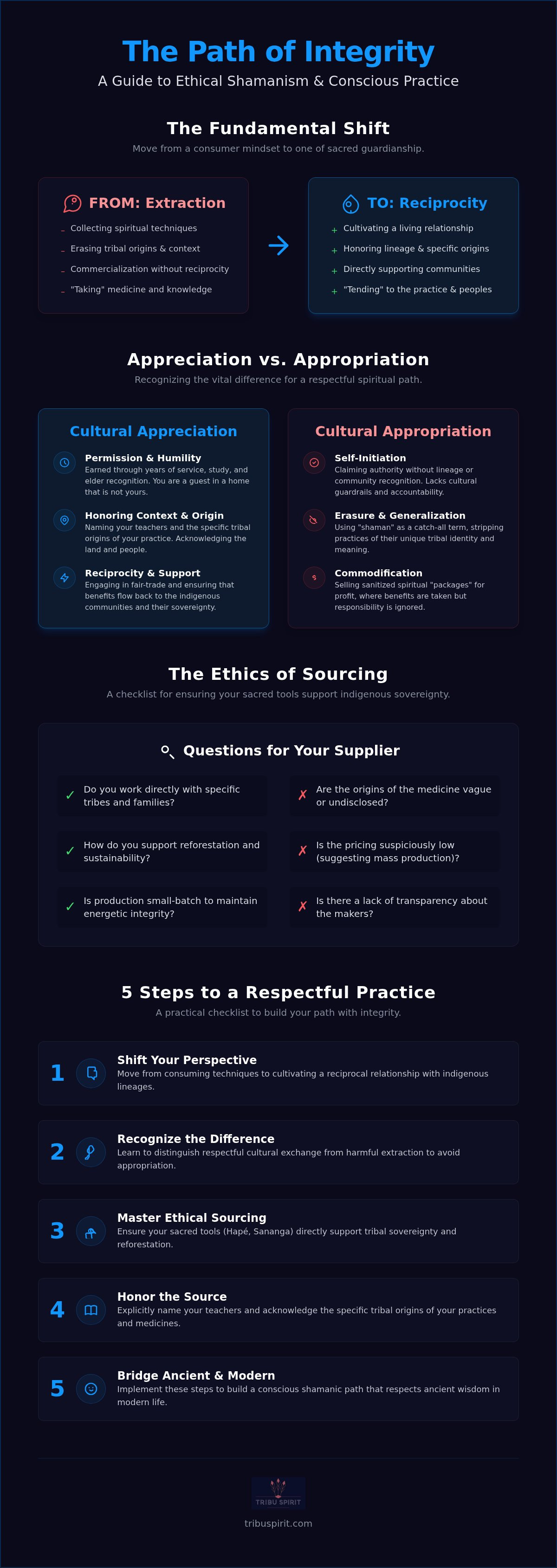
- Shift your perspective from consuming spiritual techniques to cultivating a living, reciprocal relationship with indigenous lineages.
- Learn how to avoid cultural appropriation in shamanism by recognizing the vital difference between respectful cultural exchange and harmful extraction.
- Master the ethics of sourcing to ensure your sacred tools, such as Hapé and Sananga, directly support the sovereignty and reforestation efforts of Amazonian tribes.
- Discover how to transition from "taking" to "tending" by naming your teachers and honoring the specific tribal origins of your spiritual practice.
- Implement a practical five-step checklist to build a respectful shamanic path that bridges ancient wisdom with conscious, ethical modern living.
The Foundation of Respect: Why Cultural Integrity Matters in Shamanism
Shamanism breathes through the people who keep the traditions alive. It isn't a collection of life hacks or exotic techniques; it's a living lineage rooted in specific soils and ancient memories. When we approach these paths, we must ask if we're entering a house as a guest or a thief. Learning how to avoid cultural appropriation in shamanism starts with recognizing that these practices are inseparable from the lands and ancestors that birthed them. The term "shaman" itself originates from the Evenki people of Siberia, yet it's often used as a catch-all label for any spiritual practice involving altered states. This erasure of specific tribal identities is often the first step toward extraction. True respect means honoring the Spirit of the Land and the people who have tended its medicine for millennia.
The History of Spiritual Extraction
Colonial history isn't just about the theft of land; it's about the commodification of the soul. For centuries, indigenous communities were forbidden from practicing their rites, often under the threat of violence. Today, those same rites are frequently sold in sanitized packages that strip away their depth. Good intentions don't erase the impact of using sacred symbols as mere aesthetic choices. This commercialization creates a cycle of spiritual extraction where the benefits are taken, but the responsibility to the community is ignored. Understanding 'Plastic Shamans' helps us identify those who claim authority without having walked the long, difficult road of true apprenticeship. Intention is a starting point, but it's not a shield against causing harm to the cultures we admire.
The Role of Lineage and Initiation
A path without a lineage is a path without a map. In traditional contexts, a practitioner is recognized by their elders and their community; they don't simply decide they're ready. Permission is earned through years of service, humility, and rigorous study. Self-initiation often lacks the cultural guardrails that prevent ego-driven distortion. When you work with sacred teachers like Hapé - Tsunu or Mapacho, you're engaging with a spirit that has been tended by generations of hands. True initiation is an invitation into a lineage of care. It requires us to acknowledge that we don't own these practices. We're merely students in a classroom that has been open since the beginning of time. Without elder recognition and cultural context, the practice becomes a hollow echo of its true power.
The Ethics of Sourcing: Honoring Indigenous Sovereignty and Plant Teachers
Indigenous Sovereignty is the pulse of ethical practice. It is the inherent right of tribes to govern their own ancestral knowledge, medicines, and cultural heritage. When we seek to understand what is hape, we must look beyond the physical powder to the hands that ground it and the prayers whispered during its creation. Sourcing these medicines through fair-trade relationships isn't just a business choice; it's a spiritual necessity. Mass production often strips the medicine of its spirit and destabilizes Amazonian ecosystems. High demand without reciprocity leads to over-harvesting and the erosion of tribal stability. This extraction reflects a deeper issue of Intellectual Colonialism in New Age Movements, where sacred wisdom is taken for profit while the keepers of that wisdom are left behind. Every purchase is a vote for either the preservation of a culture or its commodification.
Identifying Ethically Sourced Hapé and Sananga
Finding integrity in a crowded market requires active discernment. You should feel empowered to ask your supplier direct questions about their lineage connections. Do they work directly with the tribes? How is the reforestation of harvested plants supported? Small-batch production by indigenous families ensures the medicine carries the intended energetic frequency and respects the natural cycles of the forest. Red flags include vague origins, suspiciously low pricing, or a lack of transparency regarding the specific makers. Understanding these nuances is essential for anyone learning how to avoid cultural appropriation in shamanism. True medicine should feel like a bridge, not a transaction.
Sacred Tools and Traditional Handicrafts
Your shamanic tools are more than ritual accessories; they are sacred technology. A hand-carved Kuripe or a shamanic rattle is an extension of the artisan's prayer and a physical manifestation of their connection to the spirit world. There is a vast difference between a sacred instrument crafted with intent and a decorative souvenir made for a mass market. Ethical purchases provide tribal economic independence, allowing communities to remain on their ancestral lands and protect their traditions from external pressures. By choosing items with a clear story and a verified origin, you move from a state of extraction to a beautiful, shared growth. We invite you to explore our collection of ethically crafted tools that honor these ancient lineages.
Cultural Appreciation vs. Appropriation: A Framework for Spiritual Maturity
Spiritual maturity begins when we stop asking what a practice can do for us and start asking what we can do for the practice. In a world of instant access, it's easy to treat ancient wisdom as a buffet of experiences. However, learning how to avoid cultural appropriation in shamanism requires a fundamental shift from "taking" to "tending." This means moving beyond the superficial layers and into the heart of the lineage. When you use a tool or perform a rite, do you know the name of the teacher who passed it down? Do you know the history of the people who protected it? Naming your sources isn't just a matter of credit. It's a spiritual act of grounding your practice in truth rather than fantasy.
Engaging with sacred ritual requires a presence that honors the origin without mimicking the outward appearance. We must avoid the trap of the costume. Wearing tribal regalia, using specific face paints, or adopting indigenous clothing without a direct initiation is a form of spiritual roleplay. It causes real pain to those whose ancestors fought to keep these traditions alive. You can honor the spirit of a tradition without performing a caricature of its people. True connection is felt in the silence of the heart. It's found in the breath, not in the complexity of the wardrobe.
The Comparison Framework
Understanding where your practice sits on the spectrum of integrity is essential for growth. Use these three pillars to evaluate your path:
- Appreciation: This is a path of active, humble study. It involves learning the history, language, and social context of a practice. You approach as a guest who has been invited into a home.
- Appropriation: This occurs when a practice is stripped of its context for personal gain, profit, or a curated aesthetic. It treats sacred rites as commodities to be consumed.
- Reciprocity: This is the golden thread of integrity. It means giving back more than you take. Whether through direct financial support, reforestation, or social advocacy, reciprocity ensures the lineage thrives.
Respecting the 'Secret' Traditions
We must accept that not all indigenous knowledge is for public consumption. Some traditions are kept private by elders to protect their sanctity and power. Understanding these boundaries is a vital part of spiritual growth. It's not a rejection; it's an invitation to practice humility. Knowing when to listen instead of lead is a rare and beautiful virtue. When an elder or a community sets a boundary, we honor it without question. This restraint proves that our respect for the culture is greater than our desire for its secrets. True wisdom is knowing that some things are meant to be held only by those who carry the ancestral blood and responsibility.
5 Practical Steps to Cultivate a Respectful Shamanic Practice
Integrity is a path, not a destination. It's built through the small, conscious choices we make every time we sit with a plant teacher or pick up a sacred tool. When considering how to avoid cultural appropriation in shamanism, action speaks louder than aesthetics. You've moved beyond the "what" and "why"; now it's time to embody the "how." These five steps provide a framework for a practice rooted in respect rather than extraction.
- Step 1: Trace the lineage of your tools. Don't settle for generic origins. If you hold a rattle, know if it carries the geometric prayers of the Shipibo or the rhythmic heartbeat of the Huni Kuin.
- Step 2: Vote with your resources. Prioritize direct-trade or indigenous-owned businesses. Your financial energy should directly support the sovereignty of the people who protected these traditions through centuries of hardship.
- Step 3: Embody Sacred Reciprocity. Never take without giving. This can manifest through monthly donations to indigenous causes or active participation in Amazonian reforestation.
- Step 4: Approach with prayerful intent. When working with medicines like hape tsunu, treat the powder as a living teacher. It isn't a substance to be used; it's a spirit to be consulted.
- Step 5: Remain a lifelong student. Avoid the ego's trap of claiming mastery. True wisdom is found in the humility of someone who knows they're just beginning to listen to the forest's song.
Implementing Sacred Reciprocity
Ayni, the Quechua concept of sacred reciprocity, is the golden thread that prevents spiritual practice from becoming spiritual theft. It's the understanding that we're part of a vast, interconnected web of life. Supporting the amazonian plants and their guardians is a vital part of this balance. Your spiritual budget should reflect your values. Whether it's a portion of your income or your time, giving back ensures the well is never dry for the next generation. Sacred reciprocity is a conscious balance where energy and resources flow back to the source of wisdom in equal measure to what is received.
Building a Relationship with the Medicine
Plant teachers are sentient beings with their own agency and intelligence. They aren't tools for our convenience; they're elders who deserve our deepest attention. Building a relationship takes time, patience, and a willingness to listen. Integration is just as important as the ceremony itself. It's the process of bringing the forest's wisdom into your daily interactions, your work, and your relationships. This long-term commitment is what separates a dedicated practitioner from a spiritual tourist. We invite you to deepen this connection through the structured, respectful learning offered at the Tribu Spirit Academy, where we bridge ancient wisdom with modern ethical living.
Walking the Path of Integrity with Tribu Spirit
The transition from consumer to guardian is the most profound step in your spiritual evolution. Tribu Spirit exists as a bridge between the ancient whispers of the Amazon and the conscious needs of the modern seeker. We don't just provide tools; we offer a path of integrity. Our structure as a private ministry and academy is a deliberate, protective choice. It allows us to honor these traditions outside the noise of standard commercial markets, ensuring that every interaction remains sacred. Understanding how to avoid cultural appropriation in shamanism requires more than just reading; it requires choosing partners who live these values every day. We prioritize fair-trade practices and direct support of indigenous empowerment. Every purchase is an act of cultural preservation.
Our Ethical Sourcing Standards
We verify the origin of every blend of Hapé and Sananga through direct, personal relationships with tribal families. This transparency is the heartbeat of our ministry. We don't buy from mass-market wholesalers who strip the medicines of their context and spirit. Instead, we work with artisans who hand-carve each Bamboo Kuripe and ritual applicator with prayerful intent. This fair-trade model ensures that the wealth flows back to the villages. It supports tribal economic independence. It protects their right to remain guardians of the rainforest. When you hold a tool from our collection, you're holding a piece of a thriving ecosystem and a story of resilience.
Join the Community of Conscious Practitioners
Education is the most powerful tool for meaningful change. The Tribu Spirit Academy offers a structured space where you can learn the depth of these practices without the fear of causing harm. We teach you how to avoid cultural appropriation in shamanism by grounding your journey in history, ethics, and deep respect. It's about moving from a student of techniques to a student of the soul. Our mission extends beyond the classroom to the forest itself through direct support of Amazonian reforestation. By partnering with us, you aren't just buying a product; you're joining a movement of sacred reciprocity. We invite you to join our community of conscious practitioners. Practice with a clean heart. Walk with clear intention. Together, we can ensure that these sacred flames continue to burn bright for generations to come.
Embodying the Spirit of Reciprocity
Walking the path of the heart requires more than just curiosity; it demands a commitment to the people and lands that have held this wisdom for generations. You now have a clearer understanding of how to avoid cultural appropriation in shamanism by shifting from a mindset of consumption to one of sacred guardianship. By honoring indigenous sovereignty and choosing tools with transparent origins, you ensure your spiritual growth doesn't come at the expense of another's heritage. True medicine is always rooted in respect and the recognition that we are guests in an ancient, living lineage.
Every choice you make ripples through the forest. When you align your practice with ethical sourcing, you become a vital part of a living bridge between worlds. At Tribu Spirit, we operate as a Private Ministry dedicated to sacred integrity, maintaining direct-trade relationships with indigenous families to ensure every purchase supports Amazonian reforestation. We invite you to explore our ethically sourced collection and support indigenous heritage as you deepen your connection to the master teachers. Your journey is a sacred dance; walk it with a clean heart and the quiet confidence of one who truly honors the roots.
Frequently Asked Questions
Is it cultural appropriation to use Hapé if I am not indigenous?
Using Hapé is not inherently appropriation if you approach the medicine with deep respect, proper education, and a reciprocal relationship with the tribes who created it. Appropriation happens when the medicine is treated as a commodity without acknowledging its spiritual roots or supporting its guardians. It's vital to focus on building a relationship with the teacher spirit rather than just consuming a substance for personal gain.
How can I tell if my shamanic tools are ethically made?
You can verify the ethics of your tools by researching the supplier's direct connections to indigenous artisans and their fair-trade policies. Ask for the specific names of the makers or the village of origin. If a supplier is vague about where their Bamboo Kuripe or hand-carved rattles come from, it's often a sign of mass production. Transparency is the hallmark of integrity in this sacred market.
Can I call myself a shaman if I've completed a training program?
Completing a training program doesn't grant you the title of "shaman," as this role is traditionally recognized by an indigenous community and their elders after decades of service. Most modern practitioners prefer terms like "shamanic practitioner" or "student of the path." This distinction is a key part of how to avoid cultural appropriation in shamanism, as it respects the weight of the traditional title.
What is sacred reciprocity and how do I practice it?
Sacred reciprocity, or Ayni, is the spiritual practice of giving back in equal measure to what you receive from the forest and its people. You can practice it by donating to reforestation projects, supporting indigenous land rights, or paying fair prices for medicines. It's about ensuring the energetic flow of life remains balanced and sustainable for the lineages that have shared their wisdom with you.
Is it okay to wear traditional indigenous patterns during ceremony?
Wearing indigenous patterns is generally discouraged unless you have been gifted the items by a specific tribe or have a direct lineage connection. These designs often carry sacred meanings and ancestral stories that aren't meant for aesthetic use. It's better to wear simple, respectful attire that allows you to focus on your internal process rather than an outward performance of tribal identity.
How do I find a legitimate indigenous teacher or lineage?
Finding a legitimate teacher requires patience, research, and a willingness to listen before you act. Look for practitioners who are openly recognized by their own communities and who prioritize the preservation of their culture over commercial success. Attend workshops or academies that bridge these worlds with documented accountability and long-term relationships with tribal leaders who have given their explicit permission to teach.
Why is it important to know the specific tribe my Hapé comes from?
Knowing the specific tribe ensures you're honoring the unique prayer, plant knowledge, and ancestral energy infused into that medicine. Each tribe, such as the Huni Kuin or Yawanawá, has distinct traditions and sacred recipes. This knowledge is essential for anyone learning how to avoid cultural appropriation in shamanism, as it prevents the erasure of specific cultural identities and ensures your practice is grounded in truth.
What should I do if I realize I have appropriated something in the past?
Acknowledge the mistake with humility, stop the harmful practice immediately, and find ways to make amends through direct support of that culture. Guilt isn't as productive as conscious action. Use the experience as a catalyst to educate yourself and others on the importance of integrity. True growth comes from the courage to change your path when you find a more respectful way to walk.