
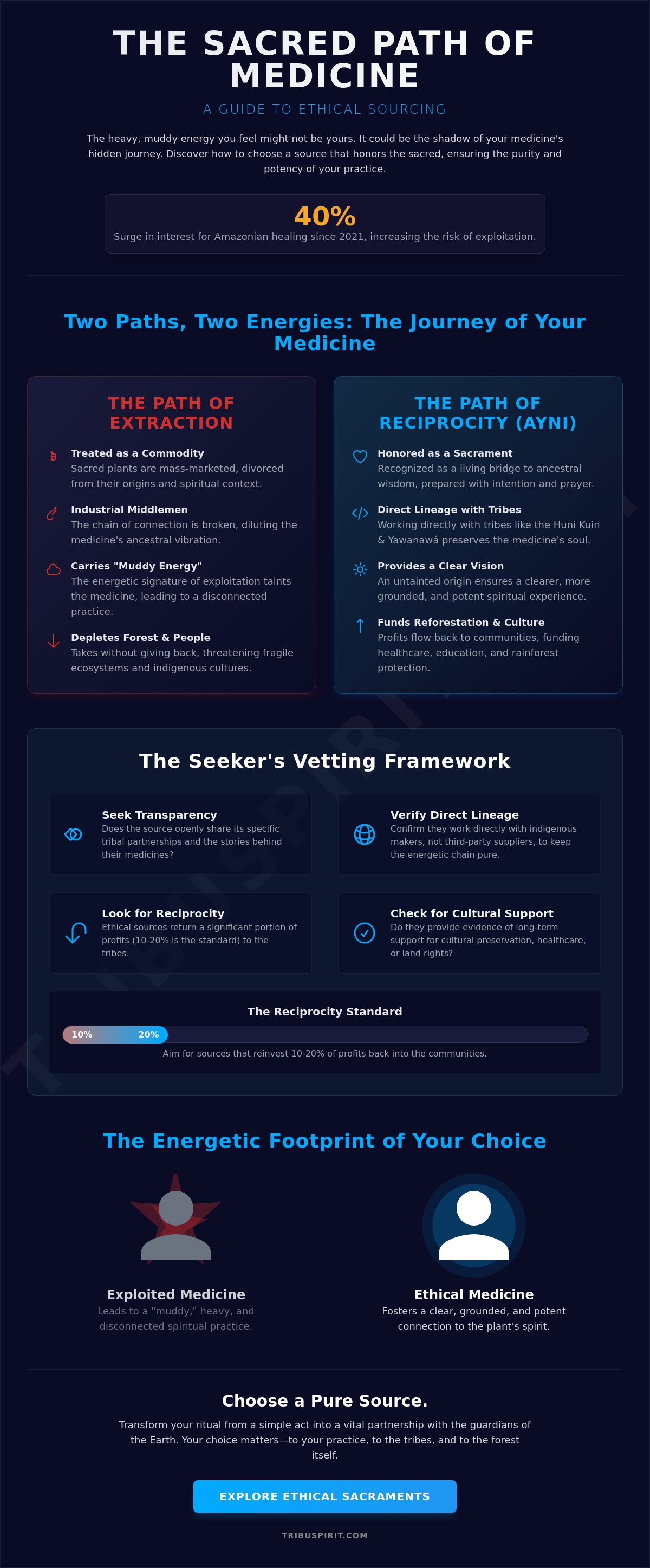
What if the heavy, muddy energy you sometimes feel during a ritual isn't a reflection of your own soul, but a shadow cast by the hidden journey your medicine took to reach you? Since 2021, interest in traditional Amazonian healing has surged by 40 percent, yet this rapid growth often masks a painful reality of exploitation and cultural theft. Truly understanding the ethical sourcing of shamanic medicines is more than a modern business metric. It's a sacred prerequisite. This integrity determines the very potency and spiritual clarity of the plant's song.
You likely feel a deep, ancestral pull toward these traditions, but you're tired of the confusion surrounding "Fair Trade" labels in a market that's shifting faster than the April 2026 federal guidelines can track. This guide will show you exactly how to identify authentic, ethically harvested sacraments that honor indigenous sovereignty rather than eroding it. You'll learn to vet spiritual shops through a clear framework of reciprocity, where returning 10 to 20 percent of profits to the forest is the standard. By the end, you'll see how choosing medicine from a pure source transforms a simple ritual into a vital partnership with the guardians of the earth.
Key Takeaways
- Learn why true shamanic medicine is a sacred relationship of reciprocity called Ayni, protecting indigenous cultures from the shadows of spiritual extraction.
- Discover how the ethical sourcing of shamanic medicines relies on direct lineage connections with tribes like the Huni Kuin to ensure every sacrament carries its true ancestral vibration.
- Understand the profound link between fair compensation and medicinal potency, ensuring your tools are free from the "muddy energy" of exploitation and provide a clearer, more grounded vision.
- Master a practical vetting framework to identify authentic sources by seeking transparency in tribal partnerships and evidence of long-term cultural support.
- Explore how a sacred ministry model preserves the sanctity of plant teachers while fostering reforestation and the preservation of ancient wisdom for future generations.
The Sacred Responsibility of Sourcing Shamanic Medicines
The journey of a sacred plant teacher does not begin when it reaches your doorstep; it starts with a prayer whispered into the canopy of the Amazon. In the traditions of the forest, the ethical sourcing of shamanic medicines is not a logistical checklist or a simple marketing slogan. It is a profound expression of Ayni. This ancient Quechua concept describes a relationship-based model of reciprocity where every interaction is a sacred exchange of energy. When you hold a bottle of Hapé or a vial of Sananga, you aren't merely holding a product. You are holding a living bridge between your modern life and the ancestral heartbeat of the jungle. If that bridge is built on extraction rather than honor, the spiritual integrity of the medicine falters.
True sourcing begins with the harvester's intention. It matters if the plants were gathered with permission from the forest spirits or if they were stripped away for profit. Many practitioners are now realizing that the source includes the songs sung during the preparation and the fair treatment of the hands that ground the ashes. As global interest in entheogens continues to expand, we must confront the shadow of spiritual extraction. This occurs when mass-market demand treats sacred tools as commodities, threatening fragile ecosystems and the cultural secrets of the tribes who guard them. Your practice remains pure only when the medicine's origin is transparent and untainted by exploitation.
The Rise of Shamanic Globalism
The sudden popularity of sacred tools has birthed a grey market where sacraments are often divorced from their origins. To truly understand what is hape, one must distinguish between commodity tobacco and the generational Tabaco Mói used in authentic rituals. Commodity tobacco is often grown with pesticides and lacks the spiritual lineage required for deep work. In contrast, authentic Tabaco Mói is tended by indigenous families over generations. Choosing the latter isn't just about quality; it is an act of defending tribal sovereignty against the tide of global commercialization.
Reciprocity vs. Extraction
Sacred Reciprocity is the fundamental spiritual law stating that every energetic intake from the Earth must be balanced by a conscious, life-sustaining offering in return. At Tribu Spirit, we believe that every ritual tool should serve as a seed for reforestation. Extraction takes without looking back, leaving the forest and its people depleted. Reciprocity looks forward, ensuring that for every gram of medicine shared, resources flow back to the Yawanawá, Katukina, or Huni Kuin communities. This ensures that the ethical sourcing of shamanic medicines directly funds healthcare, education, and the physical protection of the rainforest. When the tribe thrives, the medicine stays strong. When the medicine stays strong, your inner journey reaches its highest potential.
Defining Ethical Sourcing: Beyond Fair Trade Buzzwords
In the modern marketplace, the term "Fair Trade" often feels like a hollow sticker designed for comfort rather than change. For those walking a spiritual path, the ethical sourcing of shamanic medicines requires a much deeper commitment than simple commerce. It's about direct lineage. When we bypass industrial middlemen, we ensure that the medicine retains its specific tribal signature. Working directly with the Yawanawá or Huni Kuin isn't just a preference; it's the only way to guarantee that the prayers and intentions remain unbroken from the forest floor to your altar. This connection preserves the soul of the plant.
True integrity moves beyond "market price" to an "honored price" set by the indigenous makers themselves. This approach protects artisans from the volatility of global trends and ensures they're compensated for their spiritual labor, not just their physical output. By providing advance funding, we ensure that tribal families don't carry the financial risk of production. This stability allows for small-batch creation under the direct supervision of a Pajé, or Shaman. Mass-produced Hapé often loses its vibration because it's stripped of the ceremonial rhythm that gives it life; it becomes a product rather than a sacrament.
The Importance of Tribal Autonomy
Bypassing industrial distributors allows us to honor the specific, sacred origins of amazonian plants. This direct trade empowers tribes to fund their own schools and healthcare systems without external interference. As the landscape for spiritual tools evolves, even governmental bodies are beginning to examine the ethical and policy issues surrounding traditional knowledge and its place in the modern world. True autonomy means the tribe decides how their wisdom is shared and how their community grows.
Sustainable Harvesting and Reforestation
The physical health of the rainforest is inseparable from its spiritual potency. The ethical sourcing of shamanic medicines prioritizes sustainable cultivation over reckless wild-harvesting, which can deplete fragile ecosystems. This preserves the biodiversity of the Amazon and protects generational seeds. These seeds hold the ancient DNA of mapacho plants, ensuring that the medicine remains available for the seekers of 2026 and beyond. By choosing tools born from reforestation, you become a guardian of the forest's future. You might consider exploring our ethically crafted collection to find a partner for your next ritual that truly honors this balance.
The Energetic Impact: Why Ethics Affect Your Practice
Does the origin of your medicine change the quality of your vision? In the shamanic worldview, plants are not inert materials; they are sentient beings with a capacity to store the energetic imprints of their journey. When we discuss the ethical sourcing of shamanic medicines, we are really discussing the preservation of a plant’s original vibration. If a harvester is underpaid, or if the land is treated with aggression rather than gratitude, that suffering leaves a residue. Practitioners often describe this as muddy energy. It feels like a subtle distortion in the field, a weight that hinders the clarity of the inner journey. Conversely, clean sourcing acts as a clear lens, allowing for a more profound grounding effect and a sharper spiritual focus.
We often hear the objection that chemistry is all that matters. Skeptics might argue that as long as the alkaloids are present, the medicine will work. However, the growing awareness of ethical tensions in globalized shamanism suggests otherwise. Scholars and indigenous elders alike recognize that the efficacy of a sacrament is tied to its integrity. When you approach your altar, the medicine acts as a witness to your own alignment. Choosing sacraments through the ethical sourcing of shamanic medicines ensures that your practice is built on a foundation of truth rather than a hidden debt to the forest. If your tool was obtained through extraction, you bring that disharmony into your ritual.
The Vibration of Intention
Traditional makers imbue their work with specific prayers known as Icaros. These spiritual frequencies are woven into the medicine during the long hours of grinding and mixing. There is a palpable difference in the spiritual weight of hape tsunu when it is prepared in a sacred ceremony compared to a factory setting. The ritualized process ensures that the medicine is a carrier of healing rather than just a physical powder. The energy of the maker is physically present in the ash and tobacco of the Hapé. This presence acts as a silent guide, supporting your intention and keeping the space held during deep work.
Building a Relationship with the Spirit of the Plant
Respect is the currency of the spiritual world. The spirit of a plant teacher only fully reveals its depths to those who respect its home and its people. When you use a bamboo kuripe to administer your medicine, that physical tool becomes an extension of your breath and your ethics. A sacred ritual becomes significantly more effective when you possess the psychological peace of mind that your medicine is clean. You are no longer a consumer of the forest; you are a partner in its preservation. This shift in identity from taker to guardian is often the catalyst for the most transformative breakthroughs in a practitioner's path.
The Seeker's Checklist: How to Vet Your Shamanic Medicine Source
As you deepen your practice, you must transition from a passive consumer to a conscious seeker. Discernment is a spiritual skill that protects both your energy and the indigenous cultures you wish to honor. Finding a source that truly commits to the ethical sourcing of shamanic medicines requires looking past aesthetic packaging and reading the story between the lines. A reputable source doesn't just sell a substance; they hold a sacred space for the medicine’s lineage. They act as a transparent window into the forest, allowing you to see exactly whose hands prayed over the ashes you now hold.
When vetting a shop, look for these pillars of integrity:
- Transparency: Does the shop name the specific tribe, such as the Yawanawá or Katukina? A source that cannot name its origin is often hiding an extractive supply chain.
- Evidence of Relationship: Look for long-term partnerships. Ethical shops often share updates on community projects, reforestation efforts, or the specific Pajés they support.
- Educational Focus: A shop that treats medicine as a commodity will focus on "effects." A shop that treats it as a sacrament will provide resources on sacred ritual and traditional context.
- Reciprocity in Action: Verify their give-back model. Authentic practitioners often return 10 to 20 percent of profits directly to tribal healthcare, education, or land protection.
Red Flags in Shamanic E-commerce
Beware of "Generic" Hapé. If a product is labeled simply as "Amazonian Snuff" without tribal attribution, it's likely mass-produced in a factory setting. This lack of specificity often signals that the ethical sourcing of shamanic medicines was ignored in favor of profit. Pricing that feels significantly lower than the market average is another warning sign; it usually indicates that the indigenous makers were underpaid or that the tobacco used is industrial rather than sacred Tabaco Mói. Finally, avoid shops that sell synthetic substances alongside sacred plants. A true guardian of these traditions understands that sacred plants require a grounded, traditional framework that synthetics cannot provide.
Asking the Right Questions
Don't be afraid to email a vendor and ask direct questions. Inquire how they ensure the Pajé is compensated fairly. Ask if their medicine is produced in small batches. You'll find that authentic sources welcome these questions because they take pride in their "Small Batch" markers. They understand that real medicine isn't always in stock because it follows the rhythm of the forest, not the demands of an algorithm. Many ethical organizations operate as Private Membership Associations (PMAs) to protect the medicine from commercial overreach, ensuring it remains within a community of dedicated practitioners. If you're ready to connect with a source that values this level of transparency, we invite you to browse our ethically harvested sacraments and see the difference that sacred reciprocity makes.
Tribu Spirit’s Path: Reciprocity as a Spiritual Foundation
At Tribu Spirit, we don't view the ethical sourcing of shamanic medicines as an external goal; it's the very soil from which our ministry grows. We've chosen to move beyond the traditional retail model to create something more aligned with the spirit of the plants. By operating as a Private Ministry and Academy, we ensure that every interaction remains a sacred exchange. This structure allows us to prioritize the spiritual integrity of the sacraments over commercial expansion. We're here to guide you through the transition from a casual user to a dedicated practitioner who understands that every breath of Hapé is a prayer for the forest. When you choose to walk this path with us, your practice becomes a vital part of a global healing cycle.
Our commitment is rooted in direct tribal partnerships that have been nurtured over years of mutual respect. We work closely with the Yawanawá, Katukina, and Huni Kuin peoples, ensuring that the medicine we share is never divorced from its ancestral home. This isn't just about trade; it's about cultural preservation. By honoring the "honored price" set by the Pajés, we support the autonomy of these tribes, allowing them to protect their land and their ways of life on their own terms. Your choice to source ethically is the bridge that keeps these ancient traditions alive and vibrant in a rapidly changing world.
The Tribu Spirit Academy and Ministry
We believe that medicine without education is like a compass without a needle. Our Private Ministry and Academy model exists to provide the depth and context necessary for a safe, respectful practice. We don't just provide the tools; we offer the wisdom needed to use them with proper intention. This creates a container where the medicine can do its deepest work. By joining the Tribu Spirit community, you're entering a Private Membership Association (PMA) that fosters a sanctuary for serious practitioners. This model protects the sanctity of the plants from commercial overreach and ensures that our focus remains on spiritual growth and integration.
Your Impact in the Amazon
Every ritual you perform has a tangible ripple effect in the heart of the rainforest. As of April 2026, Tribu Spirit continues its commitment to return 10 to 20 percent of all profits directly to our indigenous partners. This funding supports essential reforestation projects and cultural heritage initiatives that ensure the forest's wisdom isn't lost to time. One bottle of Hapé can fund the planting of generational seeds or provide a family with the autonomy to stay on their land as guardians. When you choose medicine that honors its source, you aren't just healing yourself. You're participating in the reforestation of the Earth and the preservation of the human soul. We invite you to join the tribe and make your next ritual an act of sacred reciprocity.
Embody the Sacred Law of Reciprocity
Your path with plant teachers is an unfolding story of connection and honor. By choosing the ethical sourcing of shamanic medicines, you ensure that your practice remains a beacon of light for both your soul and the Amazon. You've learned that the vibration of your medicine is inseparable from the way it was gathered, and that true potency lies in the prayers of the Yawanawá and Huni Kuin artisans. This isn't just about a personal ritual; it's about a global movement toward healing and reforestation. When your medicine is clean, your vision becomes clear.
Tribu Spirit operates as a sacred Private Ministry to protect these ancient sacraments from commercial dilution. Every choice you make here ripples outward, funding the planting of generational seeds and supporting tribal autonomy. We invite you to explore our collection of ethically sourced, tribal-made Hapé and step into a partnership that honors the living heartbeat of the jungle. Your presence in this tribe is a gift to the forest. Trust the call of your spirit as you walk this path of integrity and deep presence.
Common Questions About Sacred Reciprocity
Why is ethically sourced Hapé more expensive than other options?
Ethically sourced medicine reflects the "honored price" set by indigenous makers rather than a market rate dictated by industrial demand. This cost covers the manual, ceremonial labor of the Pajés and ensures that 10 to 20 percent of profits return directly to the tribe for healthcare and land protection. You are paying for the spiritual integrity of a small-batch sacrament that hasn't been diluted by mass-market shortcuts or underpaid labor.
How do I know which tribe my Hapé comes from?
Transparency is the primary hallmark of a trustworthy source. A reputable shop will explicitly name the lineage, such as the Yawanawá, Katukina, or Huni Kuin, and often the specific village or Pajé who prepared the blend. If a vendor uses generic terms like "Amazonian Snuff" or "Jungle Tobacco," it's a clear sign that the ethical sourcing of shamanic medicines was not a priority in their supply chain.
Is it cultural appropriation to use shamanic medicines if I am not indigenous?
Using these medicines becomes appropriation when it's an extractive act of consumption without relationship or return. However, when you engage through the law of Ayni, or reciprocity, you become a partner in the tribe's sovereignty. By supporting their economy and reforestation efforts, your practice transforms from taking to honoring. It's a bridge of mutual respect that helps preserve ancient wisdom for future generations.
What does 'wildcrafted' actually mean for Amazonian plants?
Wildcrafted plants are harvested from their natural habitat according to traditional lunar cycles and spiritual protocols. Unlike monoculture farming, this method preserves the biodiversity of the rainforest and ensures the plant retains its full ancestral DNA. Indigenous harvesters take only what is needed, leaving the mother plants intact to continue their life cycle. This sustainable approach protects the forest’s delicate equilibrium while ensuring the medicine's potency remains high.
Can I verify if a shop is actually giving back to the tribes?
Look for specific evidence of impact rather than vague promises of "charity." Truly ethical shops share updates on concrete projects, such as the construction of schools, the funding of solar wells, or specific reforestation initiatives active in April 2026. A transparent partner will be able to explain exactly how their reciprocity funds are managed and which tribal leaders oversee the distribution of those resources within their own communities.
Does the way medicine is shipped affect its spiritual energy?
Intention is a frequency that travels with the medicine from the forest to your home. When medicine is handled as a commodity in high-volume warehouses, it can pick up "energetic noise" or muddy vibrations. We believe the chain of custody should be as direct and respectful as possible. Using sustainable, aesthetic packaging and maintaining a prayerful environment during the fulfillment process ensures that the medicine arrives with its original spirit and clarity intact.
Why is the Private Membership Association (PMA) model important for ethical sourcing?
The PMA model removes sacred tools from the cold, extractive world of traditional e-commerce and places them within a protected spiritual ministry. This framework ensures that the ethical sourcing of shamanic medicines remains the central focus, rather than profit margins or commercial growth. It creates a sanctuary for serious practitioners, allowing us to share these sacraments as part of a private, faith-based community dedicated to healing and ancestral preservation.
What happens to the Amazon if I buy mass-produced shamanic medicines?
Mass production often leads to "spiritual extraction," where plants are over-harvested to meet global demand, leading to local extinction of certain species. This commercial pressure can force indigenous families into exploitative labor cycles, eroding their traditional lifestyle and autonomy. Since 2021, the 40 percent increase in global interest has made it vital to choose sources that prioritize the forest's health over industrial output. Buying mass-produced snuff fuels the very systems that threaten the Amazon’s future.