
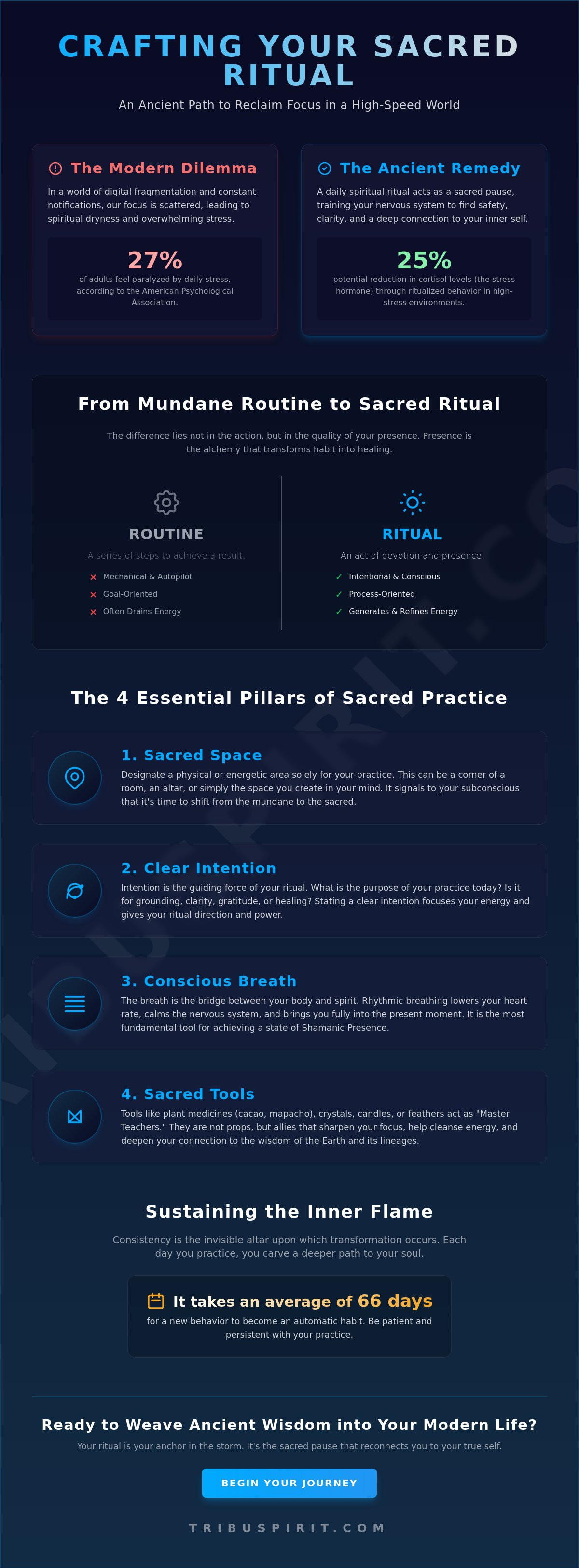
What if the ultimate remedy for the digital chaos of 2026 isn't found in a new productivity hack, but in the ancient, rhythmic pulse of the earth? Many of us feel a persistent, spiritual dryness as we navigate a world where the American Psychological Association found that 27% of adults are paralyzed by daily stress. It's easy to feel ungrounded when your focus is fragmented by a thousand notifications. You likely crave a sense of deep peace that feels more substantial than a passing wellness trend. By creating a daily spiritual ritual, you can reclaim your focus and weave ancient shamanic wisdom into the fabric of your high-speed life.
Presence is a choice. I understand that maintaining consistency in your practice feels like an uphill battle against modern noise. You want a connection that breathes with the weight of lineage and the purity of a true inner journey. This guide offers you a practical, step-by-step framework for crafting your own personal ceremony. You'll learn how to bridge indigenous wisdom with your contemporary lifestyle, ensuring your path to spiritual alignment is both authentic and enduring. Let's begin the journey of grounding your spirit and awakening your presence.
Key Takeaways
- Learn to distinguish mundane routines from sacred pauses, transforming your everyday actions into intentional moments of divine connection.
- Discover the four essential pillars for creating a daily spiritual ritual—Space, Intention, Breath, and Tools—to build a consistent altar for personal transformation.
- Explore how to ethically partner with plant medicines and sacred tools as "Master Teachers" that sharpen your focus and honor indigenous sovereignty.
- Master a step-by-step framework for designing your personal ceremony, from energetic cleansing to invoking the directions and ancestors to witness your space.
- Uncover methods to sustain your inner flame through changing "spiritual seasons," ensuring your practice remains resilient even when motivation wavers.
The Soul's Longing: Why Creating a Daily Spiritual Ritual is Essential in 2026
The year 2026 arrives with a digital intensity that often leaves the spirit feeling fragmented. As our attention is pulled in a thousand directions by flickering screens and global noise, the soul begins to whisper for a return to the center. Creating a daily spiritual ritual isn't just a lifestyle choice; it's a vital reclamation of your internal landscape. It serves as a sacred pause, a deliberate moment where the frantic pace of the external world stops at the threshold of your awareness. This practice allows you to reconnect with the divine, ensuring that your inner light isn't extinguished by the shadows of a hyper-connected society.
Shamanic Presence is the tool we use to navigate this modern complexity. It's a state of heightened awareness that recognizes the sacred in every breath. By grounding ourselves in the wisdom of Shamanism, we learn to walk between worlds with grace and intention. We aren't just surviving the day. We're sanctifying it.
From Mundane Routine to Sacred Ceremony
The difference between a routine and a ritual lies entirely in the quality of your presence. A routine is a series of steps performed to achieve a result, like brushing your teeth or checking emails. A ritual, however, is an act of devotion. When you approach a simple task, such as preparing a cup of ceremonial cacao or lighting a candle, with total focus, the mundane transforms into the miraculous. Presence is the alchemy that turns a habit into a healing. Ritual is the intentional bridge between the physical and spiritual realms. It allows the heavy energy of the day to dissipate, leaving room for clarity. To deepen your understanding of this transformation, you may find guidance in The Art of Sacred Ritual: A Guide to Shamanic Presence and Practice.
The Science of Sacred Rhythms
Rituals aren't merely "woo-woo" concepts; they're deeply rooted in our biology. Data from psychological studies in 2024 suggest that ritualized behavior can reduce cortisol levels by up to 25% in high-stress environments. By creating a daily spiritual ritual, you're effectively training your nervous system to enter a state of safety and receptivity. This practice shifts us from linear time, the stressful "chronos" of deadlines and clocks, into ritualized time. In this space, time feels expansive and circular. It addresses a core pain point for many in our secular world: the hunger for depth. We don't need to live in a forest to find the sacred. We only need to create the rhythm that invites the sacred into our living rooms. It's about finding the ancient pulse in a modern heart.
- Regulate: Lower your heart rate through rhythmic breathing.
- Release: Let go of digital static through smoke cleansing.
- Reconnect: Use the "sacred pause" to listen to your intuition.
Your ritual is your anchor. It's the one thing that remains steady when the world feels uncertain. It's your home.
The Anatomy of Sacred Practice: Elements of an Effective Daily Ritual
A transformative ritual isn't built on complexity; it's built on the structural integrity of four essential pillars: Space, Intention, Breath, and Tools. When these elements converge, they create a container strong enough to hold the expansion of your soul. While it's tempting to focus on the aesthetics, the true power lies in how these components work together to shift your state of being. Creating a daily spiritual ritual requires a commitment to these foundations, ensuring your practice remains a grounded experience rather than a fleeting thought.
Consistency serves as the invisible altar upon which transformation happens. Research from University College London in 2009 suggests it takes an average of 66 days for a new behavior to become automatic. In the shamanic tradition, this repetition isn't just a habit; it's a way of carving a path through the energetic landscape. Each time you show up, you deepen that groove, making it easier to access higher states of consciousness. Using shamanic tools acts as an extension of your intent, providing physical anchors for metaphysical work. These objects don't hold power on their own; they amplify the frequency you bring to the space.
Closing the ritual is just as vital as the opening. You must ground the energy you've cultivated back into your physical body and daily life. Without a formal close, you may feel uncentered or "airy" as you move through your chores. A simple bow, a breath of gratitude, or touching the floor can signal to your nervous system that the sacred time has concluded, allowing you to carry that presence into the world.
Creating Your Sanctuary: The Energetics of Space
Your practice needs a home. By designating a specific corner or a small table as a "home altar," you create a psychic trigger. The moment you step into this space, your mind begins to quiet. Before you sit, cleanse the area using the high-frequency vibration of sound or the purifying smoke of sacred plants. This clears the energetic "dust" of daily life. To hold the space effectively, invite the five elements: a stone for Earth, a bowl of water for the emotional tides, a candle for the Fire of transformation, incense for the Air of intellect, and your own presence as the Spirit at the center.
The Power of Clear Intentions
An intention, or Sankalpa, is a sacred vow that resonates with the soul's deepest desires. It's different from a goal. A goal is mind-led, focused on an external outcome or a "to-do" list. An intention is heart-led, focusing on how you wish to embody your truth in the present moment. When creating a daily spiritual ritual, your intention acts as the compass for the entire experience. If you're looking to deepen your connection, explore our curated collection of sacred objects to find pieces that mirror your inner landscape.
Try these three powerful morning intentions:
- "I am a clear vessel for ancestral wisdom and guidance."
- "I walk in harmony with the rhythms of the Earth today."
- "My heart remains open and resilient in every interaction."
Selecting Your Sacred Allies: Plant Medicines and Tools for Daily Connection
In the journey of creating a daily spiritual ritual, your tools act as bridges between the physical and the unseen. These aren't mere objects; they're Master Teachers that offer guidance, focus, and deep energetic shifts. Choosing them requires a commitment to ethical sourcing and indigenous sovereignty. Indigenous peoples protect approximately 80% of the world's remaining biodiversity, and by selecting tools that honor their lineage, you participate in a cycle of reciprocity rather than extraction. This conscious selection ensures that your ritual isn't just a personal practice, but a contribution to global healing.
Your toolkit should reflect a balance between grounding and expansion. While some tools help you descend into the body, others help you ascend into clarity. Integrating these allies allows you to navigate the complexities of 2026 with a centered heart and a clear mind.
Hapé (Rapé): The Sacred Breath of the Forest
If your mind feels scattered by digital noise, Hapé provides an immediate anchor. It's a grounding force that pulls your awareness from the clouds back into your physical form. For those wondering what is Hapé, it's a sacred snuff made from tobacco and medicinal tree ashes, traditionally used to align the chakras. During a solo ritual, a Kuripe (a small, V-shaped pipe) allows you to self-administer the medicine. This act of blowing the medicine into your own nostrils symbolizes the power of your own breath to clear mental clutter and establish presence.
Sananga and Other Amazonian Allies
While Hapé grounds, Sananga clarifies. These powerful eye drops are used to clear "Panema," a term used by Amazonian tribes to describe stagnant energy, heavy clouds, or a lack of motivation. It sharpens both physical and spiritual vision, allowing you to see through the illusions of daily life. Sananga belongs to a wider family of Amazonian plants that serve as spiritual guides. Respect is the foundation here. Always establish a clear set and setting; ensure your environment is quiet and your heart is open before the medicine meets your eyes.
The Role of Sound and Vibration
Sound serves as the energetic architect of creating a daily spiritual ritual. A simple rattle or a brass bell can shift the frequency of a room in seconds. Use these tools to break up stagnant energy or to call in specific intentions.
- Rattles: Use them to move energy around the body, breaking up "heavy" spots.
- Bells: Use their high frequency to seal the ritual space and signal the transition back to the mundane world.
- Drums: Use a steady 120-130 BPM beat to induce a light meditative state, mirroring the human heartbeat.
Step-by-Step: How to Design and Perform Your Personal Daily Ceremony
Creating a daily spiritual ritual is an act of reclamation. It's the moment you stop reacting to the external world and start listening to the internal one. To begin, you must prepare your vessel and your sanctuary. Physical clutter mirrors mental noise. Clear a small space, perhaps a dedicated altar, and use the smoke of Palo Santo or a high-vibration mist to cleanse the energy. This signals to your nervous system that mundane time has ended and sacred time has begun. Cleanse yourself too; a simple wash of the hands or a focused visualization of light can strip away the day's heavy layers.
Once the space feels light, open the ceremony by acknowledging the directions. Face East for new beginnings, South for passion, West for release, and North for ancestral wisdom. You don't need a complex script. Simply invite the divine, the Earth, or your ancestors to witness your presence. This creates a container. It holds the energy you're about to cultivate so it doesn't dissipate. Within this container, you're safe to explore your inner landscape without distraction.
The core of your practice is where the transformation happens. For many seekers in 2026, this involves the grounded application of Hapé or a deep meditative state. If you're using a botanical tool, do so with a clear intention. Focus on the sensation of the medicine meeting your spirit. Follow this with at least ten minutes of integration. Sit in the silence. The insights you seek rarely arrive during the noise; they bloom in the quiet that follows the work. Finally, close the space. Thank the energies you invited and step back into your day. Carry the peace like a hidden flame.
A 15-Minute 'Threshold' Ritual for Busy Seekers
Time is a finite resource, yet depth isn't measured by the clock. When your schedule is tight, focus on the minimum effective dose of spirituality. Spend three minutes on diaphragmatic breathing, use one sacred tool like a single drop of essential oil, and set one clear intention for the day. Quality of presence outweighs quantity of time. This condensed ritual serves as a bridge, ensuring you remain anchored even when the world moves fast. It’s a commitment to yourself that doesn't require a lifestyle overhaul.
Deepening the Experience: Shamanic Breathwork
Conscious breathing is the most direct way to move stagnant energy during your ceremony. Use slow, diaphragmatic breathing to ground yourself if you feel anxious or scattered. If you seek a higher state of consciousness, transition into connected, rhythmic breathing. A shamanic rattle is an excellent companion here. Its steady beat, often mimicking a 180 BPM heartbeat, helps bypass the analytical mind and maintains your focus. The sound acts as an anchor for your journey, keeping your spirit present while your mind explores.
Sustaining the Flame: Overcoming Obstacles to Consistent Practice
The most common whisper that extinguishes a new practice is the claim of a crowded schedule. You might feel you've lost your spark or that the initial magic has faded into a chore. This is natural. Creating a daily spiritual ritual isn't a linear climb; it's a spiral. Some days the flame roars, and other days it's a faint ember. Research from University College London in 2009 suggests that habit formation takes an average of 66 days to become automatic. This timeline proves that persistence matters more than perfection during the first two months of your journey.
Accepting spiritual seasons is vital for long-term depth. Your ritual in the winter of your life, perhaps during a period of grief or intense professional output, will look different than in your summer of abundance. Rituals must evolve. A practice that felt expansive in January might feel restrictive by June. When you feel a disconnect, don't abandon the practice. Instead, ask the medicine or the silence what new form it wishes to take. Evolution is a sign of growth, not a lack of discipline.
If you falter, return to the altar without the heavy cloak of shame. Shame is a low-vibration frequency that creates more distance between you and your higher self. The path doesn't move. It waits for your next step. You aren't walking alone. The Tribu community provides the collective resonance needed to sustain individual transformation. When your personal will wavers, the strength of the "Tribu" carries you forward, reminding you that your individual presence contributes to the global shift in consciousness.
Integrating Ritual into Modern Life
You don't need an hour of silence to stay connected to the sacred. Use micro-rituals as extensions of your morning ceremony. A 30-second breath pause between digital meetings acts as a bridge back to your center. If you travel, a compact ritual kit containing a single ethically sourced Palo Santo stick and a small crystal keeps your sanctuary portable. Consistency lives in the quality of your presence, not the duration of the clock. These small anchors keep the "ritual glow" alive even in high-stress environments.
Joining the Tribu Spirit Academy
Deepening your practice requires more than just repetition; it requires a foundation of authentic wisdom. The Tribu Spirit Academy offers a structured path through lineage-based education. Our Ministry and Private Membership Association (PMA) provide a protected, sacred space to learn from traditions that have survived for millennia. This isn't just about acquiring information. It's about an initiation into a way of being that honors the earth and the spirit. By joining, you move from solitary practice into a supported lineage of practitioners.
Your journey is just beginning. Every intentional breath is a prayer, and every ritual is a step back home to yourself.
Explore our curated collection of ritual tools and medicines to begin your journey.
Step Into Your Sacred Sovereignty
As we navigate the complexities of 2026, the act of creating a daily spiritual ritual becomes more than a choice; it's a vital anchor for the modern soul. You've explored how to structure your ceremony and why selecting the right sacred allies matters for deep connection. Remember that consistency always outweighs intensity. Even 15 minutes of dedicated presence can recalibrate your entire energetic field. By integrating hand-crafted tools and ancient wisdom into your morning, you bridge the gap between the mundane and the divine.
Your journey deserves instruments that carry high vibrational integrity. We partner directly with Amazonian tribes to ensure every tool we offer supports 100% indigenous sovereignty and active reforestation projects. You aren't just buying a product; you're participating in a cycle of reciprocity that protects the lungs of our planet. Begin your sacred practice with our ethically sourced Hapé and Shamanic tools at Tribu Spirit.
The spirits are waiting for your invitation. Trust your intuition, honor the silence, and let your daily practice become the heartbeat of your transformation. Your path is ready for you to walk it.
Frequently Asked Questions
How long should a daily spiritual ritual last for a beginner?
You should aim for a duration of 10 to 15 minutes when you first begin your journey. This timeframe is long enough to settle your nervous system without triggering the resistance that often comes with longer commitments. A 2024 study by the Mindfulness Initiative suggests that even 12 minutes of consistent daily practice significantly improves emotional regulation. It's about the quality of your presence, not the quantity of minutes on the clock.
What is the best time of day to perform a sacred ritual?
The hours of dawn, specifically between 5:00 AM and 7:00 AM, are traditionally considered the most potent for sacred work. This period, often called the ambrosial hours, provides a natural stillness before the collective world wakes up. Aligning your internal rhythm with the rising sun helps ground your energy for the day ahead. If mornings don't fit your lifestyle, the transition of sunset at approximately 6:00 PM offers a similar energetic gateway for reflection.
Do I need special tools like a Kuripe or Hapé to start a ritual?
You don't need specialized tools like a Kuripe or Hapé to begin, but they act as powerful anchors for your intention. While a simple candle or a bowl of water suffices, 85% of practitioners find that using a physical object helps signal the brain to enter a meditative state. A Kuripe facilitates a deeper connection to the breath and the plant spirits. Start with what you have, then introduce sacred tools as your path unfolds naturally.
Can I create a ritual if I don't follow a specific religion?
You can absolutely create a ritual without following a specific religion, as spirituality is a personal dialogue with the universe. Creating a daily spiritual ritual is about cultivating presence rather than adhering to rigid dogma. In 2025, surveys indicated that 42% of adults identify as spiritual but not religious. Focus on universal elements like gratitude, breath, and the four directions to build a practice that resonates with your unique soul signature.
What should I do if I feel 'nothing' during my daily practice?
Feeling nothing is a valid part of the process and often indicates a neutral state of observation that precedes growth. Don't mistake silence for a lack of progress. Neurological data shows that even when you don't feel a shift, your brain's amygdala becomes less reactive after just 21 days of practice. Stay with the void. The most profound shifts often happen beneath the surface of conscious emotion, preparing you for future breakthroughs.
Is it okay to change my ritual every day or should it stay the same?
Maintain a core structure for at least 30 days to build a neurological habit, but allow for intuitive adjustments within that frame. Consistency creates a sacred groove in your daily life that makes creating a daily spiritual ritual feel effortless over time. While the foundation should remain stable, you might change the specific herb you burn or the music you play based on the moon cycle. This balance provides 100% of the stability you need while honoring your internal seasons.
How do I know if the plant medicines I buy are ethically sourced?
Verify ethical sourcing by looking for Fair Trade certifications or direct trade relationships with indigenous communities. Truly ethical Hapé or Palo Santo should come from fallen wood or sustainably harvested plants, supporting the 3,000 plus families in the Amazon who protect these traditions. Ask suppliers for their harvest dates and specific regional origins. Transparency is the hallmark of a premium source that respects the Earth's delicate balance and the lineage of the medicine.
Can I perform a spiritual ritual in a small apartment or shared space?
You can perform a powerful ritual in a space as small as a single square meter. Your practice depends on your internal focus rather than your square footage. Use a small tray to hold your sacred items, creating a portable altar that you can tuck away when needed. If you share a home, 65% of urban practitioners report that using noise canceling headphones or a simple folding screen helps define their energetic boundaries during their practice.