

What if the moment you feel most "enlightened" is actually when your ego is at its most dangerous? It is a quiet, shimmering deception. You might find yourself looking at friends or family with a hidden sense of pity because they don't yet perceive the frequencies you've discovered. This is the wolf in sheep's clothing. Learning how to avoid spiritual ego traps is perhaps the most essential skill for any practitioner who wishes to move beyond spiritual performance and into genuine, heart-centered service. It is the delicate art of keeping your crown in the stars while your feet are buried deep in the mud.
You've likely felt that heavy friction when your inner growth starts to feel like a competition or an exclusive club. It is exhausting to maintain an image of constant high-vibration when your soul is simply craving raw, human honesty. We will explore how to recognize the subtle flickers of spiritual pride before they dim your true light. You'll discover how to use sacred grounding tools, such as the stabilizing force of Hapé or the focus of Mambe, to remain tethered to the earth. We are going to look at the power of indigenous reciprocity and how these ancient rituals can turn ego-inflation back into soul-growth.
Key Takeaways
- Understand the "wolf in sheep's clothing" paradox where spiritual tools can inadvertently build a new cage for the ego.
- Learn how to avoid spiritual ego traps by recognizing the subtle symptoms of moral superiority and emotional bypassing.
- Discover the grounding power of sacred Amazonian medicines like Hapé to anchor your "sky-energy" back into the physical body.
- Embrace the principle of Ayni to ensure your spiritual path remains one of sacred reciprocity and humble service.
- Implement "Mundane Zen" and the support of honest companions to keep your growth authentic and free from pretension.
The Paradox of the Path: What is the Spiritual Ego?
The spiritual path is a descent into the heart, yet the mind often tries to turn it into an ascent toward a pedestal. We call this the "wolf in sheep's clothing" because it mimics the language of light while feeding the shadow of separation. When you begin to understand how to avoid spiritual ego traps, you realize that the very tools meant to set you free can become the bars of a new, more refined cage. It is a subtle deception. The ego doesn't necessarily want to stop your growth; it simply wants to lead the parade.
It is a delicate paradox. We use meditation to quiet the mind, but the ego might use that silence to feel superior to those who live in noise. We use sacred medicines to dissolve the self, yet the ego claims the resulting visions as personal achievements. This process is a form of Spiritual materialism, where spiritual practices are treated as commodities to enhance our self-image rather than to dissolve it. True spiritual confidence is quiet, inclusive, and deeply humble. Ego-driven inflation is loud, even in its most "peaceful" presentation. Engaging in sacred ritual serves as a mirror, showing us where we are performing and where we are truly present.
Why the Ego Hijacks Enlightenment
The ego is a survival specialist. When it senses that its old, worldly identity is no longer serving your growth, it doesn't simply vanish. It adapts. It begins to identify with "high-vibration" concepts, diet choices, and esoteric knowledge. This creates a false sense of arrival. You feel you've "made it" because you can quote scripture or describe the chakras. Beginners are particularly vulnerable to the "teacher complex," where a few months of practice feel like a lifetime of mastery. Learning how to avoid spiritual ego traps requires us to see that knowledge without the weight of lived experience is just another costume.
The Difference Between Soul and Ego Awareness
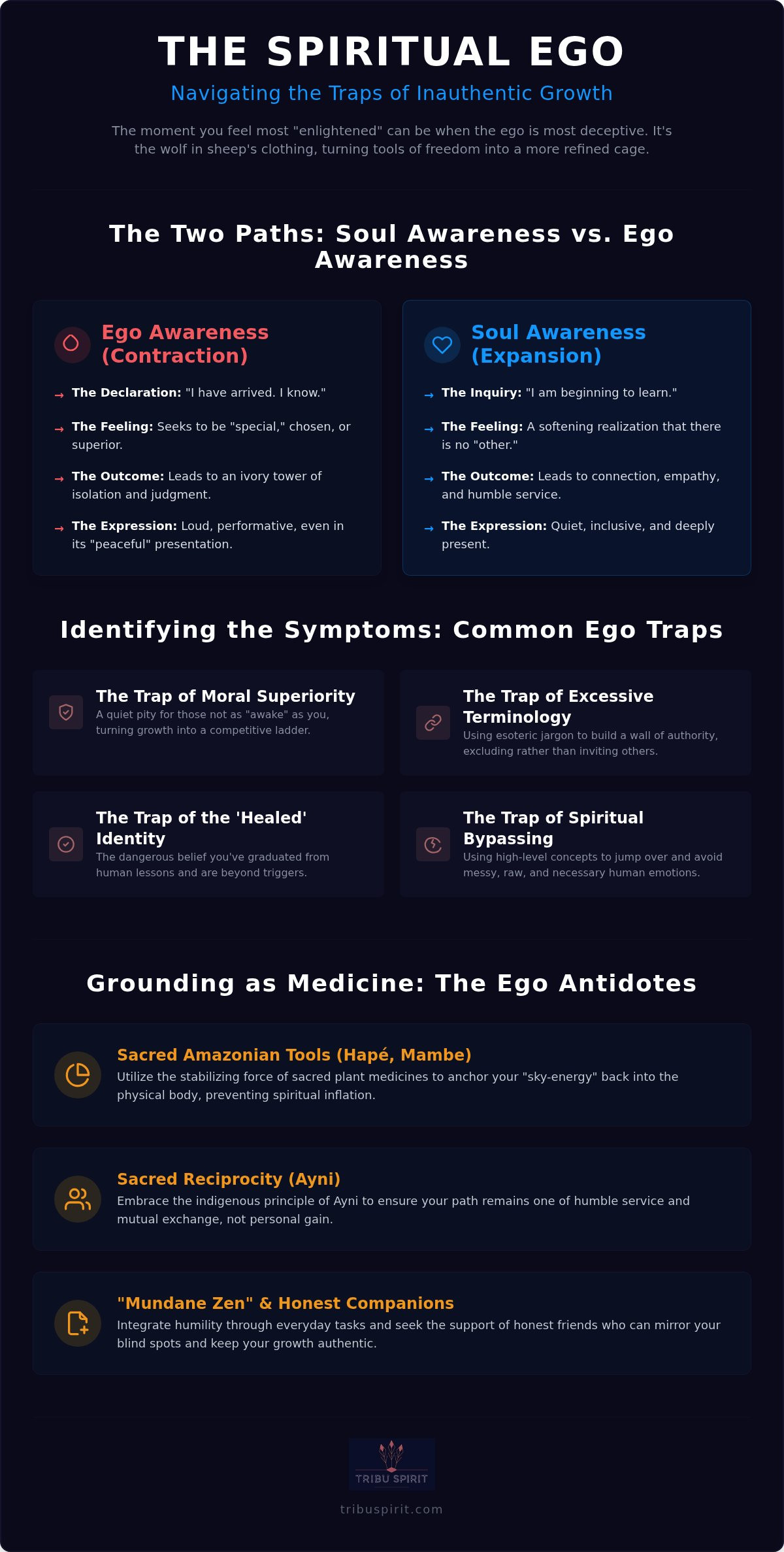
Soul awareness is an expansive movement toward unity. It feels like a softening, a realization that there is no "other." Ego awareness, even in a spiritual context, is a contraction. It seeks to make you "special" or "chosen." You can feel the difference in your body. The soul says, "I am beginning to learn," while the ego declares, "I have reached it." One leads to connection; the other leads to an ivory tower of isolation. Real growth is measured by how much more you love the world, not by how much you feel you've transcended it.
The spiritual ego is the mind's attempt to own the soul's experience.
Identifying the Symptoms: Common Spiritual Ego Traps
Recognizing the shadows within our own light is a courageous act of honesty. When we walk the shamanic path, the ego doesn't simply vanish; it becomes more sophisticated. To master how to avoid spiritual ego traps, we must first learn to spot the shimmering masks the mind wears to hide its desire for control. These traps are often built from the very virtues we strive to embody, making them difficult to detect without a dedicated practice of self-observation.
There are several common archetypes that the spiritual ego adopts to maintain its sense of "specialness" and separation:
- The Trap of Moral Superiority: This manifests as a quiet, internal pity for those who aren't as "awake" as you. It turns your growth into a ladder where you are several rungs above the "unconscious" masses.
- The Trap of Excessive Terminology: Using esoteric jargon or shamanic dialects to build a wall of authority. If your language makes others feel excluded rather than invited, it is likely serving the ego.
- The Trap of the 'Healed' Identity: The dangerous belief that you've graduated from basic human lessons. When you believe you're beyond triggers, you stop looking for the growth hidden within your daily frustrations.
The Mirror of Judgment
Our reaction to people we deem "unconscious" or "low-vibration" is a profound soul's mirror. If their behavior triggers a sense of smugness or irritation, it's a clear signal that the ego is attached to its spiritual status. True awakening leads to a softening of the heart and deeper empathy, not a higher pedestal of judgment. Maintaining a "Beginner's Mind" in every ceremony prevents our practice from becoming a performance for an invisible audience. It's about being present with what is, not appearing to be more than you are.
Spiritual Bypassing and the Avoidance of Shadow
Spiritual bypassing is the act of using high-level concepts to jump over the messy, painful work of being human. We might say "everything happens for a reason" to avoid feeling the raw sting of grief, or claim "it's all an illusion" to escape accountability for a mistake. Sacred Amazonian plants are powerful allies in this work; they act as master teachers that often strip away these intellectual shields. They force us to sit with the raw truth of our shadow, ensuring that our spirituality is grounded in reality rather than fantasy.
Developing the discernment to see these patterns requires a foundation of spiritual maturity. For those who feel called to explore these boundaries with integrity, the Tribu Spirit Academy provides the education needed to navigate the complexities of the shamanic path with a humble heart.
Grounding as Medicine: Using Sacred Tools to Anchor the Self
The spiritual path often pulls us upward, toward the expansive "Sky-energy" of visions and high-vibrational insights. While these moments are beautiful, they are also where the ego loves to build its nest. To understand how to avoid spiritual ego traps, we must cultivate "Earth-energy." This is the stabilizing weight of the physical body and the present moment. Grounding isn't just a concept; it's a physiological necessity for anyone working with deep spiritual states. Without it, our insights remain untethered, floating in the mind as fuel for self-importance.
One of the most potent allies in this process is Hapé (Rapé). This sacred snuff acts as a medicine of truth, immediately pulling the awareness out of the swirling clouds of the mind and into the center of the chest. It's hard to feel superior or enlightened when you are physically humbled by the intensity of the forest's breath. Similarly, Sananga drops are used to clear spiritual cataracts. These are the subtle layers of ego-illusion that distort our vision, making us see ourselves as more advanced than we truly are. Using a Bamboo Kuripe to administer these medicines requires a moment of pause and self-reflection, turning the act into a mirror of our own intentions.
Hapé: The Medicine of Truth and Humility
The physical intensity of a Hapé ceremony is a direct antidote to grandiosity. When the medicine enters, the mind's chatter stops. You're forced to be here, now, in this body. Using shamanic tools like the Kuripe requires a humble approach; you aren't just taking a substance, you're engaging with a tradition. Tsunu Hapé provides a profound energetic anchor, clearing the mental fog that allows the ego to weave its complex stories of self-importance. It's about finding the balance between the human and the divine, ensuring your feet remain in the mud even as your head touches the stars.
Ritual as a Humbling Practice
The ego often looks for the shortest path to enlightenment. It wants the "high" without the work. The discipline of daily ritual acts as a necessary friction against this desire. Sitting with the medicine in a structured way teaches us to listen rather than to claim we already know. When you hold your Kuripe, you are holding a bridge between your breath and the earth. It reminds you that spirit must be inhaled and then lived in the physical world. This ritualized slowing down is a core strategy for how to avoid spiritual ego traps, ensuring that every insight is anchored in humility and service.
Practicing Sacred Reciprocity: The Ultimate Ego Antidote
In the lush wisdom of the Andes and the Amazon, there is a fundamental law known as Ayni. This is the principle of sacred reciprocity, the rhythmic breathing of the universe where every taking must be met with a giving. While the spiritual ego thrives on accumulation, seeking to collect experiences, titles, and "levels" of consciousness, Ayni demands a different posture. It asks: what are you offering back to the source? Learning how to avoid spiritual ego traps requires us to move beyond the internal theater of "my enlightenment" and into the living reality of mutual support.
The ego is naturally extractive. It feels entitled to the wisdom of ancient lineages without considering the people who have protected those traditions through centuries of hardship. By practicing Ayni, we collapse the pedestal of the "special practitioner" and become part of a larger, humble ecosystem of care. When the focus shifts from self-gain to collective well-being, the ego's influence naturally begins to wither.
Service Over Self-Glorification
True spiritual maturity is often found in the most mundane places. It isn't reflected in how many ceremonies you've attended, but in how you treat your neighbor or how you serve your local community. When your practice is focused on service, the ego loses its grip because there is no room for self-congratulation. You are simply a vessel. Honoring the tribes behind medicines like Mambe or Ambil means acknowledging that this wisdom is a borrowed gift. The greatest masters don't look for followers; they look for ways to be useful. This shift in focus is a primary method for how to avoid spiritual ego traps.
The Ethics of Extraction vs. Exchange
The modern spiritual landscape often treats indigenous wisdom as a resource to be mined. This sense of entitlement is the ego's subtle way of maintaining dominance. True exchange means ensuring your path supports the preservation of the Amazon and the sovereignty of its people. It's about reciprocity, not just consumption. Tribu Spirit serves as a bridge in this process, prioritizing fair-trade practices and cultural preservation over mere commerce. When you choose tools sourced with integrity, your healing journey becomes an act of advocacy for the forest itself.
To deepen your commitment to this path of integrity, you can explore our ethically sourced shamanic tools that honor the principle of Ayni with every breath.
Integrating Humility: How to Stay Grounded Daily
The true test of a shamanic practice doesn't happen in the glow of a candle or the quiet of a temple. It happens in the friction of a Tuesday morning. Spiritual growth isn't measured by the height of your visions, but by the depth of your humility in the face of the mundane. If your practice makes you feel too "advanced" for the grocery store or the dishes, the ego has taken the wheel. Learning how to avoid spiritual ego traps requires a commitment to the small, invisible acts of life that keep the heart soft and the mind quiet.
To stay anchored, we must build a structure of accountability into our daily lives. This begins with inviting "Mirror People" into your circle. These are the friends who don't care about your "vibration" and aren't afraid to tell you when you're being pretentious or self-absorbed. We also practice "Mundane Zen." This is the intentional act of treating chores, physical labor, or administrative tasks as high spiritual work. When you scrub a floor with the same presence you bring to a ceremony, the ego has no pedestal to stand on. Finally, practice regular self-inquiry. Before you speak or post about your journey, ask: "Who is this practice serving right now?" If the answer is your image, it's time to return to the breath.
The Importance of Integration
The work only begins after the ceremony ends. We often chase the peak experience, but the medicine's real value is found in how it changes your interactions with your family and colleagues. Integration is the process of making the sacred ordinary and the ordinary sacred. It involves bringing that shamanic presence into your workplace, where your "enlightenment" is tested by deadlines and difficult conversations. If you can't be kind when you're tired, your spiritual knowledge is still just a theory. Stay a student of your own reactions.
Staying the Course with Tribu Spirit
A lifelong path of growth requires a community that values indigenous wisdom over personal branding. The Tribu Spirit Academy offers a space to deepen your understanding of these ancient traditions while remaining a "forever student." This mindset is a primary strategy for how to avoid spiritual ego traps, as it replaces the "master" complex with a heart of service. By staying connected to the roots of the medicine, we ensure our growth remains authentic and grounded in truth. Explore our grounding Hapé blends to support your journey and keep your spirit tethered to the wisdom of the earth.
Walking the Path of Humble Presence
The journey toward the self is not a climb up a ladder, but a deepening of the roots. By recognizing the subtle symptoms of the spiritual ego and embracing the grounding weight of sacred tools, you transform your practice from a performance into a genuine way of being. Understanding how to avoid spiritual ego traps is a lifelong commitment to radical honesty and earth-energy. It's about finding the sacred in the mundane and ensuring that every insight is balanced by the humble principle of Ayni.
As you continue to evolve, remember that you don't have to walk this path alone. You can Explore Grounding Medicines & Tools at Tribu Spirit, where every Hapé blend and Kuripe is ethically sourced from indigenous tribes. Through our Academy, we offer the educational support needed to cultivate spiritual maturity while contributing to Amazonian reforestation. Your growth is a gift to the world when it's anchored in truth and reciprocity. Stay curious, stay grounded, and remain a forever student of the forest's quiet wisdom.
Frequently Asked Questions
What are the first signs of a spiritual ego trap?
The first signs of a spiritual ego trap often manifest as a subtle sense of moral superiority or a quiet judgment toward those you perceive as "less conscious." You might feel a need to perform your spirituality for others or use esoteric language to build a wall of authority. Recognizing these flickers of pride is the first step in learning how to avoid spiritual ego traps. It's about noticing when your growth becomes a way to separate yourself rather than a way to connect.
Can I use Hapé to help overcome spiritual pride?
You can certainly use Hapé as a powerful ally to overcome spiritual pride because its physical intensity demands immediate presence and deep humility. The medicine acts as a "medicine of truth" that clears mental grandiosity by pulling your awareness back into your physical body. It's difficult for the ego to maintain a pedestal when you're physically humbled by the forest's breath. Regular, intentional use of Tsunu or Mulateiro blends helps keep your spirit anchored in reality.
Is it possible to be spiritual without having an ego?
It's not possible to be a human being without an ego, as it serves as the necessary interface for our physical experience. The goal of a grounded practice isn't to kill the ego, but to bring it into right relationship with the soul. When the ego is healthy, it acts as a servant to your higher purpose rather than the master of your journey. Spiritual maturity is about transparency and honesty, not the absence of a self.
How do I deal with friends who say I've changed since starting my spiritual path?
When friends observe that you've changed, listen to their feedback with genuine humility rather than defensiveness or hidden pity. Their observations can serve as a valuable mirror, showing you where you might be acting from a place of spiritual pretension. If you've become less accessible or more judgmental, use their honesty as a catalyst for deeper grounding. True awakening should make you more relatable and compassionate, not more isolated in your "specialness."
What is spiritual bypassing and how do I avoid it?
Spiritual bypassing is the tendency to use high-level spiritual concepts to avoid facing messy human emotions or personal accountability. You can avoid it by committing to shadow work and acknowledging that your "human-ness" is just as sacred as your "spirit-ness." Understanding how to avoid spiritual ego traps involves realizing that no amount of meditation replaces the need for psychological honesty. Facing your pain directly is the only way to ensure your growth is authentic and stable.
Why is grounding so important in shamanic practices?
Grounding is essential because it balances the "Sky-energy" of spiritual insights with the "Earth-energy" of physical stability. Without a strong anchor, practitioners can become unmoored, leading to the inflation and grandiosity typical of the spiritual ego. In shamanic traditions, the earth provides the necessary weight to process high-vibrational experiences safely. It ensures that your visions are translated into practical service and stable, daily wisdom rather than just mental fantasy or self-serving stories.
How does the Tribu Spirit Academy help with spiritual maturity?
The Tribu Spirit Academy provides structured education that emphasizes the ethics and spiritual maturity required for working with sacred medicines. By focusing on indigenous sovereignty and the principle of Ayni, the Academy ensures that students remain in a state of "forever student" humility. This educational framework prevents the "teacher complex" that often plagues beginners who feel they've reached a final destination. It offers a community that values deep, slow integration over the pursuit of quick breakthroughs.
What is the role of a Kuripe in a grounding ritual?
The Kuripe serves as a sacred bridge between your breath and the earth, facilitating a focused, self-administered grounding ritual. Using this tool requires a moment of pause and clear intention, which naturally humbles the practitioner. It allows you to take responsibility for your own state of being, fostering self-reflection and presence. By connecting your life-force to the medicine, the Kuripe reinforces the idea that spiritual tools are for service and self-correction, not for display or status.