
You step out of the sacred circle and back into the hum of the city, only to find that the profound whispers of the medicine are already starting to fade like a half-remembered dream. It's a common, heavy realization. The altar felt like home, but the daily grind feels like a foreign land where your new insights don't quite fit. You aren't alone in feeling that post-ceremony disconnect or the quiet fear that your old habits are waiting just around the corner. Integration is the most vital part of the journey. It's the active ritual of sacred witnessing that ensures your transformation isn't just a fleeting moment. To help you anchor these visions, we have curated a list of intentional journal prompts for after a plant medicine ceremony that will serve as your bridge back to yourself.
In this 2026 integration guide, we'll explore how to translate non-linear experiences into a practical roadmap for your life. You'll find 33 sacred inquiries designed to bring clarity to the messages you received and a sense of deep, lasting peace to your spirit. We'll also discuss how to use grounding tools like Hapé - Tsunu to stabilize your energy as you write. By the end of this guide, you'll have the tools to turn your spiritual insights into a lived reality. The journey doesn't end when the music stops; it's only just beginning.
Key Takeaways
- Understand the sacred "ceremonial container" and how to utilize the 72-hour neuroplasticity window to anchor your spiritual transformation into the physical realm.
- Master the art of capturing non-linear visions through 33 specific journal prompts for after a plant medicine ceremony that prioritize sensory feeling over logical analysis.
- Learn to realign your relationships, career, and daily habits by shifting your focus from the events of the journey to the person you are evolving into.
- Discover how to create a grounded sanctuary for your integration practice using sacred tools like Mapacho and Hapé - Tsunu to stabilize your energy and focus.
The Architecture of Integration: Why Your Journey Doesn’t End at the Altar
The medicine has spoken, the songs have faded, and the candles have burned low. Many believe the work is finished once they leave the sacred circle, but the truth is that the ceremony has only just begun to breathe within you. We call this the ceremonial container. It's an energetic field that remains open long after the physical space is closed, acting as a bridge between the divine realms and your earthly existence. This period is a shimmering threshold. It's a time when the veil is thin and your spirit is exceptionally porous. If you simply return to your old routines without a plan, the profound insights you received can quickly evaporate like mist in the morning sun.
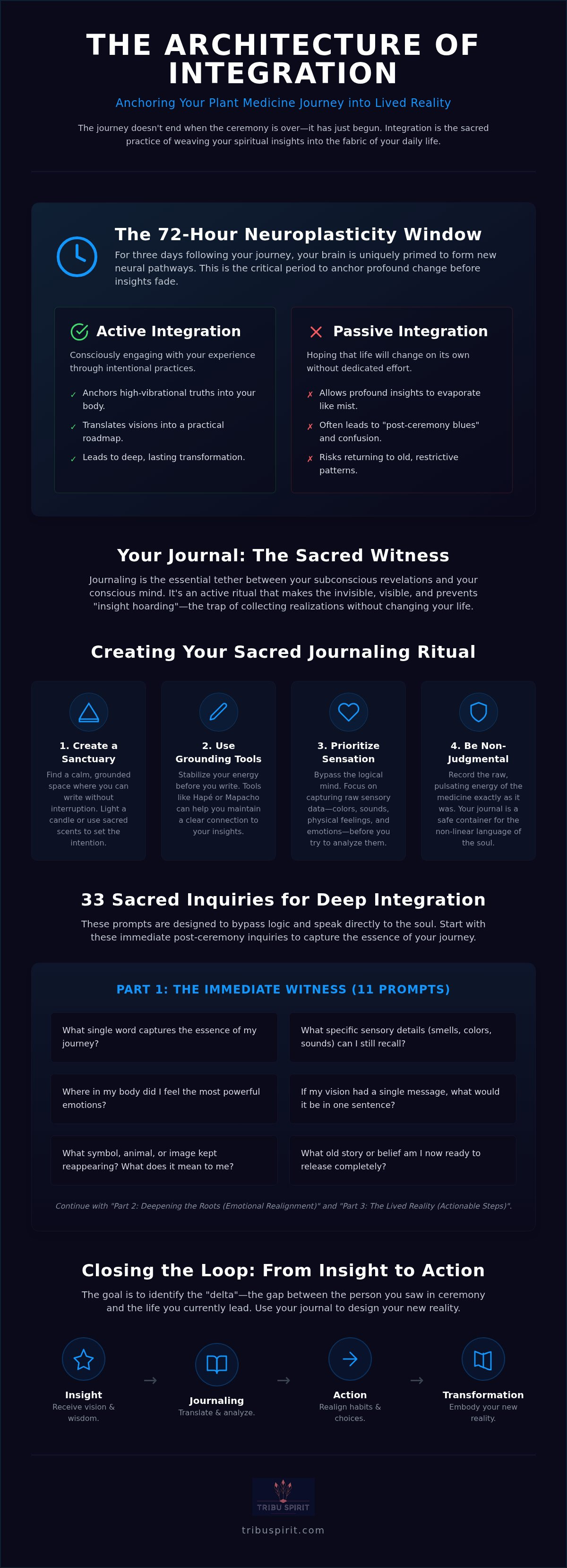
Science and spirit meet in the 72 hours following your journey. This is a critical window of neuroplasticity where your brain is uniquely primed to form new pathways and shed old, restrictive patterns. It's a state of high receptivity. During these three days, your experiences haven't yet solidified into memories; they're still living, breathing energies. Passive integration, which is simply waiting for life to change on its own, often leads to the "post-ceremony blues." Active integration, however, involves using tools like journal prompts for after a plant medicine ceremony to anchor those high-vibrational truths into your physical body. Your journal becomes a Sacred Witness. It's a non-judgmental space where the non-linear language of the soul is translated into the practical steps of a new life.
Closing the Loop on Sacred Experiences
Without a dedicated practice to ground your visions, you risk falling into spiritual bypass. This happens when we use high-state insights to avoid the messy, necessary work of human healing. Writing acts as the essential tether between your subconscious revelations and your conscious mind. It's the process of making the invisible, visible. By engaging in sacred ritual through the act of journaling, you honor the medicine's gifts. You aren't just thinking about the experience; you're physically manifesting it onto the page. This closes the loop, ensuring that the energy of the ceremony is fully digested rather than left hanging in your energetic field as confusion or ungrounded static.
Moving from Insights to Action
The modern seeker often falls into the trap of "insight hoarding." This is the habit of collecting profound realizations without ever changing a single habit or belief. It's a form of spiritual stagnation. Journaling allows you to clearly identify the "delta," which is the specific gap between the person you saw yourself becoming in the ceremony and the life you are currently leading. When you sit down with your journal prompts for after a plant medicine ceremony, you aren't just reflecting. You're designing. You're setting a clear intention for how those celestial lessons will show up in your relationships, your career, and your self-care. It's the difference between a dream and a transformation. Every word you write is a seed planted in the fertile soil of your new reality.
The Sacred Witness: 11 Immediate Post-Ceremony Journal Prompts
The ink meets the paper as a sacred act of preservation. In the hours following your journey, the mind often tries to sanitize the experience by forcing it into logical boxes. Resist this temptation. Your logic is a tool for the mundane world, but here, it acts as a limitation. Using sensory-focused journal prompts for after a plant medicine ceremony allows you to bypass the analytical mind and speak directly to the soul. You are the Sacred Witness. Your task is to record the raw, pulsating energy of the medicine before it is filtered through the lens of 'making sense.' You aren't just writing a diary entry; you're creating a map of a territory few ever visit.
Capture the smells, the temperature of the air, and the specific way the light changed behind your eyelids. These fragments are the breadcrumbs that will lead you back to the center of your vision when the physical world feels loud again. Before you dive into the lists below, settle your energy. You may find that using a bamboo kuripe to center yourself helps maintain the connection to the visionary state while you write. Once grounded, allow your hand to move without hesitation, letting the spirit of the medicine flow through your pen.
Capturing the Visionary Landscape
Focus on the textures and the "atmosphere" of the experience. When we describe the visionary landscape, we often focus on what happened, but it's more vital to record how it felt. Was the space cold and crystalline, or warm and earthy? Capturing these nuances prevents the experience from becoming a flat, intellectual memory. Use these prompts to preserve the non-linear architecture of your journey:
- What were the three most vivid colors, sounds, or textures you experienced?
- If the medicine was a person, what was its personality during this session?
- What was the most challenging moment, and how did you navigate it?
- What ancient symbols or animal guides appeared, and what was their silent message?
- Describe the geometry of the space you inhabited. Was it expansive, or intimately enclosed?
Honoring the Emotional Release
The body often remembers what the mind forgets. Emotional release is a physical event. Whether it was a sob that shook your chest or a quiet sense of forgiveness, these shifts need to be acknowledged as the evidence of your transformation. Tracking where the energy still lingers in your limbs helps you stay present with the ongoing healing process. Reflect on these queries:
- What emotions came to the surface that you haven’t felt in a long time?
- Where in your body do you still feel the "residue" of the ceremony?
- What did you leave behind at the altar?
- Who did you feel a sudden, deep surge of forgiveness for, including yourself?
- Describe the texture of your breath during the peak of the experience.
- What was the "song" of your heart as the ceremony came to a close?
The Final Distillation: After reflecting on these points, write a single, potent sentence defining your primary "takeaway" from the ceremony. This sentence will serve as your North Star in the weeks to come.
Deepening the Roots: 11 Prompts for Emotional and Spiritual Realignment
As the initial glow of the ceremony softens, the real work of transformation begins to take root in your daily life. It's no longer just about the visions you saw. Now, it's about the person you are becoming. This phase, typically spanning weeks two through four, is where the ephemeral insights of the altar become the solid foundation of your character. You are learning to walk with the medicine in your heart while your feet are firmly on the ground. Integrating these lessons requires patience and a willingness to look at the structures of your life with fresh eyes. These journal prompts for after a plant medicine ceremony are designed to help you navigate this transition with grace.
The amazonian plants you encountered often act as master teachers long after the physical session ends. Their wisdom continues to unfold as you navigate your career and spiritual path. These master teachers don't just provide a one-night show; they offer a curriculum for a lifetime of growth. By continuing to engage with their energy through journaling, you keep the dialogue alive. You allow the seeds planted in the ceremony to sprout into tangible changes in your behavior and mindset. This is how you honor the lineage and the sacrifice of the plants.
The Body’s Wisdom and Somatic Integration
The body is the vessel for all spiritual expansion. If you don't integrate somatically, the insights remain trapped in the mind as abstract concepts. True change requires a felt sense of safety and presence in your physical form. Your body is the anchor for your new frequency. Use these prompts to check in with your physical temple:
- How has your relationship with your physical body changed since the ceremony?
- What "food" (literal or energetic) does your body now crave or reject?
- Describe the sensation of being "grounded" in your current environment.
- What physical activities now feel like a form of prayer or meditation?
- Where in your body do you feel the most "spaciousness" today compared to before your journey?
Relational and Social Realignment
Your new frequency will naturally interact with your existing social structures. Some connections will harmonize with your growth; others may feel discordant. This is a natural recalibration of your energetic field. It's a process of pruning and nourishing. Use these journal prompts for after a plant medicine ceremony to evaluate your social landscape and ensure your environment supports your evolution:
- Which relationships in your life feel most "in alignment" with your ceremony insights?
- What boundaries do you feel called to draw to protect your new energy?
- How can you bring the "spirit of the ceremony" into your next difficult conversation?
- What parts of your career or daily routine no longer resonate with the truth you discovered?
- Who in your life supports the version of you that emerged from the altar?
- What specific act of service can you perform this week to honor your insights?
The Integration Checklist: Creating Your Sacred Journaling Ritual
Journaling is often mistakenly viewed as a mundane homework assignment; a chore to be completed after the "real" work of the ceremony is done. This perspective creates a disconnect. To truly bridge the gap between the altar and your daily life, your writing practice must become a ritual in itself. By treating your journal as a sacred object and your writing space as a sanctuary, you invite the spirit of the medicine to remain present. This intentionality signals to your subconscious that you are ready to receive and anchor the lessons. When you sit down with your journal prompts for after a plant medicine ceremony, you aren't just recording thoughts. You are weaving a tapestry of your new reality.
Follow this five-step checklist to establish a powerful container for your integration sessions:
- Step 1: Cleanse your field. Light a piece of Palo Santo or use Mapacho to clear the energetic static from your environment. This resets the space and helps you transition from the noise of the day into a state of receptivity.
- Step 2: Ground your energy. Use a bamboo kuripe to administer a small amount of Hapé - Tsunu. This traditional medicine provides an immediate "drop" into the body, silencing the chatter of the ego and focusing the mind for deep inquiry.
- Step 3: Shift your frequency. Gently use a hand-carved shamanic rattle for two or three minutes. The rhythmic vibration helps shift your brainwaves into a more receptive theta state, making it easier to access the non-linear memories of your journey.
- Step 4: The Timer of Silence. Set a timer for five minutes. Sit in absolute stillness before your pen touches the paper. Allow the internal images to settle and the most important message to rise to the surface.
- Step 5: The Weekly Review. Once a week, read through your previous entries. This allows you to track the evolution of your integration and spot recurring patterns that your daily mind might miss.
Setting the Sacred Container for Writing
The environment where you journal matters as much as the ceremony space itself. If you write in a cluttered office or while distracted by notifications, the quality of your insights will reflect that fragmented energy. Create a dedicated altar for your integration tools. Using the same scent, such as Mapacho, or the same sound, like the rattle, creates a Pavlovian trigger. It tells your nervous system it's time to return to the medicine space. Consistency is your greatest ally. Dedicating the first 30 minutes of your day to this practice ensures that you are moving from a place of soul-alignment rather than reactionary stress.
Overcoming the "Blank Page" Resistance
Resistance is a natural part of the healing process. Sometimes the experience feels too vast, too luminous, or too terrifying to be captured by human language. When you feel stuck, try "stream of consciousness" writing. Don't worry about grammar or logic; just let the words flow. If words fail entirely, use symbols, colors, or drawings. A single golden circle might represent an entire hour of a journey more accurately than three pages of prose. The goal isn't to write a masterpiece. It's to be honest with the page. You can find the essential tools to support this process by exploring our collection of ethically sourced shamanic tools designed for modern ritual.
Sustaining the Spark: Using Hapé and Sacred Tools to Anchor Insights
The echoes of the ceremony can feel like a distant melody as the demands of the modern world begin to crowd your mental space. It's during this transition that the "spark" of your vision is most vulnerable to being extinguished by stress or old habits. Integration isn't a one-time event; it's a sustained practice of remaining in dialogue with the plant spirits. While your journal prompts for after a plant medicine ceremony provide the intellectual and emotional map, sacred tools act as the physical anchor. They serve as a sensory bridge, allowing you to return to the heart of your experience whenever you feel adrift. By incorporating these medicines into your daily life, you ensure that the transformation isn't just a memory, but a living, breathing reality.
Understanding what is hape is essential for anyone serious about the integration path. This sacred Amazonian snuff is more than just a tool for focus; it's a grounding technology that helps the nervous system process the high-vibrational shifts that occur during a journey. It provides a moment of absolute presence, silencing the chatter of the ego so you can hear the quiet whispers of your soul's new direction. When you pair this medicine with your writing practice, the words you record become more than just ink. They become commitments etched into your energetic field.
Grounding the Vision with Hapé
The science of the sacred tobacco in Hapé is deeply connected to the nervous system. After a deep journey, your energetic body can feel "wide open" or even uncomfortably sensitive. Hapé acts as a weighted blanket for the spirit, pulling those celestial visions down into the marrow of your bones. When choosing a blend for integration, hape tsunu is the ideal companion. Known for its ability to provide profound mental clarity and physical stability, it helps you sit with your journal prompts for after a plant medicine ceremony without feeling overwhelmed by the complexity of your insights. Your Kuripe becomes a physical bridge, a tool that connects the "you" who saw the divine with the "you" who is now building a new life.
Maintaining Clarity with Sananga
Post-ceremony "mental fog" is a common hurdle. It's the feeling of being caught between worlds, unable to see how your visions apply to your current reality. Sananga - Strong Strength is a powerful ally for maintaining "spiritual sight." While the medicine works physically on the eyes, its true power lies in its ability to clear the energetic debris from your third eye. Integrating Sananga into your morning ritual helps you "see" the truth of your insights in real-time. It strips away the illusions and excuses that keep you from taking action on your ceremony's messages. This clarity ensures that you don't just write about change; you embody it.
Transformation is a journey best shared with those who honor the same path. We invite you to join the Tribu Spirit community, a space where you can find ongoing support, education, and the high-quality tools necessary for a life of deep integration. Your journey didn't end at the altar. Let us help you sustain the spark as you walk the path of the modern seeker with integrity and grace.
Walking the Path of Integrated Wisdom
The journey beyond the altar is where your true transformation takes root. We've explored how the initial 72 hours post-ceremony represent a vital window for neuroplasticity, and why active integration is the bridge between a fleeting vision and a changed life. By engaging with sensory-focused journal prompts for after a plant medicine ceremony, you anchor non-linear insights into the physical realm. You've also seen how a dedicated ritual space, supported by the right energetic allies, can turn a simple writing practice into a profound act of witnessing. Integration isn't just about remembering; it's about becoming the person your visions showed you could be.
To support this sacred process, we provide hand-carved traditional tools and medicines that are ethically sourced from Amazonian tribes. Our status as a PMA and spiritual ministry ensures that every item you use is handled with the highest level of respect and integrity. Explore our ethically sourced Hapé and Sacred Tools to support your integration ritual. You have the map and the compass. Now, it's time to walk the path with a grounded heart and a clear mind. Your evolution is a continuous prayer.
Frequently Asked Questions
How long after a plant medicine ceremony should I start journaling?
You should ideally begin your practice within the first 24 to 72 hours while your spirit is still porous. This period allows you to capture raw, non-linear impressions before the analytical mind begins to filter them. While immediate writing is powerful, don't rush the process if you feel physically exhausted. Listen to your body's rhythm; even a few sensory keywords written on the first morning can serve as vital anchors for deeper work later.
What if I can’t remember the details of my journey?
Don't worry if the specific narrative of your journey feels elusive. Memory in the medicine space is often stored in the body rather than the intellect. Instead of searching for facts, focus on the emotional residue or physical sensations you carry. Describe the temperature of your heart or the weight in your limbs. These somatic breadcrumbs often lead to the most profound realizations as you engage with your journal prompts for after a plant medicine ceremony.
Is it better to journal by hand or on a computer for integration?
Journaling by hand is significantly more effective for spiritual integration. The physical act of moving a pen across paper creates a somatic bridge between your subconscious and the material world. It slows your thoughts down, allowing for a more meditative and reflective pace. While computers are efficient for data, they lack the energetic imprint and tactile presence required to truly anchor the high-vibrational insights received during your journey.
What should I do if my journal entries feel dark or confusing?
Treat dark or confusing entries with deep compassion and curiosity. These fragments often represent the shadow aspects of your psyche that the medicine is helping you purge or understand. Instead of trying to fix the confusion, simply witness it on the page. You might find that these difficult passages contain the most potent seeds of growth once the initial intensity fades. Peace comes from acceptance, not from having every answer immediately.
How often should I revisit my integration journal prompts?
You should revisit your entries once a week during the first month and then once a month for the following year. Integration is a slow, unfolding process that often reveals its true depth in hindsight. By looking back at your initial journal prompts for after a plant medicine ceremony, you'll notice patterns and shifts that were invisible in the moment. This long-term perspective helps you honor the continuity of your growth and transformation.
Can I use Hapé every time I journal for integration?
Yes, using Hapé can be a beautiful way to center your energy before each writing session. A blend like Hapé - Tsunu is particularly helpful for silencing the ego's chatter and focusing the mind on the heart's wisdom. This ritual creates a sacred container for your writing, signaling to your nervous system that it's time to go deep. Just remember to approach the medicine with prayerful intention rather than using it as a habit.
What are the best grounding prompts if I feel too spaced out?
When you feel unanchored, focus on prompts that bring you back to the current moment. Ask yourself: "What are five things I can physically touch in this room right now?" or "How does the weight of my body feel against the chair?" Describe the specific texture of your breath or the scent of the air. These inquiries pull your awareness out of the ethereal realms and back into the safety of your physical form.
How do I know if my integration is working?
You'll know your integration is working when your automatic reactions and daily habits begin to shift. It isn't about having perfect thoughts; it's about noticing a new sense of peace in difficult conversations or a natural desire for healthier boundaries. If you feel more connected to your purpose and less governed by old fears, the medicine is successfully taking root. True integration is a lived experience, not just a mental concept.