
What if the heavy silence you encounter during a ceremony isn't a failure of the sacred tools, but the medicine itself speaking in a language your mind hasn't yet learned to translate? It's deeply isolating to sit in a circle, surrounded by the sighs and tears of others, while you feel nothing but the cold floor and your own racing thoughts. You've invested your heart, your time, and your resources, yet the breakthrough remains elusive. If you're wondering what to do when plant medicine doesn't work for you, please know that you aren't broken. The medicine hasn't abandoned you. Often, the path is simply more subtle than the modern world has led us to believe.
In this guide, we'll peel back the layers of frustration to reveal why your experience might feel blocked or stagnant. You'll discover how to realign your practice to catch the quiet, somatic whispers of sacred tools like Hapé or Sananga. We'll look at the difference between macrodose expectations and the profound, rhythmic shifts of a more grounded, integrated approach. We invite you to slow down. By shifting your perspective, you'll learn to hear the medicine in the stillness that once felt like an empty void. Your journey is unique. It's time to listen differently.
Key Takeaways
- Reframe the silence of a ceremony as a "Quiet Ceremony," a valid stage where medicine works on subtle somatic layers beyond the mind's reach.
- Identify the biological and psychological "Pillars of Resistance" that may be temporarily gatekeeping your spiritual breakthrough.
- Discover what to do when plant medicine doesn't work for you by mastering the "Bridge of Breath" and refining your active participation with tools like Hapé.
- Apply a practical five-step reset protocol to harmonize your internal state and physical environment before your next session.
- Transition from a transactional mindset to a relational one, treating sacred plants as wise allies rather than products for consumption.
Understanding the 'Quiet Ceremony': What Does it Mean When Medicine Stays Silent?
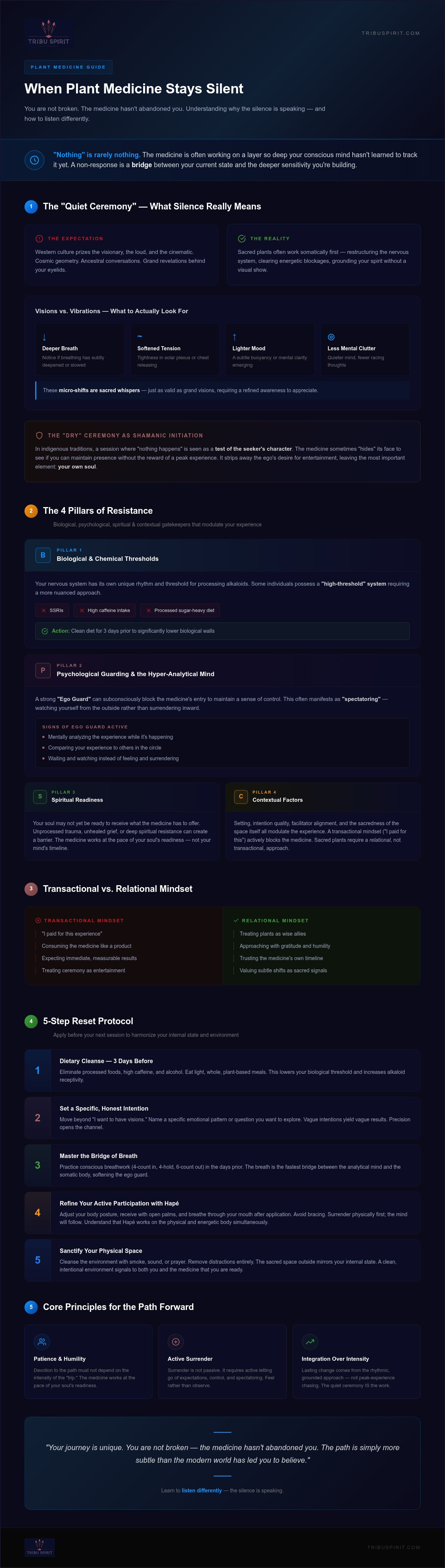
The silence of a ceremony can feel like a heavy, uninvited guest. You sit in expectation, waiting for the veil to lift, yet the world remains stubbornly familiar. This is the "Quiet Ceremony." It's a valid, essential chapter in your spiritual evolution that serves a purpose far beyond mere frustration. While it feels like a void, it's actually a profound invitation to listen with more than just your eyes. We often wonder what to do when plant medicine doesn't work for you, but the truth is that "nothing" is rarely actually nothing. It's often the medicine working on a layer so deep your conscious mind hasn't learned to track it yet. A non-response is a temporary bridge between your current state and the deeper sensitivity you're currently building.
Western culture prizes the visionary, the loud, and the cinematic. We want the lights and the grand revelations. However, indigenous wisdom teaches that the most lasting changes often happen somatically. This means the medicine is restructuring your nervous system, clearing energetic blockages, or grounding your spirit into your body without the distraction of a visual show. When the mind doesn't receive a "show," it's forced to confront the subtle reality of the present moment. This is where true integration begins.
Visions vs. Vibrations: Realigning Your Expectations
The "Hollywood" version of plant medicine suggests that every session must involve cosmic geometry or ancestral conversations. In reality, sacred tools like Hapé and Sananga often work on the subtle energy body first. They're masters of vibration. Instead of waiting for a movie to play behind your eyelids, notice the micro-shifts. Is your breath deeper? Has the tightness in your solar plexus softened? Perhaps your mood feels slightly more buoyant or your mind feels less cluttered. These are the whispers of the plants. They're just as sacred as the loud roars, requiring a refined sense of awareness to appreciate. You're learning to feel the medicine rather than just see it.
The 'Dry' Ceremony as a Shamanic Initiation
In many indigenous traditions, a session where "nothing happens" is seen as a test of the seeker's character. The medicine sometimes "hides" its face to see if you can maintain your presence without the reward of a peak experience. This "dry" ceremony is a powerful initiation. It strips away the ego's desire for entertainment and forces you to sit with yourself in absolute honesty. This is where you practice sacred ritual and pure presence. Without the fireworks, you're left with the most important element of the work: your own soul. It's a lesson in patience and humility, proving that your devotion to the path isn't dependent on the intensity of the "trip."
The 4 Main Reasons Plant Medicine Might Feel Ineffective
When the expected shift fails to materialize, it's easy to feel like an outsider in your own spiritual journey. We often label this as a failure, yet it's more accurate to view it as the "Pillars of Resistance." These pillars are the biological, psychological, spiritual, and contextual gatekeepers that modulate your experience. If you're searching for what to do when plant medicine doesn't work for you, start by releasing the idea that you're broken. You aren't immune to the sacred. The plants are simply meeting you at your current frequency, acting as a mirror for the barriers you've unknowingly built. Knowing what to do when plant medicine doesn't work for you requires a holistic look at these four key areas of the self.
Biological and Chemical Thresholds
Your nervous system has its own unique rhythm and threshold for processing alkaloids. Some individuals possess a "high-threshold" system that requires a more nuanced approach to achieve sensitivity. External factors play a significant role here. Substances like SSRIs, high caffeine intake, or a diet heavy in processed sugars can dampen your receptivity. Understanding what is hape involves recognizing how its physical components interact with your body's chemistry. A "clean-up" of your diet three days prior to a session can significantly lower these biological walls and increase your natural sensitivity.
Psychological Guarding and the 'Hyper-Analytical' Mind
The mind is a fierce protector. A strong "Ego Guard" can subconsciously block the medicine's entry to maintain a sense of control. This often manifests as "spectatoring," where you find yourself watching the experience from a distance rather than surrendering to it. You analyze the music, the room, or your own lack of visions. To break this cycle, try a simple heart-centered breath. Inhale for four counts into your chest, hold for two, and exhale slowly. This small shift moves your awareness from the analytical head into the feeling heart. It's a gentle way to invite the medicine deeper.
The Quality and Potency of the Source
The physical vessel of the medicine matters deeply. In the commercial market, stale or poorly stored powders lose their vital spark. This is why ethically sourced hape is so vital; it carries the intentional prayers and fresh potency of tribal preparation. Industrial versions often lack the energetic depth found in medicine made in small, sacred batches. If your practice feels flat, it might be the medicine itself that lacks the necessary life force. Choosing vibrant, prayer-infused tools like Tsunu Hapé ensures you're working with a living ally rather than mere dust.
Lack of Preparation and Integration
The effectiveness of plant medicine is profoundly influenced by what happens before and after the session. Inadequate preparation, such as a rushed mindset or an unsupportive environment (known as "set and setting"), can hinder your ability to connect with the plant's wisdom. Equally crucial is the integration phase. Without consciously processing insights, journaling experiences, or making actionable changes in your daily life, the profound shifts offered by the medicine can remain ungrounded or quickly fade. True transformation requires dedicated effort to weave the plant's teachings into your ongoing reality.
Troubleshooting Hapé: When the 'Sacred Tobacco' Feels Like Just Dust
Hapé is not a transaction; it is a partnership. Unlike modern remedies that you simply consume, this sacred snuff requires your active participation and your life force to awaken its potential. When the medicine feels like mere dust in your nose, the connection has likely frayed at the point of application. If you are seeking answers on what to do when plant medicine doesn't work for you, the first place to look is the "Bridge of Breath." This bridge, known as the Sopro, is the energetic conduit that carries the medicine from the physical tool into your spirit. Without a conscious, intentional blow, the medicine remains dormant, unable to cross the threshold into your deeper consciousness.
The Mechanics of the Blow: Sopro and Intent
In the Amazonian tradition, the way you blow determines the medicine's destination. The "Turtle" blow is long, steady, and grounding, perfect for those seeking to anchor themselves in the body. The "Hummingbird" is a quick, sharp burst that clears mental fog and resets the nervous system instantly. Then there is the "Jaguar," a powerful, assertive blow used for deep transformation and clearing heavy energies. A weak or hesitant Sopro leads to a superficial experience because the medicine doesn't reach the deeper chambers of the sinus where the energetic "gates" reside. You should practice your Sopro with an empty Kuripe before your next session to build muscle memory and confidence. This ensures that when the medicine is present, your breath is ready to lead the way.
The Role of the Kuripe and Tepi
The physical vessel you choose is just as vital as the blend inside it. Shamanic tools are precision instruments of sacred technology, designed to direct airflow with specific intent. If your Kuripe is poorly angled or the bore is too narrow, the medicine will bypass the correct sinus cavities, leading to an ineffective session. Bamboo Kuripes offer a smooth, natural airflow that mirrors the plants' own organic rhythm. Hand-carved wooden tools provide a more weighted, intentional delivery that can help ground a wandering mind. Upgrading to a tool that fits your unique anatomy ensures the medicine travels exactly where it needs to go, turning a stagnant moment into a flowing experience.
Sometimes, the issue isn't the technique but the specific frequency of the blend you've chosen. If you feel "blocked" or "stuck," a more robust and grounding variety like Tsunu Hapé can provide the necessary clarity to break through the mental noise. Knowing what to do when plant medicine doesn't work for you often involves experimenting with these subtle variations in both your chosen tool and your plant ally. When the breath and the tool align, the "dust" transforms back into a sacred key.
Practical Steps to 'Reset' Your Connection with the Plants
When the connection feels severed, the most powerful action is often a conscious pause. Finding what to do when plant medicine doesn't work for you often begins with a deliberate retreat into silence. This isn't a sign of failure or a lack of spiritual aptitude. It's a strategic withdrawal to allow your nervous system and energetic field to recalibrate. If you've been pushing for a result, you've likely created a subtle tension that acts as an energetic barrier. A reset protocol allows the medicine to approach you once more on fresh, uncluttered ground, free from the weight of previous expectations.
- Step 1: The Sacred Fast. Cease all medicinal use for at least seven to fourteen days. This clears the informational noise and resets your energetic receptors.
- Step 2: Environmental Purification. Deep clean your physical ceremony space. Remove clutter and use Mapacho to clear stagnant energy from the corners of the room.
- Step 3: Sensorial Dieta. For three days, abstain from caffeine, heavy media, and loud environments. This lowers your baseline of stimulation and increases sensitivity.
- Step 4: The Humble Intention. Approach your next sitting with a single, open-ended prayer: "Show me what I am missing."
- Step 5: Somatic Integration. After your ceremony, spend time in nature without digital distractions. The medicine often speaks through the wind or the trees long after the physical effects fade.
Deepening the 'Dieta' and Preparation
True preparation begins long before the Kuripe touches your nose. A three day quiet period is essential for those who feel blocked. During this time, focus on your internal landscape by minimizing external noise and distractions. You might use clearing agents like Mapacho or a drop of Sananga to sharpen your focus and clear the energetic "cobwebs" that accumulate in daily life. This isn't just about diet; it's about making space. By the time you sit for your main practice, your field is primed and receptive. This humble approach shifts the dynamic from a transaction to a relationship. Instead of demanding a breakthrough, you are inviting a conversation.
Changing the Modality: Solo vs. Facilitated
If solo practice continues to feel stagnant, the "field" of a facilitator can provide the necessary breakthrough. Sometimes, we're too close to our own shadows to see the blocks we've placed. A guided ceremony offers a protected container where the facilitator's experience acts as a steadying frequency for your own. For those seeking to master these techniques and deepen their relationship with the plants, the Tribu Spirit Academy provides the structured education and integration support needed to move from frustration to mastery. Learning what to do when plant medicine doesn't work for you is a skill that flourishes best under wise, compassionate guidance.
The Tribu Spirit Path: Moving from Frustration to Mastery
Mastery over the medicinal path isn't defined by the intensity of your visions, but by the depth of your resonance with the plants. At Tribu Spirit, we view these sacred tools not as transactions to be consumed, but as living relationships to be nurtured. When the connection feels thin, it's often because the modern consumer mindset has replaced the ancient student's devotion. If you have been searching for what to do when plant medicine doesn't work for you, the answer lies in shifting your perspective. You aren't just seeking a result. You're seeking a conversation with the forest. This shift from demanding a breakthrough to inviting a presence changes the very frequency of your practice.
The journey from frustration to mastery requires patience and the right allies. It's about moving beyond the "pill for an ill" mentality and embracing a holistic lifestyle of awareness. When you align your intent with the spirit of the plants, the blocks begin to dissolve. You stop looking for what the medicine can do for you and start asking what you can learn from the silence. This is the path of the modern esztéta and the conscious seeker; a path where every ceremony, even the quiet ones, becomes a step toward inner equilibrium.
Why Source and Intent Matter
The "energy of the hands" that prepared your medicine influences your experience more than you might realize. Medicine isn't just a chemical composition. It's an energetic imprint. When you choose tools that have been birthed in prayer and prepared with the ancient wisdom of Amazonian tribes, you're entering into a lineage of healing. Our commitment to ethically sourced offerings ensures that the medicine carries a high vibrational frequency. This isn't just about quality; it's about integrity. By supporting indigenous sovereignty and reforestation efforts in the Amazon, your practice becomes part of a larger healing cycle. Your purchase feeds back into the earth that provided the medicine, creating a harmonious loop of reciprocity that the plants themselves recognize and reward.
Education through the Tribu Spirit Academy
Technical skill and proper integration are the foundations of a successful practice. Often, what feels like a "non-response" is simply a lack of refined technique or a misunderstanding of the medicine's subtle language. We've found that proper training can resolve the majority of issues seekers face when they feel blocked. Our training modules are designed to bridge the gap between ancient tradition and modern life, providing you with the tools to navigate your inner landscape with confidence. You'll learn the nuances of the Sopro, the importance of the internal Dieta, and how to hold a sacred container for your own growth. Join the Tribu Spirit Academy to master the art of sacred medicine and transform your frustration into a profound, lifelong mastery. The plants are waiting to speak. It's time to learn how to listen.
Awakening the Silent Conversation
The journey with sacred plants is rarely a straight line. It's a spiral that demands patience, humility, and a refined sense of listening. You've discovered that silence in a ceremony isn't a void, but a somatic restructuring that requires a different kind of awareness. By auditing your biological thresholds, refining your Sopro, and ensuring your tools are precision instruments, you bridge the gap between frustration and connection. If you've been wondering what to do when plant medicine doesn't work for you, remember that the medicine is always speaking; it's simply a matter of learning its subtle dialect. This path is about relationship, not consumption.
At Tribu Spirit, we offer more than just ethically sourced Hapé from the Tsunu and Mulateiro traditions. We provide a bridge between ancient wisdom and modern life. Through our Ministry's guidance and community backed integration support, you can transform every quiet moment into a profound initiation. It's time to deepen your devotion and refine your technique. Master the Art of Sacred Medicine at the Tribu Spirit Academy and find the clarity you've been seeking. Your breakthrough isn't behind you. It's waiting in the next conscious breath.
Frequently Asked Questions
Is it possible to be 'immune' to plant medicine like Hapé or Sananga?
You aren't immune to these sacred tools, though your current biological threshold might be set quite high. Every human possesses the receptors for these plant alkaloids; however, energetic or chemical "noise" can temporarily dampen the connection. If you feel unresponsive, it's usually a signal to refine your preparation or explore a more grounding blend like Tsunu to lower your natural resistance.
How many times should I try a medicine before deciding it doesn't work?
We recommend sitting with a specific medicine at least three to five times before concluding it isn't resonating with your spirit. Sacred plants are teachers that require time to build a relationship with your unique energy. Jumping between different tools too quickly creates a fragmented experience. Give the medicine space to reveal its subtle layers through a consistent, rhythmic practice.
Can my diet or medications block the effects of sacred plants?
Your physical diet and certain medications definitely influence your receptivity to sacred tools. SSRIs and heavy stimulants like caffeine can create a chemical barrier that makes it difficult to feel the medicine's subtle shifts. This is a common factor when considering what to do when plant medicine doesn't work for you. A three day fast from stimulants often restores the sensitivity needed for a deep experience.
What should I do if I feel 'nothing' during a Sananga ceremony?
Feeling "nothing" during a Sananga ceremony suggests your energetic channels may be heavily guarded or your physical threshold is exceptionally high. Even without the typical intense sensation, the medicine is still working to clear your ocular and energetic fields. Focus on your breath and try a Strong Strength Sananga to see if a higher potency helps break through the initial resistance.
Does the quality of my Kuripe really affect my Hapé experience?
The quality and fit of your Kuripe are fundamental to the medicine's effectiveness. A poorly constructed tool can cause the Hapé to bypass the correct sinus cavities or deliver an uneven airflow that disrupts your focus. Moving to a hand-carved or bamboo Kuripe ensures a smooth, intentional delivery. This allows the medicine to land exactly where it can begin its spiritual work.
What happens if I don't have visions? Does the medicine still work?
Plant medicine is profoundly effective even without the presence of visions. Most traditional healing happens somatically, through shifts in your nervous system, emotional release, or physical grounding. Visions are often just "mental theater" that can distract from the deeper work occurring in your cells. Trust the quiet, steady changes in your mood and clarity as evidence of the medicine's success.
How do I know if I'm using too little or too much medicine?
Finding the right dosage is a delicate dance between your intention and your body's current needs. Start with a small, pea-sized amount for each nostril and wait ten minutes to observe the somatic shifts. If the effect feels superficial, you can gradually increase the dose in subsequent sittings. Overloading the system often leads to a "shutdown" response where the body blocks out the intensity.
Can a 'blocked' heart chakra stop plant medicine from working?
An emotionally guarded or "blocked" heart space can certainly act as a gatekeeper during your practice. When we hold onto old grief or the need for control, the medicine struggles to move past the analytical mind. This is a key insight when exploring what to do when plant medicine doesn't work for you. Incorporating heart-opening breathwork before your ceremony can help soften these internal walls and invite the plants deeper.