
What if the silence you've been seeking isn't found by escaping the world, but by grounding yourself more deeply within it? In a time when the digital hum often drowns out our inner voice, it's natural to feel a persistent disconnection from the earth and a heavy mental fog that refuses to lift. You may have heard whispers of a sacred Amazonian tool and found yourself wondering, what is hape, yet hesitated out of a deep-seated fear of using such potent medicine incorrectly or without the reverence it deserves.
Hapé is far more than a substance; it's a sacred bridge between human intention and the spirit of the forest. By reading this guide, you'll discover the ancient origins, spiritual benefits, and sacred rituals of Hapé to deepen your connection with Amazonian plant wisdom. We'll walk you through its true purpose and provide the confidence you need to start a respectful personal practice. From understanding the grounding power of the Tsunu blend to finding ethical sources that support indigenous tribes, this journey will lead you from the physical powder to a profound inner transformation. It's time to clear the clouds and return to your center.
Key Takeaways
- Learn exactly what is hape by exploring its origins as a sacred shamanic medicine used for centuries by Amazonian tribes to ground the spirit.
- Discover the alchemy behind the medicine, from the potent Mapacho base to the sacred ashes of trees like Tsunu and Mulateiro that create its unique energetic profile.
- Explore how the physical purge works to clear Panema, or stagnant energy, allowing you to move from mental fog into a state of profound spiritual clarity.
- Master the art of a respectful personal ritual by learning how to set heart-centered intentions and choose the right sacred tools, such as the Bamboo Kuripe.
- Gain the confidence to source your medicine with integrity, ensuring your practice supports reforestation and the empowerment of the indigenous communities who hold this wisdom.
What is Hapé? Understanding the Sacred Amazonian Snuff
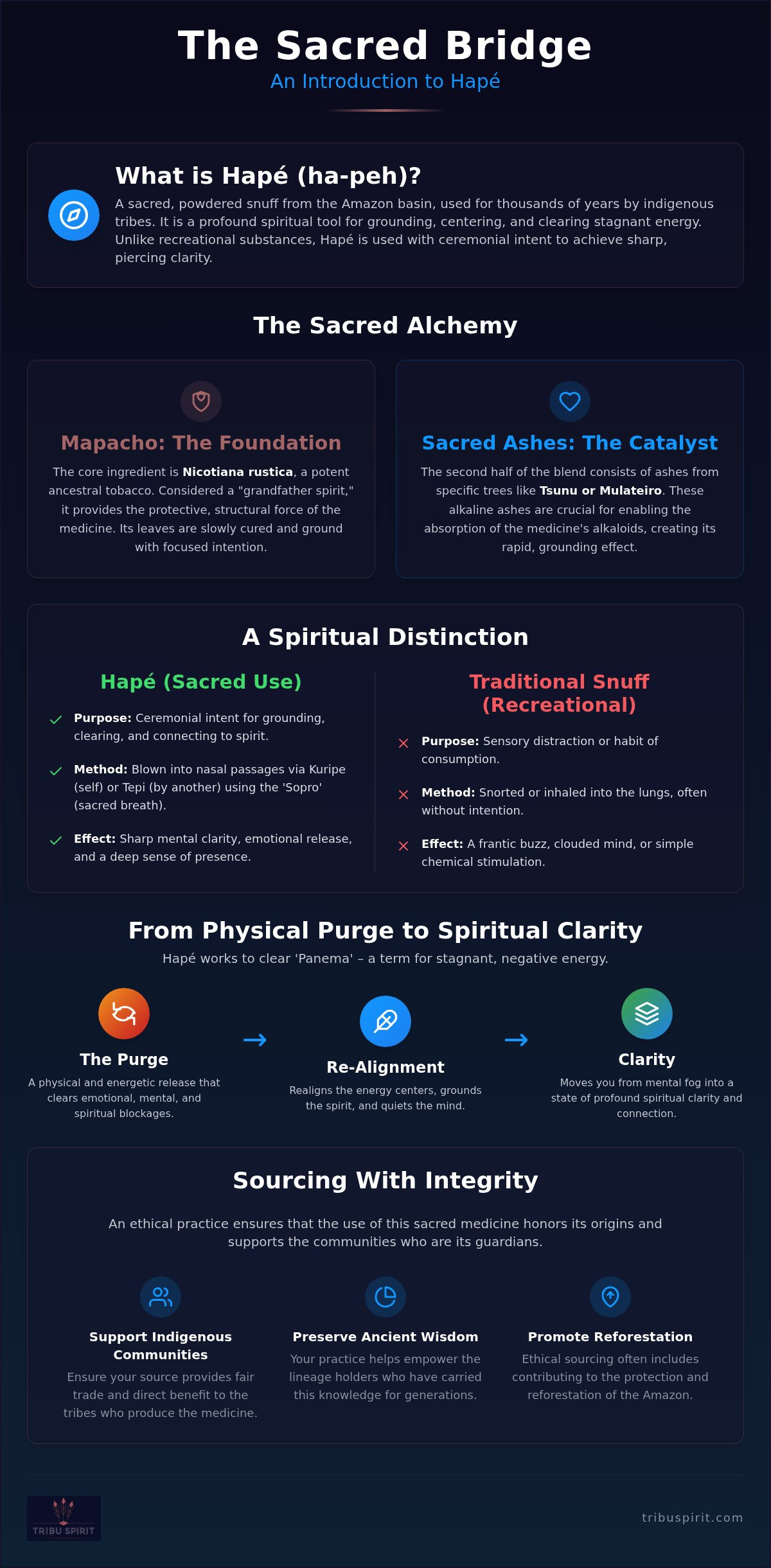
Imagine a medicine that doesn't just treat a physical symptom but reconnects you to the very pulse of the earth. Hapé (pronounced ha-peh) is a sacred, powdered snuff that has been prepared and used for thousands of years by the indigenous peoples of the Amazon basin. It's a complex blend of finely ground medicinal plants, tree barks, and sacred ashes, meticulously crafted through a process of prayer and intention. When people first encounter this tradition, they often ask, what is hape, and how does it fit into a modern spiritual practice? At its core, Hapé is a profound tool for grounding, centering, and clearing the heavy, stagnant energies that accumulate in our daily lives.
The terminology can sometimes be confusing for those new to the path. You'll see it written as 'Rapé' in Portuguese contexts, while 'Hapé' is the phonetic spelling that honors the breath and the spirit of the medicine as it's spoken by the tribes. This isn't just a linguistic difference; it's a mark of respect for the cultural nuances of the forest. Unlike recreational tobacco products that are designed for sensory distraction, Hapé is used with ceremonial intent. It doesn't cloud the mind or create a frantic buzz. Instead, it invites a sharp, piercing clarity that cuts through mental noise, leaving you anchored in the present moment. It's a practice of stillness, not a habit of consumption.
The Ancient Roots: A Lineage of the Forest
The history of Hapé stretches back into the pre-Columbian era, forming a vital part of the spiritual fabric of the Amazon. Key tribes such as the Yawanawa, Huni Kuin (Kaxinawa), and Katukina have carried this wisdom through generations, guarding the secrets of the forest. In shamanic cosmology, Hapé is considered a 'Master Teacher'. It's believed to possess its own consciousness, a living spirit that works with the individual to reveal internal blockages and hidden truths. Every blend carries the lineage of the maker, infused with the songs and prayers of the tribe. When you sit with this medicine, you aren't just using a substance; you're engaging with a deep, ancestral lineage that views the forest as a living, breathing cathedral.
Hapé vs. Traditional Snuff: A Spiritual Distinction
A common misconception is that Hapé is inhaled like traditional European snuff or other powders. In reality, Hapé is never snorted into the lungs. It's blown into the nasal passages using a sacred pipe, either by a practitioner (using a Tepi) or by oneself (using a Bamboo Kuripe). This method of delivery is symbolic of the 'Sopro', the sacred breath of life that carries the medicine's spirit into the body. While it shares some historical roots with various forms of Hallucinogenic snuff found across South America, Hapé is primarily focused on grounding and purification rather than inducing visions. The alchemy of the medicine goes far beyond its chemical parts; it's the specific combination of Mapacho and sacred ashes like Tsunu or Mulateiro that creates its unique energetic signature. Hapé is a sacred tool for realigning the physical and spiritual bodies.
The creation of Hapé is a sacred ritual of transformation, where raw elements of the earth are refined into a high-vibrational dust. At the heart of this alchemy lies Mapacho, or Nicotiana rustica. This is no ordinary plant. It's a potent, ancestral tobacco that contains significantly higher concentrations of nicotine and alkaloids than the varieties used in commercial products. For the tribes, Mapacho is a grandfather spirit, a protector that provides the structural force of the medicine. The process begins with the slow drying and curing of these leaves, followed by a labor-intensive cycle of grinding and sifting. Every movement is intentional. The creator must maintain a clear, focused state of mind, often fasting or observing silence, because their energy is literally woven into the powder. If the mind is cluttered, the medicine will be heavy. When exploring what is hape, it's essential to understand that the tobacco is only half of the story. The other half is the ash. To create the medicine's alkaline base, specific trees are burned in a ceremonial fire. The resulting sacred ashes, such as those from the Tsunu or Mulateiro trees, are what allow the medicine to be absorbed effectively through the mucous membranes. Recent studies into the chemical composition of Hapé highlight how these alkaline components interact with the plant alkaloids to create a rapid, grounding effect. This interaction is what gives the medicine its unique ability to "pierce" through mental fog.Common Tribal Blends and Their Properties
Each tribe has its own signature "recipe," often named after the primary tree used for the ash. These blends aren't interchangeable; they carry distinct energetic signatures.
- Tsunu: This is the flagship of Amazonian medicine. It's prized for its ability to ground the user instantly, bringing a sense of profound balance and clarity to the energetic body.
- Mulateiro: Sourced from the "tree of youth," this blend is specifically used to release deep-seated physical tension and clear the mental clutter that keeps us from our true path.
- Parica: A more intense variety, Parica is often reserved for deeper visionary work and a powerful, full-body cleansing of stagnant energy.
The Role of Botanical Additives
The medicine's frequency is further refined by adding local flora. Some blends incorporate mint for cooling, or cinnamon for warmth, while others remain pure. You'll often hear practitioners distinguish between "Grey Hapé," which is high in mineral-rich ash and provides a sharp, grounding impact, and "Green Hapé," which is herb-heavy and focuses more on the subtle aromatic healing of the plants. The specific tree species define the blend's name because the spirit of that tree is what guides the experience. To experience these unique vibrations for yourself, you can explore our ethically sourced collection of tribal blends.
The Effects of Hapé: From Physical Purge to Spiritual Clarity
When the fine dust of Hapé meets the senses, the world as you know it pauses. There's an immediate, sharp sensation often described as a "hit" of pure presence. A wave of heat might wash over your skin, followed by a sudden, profound stillness that settles into your bones. This is the moment where the intellectual question of what is hape dissolves into a direct, lived experience. The mental chatter that usually dominates our awareness simply falls away. It leaves behind a clear, open space where you can finally hear your own breath. The medicine doesn't just demand your attention; it commands a total return to the present moment.
In the Amazonian tradition, this medicine is used to clear "Panema." This term refers to a heavy, stagnant energy that manifests as bad luck, depression, or a persistent lack of motivation. When we feel stuck in life, it's often because this energetic grayness has accumulated in our field. Hapé acts as a spiritual broom. It's natural to experience a physical purge during this process. Sneezing, watering eyes, or even a brief wave of nausea aren't side effects to be feared. They're signs that the medicine is working. It's pulling out the toxins, both physical and energetic, that have been weighing you down. Instead of resisting these sensations, practitioners are encouraged to welcome them as a necessary cleaning of the temple.
The Pineal Gland and the Third Eye
Beyond the immediate physical release, Hapé is deeply revered for its effect on the subtle body. Many traditions believe the medicine helps decalcify the pineal gland, often referred to as the "Third Eye." In our modern environment, this small but vital gland can become dormant due to environmental factors and chronic stress. By clearing these blockages, Hapé helps open our internal vision. This allows for greater spiritual insight and intuition. The key to navigating the initial intensity is the breath. By breathing slowly and deeply through the nose, you move past the fire and reach the still point. This is a state of expanded consciousness where deep healing occurs and clarity is found.
Grounding in a Modern World
Our digital lives often leave us feeling airy and unsettled, trapped in a loop of notifications and abstract thoughts. Hapé provides an immediate antidote by pulling our awareness back into the physical body and down into the earth. The "Sopro," or the blow, is the vehicle for this grounding. The force and rhythm of the blow can change the entire nature of the experience. A soft, long blow might invite gentle meditation, while a short, strong blow is used for a more vigorous clearing of energy. For those looking to master this sense of rootedness, our Tsunu Hapé guide offers specific insights into using this flagship blend for spiritual clarity. Over time, a consistent practice fosters enhanced focus and a resilient emotional state that remains steady even in the chaos of the modern world.
The Sacred Ritual: How to Use Hapé Respectfully
Sitting with the medicine is an invitation to pause. When you ask what is hape in a ceremonial context, you're looking for the protocol of the soul. Ritual is the container that allows the medicine to work safely and deeply. Without it, you're merely using a substance; with it, you're engaging in a conversation with the forest. This process begins with preparation. Cleanse your space, perhaps with sacred smoke, and settle into a seated position. Your intention is your compass. Approach the medicine with a clear, heart-centered request, such as a desire for grounding or the release of a specific emotional burden.
The physical application follows a specific, ancestral sequence. Start with a small, pea-sized amount of powder for each nostril. Using your chosen tool, you'll first blow the medicine into the left nostril. This side represents a symbolic death, a letting go of the past and the shedding of what no longer serves you. Immediately follow with the right nostril, which signifies rebirth, the future, and the invitation of new energy. It's vital to apply the medicine to both sides to maintain energetic balance. Once the application is complete, the most important phase begins: integration. Stay in silence for at least 10 to 15 minutes. Put down your phone. Close your eyes. This is the "still point" where you receive the medicine's message and allow the spirit of the plants to settle into your field.
Essential Tools for the Practice
To facilitate this exchange, you'll need the correct instruments. A Kuripe is a small, V-shaped pipe designed for self-administration, connecting your own breath directly to your nasal passages. In a shared or ceremonial setting, a Tepi is used. This is a longer pipe that allows a practitioner to blow the medicine for another person. Bamboo and bone are the preferred materials for these tools. They aren't just durable; they're chosen for their energetic conductivity. These natural materials act as a bridge, carrying the "Sopro" or sacred breath without interference.
Creating Your Personal Altar
Your ritual space can be enhanced by creating a simple altar. You might incorporate shamanic tools like hand-carved rattles to shift the frequency of the room or feathers to clear the air. Many practitioners choose to honor the four directions and the elements of earth, air, fire, and water. On a practical level, always have tissues, a glass of water, and a small bucket nearby. The physical purge is a natural part of the cleaning process, and having your supplies ready allows you to remain in the meditative state without distraction. To begin your journey with the right intentions, explore our collection of sacred tools crafted by indigenous artisans.
Sourcing with Integrity: The Ethics of Plant Medicine
The journey of the medicine from the heart of the Amazon to your hands is as vital as the ritual itself. When you seek to understand what is hape, you must look beyond the physical dust to the web of relationships that brought it to you. In a world where plant wisdom is often commodified, the energetic purity of your Hapé depends on the integrity of its source. Extractive practices and spiritual tourism can leave indigenous communities depleted, taking their sacred knowledge without offering true support in return. Choosing medicine that is sourced through direct, fair trade relationships ensures that the tribes remain the sovereign guardians of their own traditions.
At Tribu Spirit, we operate as a private ministry and academy rather than a standard retail outlet. This distinction is central to our mission of sacred reciprocity. We believe that every exchange should empower the hands that crafted the medicine. By sourcing directly from tribes like the Yawanawa, Huni Kuin, and Katukina, we help protect their ancestral lands and support their cultural sovereignty. This isn't just about commerce; it's about reforestation and indigenous empowerment. Every purchase contributes to the preservation of the forest, ensuring that these master plants continue to thrive for generations to come.
Tribu Spirit: A Ministry of Sacred Reciprocity
True healing requires education and respect. This is why we established the Tribu Spirit Academy, a space designed to teach practitioners how to engage with these tools responsibly. We don't just provide the medicine; we invite you to become a guardian of the forest through your personal practice. When you sit with our Hapé, you're participating in a cycle of giving that supports indigenous families and funds vital reforestation projects. It's a path of mutual growth where your inner development directly fuels the protection of the earth's most vital ecosystems.
Choosing Your First Blend
If you're just beginning your journey, the choice of blend can feel overwhelming. We generally recommend starting with the Tsunu blend. It's the classic grounding flagship, offering a balanced and clear introduction to the spirit of the medicine. For those who have already established a deep relationship with the forest, more complex offerings like Mambe or Ambil can provide deeper layers of insight. A wonderful way to begin with intention is by selecting a shamanic starter kit, which includes the essential tools and guidance needed for a respectful practice. We invite you to explore our ethically sourced Hapé collection and find the blend that resonates with your current intention.
Embracing the Breath of the Forest
Returning to your center is a journey of both the heart and the earth. You've explored how this medicine is crafted through prayer and how the physical purge leads to profound mental clarity. You now know that what is hape is not just a substance; it's a living bridge to the ancient Amazonian lineage. By choosing a path of respect and intentional ritual, you transform a simple moment into a sacred act of reconnection. This practice isn't about escaping reality, but about grounding yourself so deeply that you can finally hear your own inner wisdom.
At Tribu Spirit, we stand as a private ministry dedicated to your growth and the protection of the forest. Every purchase supports reforestation and ensures that indigenous tribes remain the sovereign keepers of their wisdom. Through our ministry-backed education and direct-from-tribe sourcing, you can feel confident that your practice is built on a foundation of true integrity. It's time to clear the fog and listen to the whispers of the trees. Begin your journey with our ethically sourced Hapé collection and step into a life of deeper presence. The spirit of the forest is waiting to welcome you home.
Frequently Asked Questions
Is Hapé legal to use and purchase?
Yes, Hapé is legal to purchase and possess in most countries where tobacco is regulated for adults because it's classified as a tobacco product. As of August 2026, it's not a controlled narcotic in the United States or the United Kingdom. It is generally imported under the same legal framework as other smokeless tobacco products. You should always check your local import rules, as some regions have specific restrictions on tobacco quantities and age requirements.
Can I get addicted to the tobacco in Hapé?
While the Mapacho used in the medicine contains high levels of nicotine, the ceremonial context and the physical purge generally discourage the habitual use seen with commercial cigarettes. When used as a sacred tool with clear intention, it becomes a medicine of discipline. It's not a habit of distraction. However, because it's a tobacco product, individuals with a history of nicotine dependency should approach the practice with heightened awareness and deep respect for the plant's power.
What is the difference between Hapé and Rapé?
The primary difference is linguistic rather than medicinal. Rapé is the Portuguese spelling commonly used in Brazil, while Hapé is the phonetic spelling that honors the sacred breath of the forest. Both terms refer to the same ancestral snuff. When people ask what is hape, they're often seeking the spiritual depth behind the name. This depth remains consistent across different regional spellings and tribal dialects, representing a bridge to the spirit of the Amazon.
Do I need a shaman to use Hapé for the first time?
You don't necessarily need a shaman present for your first experience, but you do need proper education and a reverent mindset. Starting a personal practice with a Bamboo Kuripe is a beautiful way to connect with the medicine's spirit. We recommend learning the foundational techniques through a dedicated ministry or academy. This ensures you're honoring indigenous traditions and using the medicine safely. Respect for the lineage is the most important part of the journey.
How often should I use Hapé in my spiritual practice?
There's no fixed schedule for using Hapé, as it shouldn't be treated as a recreational habit. Some practitioners use it daily for morning grounding, while others sit with it only during significant life transitions. Listen to your body and your intuition. If the medicine begins to feel like a "quick fix" rather than a sacred ceremony, it's often a sign to step back. Re-evaluate your intention and give your field space to integrate the lessons.
Are there any contraindications or people who should avoid Hapé?
Individuals with high blood pressure, heart conditions, or those who are pregnant should avoid using Hapé. Because it can cause a temporary spike in heart rate, it's vital to consult a healthcare provider if you have underlying medical concerns. It should also never be combined with alcohol or other substances that cloud the senses. This medicine requires a clean vessel. Disrespecting the spirit of the plants can lead to a heavy or unsettled energetic experience.
What should I do if I feel overwhelmed during a Hapé experience?
If the intensity feels too strong, the most important thing is to keep breathing deeply through your nose and stay in a seated position. Drink small sips of water and remember that the physical sensations are temporary. Focus on the soles of your feet touching the earth. The initial "hit" will peak quickly and then transform into a deep, meditative stillness. Trust the process. The medicine is simply clearing the space for your own inner light to shine.
How do I clean my Kuripe or Tepi after use?
Cleaning your tools is both a physical and energetic necessity. Physically, you can use a small brush or a natural pipe cleaner to remove any leftover powder from your Kuripe or Tepi. Energetically, many practitioners pass their tools through the smoke of Palo Santo or Sage after each ceremony. This clears the instrument of any stagnant energy it may have absorbed. Keeping your tools clean ensures they remain high-vibrational conduits for your next sacred session.