

What if the answers to your most profound questions weren't hidden in logic, but within a landscape you've simply forgotten how to visit? Perhaps you feel a quiet, persistent tug toward a purpose you can't quite name. You aren't alone. In fact, a 2026 report found that 37 percent of seekers now prioritize mental and spiritual well-being as their primary motivation for inner work. Yet, the path inward often feels clouded by a modern fog. You might wonder if your intuition is merely a vivid imagination, or perhaps a subtle fear of the unknown keeps you tethered to the shore. It's natural to desire a map for these unseen territories.
In this sacred guide, you'll learn to master the shamanic journey to connect with helping spirits and reclaim your inner landscape. We'll show you how to navigate non-ordinary reality with clarity and integrity, ensuring your practice remains grounded and safe. We'll explore the essential tools for preparation, from the clearing power of traditional offerings to the rhythmic heartbeat of the hand-carved rattle. By the end, you'll have the foundation to distinguish true spiritual guidance from the noise of the mind. Your path to deep soul healing begins with a single, intentional step into the silence.
Key Takeaways
- Discover the distinction between passive meditation and the active, intentional exploration of non-ordinary reality.
- Learn to navigate the three vibrational realms of the spirit world using the ancient map of the Axis Mundi.
- Explore how physical tools like a hand-carved shamanic rattle serve as essential anchors for the soul during spiritual travel.
- Master the preparation and intention-setting needed to embark on a safe and transformative shamanic journey.
- Understand the vital role of integration and the "24-hour rule" in turning fleeting visions into lasting soul healing.
What is a Shamanic Journey? Beyond Meditation and Imagination
A shamanic journey is far more than a simple visualization or a moment of quiet reflection. It's a purposeful, conscious shift into what practitioners call non-ordinary reality. While many people mistake it for a form of meditation, the two practices serve different masters. Meditation often seeks to empty the mind; it's a passive act of release. In contrast, journeying is an active, directed exploration. You aren't just sitting in the silence. You're moving through it with a specific intention. You're seeking answers, reclaiming lost fragments of your soul, or meeting with helping spirits who wait in the unseen folds of existence. This is the doorway to true transformation.
To succeed, you must become a "hollow reed." This ancient metaphor describes a state where you've set aside your personal ego and daily anxieties to become a clear vessel for spirit communication. It's about being empty enough to be filled by the wisdom of the realms, yet present enough to remember the path back. This transition isn't just spiritual; it's physiological. Your brain naturally shifts from the frantic Beta waves of daily survival to the deep, rhythmic Theta waves associated with dreaming and deep trance. In this state, the conscious and subconscious meet to dance. The logic of the ego fades. The wisdom of the soul takes the lead.
The History and Universality of Journeying
This practice isn't a modern invention or the property of a single culture. From the frozen tundras of Siberia to the lush canopies of the Amazon and the mist-covered hills of the Celtic lands, humanity has always used the shamanic journey to bridge the worlds. If you explore What is Shamanism?, you'll see it's a global heritage rooted in our very DNA. In the late 20th century, Michael Harner identified the universal threads connecting these diverse lineages, naming them "Core Shamanism." He proved that these techniques are a human birthright. They belong to anyone willing to listen with a humble heart.
Ordinary vs. Non-Ordinary Reality
We spend most of our lives in Ordinary Reality, the three-dimensional world of clocks, bills, and physical survival. It's necessary, but it's only half the story. Non-Ordinary Reality is the energetic blueprint that sits behind the physical. It's a vibrational landscape where time is fluid and spirits reside. Through ritual and sound, we thin the veil between these two worlds. We step out of the heavy, material "here" and into the luminous, infinite "everywhere." This isn't an escape from reality. It's a deeper engagement with the forces that shape it. We return not just with information, but with a renewed sense of being.
Mapping the Spirit World: The Three Realms of the Shaman
Stepping into a shamanic journey requires more than just intent; it requires an understanding of sacred geography. Ancient traditions describe the Axis Mundi, or the World Tree, as the central pillar that anchors all of existence. Its roots reach deep into the earth, while its branches brush the heavens. It's vital to understand that these realms aren't located in physical space. You aren't traveling to a place above the clouds or beneath the soil in a literal sense. Instead, you're shifting your internal frequency to match different vibrational layers of reality. Each realm has its own laws, its own light, and its own inhabitants.
Before you depart, you must establish a "Starting Place." This should be a location in nature from your ordinary life that you know intimately; perhaps a sun-drenched meadow, a specific ancient oak, or a hidden mountain spring. This serves as your anchor. For safety, always use the same entry and exit point. This consistency builds a neural and spiritual pathway, ensuring you don't wander aimlessly. From an anthropological perspective on shamanism, this three-tiered cosmology is a universal human map for navigating the psyche and the spirit world alike. To maintain integrity during your flight, keep these principles in mind:
- Always return through the same door you entered.
- Keep your heart's question simple and humble.
- Trust the first image or sensation that arrives.
The Lower World: Ancestors and Power Animals
The Lower World is a place of immense density, warmth, and primal life. It isn't a place of darkness; it's the realm of the soul's roots. Here, the landscapes are earthy and rich, filled with forests, oceans, and deserts. This is where you meet your Power Animals, the spirited guardians who offer protection and instinctual wisdom. You might enter this realm by visualizing yourself descending through a cave, a hollow tree root, or even a deep spring. It's a place of profound healing and restorative energy.
The Upper World: Teachers and Celestial Wisdom
Contrastingly, the Upper World feels ethereal and crystalline. It often appears as a landscape of clouds, mountains of light, or geometric cities. This is the home of ascended masters, archetypal teachers, and star beings who provide high-level guidance on your destiny. To reach it, you might imagine yourself climbing a silver cord, riding on the smoke of sacred Mapacho, or being carried by a great bird. The wisdom here is often abstract and deeply philosophical.
The Middle World: The Energetic Double of Earth
The Middle World is the most complex realm to navigate. It's the spiritual dimension of our physical reality. Think of it as the "hidden side" of the world you see every day. While you can journey here to speak with the spirits of plants or find lost objects, it's considered trickier for beginners. This realm is home to shadows and lost souls who haven't yet moved on. It requires a high degree of discernment and strong protection to explore safely. Always ensure your intention is clear before peering into the spirit-side of the physical world.
Sacred Technology: Tools to Catalyze the Shamanic State
While the mind travels through the vibrational realms we've mapped, the body remains the essential anchor in ordinary reality. A shamanic journey isn't a flight from the physical; it's a dialogue between the seen and unseen. To maintain this connection, practitioners use sacred technology. These aren't mere ornaments. They're functional tools designed to stabilize your frequency and protect your energetic field. Without them, the spirit risks drifting into the noise of imagination rather than the clarity of truth. Physical tools provide the weight necessary for the soul to fly safely.
Sound acts as the first catalyst. A hand-carved shamanic rattle serves a vital purpose by breaking up stagnant energy that clings to the auric field. Its sharp, percussive rhythm acts like a broom, sweeping away mental clutter. This allows the seeker to enter the Theta state with a clean slate. When the rattle sounds, the environment shifts. The air feels different. The space is set. This rhythmic pulse provides a tether, ensuring you always have a heartbeat to follow back to your body.
Hapé and Mapacho: The Guardians of the Threshold
Before entering the deep silence, many seekers turn to sacred Hapé to clear the mental fog. This Amazonian snuff works quickly to quiet the frontal lobe, where the analytical ego usually resides. By quieting this internal chatter, you create space for clearer visions. Using Tsunu Hapé is particularly effective for those who struggle with flighty energy. It acts as a grounding cord, pulling your awareness back into your center so you don't wander into fantasy. To seal this sacred space, the smoke of Mapacho is often used. It creates a protective boundary, ensuring only helping spirits enter your field of work.
The Kuripe: Your Personal Bridge to Spirit
The act of administration is a ritual in itself. A bamboo kuripe is more than a pipe; it's an extension of your own breath. As you blow the medicine, you're literally blowing your intention into the spirit world. This physical movement signals your subconscious that the shamanic journey has officially begun. It bridges the gap between your physical body and your spiritual intent. Ethical sourcing of these tools is a spiritual requirement, not an option. When a tool is crafted with honor and respect for the indigenous tribes, it carries that high-vibrational integrity into your practice. It isn't just about what the tool does, but where it comes from and the prayers it carries from the forest.
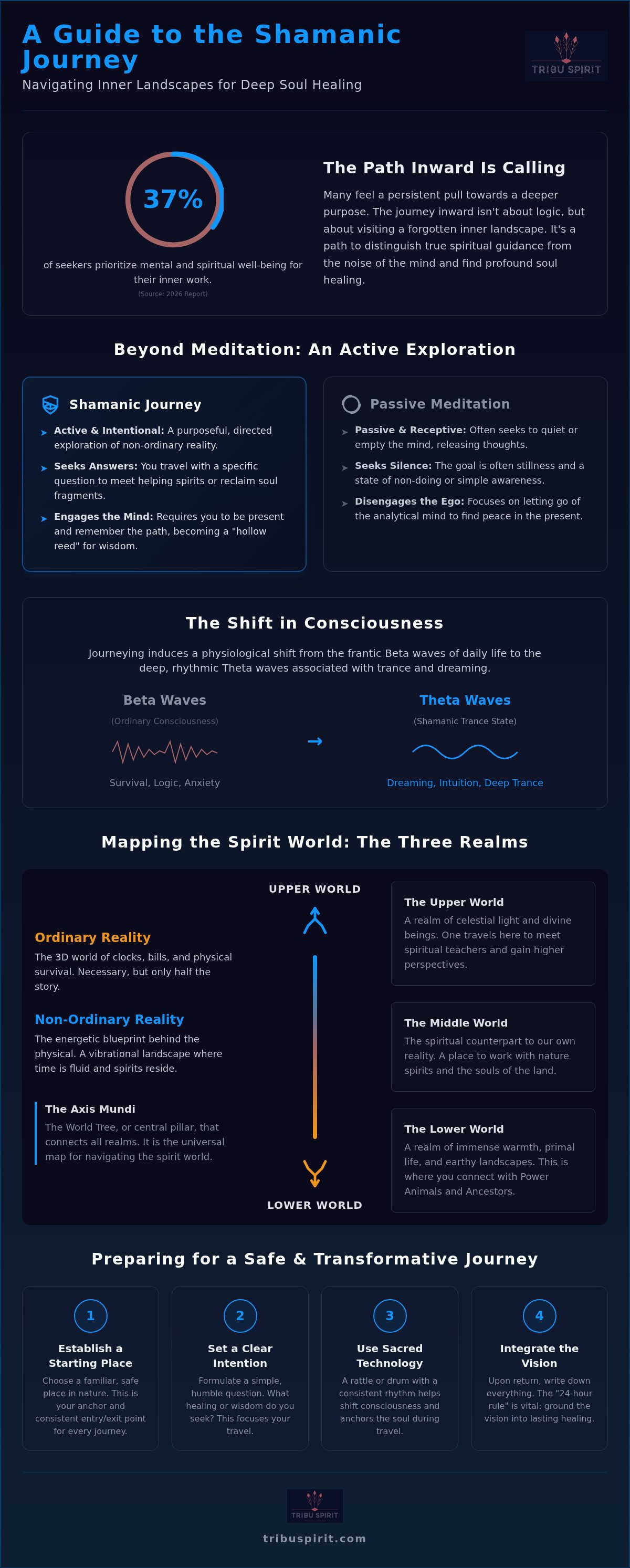
Step-by-Step: How to Take Your First Shamanic Journey
Embarking on your first shamanic journey is a transition from being a spectator to becoming an active participant in the spiritual architecture of the world. It's a deliberate movement. You aren't simply closing your eyes and hoping for a random vision; you're following a sequence of steps refined over millennia. This process ensures that you remain grounded, protected, and capable of bringing back the wisdom you seek. It begins long before you pick up your rattle. It starts with the breath.
Setting the Container and Intention
A vague intention always leads to a vague journey. If you don't know what you're looking for, the spirit world will reflect that lack of clarity back to you. Start by crafting a "Quest-ion." This should be an open-ended, humble inquiry like "What do I need to know about my current path?" rather than a rigid "yes or no" demand. Once your intention is clear, focus on creating a sacred space that feels physically and energetically safe. This might involve smudging with Mapacho or clearing your field with a quick application of Tsunu Hapé to settle the mind. Finally, perform the "Permission" step. Silently or aloud, ask the spirits of the land and the ancestors of the place where you sit for permission to enter the unseen realms. Respect is the currency of the spirit world.
To ensure your energy is aligned before you step through the veil, you may wish to explore traditional ritual tools that help anchor your physical presence during the flight.
Navigating NOR (Non-Ordinary Reality)
Once you enter the tunnel or pass through your chosen threshold, your experience may not be purely visual. Some seekers "know" things, while others hear whispers or feel temperature shifts. Use all five of your spiritual senses to explore. If you encounter a shadow figure or a frightening image, don't turn away in fear. Instead, stand your ground and ask, "What do you have to teach me?" Often, these figures are guardians or repressed parts of the self waiting to be integrated. When interacting with power animals, let them lead. Don't force a connection or demand they speak. Observe their movements. Notice where they take you. The teaching is often in the action, not the words.
The return is just as important as the flight. When you hear the "Call Back"—a rapid, rhythmic drumming or rattling—retrace your steps immediately. Return through the same cave, tree root, or mountain spring you used to enter. Feel your weight return to your seat. Wiggle your toes. Give thanks to the spirits who assisted you. This closure seals the energetic door and keeps your soul fragments gathered and whole. Your shamanic journey is complete only when you are fully back in your skin.
Integration: Bringing the Vision into the Physical World
The silence following your return is as sacred as the rattle that carried you there. A shamanic journey without integration is merely a spiritual movie; it's a series of vivid images that entertain the mind but fail to touch the soul. If you don't anchor the wisdom you've received, the medicine of the experience will eventually evaporate. Integration is the bridge. It's the deliberate work of weaving the threads of non-ordinary reality into the heavy, beautiful fabric of your daily existence. It's how a vision becomes a transformation.
One of the most vital practices for a seeker is the 24-hour rule. For the first full day after your journey, keep the details of your experience within your own internal cauldron. Speaking about the vision too soon can dissipate its power; it lets the steam out before the medicine has finished brewing. Instead of talking, focus on physical anchoring. Carry a specific stone that reminds you of a spirit you met, or spend time drawing the colors you saw. By creating a physical representation of the journey, you signal to your subconscious that the wisdom is now part of this world.
Methods of Sacred Integration
Begin your integration by journaling the "Raw" experience before you attempt any "Interpreted" analysis. Write down exactly what you saw, smelled, and felt without judging it or trying to make it logical. Once the story is on paper, look for the "Action Step." What is one small, tangible thing you can change in your ordinary life to honor what you learned? If a power animal showed you the importance of boundaries, your action step might be saying "no" to a draining commitment. True healing requires this physical commitment. While the journey happens in the spirit, the results must manifest in your hands and feet.
Avoiding the 'Am I Making This Up?' Trap
It's natural for the analytical mind to question the validity of your experience. The ego often tries to dismiss the shamanic journey as mere imagination. To distinguish between ego-imagination and spirit-revelation, use the "Evidence Test." Did the journey provide information you couldn't have known? Did the guidance feel surprising or even challenging to your current perspective? Ego usually tells you what you want to hear, using familiar patterns. Spirit, however, often speaks in symbols that feel "other" or possess a vibrational resonance that lingers long after you wake.
You don't have to walk this path in isolation. The role of community is to provide a grounded mirror for your experiences, helping you find clarity when the visions feel complex. We invite you to join the Tribu Spirit Academy to deepen your sacred ritual practice alongside a circle of conscious seekers. Together, we can ensure that every flight into the unseen brings back a more profound sense of presence and purpose to our shared world.
Step Into the Living Wisdom of the Spirit World
You've discovered that a shamanic journey is much more than a flight of fancy; it's a disciplined and sacred return to the soul's origin. By understanding the vibrational maps of the three realms and honoring the ancient technology of the forest, you move from feeling disconnected to being deeply rooted in your spiritual purpose. The clarity of your vision is always mirrored by the integrity of your preparation. True transformation happens only when you bring those luminous insights back into your physical life through dedicated, grounded integration.
To anchor your practice with authenticity and grace, explore our curated Shamanic Tools to support your next journey. Every rattle and kuripe in our collection is hand-crafted with sacred intent and ethically sourced from indigenous Amazonian tribes. By choosing these instruments, you aren't just enhancing your ritual; you're supporting vital reforestation initiatives and the preservation of ancestral cultural wisdom. Your path to healing is a unique dialogue with the infinite. Trust the rhythm of your heart and the guidance of the helping spirits. The veil is thin, and the realms are waiting for your return.
Common Questions About the Shamanic Journey
Is shamanic journeying dangerous for beginners?
Shamanic journeying is a safe and natural practice when you approach it with respect and a clear, humble intention. The primary challenge for beginners is feeling ungrounded or confused by the imagery they encounter. By establishing a "Starting Place" in a nature spot you know well and always returning through the same threshold, you create a secure energetic container. These traditional protocols ensure that your spirit remains anchored and your transition back to ordinary reality is smooth and integrated.
What is the difference between a shamanic journey and a lucid dream?
A shamanic journey differs from a lucid dream in its level of conscious control and the physiological state of the practitioner. While lucid dreaming occurs during sleep, a journey is a wakeful, intentional shift into a trance state, often catalyzed by the rhythmic pulse of a drum or a hand-carved rattle. In a journey, you maintain a specific "Quest-ion" and can choose to end the experience at any moment by simply opening your eyes and wiggling your toes.
Do I need to take plant medicines like Ayahuasca to journey?
You don't need psychoactive substances to enter non-ordinary reality. Most practitioners throughout history have relied on rhythmic sound to shift their brainwaves into the Theta state. While supportive tools like Hapé can help clear the "mental fog" and ground your energy before you begin, the ability to journey is a natural human birthright. It requires only your breath, your intention, and a willingness to listen to the subtle whispers of the spirit world.
How do I know if I've found my true power animal?
You'll know you've met a true power animal when the connection feels consistent, protective, and unforced. During a shamanic journey, a true guardian often appears three or more times or shows itself from several different angles to confirm its presence. You may feel a deep sense of "knowing" or a physical warmth in your heart center when they arrive. Their energy will feel distinct and supportive, offering a vibrational signature that lingers long after you return.
Can I journey if I have a hard time visualizing things?
Yes, you can journey effectively even if you don't see vivid, cinematic images. Spiritual perception involves all your senses; many seekers experience the realms through a sense of "knowing," hearing spirit whispers, or feeling temperature changes and physical sensations. Trusting your unique way of receiving information is more important than forced visualization. If you feel a presence or hear a rhythmic pulse in your mind, you're already successfully navigating the spirit world.
How long does a typical shamanic journey last?
A typical journey for a beginner usually lasts between 15 and 30 minutes. In the timeless space of non-ordinary reality, this brief window can feel like hours of profound exploration. It's often better to have a short, clear journey with a strong integration phase than a long, wandering experience that's difficult to remember. As you build your spiritual stamina, you might find your journeys naturally extending to meet the needs of your inquiry.
What should I do if I can't seem to 'get out' of my body or enter the tunnel?
If you feel stuck at the threshold, the best approach is to relax your effort and refocus on your breath. Resistance often comes from the analytical ego trying too hard to "make it happen." Using a tool like Tsunu Hapé can help clear this mental resistance and drop your awareness into your heart center. If one entry point, like a specific cave, feels blocked, try an alternative like a hollow tree root or a hidden mountain spring.
Is shamanic journeying a religious practice?
Shamanic journeying is a spiritual methodology rather than a formal religion. It's an ancient system of direct revelation that doesn't require adherence to a specific dogma or the worship of particular deities. Because it's based on personal experience and a direct connection with the natural world, many people find it perfectly compatible with their existing religious beliefs. It's simply a way to explore the energetic blueprint of existence first-hand.