
A Hapé facilitator is not a technician operating a tool; they are a living bridge between ancient forest wisdom and the modern soul. You likely feel a deep, quiet pull to share this medicine, yet that call often comes with a heavy weight of responsibility. It's natural to worry about the ethics of cultural appropriation or the physical safety of those in your care. True mastery requires more than just a tool. It demands a heart aligned with the rhythm of the jungle. Finding your footing in this sacred work starts with a commitment to deep, humble study.
This article serves as your compass for navigating the profound transition from a curious student to a mindful practitioner. You'll discover the spiritual requirements of holding space and the vital differences between using a kuripe and a tepi when serving others. We'll also explore how structured hapé facilitator training through an academy can provide the essential mentorship needed to honor indigenous lineages with transparency. By the end, you will understand how to master the "Sopro" as a form of prayer while upholding the highest standards of integrity and safety.
Key Takeaways
- Realize that becoming a facilitator is an invitation to hold an energetic container, ensuring every ceremony is a safe harbor for spiritual growth.
- Master the ancient technology of the Sopro, learning how different blowing frequencies can subtly shift the energetic impact of the medicine.
- Ensure the highest standards of safety by recognizing physical contraindications and practicing Ayni, or sacred reciprocity, with the Amazonian tribes.
- Explore how a dedicated hapé facilitator training serves as a bridge between modern space-holding and the timeless wisdom of ancestral lineages.
- Learn to guide participants through a complete ceremonial arc, from the first spark of intention to the deep grounding of post-ceremony integration.
What is a Hapé Facilitator? Defining the Sacred Role
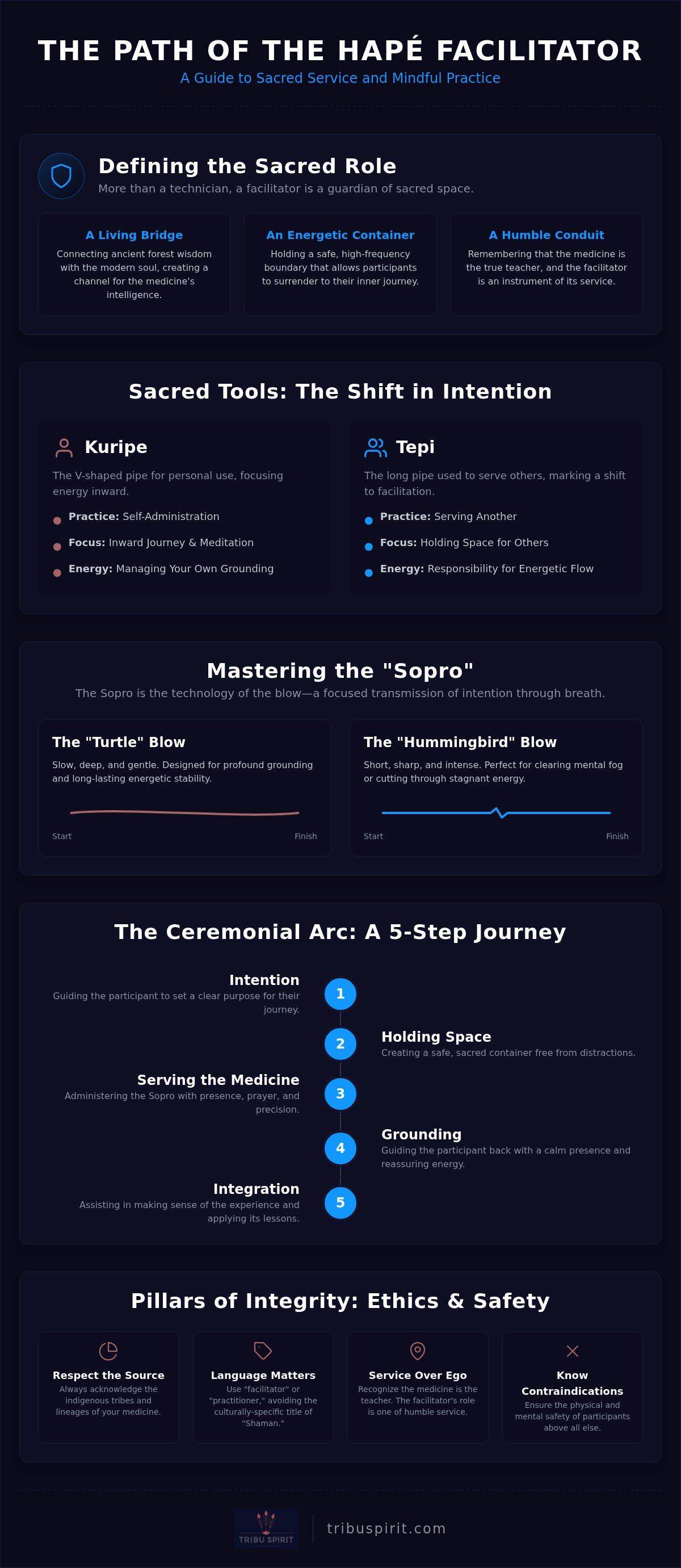
A Hapé facilitator is a trained soul who serves this sacred shamanic snuff within a dedicated ceremonial context. This role is far more than a technical exchange of medicine. It's a commitment to becoming a living bridge between the ancient spirits of the Amazonian forest and the modern seeker. When you step into this position, you aren't just administering a substance; you're holding an energetic container. This container is the invisible boundary of safety and intention that allows a participant to surrender to their inner journey. You are the guardian of that space. You ensure the frequency remains high and the environment stays grounded.
Many individuals feel the call to share this medicine after experiencing its profound grounding effects personally. However, the first step for any aspiring practitioner is distinguishing between social use and ceremonial facilitation. Social use might be casual or individual. Facilitation is an act of service. It requires a level of presence that can only be cultivated through time and proper hapé facilitator training. A facilitator doesn't just "do" the ceremony; they "are" the ceremony. They remain anchored while the participant navigates deep emotional or spiritual waters. It's a heavy responsibility. It's a beautiful gift.
The Difference Between Personal Practice and Facilitation
Your personal practice usually involves a Kuripe, the small V-shaped pipe used for self-administration. In this space, your focus is inward. You're working on your own grounding and your own meditation. Facilitation requires the Tepi, a long pipe designed to bridge the breath between two people. Using a Tepi marks a significant shift in your path. You're no longer just managing your own energy; you're now responsible for the energetic flow of another. You must learn to remain receptive to their needs while keeping your own channel clear. This transition from student to space-holder is the core of any authentic hapé facilitator training program.
Honoring the Indigenous Lineages
Integrity in this work begins with deep humility toward the tribes who have carried this medicine for millennia. Groups like the Yawanawa, Huni Kuin, and Katukina are the true keepers of this wisdom. As Western facilitators, we must recognize that we are guests in their spiritual house. This is why most mindful practitioners avoid the title "Shaman." That title carries a weight and a cultural history that belongs to indigenous elders. We are facilitators. We are space-holders. We are guardians. We don't claim to be the source of the power. Instead, we act as humble conduits for the medicine's natural intelligence to do its work.
- Respect the Source: Always acknowledge the specific tribe and lineage of your medicine.
- Language Matters: Use terms like "facilitator" or "practitioner" to maintain cultural integrity.
- Service Over Ego: Remember that the medicine is the teacher, not the person holding the pipe.
The Technology of the Blow: Mastering the Sopro and Sacred Tools
The Sopro is the primary technology of the Hapé facilitator. It's not just a physical act of exhaling; it's a focused transmission of intention through the medium of breath. In hapé facilitator training, the student learns that the blow is a bridge. It carries the medicine and the prayer into the participant's system with precision. Your breath must be steady. Your mind must be silent. If the facilitator is scattered, the medicine will feel chaotic. The quality of your presence determines the quality of the delivery.
Mastery involves understanding different frequencies. The "Turtle" blow is slow and deep, designed for grounding and long-lasting stability. Conversely, the "Hummingbird" blow is short, sharp, and intense, perfect for clearing mental blockages or stagnant energy. Each participant requires a different rhythm. You listen to their energy before you exhale. You adjust your force based on their constitution. This intuitive calibration is what separates a technician from a true space-holder. It's a language spoken without words.
The Art of the Sopro: More Than Just Air
During the use of shamanic tools, an energetic exchange occurs. The facilitator acts as a filter. You must be grounded before you serve. If you aren't centered, you might inadvertently pass your own stress to the seeker. Use your breath to guide them through the initial moments of the medicine. It's intense. Your calm breath acts as an anchor. It tells their nervous system that they are safe. You are breathing with them, not just for them. This shared rhythm creates the container for transformation.
The Tepi as a Sacred Conduit
The Tepi is the essential tool for serving others. It creates a different energetic circuit than a self-applicator. It connects the hearts of two people through the breath. We prioritize tools made from sustainable materials like bamboo or ethically sourced bone. These materials hold the frequency of the earth. They respect the life that gave them form. Using a Tepi requires a commitment to physical and spiritual hygiene that personal use doesn't always demand.
Maintenance is a ritual in itself. You must clean the pipe with a brush after every session to ensure physical hygiene. However, energetic clearing is just as vital. Blowing the smoke of Mapacho through the Tepi helps clear any residual energy from previous ceremonies. This keeps the tool a pure channel for the next soul. If you feel called to deepen your connection with these instruments, you can explore our collection of ethically sourced sacred tools to find your perfect ceremonial companion. Treat your tools with the same reverence you give the medicine. They are extensions of your own spirit.
Ethics and Safety: Holding a Secure Shamanic Container
Safety isn't a mere checklist; it's a sacred pact between the facilitator and the seeker. When you hold space, you become the silent foundation for another's transformation. This role requires a deep understanding of the physical body. You must identify contraindications like high blood pressure, heart conditions, or pregnancy before the ceremony begins. It's your responsibility to provide informed consent. Participants need to know that intense sweating, heat, or a physical purge are possible. This transparency isn't just about safety; it's about building a container of trust. It ensures the participant feels secure enough to let go.
Physical and Energetic Safety Protocols
Creating this secure container involves every detail of the physical environment. You provide grounded seating, soft lighting, and accessible water. If a participant experiences a strong emotional release or a vigorous purge, your presence must remain unshaken. Understanding what is hape and its effects on the nervous system allows you to offer grounded support during a spiritual crisis. This level of preparation is a hallmark of quality hapé facilitator training. You aren't just serving medicine; you're managing a complex energetic process with poise. You stay present. You stay calm.
Indigenous Sovereignty and Ethical Sourcing
Integrity also extends to the medicine's origin. Ayni, or sacred reciprocity, is the heartbeat of this practice. If you benefit from the wisdom of the forest, you must contribute to its preservation. Buying Hapé from transparent, ethical sources is a non-negotiable requirement for a mindful practitioner. This supports fair trade, Amazonian reforestation, and tribal empowerment. Avoiding spiritual extraction means ensuring that the tribes who created the medicine, such as the Huni Kuin or Yawanawa, are respected and compensated. Your ceremony's power is tied to the purity of your supply chain. Respect the source, and the medicine respects the work.
Finally, we must address the ethics of exchange. Balancing a spiritual ministry with modern sustainability is a delicate dance. Charging for a ceremony is an exchange of energy. It honors your time, your expertise, and the sacred space you maintain. It isn't about selling the medicine itself; it's about sustaining the path that allows you to serve. When hapé facilitator training is approached with this mindset, the practitioner understands that financial reciprocity is simply another form of Ayni. It allows the work to continue. It allows the community to thrive. True abundance flows from a place of clear, honest intention.
The Ceremonial Arc: From Intention to Integration
A Hapé ceremony is a sacred narrative with its own unique pulse. It's a journey that requires a beginning, a middle, and a grounded end. As a facilitator, you are the narrator who ensures every chapter is held with grace. This process begins long before the medicine touches the breath. It starts with the atmosphere you create. A well-structured ceremony provides the safety necessary for deep emotional exploration. Without this arc, the experience can feel fragmented or overwhelming for the seeker. Proper hapé facilitator training emphasizes that the structure is just as important as the medicine itself.
- Step 1: Opening the Space. We begin with smudging, using sacred smoke to clear the air. Prayer and a collective intention set the frequency for the work ahead.
- Step 2: Individual Intake. You consult with the participant. You listen to their needs. This is where you might choose a specific blend, such as hape tsunu, if they require deep grounding and spiritual clarity.
- Step 3: The Service. Administering the medicine with the Tepi. This is the moment of transmission where your Sopro meets their intention.
- Step 4: The Silence. After the blow, silence is essential. You allow the participant 15 to 20 minutes to sit with the medicine without interruption.
- Step 5: Closing and Integration. We gently bring the participant back. We use grounding food, water, or soft music to seal the experience.
Selecting Blends for Ceremony
A facilitator must be an intuitive alchemist. You match the medicine to the participant’s specific energetic blockage. If someone is stuck in their head, you choose a grounding blend. If they seek vision, you look for something more expansive. During this selection, the use of Mapacho is vital. It protects your own energy while you tune into the seeker's field. Intention acts as the rudder that steers the Hapé experience through the currents of the subconscious. Without a clear rudder, the medicine may wander. With it, the medicine finds its target with surgical precision.
The Vital Art of Integration
The ceremony doesn't end when the participant opens their eyes. Integration is the most overlooked phase of space-holding. It's the process of returning to the body and translating forest wisdom into daily life. You might guide them through a sacred ritual like journaling or mindful walking to anchor their insights. A professional facilitator provides follow-up care. You check in. You help them bridge the gap between their visions and their reality. If you feel ready to deepen your own practice and learn these nuances of service, we invite you to explore the Tribu Spirit Academy for structured mentorship. True mastery is found in the care you provide after the pipes are put away.
Embarking on the Path: Hapé Training and the Tribu Spirit Academy
Facilitation isn't a destination you reach with a simple weekend certificate. It's a lifelong apprenticeship. It's a deep, ongoing dialogue with the forest spirits that requires patience and humility. Choosing a path of hapé facilitator training is a declaration of intent to the universe. You are stating that you're ready to serve. However, that service must be earned through consistent personal practice. You can't lead a soul through a landscape you haven't walked yourself. You must sit with the medicine for extended seasons, learning its nuances in your own body before you ever pick up a Tepi for another soul.
The transition from student to practitioner is a sacred threshold. It's about more than just the "Sopro" or the tools; it's about the refinement of your own character. At the Tribu Spirit Academy, we believe that a facilitator must be a clear vessel. This clarity comes from sitting in the silence, facing your own shadows, and developing a relationship with the medicine that is rooted in love rather than ego. You aren't just learning a skill. You're entering a community of practice where insights and challenges are shared with transparency and grace. You're never walking this path alone.
The Tribu Spirit Academy Curriculum
Our curriculum bridges the gap between ancient forest wisdom and the needs of the modern, holistic seeker. The Academy operates as a Private Membership Association (PMA). This model is vital. It ensures we operate within a protected spiritual ministry, focusing on the energetic and sacramental nature of the medicine. The hapé facilitator training we provide focuses on three core pillars: safety protocols, ethical reciprocity, and lineage connection. You'll learn the science of contraindications alongside the art of the Hummingbird blow, ensuring your practice is as safe as it is spiritually profound.
Apprenticeship as a Lifelong Journey
We encourage our students to start small. Begin with private circles for trusted friends and family. This is where you find your voice. It's where you develop your own unique medicine song or ceremonial rhythm. Your style shouldn't be a copy of another; it should be an authentic expression of your own connection to the earth. As you grow, your confidence will naturally expand. You'll move from a place of hesitation to a place of grounded expertise, always remembering that the medicine is the true teacher. We are merely its humble assistants.
The call to facilitate is a call to a life of deeper meaning and connection. If you feel this resonance in your heart, the door is open. Explore the Tribu Spirit Academy and begin your facilitator journey today. Your path toward becoming a mindful, integrity-led practitioner starts with a single, intentional step.
Step Into Your Sacred Service as a Guardian of the Sopro
Becoming a Hapé facilitator is a profound commitment to walking with integrity and humility. You've explored how mastering the Sopro is an act of prayer and how holding a secure shamanic container requires both physical safety protocols and a deep dedication to sacred reciprocity. This path isn't a quick transition; it's a beautiful, lifelong apprenticeship that honors the indigenous lineages of the Amazon. By aligning your intention with ethically sourced medicines and structured hapé facilitator training, you ensure that every ceremony you lead becomes a true bridge to spiritual clarity.
The world needs mindful practitioners who value reforestation and tribal empowerment as much as the ritual itself. Through our structured modules and worldwide community of shamanic practitioners, you'll find the mentorship needed to refine your unique medicine song. Your journey of service is waiting to unfold with grace and expertise. Every breath you share is an opportunity to anchor more light into the world.
Join the Tribu Spirit Academy: Master the Art of Hapé Facilitation and step into your role as a guardian of this ancient forest wisdom today.
Frequently Asked Questions
Do I need a special license to be a Hapé facilitator?
No government-mandated license exists for Hapé facilitators in the United States as of 2026. Instead, practitioners often operate within a Private Membership Association (PMA) to establish a protected spiritual ministry framework. Real authority comes from lineage connection and a commitment to rigorous hapé facilitator training that emphasizes ethics, safety, and indigenous reciprocity.
Is it necessary to use a Tepi when serving others?
Yes, using a Tepi is essential for serving others because it creates the necessary energetic bridge between the facilitator and the participant. While a kuripe is designed for self-application, the Tepi allows for the transmission of the Sopro with the correct distance and intention. It transforms the act into a shared ceremonial experience rather than a solitary practice.
How do I know if I am ready to serve Hapé to someone else?
You are ready when your personal practice has become a stable foundation and you've sat with the medicine through diverse emotional cycles. Readiness isn't a feeling of egoic power, but a quiet, humble call to service. Many find that completing a structured hapé facilitator training provides the final layer of confidence and protocol needed to hold space safely for others.
What is the most important quality of a Hapé facilitator?
Presence is the most vital quality a facilitator can possess. You must be a clear, grounded vessel so the medicine can work through you without the interference of your own energetic noise. This requires a constant commitment to your own inner healing and spiritual hygiene before you ever step into the role of space-holder.
Can I facilitate Hapé ceremonies for large groups?
Facilitating for large groups is possible, but it requires advanced skills in energetic management and often requires trained assistants. For those beginning their path, we recommend holding intimate circles of two to five people. This ensures every participant receives the deep, focused attention required for a safe and transformative ceremonial arc.
How much should a Hapé facilitator charge for a ceremony?
Charging for a ceremony is an act of Ayni, or sacred reciprocity, and should reflect the value of your time, the cost of the medicine, and the sacred space provided. There's no fixed industry standard, so practitioners should choose a fee that sustains their ministry while remaining accessible to their community. Integrity in exchange is just as important as integrity in the blow.
What should a facilitator do if a participant has a bad reaction?
If a participant has a strong reaction, your primary job is to remain calm and anchored. Guide them with your breath, provide a grounding physical touch if appropriate, and ensure they have access to water or a purge bucket. Having a clear protocol for spiritual crisis support is a non-negotiable part of responsible and professional facilitation.
How do I ensure my Hapé is ethically sourced?
Ensure ethical sourcing by choosing providers who have direct, transparent relationships with indigenous tribes like the Huni Kuin or Yawanawa. Look for brands that actively fund reforestation and tribal empowerment projects in the Amazon. When you support fair trade, your ceremony carries the frequency of respect and true reciprocity for the medicine's origin.