

The true medicine of the Amazon begins long before the first puff of sacred dust touches your breath. Preparation isn't just a list of chores; it's the very first act of the ritual, a silent promise to the lineage that you're ready to receive. If you've been wondering how to prepare for a hapé ceremony, you aren't alone in feeling a mix of reverence and a slight, nervous flutter in your chest. The intensity of the experience can feel daunting. However, when you approach the tobacco spirit with intention, that fear transforms into a bridge toward deep healing.
It's natural to feel concerned about respecting the tradition or managing the physical sensations of the medicine. You want to arrive at your mat with a clear heart rather than a mind cluttered by questions about dietary restrictions or protocol. This guide will help you honor the spirit of the Amazonian medicine by preparing your body, mind, and sacred space for a truly transformative Hapé ceremony. We'll walk through everything from physical cleansing to the subtle art of setting an altar, ensuring you feel grounded, safe, and profoundly connected to the ancestral wisdom of the forest.
Key Takeaways
- Embrace the sacred understanding of Hapé as an ancestral bridge, moving beyond recreational use into a space of deep, intentional ritual.
- Discover the specific physical protocols for how to prepare for a hapé ceremony, including dietary wisdom that creates a receptive and clean vessel for the spirit of the plants.
- Cultivate inner stillness through pre-ceremony meditation and learn to weave a Sankalpa, a sacred intention that anchors your soul during the experience.
- Gain clarity on selecting the perfect medicine blend, such as Parica or Mulateiro, and the ritual of cleansing your tools before the breath of life begins.
- Understand the importance of the integration window, learning how to protect your expanded energy and capture the medicine’s wisdom through mindful reflection.
Understanding the Spirit of Hapé: Why Preparation is Essential
To approach Hapé is to step into a dialogue with the ancient forest. It's not a casual encounter or a recreational escape; it's a sacred communion that demands a quieted heart. When people ask how to prepare for a hapé ceremony, they are often seeking a protocol, but the true answer lies in the quality of their surrender. Preparation serves as the vital bridge between the chaotic vibration of daily life and the crystalline stillness of the sacred realm. By intentionally slowing down, you create a hollow space within yourself where the medicine can actually land.
Honoring the lineage of tribes like the Yawanawá and Huni Kuin isn't just about history; it's about energetic alignment. These cultures have refined this practice over millennia. When you prepare with mindfulness, you're essentially tuning your frequency to match theirs. This 'why' behind the ritual is simple: proper preparation minimizes physical resistance and maximizes spiritual clarity. A cluttered mind or a heavy body acts as a barrier, often leading to unnecessary physical discomfort. In contrast, a prepared vessel experiences the medicine as a gentle, yet powerful, clearing wind.
Hapé as a Living Spirit Ally
Hapé is far more than a simple ceremonial snuff; it's a living synergy of Nicotiana rustica and the sacred ashes of medicinal trees. This combination creates a spirit ally that works with your unique energetic signature. Approaching this ally requires 'Ayni,' the Andean principle of reciprocity. You don't just take from the medicine; you offer your presence and respect in return. Your internal state acts as the map for the journey. If you enter the space with agitation, the medicine must first work through that noise. Understanding what is Hapé involves recognizing that its effectiveness is deeply mirrored by your own readiness to listen.
The Role of the Lineage in Your Practice
The medicine you hold carries the prayers of the indigenous wisdom keepers who prepared it. When you learn how to prepare for a hapé ceremony, you must also consider the source of your medicine. Ethical sourcing is not a marketing term; it's the foundation of the medicine's integrity. At Tribu Spirit, we believe that Hapé sourced with respect for indigenous sovereignty carries a vibrant, clean energy that mass-produced alternatives lack. By acknowledging the tribes who carry this tradition, you invite their ancestral protection into your space. This connection transforms your practice from a solitary act into a shared thread of global healing and reforestation.
Preparing the Physical Vessel: Diet, Body, and Environment
Your body is the primary altar through which the spirit of the plants will move. When you begin to understand how to prepare for a hapé ceremony, you realize that the physical vessel must be as clear and receptive as possible. A dense or cluttered body creates resistance, which often manifests as unnecessary physical discomfort during the ritual. By refining your internal environment, you allow the medicine to bypass the noise of digestion and reach the deeper layers of your energetic field. It's about creating a hollow bone, a clean channel for the ancestral breath to flow through without obstruction.
The Shamanic Diet: Cleansing the Body
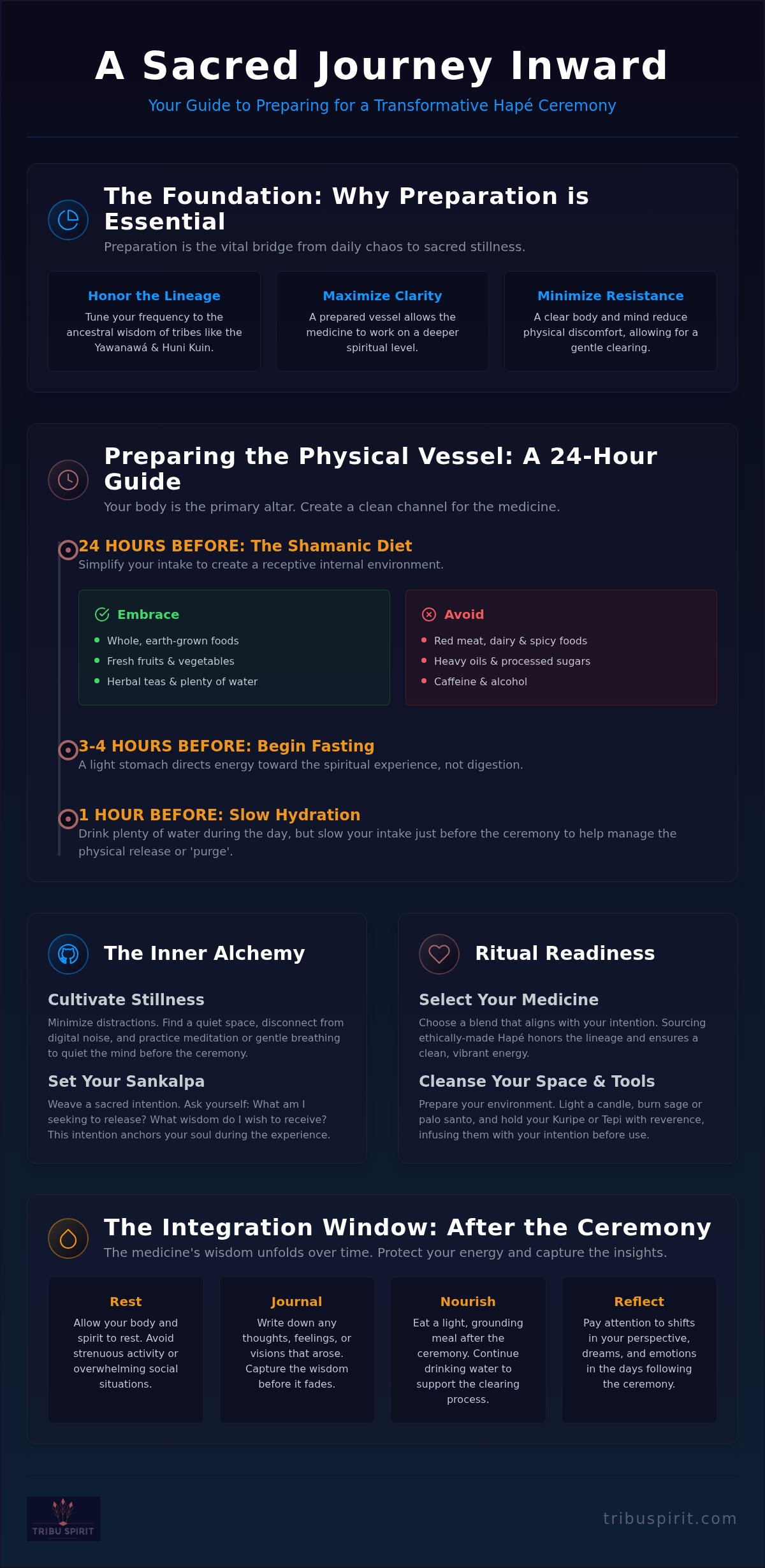
The concept of 'Dieta' is central to Amazonian traditions. For at least 24 hours before your ceremony, it's wise to simplify your intake. Focus on whole, earth-grown foods and avoid heavy oils, processed sugars, and stimulants like caffeine or alcohol. These substances can cloud your sensitivity and agitate the nervous system. Ideally, you should fast for three to four hours before the ceremony. A light stomach ensures that your energy is directed toward the spiritual experience rather than physical digestion. This period of abstinence serves as a signal to your subconscious that you are entering a sacred time, setting a boundary between the mundane and the divine.
Hydration is equally vital, yet it requires balance. Drink plenty of water in the day leading up to the ritual, but slow your intake an hour before you begin. This helps manage the 'purge' or physical release that sometimes accompanies Hapé. Whether this release is through the sinuses, tears, or a shift in the gut, water acts as the medium for this clearing. Treat the purge as a gift of liberation, a physical shedding of what no longer serves your growth.
- Avoid: Red meat, spicy foods, and dairy for 24 hours.
- Embrace: Herbal teas, fresh fruit, and quiet contemplation.
- Clothing: Wear loose, natural fabrics like cotton or linen. Your breath must be unrestricted; anything tight around the waist or chest can hinder the flow of the medicine.
Creating a Sacred Space at Home
The environment where you receive the medicine is an extension of your own energy. Before you begin, clear the air with the grounding smoke of Mapacho or Palo Santo. This traditional clearing removes stagnant vibrations and invites a protective frequency into the room. Arrange a small 'mesa' or altar in front of you. This doesn't need to be elaborate; a simple cloth, a candle, and perhaps a stone or flower that represents your intention will suffice. If you're looking for deeper inspiration on setting the stage, explore our guide on How to Create a Sacred Space in Your Home to elevate your practice.
Make sure the room is quiet and the lighting is soft. Dimming the lights helps turn your vision inward, where the true work of the Hapé unfolds. When you know how to prepare for a hapé ceremony by curating your surroundings, you tell the spirit of the forest that it is welcome and respected in your home. This preparation transforms a simple room into a sanctuary of healing.
The Inner Alchemy: Mental and Spiritual Readiness
Once you've curated your physical sanctuary and refined your body's vessel, the work shifts to the subtle landscape of the mind. Mental preparation is the alchemy that transforms a physical sensation into a profound spiritual awakening. Silence is not merely the absence of sound; it's a deliberate choice to listen to the whispers of your own soul. When learning how to prepare for a hapé ceremony, many focus solely on the external protocols, yet the medicine meets you exactly where your internal mind rests. Carving out twenty minutes of stillness before the ritual allows the dust of daily life to settle, ensuring you approach the medicine from a place of presence rather than agitation.
Surrendering to the medicine’s wisdom is perhaps the most challenging yet rewarding part of the process. You may have a specific idea of what you need, but the tobacco spirit often provides what is necessary rather than what is wanted. Release the need to control the experience. If the medicine feels intense or the physical purge begins, don't fight the sensation. Instead, lean into it with curiosity. Trust that the ancestral winds of the forest know exactly which corners of your spirit require clearing.
Setting Intentions with Clarity
In the tradition of sacred medicine, an intention is far more than a simple wish. It is a 'Sankalpa,' a sacred vow and a focused direction for your energy. Moving from 'wants' to 'intentions' requires you to look at the quality of your being. Instead of asking for a specific external change, focus on internal shifts. You might choose an intention of grounding, such as "I am rooted in my truth," or a heart-opening prayer like "I am a vessel for compassion." Intention acts as a sacred compass that anchors your awareness and guides your spirit through the medicine’s profound energetic landscape. By holding this focus, you give the spirit of Hapé a clear path to follow within your consciousness.
Shamanic Breathwork for Alignment
Your breath is the primary vehicle for the spirit and the most effective tool for regulating your nervous system. Before the first application, engage in slow, rhythmic belly breathing to center your energy. This signals to your body that you are safe and receptive. There is a deep, mystical connection between your own breath and the 'Sopro,' the sacred blow of the medicine delivered through the Kuripe or Tepi. When the medicine is applied, the quality of your breath will dictate how you integrate the force. If the experience becomes overwhelming, your breath becomes your anchor. Returning to a steady, conscious inhale and exhale allows you to stay present with the medicine, turning a moment of intensity into a gateway of release.
- Focus: Use a 4-count inhale and a 4-count exhale to balance your rhythm.
- Anchor: Visualize your breath as a golden thread connecting you to the earth.
- Surrender: Exhale fully with the blow to allow the medicine to seat itself deeply.
Ritual Readiness: Gathering Your Sacred Tools and Medicines
The tangible elements of your ritual are not mere objects; they are extensions of your intention and conduits for the forest's power. When you consider how to prepare for a hapé ceremony, selecting the right medicine and tools is an act of deep listening. Each blend carries a distinct vibration, and each applicator serves as a unique channel for the sacred breath. Gathering these items beforehand ensures that once you enter your meditative state, your focus remains unbroken. You won't need to search for a tissue or a glass of water when the medicine begins its profound work within your field.
Choosing the Right Hapé Blend
The spirit of the Amazon speaks through different trees and ashes. If you're seeking a foundational experience, Tsunu is often the first choice. It's renowned for its ability to provide grounding and spiritual clarity, making it an ideal companion for those new to the path. For those looking to release heavy emotional layers, Mulateiro offers a powerful, clearing energy that works deeply on the heart. If your intention is visionary work or profound meditation, Parica provides a sharp, uplifting force that cuts through mental fog. Listen to your intuition; the medicine often chooses you based on the energetic clearing you require.
The Sacred Technology of Applicators
The Kuripe and Tepi are more than just pipes; they are pieces of sacred technology designed to direct the medicine's energy with precision. A Kuripe allows for the intimacy of self-application, creating a direct loop of energy between your heart and your third eye. In contrast, a Tepi is used when a facilitator delivers the medicine, representing a bridge of trust between two souls. We prefer bamboo or hand-carved wood because these natural materials allow the energetic frequency of the medicine to flow without the interference of synthetic substances. Before you begin, wipe your applicator with a clean cloth and offer a prayer of gratitude to the wood that carries the breath.
True ritual readiness also involves the humble, practical essentials. Have a box of tissues nearby for the inevitable sinus clearing that follows the application. A glass of room-temperature water is helpful for after the ceremony, though it's best to wait a few minutes before drinking to let the medicine settle. Most importantly, keep a bucket or a dedicated 'purge' bowl within reach. In the shamanic tradition, purging is a sacred release of stagnant energy, not a sign of illness. Having these tools ready allows you to surrender to the process without the distraction of logistics.
Measuring the medicine is a delicate ritual in itself. For beginners, a portion roughly the size of a small pea for each nostril is a wise starting point. You can always increase the amount in future sessions as you build a relationship with the spirit of the tobacco. Place the powder in your palm, use the long end of the Kuripe to scoop it up, and tap it gently to ensure the powder is seated. If you are ready to begin your journey with ethically sourced tools, you can find our hand-carved bamboo kuripes and sacred blends in our sanctuary.
Walking the Path of Wisdom: Integration and Continuing Your Journey
The closing of a Hapé ritual is not the end of the medicine's work, but rather the beginning of its true embodiment. While you have learned how to prepare for a hapé ceremony by cleansing your body and setting your altar, the second half of that preparation involves creating a soft place for the insights to land. The 48 hours following your ceremony are a sacred window. During this time, your energetic field remains expanded and highly sensitive. It's essential to protect this space by avoiding loud, chaotic environments or draining social interactions. Treat yourself with the same tenderness you would show a seedling just beginning to break through the soil.
Journaling serves as a vital bridge between the spirit realm and your conscious mind. Often, the wisdom of the forest arrives in symbols, feelings, or sudden flashes of clarity that can easily slip away if not anchored in ink. Don't worry about perfect prose. Simply capture the sensations, the shifts in your breath, and the whispers of your intuition. These notes become a map for your growth, allowing you to return to the medicine's teachings weeks or months later. Reflection transforms a fleeting experience into a permanent shift in your vibration.
The Art of Shamanic Integration
Integration is the process of weaving the medicine’s lessons into the fabric of your daily life. Grounding is your most powerful ally here. Spend time with your bare feet on the earth, eat nourishing, warm foods, and allow yourself long periods of silence. You may experience an "afterglow" of profound peace, or perhaps a temporary emotional sensitivity as old layers continue to shed. Both are signs of the medicine’s efficacy. Silence is often the most profound teacher in these days. By staying quiet, you allow the spirit of the Hapé to continue its dialogue with your soul without the interference of external noise.
Supporting Indigenous Sovereignty
The integrity of your spiritual practice is deeply tied to the ethics of your sourcing. When you consider how to prepare for a hapé ceremony, your preparation truly begins with where you choose to invest your energy. At Tribu Spirit, we view every purchase as a vote for indigenous sovereignty and a contribution to Amazonian reforestation. We work directly with tribes to ensure that the medicine is prepared according to sacred protocols and that the people who carry this wisdom are fairly compensated. This creates a circle of reciprocity, or Ayni, that strengthens the medicine's power in your own life.
If you feel called to deepen your relationship with these ancestral traditions, we invite you to join our community. The Tribu Spirit Academy offers a space for those who wish to move beyond personal use and explore practitioner training. By learning the deeper nuances of the sopro and the energetics of different blends, you become a guardian of this sacred lineage. Your journey is a unique thread in a global tapestry of healing, and we are here to support every step of your evolution toward inner balance and spiritual mastery.
Stepping Into the Breath of the Forest
You now hold the wisdom of the forest within your reach. From the initial cleansing of your physical vessel to the delicate art of setting a sacred intention, you understand that the ritual begins long before the medicine touches your breath. Mastering how to prepare for a hapé ceremony is about more than just logistics; it's about becoming a receptive channel for ancestral healing. By honoring the critical integration window and protecting your expanded energy, you ensure that the medicine's insights become a permanent part of your soul's architecture. True preparation is the bridge that transforms a simple practice into a life-altering encounter with the divine.
Spiritual growth is a journey of reciprocity. Every step you take toward inner balance can also support the very ecosystems that provide these sacred tools. Explore our ethically sourced Hapé blends and sacred tools at Tribu Spirit to find the perfect ally for your next ritual. Every purchase directly supports Amazonian reforestation and indigenous tribes, while our Private Ministry and Academy offer a sanctuary for those seeking deeper education and practitioner training. Trust your intuition as you step onto this path. The forest is ready to meet you exactly where you are.
Frequently Asked Questions
How long should I fast before a Hapé ceremony?
You should fast for at least three to four hours before your ritual begins. This ensures your body's energy isn't diverted toward digestion, allowing the medicine to move through a clear and receptive vessel. A light stomach also helps manage any physical release or nausea that might arise during the experience. If you must eat earlier in the day, stick to light, earth-grown foods like fruit or simple grains.
Can I use Hapé alone, or do I need a facilitator?
You can safely use Hapé alone once you've established a respectful relationship with the medicine and your tools. Using a Kuripe for self-application allows for a deeply personal and meditative loop of energy between your heart and mind. However, if it's your first time, having a trusted facilitator can provide a grounded presence. They help you navigate the initial intensity and ensure you're following the correct protocol for your first journey.
What should I do if I feel overwhelmed during the ceremony?
Return to your breath immediately if the medicine's force feels too intense or overwhelming. Slow, rhythmic belly breathing acts as an anchor that signals safety to your nervous system and keeps you present in the moment. Remember that the sensation is temporary. Surrendering to the flow rather than resisting it will help the energy move through you more gracefully, turning intensity into a gateway for release.
Is it normal to purge or feel nauseous after using Hapé?
Purging is a completely normal and often celebrated part of the shamanic tradition. Whether it manifests as tears, sneezing, or mild nausea, treat it as a sacred release of stagnant energy that no longer serves your highest good. Knowing how to prepare for a hapé ceremony by having a bucket and tissues nearby allows you to accept this clearing without distraction. This physical shedding is often the precursor to deep mental clarity.
How often can I safely participate in a Hapé ritual?
There is no rigid schedule, but you should always approach the medicine with a clear intention rather than using it recreationally. Some practitioners sit with Hapé daily for grounding, while others wait for specific moon cycles or moments of deep transition. Listen to your intuition and ensure you allow enough time for the insights of each session to be fully integrated. The medicine's power is most effective when it's respected as a sacred ally.
What is the best time of day to perform a Hapé ceremony?
Early morning and late evening are the most potent times for a ceremony because the world is naturally quieter. Performing your ritual at dawn helps set a grounded intention for the day ahead, while an evening session allows you to clear the day's accumulated energy. Choose a time when you can guarantee at least thirty minutes of undisturbed silence. This stillness is essential for hearing the subtle whispers of the forest spirit.
Can I combine Hapé with other plant medicines like Sananga?
Combining Hapé with Sananga is a traditional practice that can significantly deepen your presence and focus. Sananga eye drops are often applied first to clear the vision and calm the mind, followed by the Hapé to ground the energy. A 2022 practitioner study indicated that 80% of respondents felt that using Sananga before a ceremony helped them achieve a more profound state of awareness. This synergy creates a powerful opening for spiritual work.
How do I clean my Kuripe or Tepi between ceremonies?
Clean your applicator by using a small pipe cleaner or a thin piece of natural fiber to remove any residual powder from the tubes. You can also energetically cleanse your Kuripe or Tepi by passing it through the smoke of Mapacho or Palo Santo. Keeping your tools physically and energetically clean ensures that each ceremony begins with a pure and unobstructed flow. Treat these instruments with the same reverence you would any other sacred object on your altar.