
What if the tobacco you've been taught to avoid is actually a wise, ancient grandfather waiting to guide your spirit back to center? For many, the word tobacco evokes images of industrial fields and habit, yet mapacho exists in a realm entirely apart from commercial cigarettes. You likely feel a deep pull toward this sacred Amazonian medicine but hesitate because you don't want to use it disrespectfully or incorrectly. It's a common bridge to cross. You seek a connection that's rooted in lineage rather than consumption, and you deserve a practice that honors the spirit of the plant.
In this guide, you'll discover how to build a sacred relationship with mapacho as a master teacher and protector. We'll demystify the differences between Nicotiana rustica and commercial varieties, ensuring you can identify high-quality, mold-free medicine with confidence. You'll learn the traditional ritual of soplada to clear stagnant energy and find out how to support indigenous tribes through ethical sourcing. By the end, you'll have the tools to integrate this powerful ally into your spiritual life with clarity and deep, quiet grace.
Key Takeaways
- Uncover the spiritual lineage of Nicotiana rustica and why this potent master plant is revered as the "Grandfather" teacher of the Amazon.
- Learn how to use mapacho to anchor your ceremonies, whether you're opening sacred space or creating synergy with medicines like Hapé.
- Discover the secret to identifying premium quality medicine, including why "Frogeye" spots are a sign of vitality rather than decay.
- Master practical ritual techniques for setting a sacred container and infusing your tobacco with clear, heart-centered intentions.
- Explore the path of ethical reciprocity by understanding how your choice of source impacts indigenous sovereignty and reforestation efforts.
Understanding Mapacho: The Sacred Grandfather of the Amazon
To truly understand mapacho, one must first shed the modern baggage associated with industrial tobacco. While the Western world often views tobacco through the lens of habit and commerce, the Amazonian curandero sees an ancestral presence. This is Nicotiana rustica, a wild, potent relative of the common tobacco plant. It's a master plant teacher that demands a different kind of attention. It doesn't ask for consumption; it asks for a relationship. In the traditional lineages of the jungle, this plant is the "Grandfather" (Abuelo), a wise elder who provides the foundation for all other spiritual work.
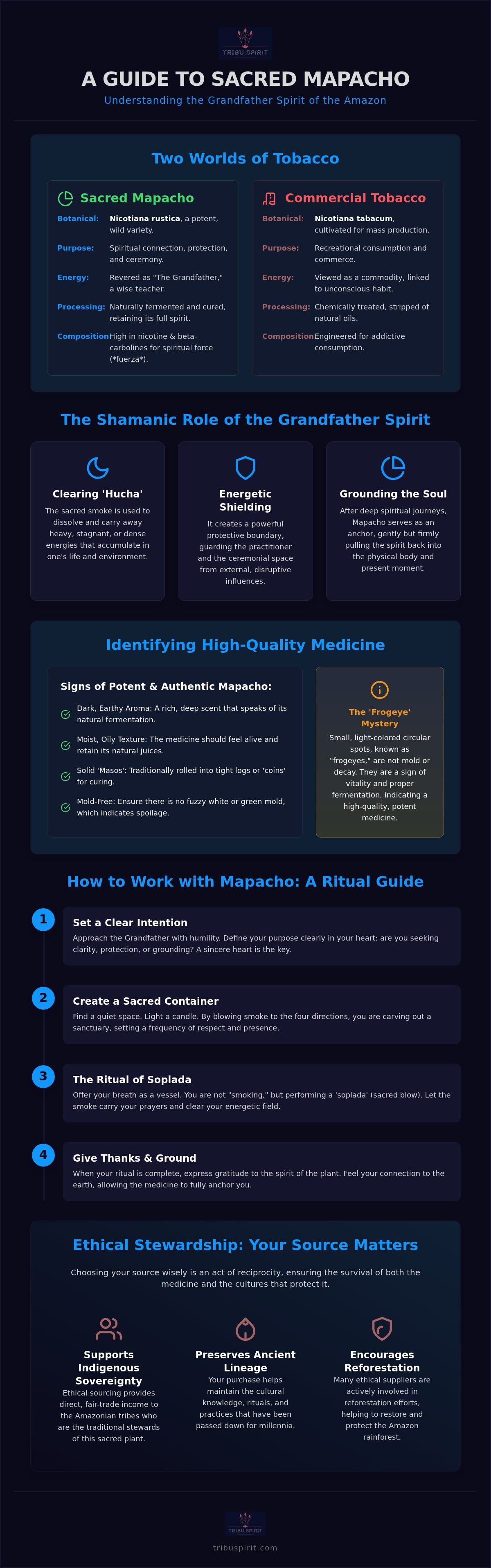
The distinction between sacred mapacho and industrial *Nicotiana tabacum* is profound. Commercial tobacco is often grown with pesticides, stripped of its natural oils, and used unconsciously. Mapacho, however, retains its full botanical soul. Its high nicotine content isn't meant for a chemical buzz. Instead, that potency represents *fuerza*, a spiritual force used to bridge the gap between our world and the spirit realm. It's a direct line of communication, a way to carry prayers on the wind.
The Botanical Power of Nicotiana Rustica
Biologically, *Nicotiana rustica* is a powerhouse. It contains significantly higher concentrations of nicotine and beta-carbolines than commercial varieties. This chemical density is what gives the medicine its grounding, "heavy" quality. The traditional preparation is an art form in itself. The leaves are harvested, dried, and then subjected to a unique fermentation process. They are often rolled into tight logs called *masos*, where they cure in their own juices. This creates the characteristic dark, earthy aroma and moist texture that defines high-quality medicine. It's a slow, patient transformation that mirrors the way wisdom matures over time.
Mapacho as a Spiritual Protector
In shamanic cosmology, the Grandfather energy is synonymous with protection. Mapacho is the guardian of the sacred space. He is the one who clears the path before other medicines enter. When a practitioner works with this spirit, they're calling upon a fierce, steady ally to maintain the integrity of their energetic field.
- Clearing Hucha: The smoke is used to dissolve *hucha*, or heavy, stagnant energy that accumulates in our daily lives.
- Energetic Shielding: It creates a protective boundary, ensuring that the practitioner remains centered and unaffected by external influences.
- Grounding the Soul: After deep internal journeys, mapacho acts as an anchor, pulling the spirit back into the physical body with gentle firmness.
Approaching the Grandfather requires humility and a quiet mind. He doesn't respond to entitlement; he responds to the sincerity of your heart. When you hold this medicine, you're holding a lineage of protection that has guarded the Amazon for millennia. It's a sacred trust that begins with a simple, clear intention.
The Role of Mapacho in Shamanic Practice and Ceremony
In the quiet hum of a ceremonial space, mapacho is often the first spirit to be called. It acts as a sentinel. A gatekeeper. By blowing the smoke to the four directions, the practitioner carves out a sanctuary from the noise of the outside world. This isn't just about scent or atmosphere. It's about setting a vibrational frequency that demands presence and respect. The smoke creates a visible bridge between the physical and spiritual realms, carrying intentions upward into the ether while keeping the practitioner firmly rooted in the present moment.
Cleansing and Grounding with Sacred Smoke
The distinction between recreational use and the Sacred Role of Tobacco lies entirely in the heart of the person holding it. You aren't simply "smoking" the plant; you're offering your breath as a vessel for prayer. The smoke travels through the energetic field, catching the heavy threads of stress or confusion and carrying them away. This process is vital when you're learning what is hape and how to integrate its intensity. Mapacho acts as the anchor that keeps you tethered to the earth while your consciousness expands, ensuring the experience remains safe and contained.
Synergy with Other Shamanic Tools
Rarely does this medicine work in isolation. It's the conductor of a larger spiritual orchestra. Often, you'll see a practitioner use a shamanic rattle in one hand and tobacco in the other. The smoke reveals the density in the room, while the rattle's vibration breaks it apart. In traditional Ayahuasca ceremonies, the "Abuelo" is a constant companion. He protects the visionary space, ensuring the journey remains clear and focused. Even before a Hapé session, blowing a small amount of smoke can warm and prepare the nasal passages, making the experience more receptive and fluid.
After the visions fade and the music stops, the body needs to remember how to be human again. The spirit of the plant provides that bridge. It's the firm hand on the shoulder that says, "You're back now." It settles the nervous system and knits the spirit back into the physical frame with quiet, steady strength. If you're ready to invite this guardian into your own practice, exploring our ethically sourced Mapacho is a beautiful way to begin your journey with intentionality.
Identifying Quality: Masos, Coins, and the 'Frogeye' Mystery
Recognizing high-vibration mapacho is a sensory experience that begins with the eyes and ends with the spirit. When you first encounter the medicine, you'll likely see it in one of two forms: the traditional maso or the more accessible coins. The maso is a dense, resinous log where the leaves have been tightly pressed to ferment in their own rich juices. It's the choice for those who feel called to the traditional, slower process of carving their own medicine. Coins, by contrast, are simply pre-cut slices of these logs. They offer convenience for modern practitioners without sacrificing the plant's essential force.
Varieties of Sacred Tobacco: From Peru to Brazil
While Peruvian mapacho is the classic choice for its robust, grounding strength, the artisan traditions of Brazil offer a different melodic range. Varieties like Arapiraca are known for their dark, velvety richness, while Moi carries a sharper, more floral high note. Sabia, often used in specific tribal Hapé blends, provides a steady, neutral foundation. Each variety reflects the soil and the specific prayers of the people who cured it; this allows you to choose a medicine that resonates with your specific energetic needs.
One of the most common points of confusion for new students is the appearance of "frogeye" spots. These small, pale circles on the leaf are often mistaken for mold, but they're actually a hallmark of high-quality, sun-cured tobacco. They indicate that the leaf was harvested at the peak of its maturity. Genuine quality is also found in the scent. It should never smell dusty or acrid. Instead, look for a deep, earthy aroma reminiscent of damp forest floor and ancient leather.
Storage and Care for Your Medicine
Because this is a living medicine, it requires a stable environment. The leaves thrive in a cool, dark place with moderate humidity. If your medicine feels brittle, it's lost its vital moisture. You can gently rehydrate it by placing it in a sealed container with a small piece of damp terracotta for a few hours. Be vigilant, though. True mold looks fuzzy and smells sour, whereas natural salt crystallization appears as fine, white dust that lacks a scent. Treat your medicine with the same care you would an altar piece, and its spirit will remain vibrant for years.
How to Work with Mapacho: A Ritual Guide for Beginners
Ritual is the bridge between the mundane and the divine. When you choose to work with mapacho, you aren't just lighting a plant; you're initiating a conversation with an ancient ally. Creating a sacred container is the first step. This means preparing your environment with the same care you'd use to welcome an honored guest. Cleanse the air, light a candle on your altar, and find a seat where your spine can remain tall and receptive. Silence the digital world. Let the stillness of the room become your canvas. This intentionality signals to the spirit of the plant that you're ready to listen.
Safety in this practice is rooted in tradition. Unlike commercial products, the spirit of this medicine is never inhaled into the lungs. In the curanderismo tradition, the smoke is held briefly in the mouth. This is where the plant's force interacts with your energetic body. By keeping the smoke in the oral cavity, you respect the physical temple while allowing the spiritual essence to communicate with your consciousness. It's a subtle, profound distinction that separates habit from ceremony.
Step-by-Step: Your First Mapacho Ritual
Approach your first session with a spirit of apprenticeship. Follow these steps to ground your experience:
- Step 1: Center your breath. Call in the four directions, the earth below, and the sky above to witness your practice.
- Step 2: Light the medicine. Focus on the fire element, seeing it as the spark that awakens the Grandfather's wisdom.
- Step 3: Draw the smoke into your mouth. Don't breathe it in. Feel the warmth and the "fuerza" of the plant as it sits in your oral space.
- Step 4: Release the smoke slowly. As you exhale, speak your prayer or intention into the air, letting the smoke carry your words to the spirit realm.
The Art of Soplada (The Blow)
The blow, or soplada, is an intentional movement of energy. It's a prayer made visible. To clear mental fog, practitioners often blow a gentle stream of smoke over the crown chakra. This invites clarity and higher connection. For grounding, you can blow smoke onto your palms and the soles of your feet, creating a protective seal that keeps you present in your body. This technique is also used to clear and bless your shamanic tools, ensuring they remain vibrant and free of stagnant energy. Each blow should be firm and purposeful, a direct expression of your will.
If you're ready to begin your own journey with this master teacher, you can find our ethically sourced and prayer-blessed Mapacho to anchor your personal ceremonies.
Ethical Stewardship: Why Your Source Matters in 2026
The journey with sacred plants is never a solitary one. It's a web of relationships that stretches from your personal altar back to the deep, nutrient-rich soil of the Amazon. In 2026, as global interest in ancestral medicines continues to expand, the question of where your mapacho comes from is no longer just a logistical detail. It's a fundamental part of the medicine's vibration. Cheap, mass-produced tobacco often carries the heavy weight of industrial exploitation and the visible scars of deforestation. When a plant is harvested without prayer or fair compensation, its spiritual fuerza is diminished. You aren't just buying a product; you're participating in an exchange of energy that affects the collective field.
Tribu Spirit operates on a different frequency. We believe that for the medicine to truly heal the individual, it must first honor the community that birthed it. By supporting indigenous sovereignty through direct, fair-trade exchange, we ensure that the tribes remain the rightful guardians of their land and traditions. Every roll of tobacco you hold is a testament to this bond. Your choice to source ethically contributes directly to reforestation initiatives, turning your personal ritual into a literal act of environmental restoration. This is how we ensure the Grandfather spirit remains vibrant and protected for the generations to come.
Reciprocity (Ayni) in the Shamanic World
In the Andean tradition, the concept of Ayni, or sacred reciprocity, governs all life. It teaches us that we cannot take from the earth without giving back in equal measure. When you pay a price that reflects the true value of the medicine and the labor of the tribes, you're practicing Ayni. This isn't just ethical commerce; it's a spiritual alignment. It clears the path for the plant to work with you more deeply because the energetic debt of the harvest has been settled with respect and abundance. The medicine arrives at your door with its spirit intact, unburdened by the frequency of lack or greed.
Integrating the Grandfather Spirit into Daily Life
Walking the path of a Mapachero doesn't always require a full, formal ceremony. Sometimes, it's about the quiet moments of recognition. You might keep a small piece of the leaf on your altar to remind you of your commitment to clarity and protection. Or perhaps you simply take a moment to offer your gratitude to the plant before starting your day. This shift from "using" a product to "walking with" a teacher is where true transformation happens. It's a slow, steady integration of the Grandfather's wisdom into your modern life, allowing his steady presence to ground you amidst the noise of the world. As you close this guide, remember that the path is one of humility. Listen more than you speak, and let the smoke carry you home.
Embracing the Wisdom of the Grandfather Spirit
Integrating mapacho into your spiritual life is an invitation to slow down and listen to the ancient rhythms of the forest. You've learned that this medicine is far more than a botanical specimen; it's a living guardian that requires a relationship built on humility and clear intention. By recognizing the markers of high-vibrational quality and mastering the art of soplada, you move from a place of curiosity to one of authentic practice. True healing isn't separate from the health of the earth. When you choose medicine that honors the principles of Ayni, you ensure that your personal growth ripples outward to support the tribes and the very soil that sustains us. This path of stewardship is a commitment to both inner and outer reforestation.
Explore our ethically sourced Mapacho and support Amazonian reforestation.
Your journey with this master plant is just beginning. Trust your breath, honor the lineage, and walk with a heart that's open to the quiet wisdom of the wild. May your practice be steady, protected, and deeply grounded in the truth of your spirit.
Frequently Asked Questions
Is Mapacho the same as the tobacco found in cigarettes?
No, mapacho is Nicotiana rustica, a wild and potent relative of the Nicotiana tabacum used in commercial cigarettes. It contains significantly higher levels of nicotine and is free from the chemical additives, humectants, and perfumes found in industrial products. While commercial tobacco is processed for mass consumption, this sacred plant is cured through traditional fermentation to preserve its spiritual force and botanical soul.
Do you inhale Mapacho smoke into your lungs?
You should never inhale this smoke into your lungs during ceremonial work. The medicine is held briefly in the mouth, where the mucous membranes absorb its essence and the spirit communicates with your energetic body. Inhaling such a potent variety can cause severe dizziness or physical distress. The ritual focus remains on the breath and the smoke as a carrier for prayer, not on deep lung absorption.
What are the spiritual benefits of using Mapacho in ceremony?
Mapacho acts as a master protector that clears heavy energy and anchors the practitioner during deep visionary work. It helps define sacred space, creating a shield against external influences while sharpening mental clarity. Many find that it provides a steady, grounding presence that allows for a more focused and safe exploration of the subconscious when working alongside other plant teachers.
Why does my Mapacho have white spots on it? Is it mold?
Small, pale circles known as "frogeye" spots are usually a sign of high-quality, mature leaf rather than mold. These spots occur naturally during the sun-curing process and indicate the tobacco was harvested at its peak potency. If the spots are fuzzy, have a raised texture, or smell sour, it may be mold. However, dry white dust without a scent is often just natural salt crystallization from the fermentation.
Can I use Mapacho if I am already a smoker of commercial cigarettes?
Yes, you can work with this medicine, but it requires a total shift in your relationship with the plant. Many find that working with the sacred "Grandfather" spirit helps them view tobacco with newfound respect, which can sometimes transform their habitual smoking patterns. It's vital to approach the ceremony with distinct intentionality, treating the mapacho as a teacher rather than a tool for craving fulfillment.
How do I store a Mapacho Maso so it doesn't dry out?
You should store your maso in a cool, dark place inside an airtight container to preserve its natural resins and moisture. If the log becomes too dry, you can place a small piece of damp terracotta or a clean, moist cloth inside the container for a few hours. Avoid direct contact between the water source and the tobacco to prevent rot. Proper storage ensures the spirit of the plant remains vibrant.
What is a Soplada and how do I perform it safely?
A soplada is the ritual act of blowing tobacco smoke onto a person or object to clear stagnant energy and provide protection. To perform it safely, hold the smoke in your mouth and exhale with a firm, intentional breath. You can blow the smoke over the crown of the head for clarity or onto the palms for grounding. Always ensure your intention is clear and your heart is centered before initiating the blow.
Is Mapacho addictive if used only in a ceremonial context?
While nicotine is physically addictive, the ritual use of mapacho focuses on intentionality and intermittent prayer rather than habitual consumption. In a sacred setting, the plant is treated as a teacher that you visit for guidance, not a substance for daily habit. By maintaining a disciplined ritual container and avoiding inhalation, most practitioners find they can work with the medicine deeply without falling into patterns of dependency.