
What if the very silence you seek in meditation is actually what's triggering your nervous system's alarm bells? You sit down to find peace, but instead, your heart races and intrusive thoughts begin to swarm. It's a confusing, lonely experience to feel "spaced out" or ungrounded when you're supposed to be reaching for the divine. Knowing what to do when spiritual practices cause anxiety is essential for anyone walking a conscious path, as it's often a sign that your spirit is expanding faster than your body can anchor. You aren't doing it wrong. Your system is simply asking for a deeper level of safety.
You deserve to feel held by your practice, not hunted by it. We understand the weight of feeling disconnected from your own center during the moments you need it most. In this guide, you'll discover how to navigate spiritual overwhelm and reclaim your inner peace through ancestral grounding techniques and somatic wisdom. We'll explore the "why" behind these spirals and introduce tools like the earthy focus of Hapé or the clearing rhythm of a Shamanic Rattle to help you return home to yourself. It's time to transform your practice into a stable sanctuary once again.
Key Takeaways
- Understand why spiritual practices can leave your nervous system feeling "unzipped" and how to recognize the signs of a spiritual bypass.
- Discover exactly what to do when spiritual practices cause anxiety, including the vital first step of "closing the portal" to regain your footing.
- Learn why physical movement and somatic anchoring are more effective than sitting still when you're caught in a spiritual overwhelm spiral.
- Explore how sacred tools like Hapé and the Bamboo Kuripe can serve as physical extensions of your breath to drop energy from your head to your heart.
- Master the art of integration by building a sacred container that respects your human limits during the critical 24 hours after a practice.
Why Spiritual Practices Can Sometimes Trigger Anxiety
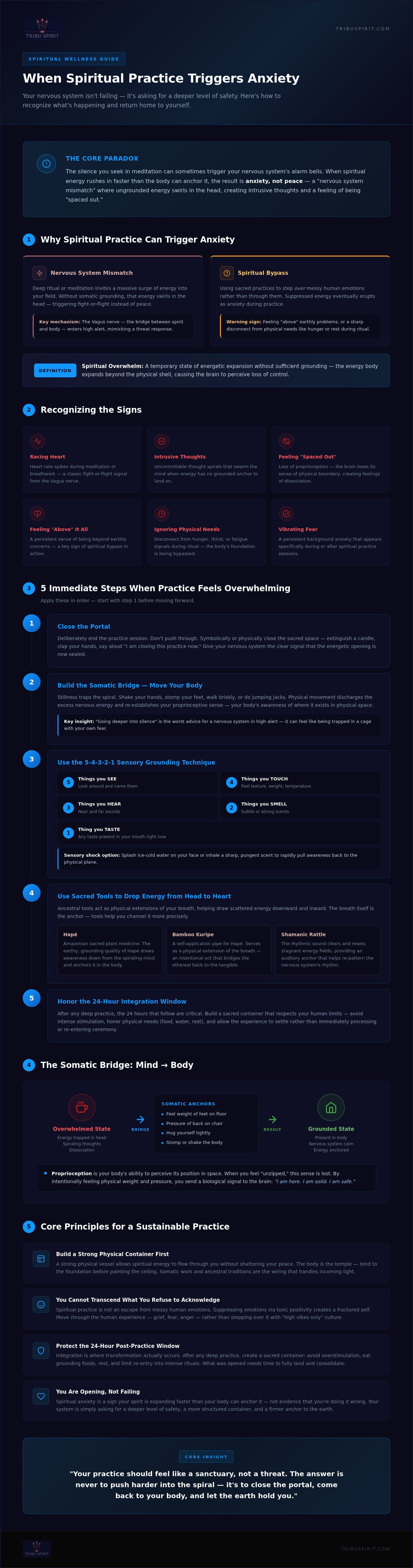
There's a quiet, shimmering expectation that walking a spiritual path will lead only to tranquility. When the opposite happens, it feels like a betrayal of the soul. You sit in silence, hoping for clarity, but instead, you're met with a racing heart and a mind that feels dangerously porous. Spiritual anxiety is a state of deep overwhelm where your nervous system feels exposed; it's as if the protective layers of your energetic field have been unzipped before your physical body was ready to hold the light. Learning what to do when spiritual practices cause anxiety begins with recognizing that your body isn't failing; it's simply trying to process a sudden surge of luminous energy without a firm anchor.
This experience often stems from a "nervous system mismatch." When we engage in deep ritual or meditation, we're inviting a massive amount of energy into our field. If our "inner wiring" isn't yet grounded through somatic work or ancestral traditions, that energy has nowhere to go. It swirls in the head, creates intrusive thoughts, and leaves us feeling "spaced out" or untethered. You aren't failing. You are opening. This opening simply requires a more structured container to keep you safe and present.
The Concept of Spiritual Bypass
Spiritual circles often fall into the trap of toxic positivity, where only "high vibes" are welcomed. This creates a heavy shadow. Spiritual bypass occurs when we use sacred practices to step over our messy, visceral human emotions rather than moving through them. If you're using meditation to avoid the pain of a breakup or the stress of your career, that suppressed energy eventually erupts as anxiety. You cannot transcend what you refuse to acknowledge. Suppressing the human parts of yourself leads to a fractured sense of self, manifesting as a persistent, vibrating fear during your practice. Signs you might be bypassing include a feeling of being "above" earthly problems or a sudden, sharp disconnect from your physical needs, like hunger or rest, while in ritual.
Nervous System Overstimulation
The bridge between the spirit and the body is the Vagus nerve, a winding path of communication that governs our sense of safety. High-intensity breathwork or deep, unguided meditation can sometimes signal this nerve to enter a state of high alert, mimicking a fight-or-flight response. Instead of peace, your body feels a threat. Spiritual Overwhelm is a temporary state of energetic expansion without sufficient grounding. When this happens, the energy body expands so far beyond the physical shell that the brain perceives a loss of control. Understanding what to do when spiritual practices cause anxiety involves recognizing this biological trigger and choosing to "close the portal" until your nervous system returns to a state of equilibrium.
The Somatic Bridge: Moving from the Mind to the Body
When your spirit feels like it's drifting into a storm, the worst thing you can do is stay perfectly still. Conventional wisdom often suggests "breathing through it" or "going deeper into the silence," but for a nervous system in high alert, stillness can feel like being trapped in a cage with your own fear. Knowing what to do when spiritual practices cause anxiety often requires a radical shift from the ethereal back to the tangible. You must build a somatic bridge. This means moving your awareness out of the swirling thoughts of the mind and down into the heavy, reliable weight of your bones. The body is the temple. Sometimes, we forget to tend to the foundation while we're busy painting the ceiling.
Proprioception is your body's ability to perceive its position in space. When you feel "unzipped" or spaced out, your brain loses this vital sense of physical boundary. By intentionally feeling the weight of your feet on the floor or the pressure of your back against a chair, you send a biological signal to the brain that you are here, you are solid, and you are safe. This is the foundation of "The Container." A strong physical vessel allows spiritual energy to flow through you without shattering your peace. Without this vessel, the light has nowhere to land.
Grounding via the Five Senses
Grounding is the act of returning to the present moment through the gateway of the senses. The 5-4-3-2-1 technique is a powerful anchor: acknowledge five things you see, four you can touch, three you hear, two you can smell, and one you can taste. If the spiral feels too intense, use a "sensory shock" like splashing ice-cold water on your face or inhaling a sharp, pungent scent. These sensations act as a tether, pulling you back from the astral plane. Simply hugging yourself tightly provides the physical compression your nervous system needs to feel contained. It's a primal reminder of where you end and the world begins.
Movement as a Spiritual Anchor
Movement is a sacred release. Shaking medicine, an ancient practice used by various indigenous cultures, involves literally shaking your limbs to discharge excess energetic "static." It's a primal way to clear the nervous system. Stomping your feet against the earth or practicing a low, grounding yoga pose like Malasana helps redirect energy from the head down to the root. If you find your energy remains stagnant, connecting with the rhythmic pulse of ritual can help shift the internal climate. Learning about essential shamanic tools can provide you with the physical anchors needed to ground your practice when the air feels too thin.
5 Immediate Steps to Take When Spiritual Practice Feels Overwhelming
When the energy of a ritual becomes too vast to contain, your body needs a practical first-aid kit to return to its center. Knowing what to do when spiritual practices cause anxiety is about moving quickly from the ethereal to the material. These five steps provide an immediate pathway back to your own skin. They are your anchors in the storm.
- Step 1: Stop the practice immediately. If you feel a spiral beginning, do not try to push through it. It's okay to close the portal. Your safety is more sacred than any meditation.
- Step 2: Change your environment. Move away from your altar or meditation cushion. Go to a mundane space, like the kitchen or the bathroom. Splashing cold water on your face or washing a few dishes can help break the energetic loop.
- Step 3: Hydrate and eat heavy foods. Drink a large glass of room-temperature water. Eat something dense, like root vegetables, nuts, or protein. These foods provide the physical weight and density your system needs to ground.
- Step 4: Use a physical anchor. Hold a heavy stone, a piece of wood, or a Hand-Carved Shamanic Rattle. The weight and texture of a physical object give your brain a concrete point of focus.
- Step 5: Practice Box Breathing. Inhale for four counts, hold for four, exhale for four, and hold for four. This simple rhythm forces the parasympathetic nervous system to reset, signaling to your body that the perceived threat has passed.
Closing the Sacred Space Safely
Even if a ritual feels unfinished, you must formally end it to protect your energy. Leaving a "portal" open while you are in a state of anxiety can lead to further fragmentation. Stand up, take a deep breath, and state clearly: "I am now closing this session. I am returned to my physical body." Imagine a golden seal forming around your energetic field. This simple act of boundary-setting provides the psychological and spiritual closure necessary to begin your descent back to the ordinary world.
The Role of Diet in Grounding
While "high-vibe" diets consisting of juices and light greens are popular in spiritual circles, they can often leave the practitioner too "airy" and susceptible to overwhelm. If you are prone to spiritual anxiety, you need the stability of the earth. Salt is an incredible conductor of grounding energy; a small pinch on the tongue can snap you back into the present. Walking barefoot on soil physically discharges static energy, allowing the excess charge of a spiritual surge to return to the heart of the Earth. Focus on minerals and earthy flavors to keep your vessel strong and stable.
Sacred Shamanic Tools for Grounding and Protection
When the internal landscape becomes turbulent, ancestral wisdom offers us material allies to steady the spirit. While mental techniques are vital, there's a profound power in holding a physical object that carries a lineage of protection. These tools don't just symbolize safety; they are energetic anchors that help the nervous system find its way back to the earth. If you're wondering what to do when spiritual practices cause anxiety, the answer often lies in shifting from the abstract to the elemental. By working with sacred plants and hand-crafted instruments, you create a structured container that can hold the intensity of your expansion.
Mapacho serves as a foundational protector in this tradition. Known as the "grandfather medicine," it's used to clear stagnant energy and establish a perimeter of safety around your field. When the mind feels "unzipped" or vulnerable, the presence of Mapacho helps seal the aura and bring a sense of quiet authority back to your presence. It's not about escaping the experience; it's about claiming your space within it.
Hapé: The Sacred Ash of Grounding
Hapé is a sacred Amazonian snuff that acts as a powerful stabilizer for an overactive mind. It works by "dropping" the energy from the head, where anxiety often loops, down into the heart and the root. Using Tsunu Hapé is particularly effective for this purpose, as it's traditionally used for spiritual clarity and building a deep connection to the earth's frequency. The medicine is administered through a Bamboo Kuripe, which serves as a physical extension of your own breath. This ritual requires you to set a clear, grounding intention before use. The immediate, sharp focus Hapé provides helps snap the nervous system out of a spiral and into a state of presence. It's a tool of radical alignment.
Sound as an Anchor
Anxiety often manifests as "energetic static," a buzzing frequency that makes it hard to feel centered. Using a Hand-Carved Shamanic Rattle allows you to break up this density through vibration. The rhythmic sound of the rattle creates an auditory boundary, a sonic wall that protects you from intrusive thoughts and external noise. This frequency helps synchronize the brain's hemispheres, moving you from a state of high-beta "fight-or-flight" into a more coherent alpha or theta state. You can also use your own voice through "toning" or low humming. This vibrates the Vagus nerve directly, sending an immediate signal of safety to every organ in your body. Sound is the thread that weaves the spirit back into the physical vessel.
If you feel called to deepen your relationship with these ancestral allies, you can explore our collection of ethically sourced Amazonian medicines and tools to find the anchor that resonates with your path.
Creating a Sustainable Practice: Integration and Safety
The true test of a spiritual path isn't the height of the peak, but the grace of the descent. Integration is the process of weaving the threads of a cosmic experience back into the fabric of your daily life. It's where the medicine becomes a part of your marrow. When you're trying to figure out what to do when spiritual practices cause anxiety, remember that the 24 hours following a ceremony or deep meditation are the most vital. This is the window where your nervous system is most plastic, most sensitive, and most in need of a gentle, sacred container. You don't need to rush back into the noise of the world. Give yourself the gift of a slow landing.
Building a sustainable practice requires a deep respect for your own human limits. It's easy to get caught in the pursuit of "more" expansion, but without equal contraction and rest, the system begins to fray. You must learn to differentiate between growth discomfort and nervous system danger. Growth feels like a stretch; it's the uncomfortable but manageable sensation of your boundaries expanding. Danger feels like a fracture. It's the visceral sense of being "unzipped" or shattered, where you no longer feel like the master of your own house. If you feel the latter, it's a sign to step back and prioritize grounding over further opening.
The modern seeker often walks a lonely road, but the spiritual path was never meant to be traveled entirely alone. Community provides the mirrors we need to see our own shadows clearly. Sharing your experiences with a trusted circle or a mentor can help discharge the "charge" of anxiety, turning a terrifying internal spiral into a shared human experience of transformation.
The Art of Integration
Integration doesn't happen in the astral planes; it happens in the kitchen, the garden, and the quiet moments of reflection. Journaling is a powerful tool for grounding spiritual insights, allowing you to anchor fleeting visions into concrete words. A Sacred Ritual requires a delicate balance of silence and action. Whether you're washing dishes or tending to your plants, these mundane acts provide the heavy, earthly anchor that allows your spiritual insights to take root. Ordinary life is the ultimate spiritual practice. It's the soil in which your soul's growth is tested and nourished.
When to Seek Professional Support
There's a subtle but profound difference between "Spiritual Emergence," which is a natural, if intense, unfolding of the self, and "Spiritual Emergency." In a state of emergency, the system is overwhelmed beyond its capacity to cope, leading to persistent dissociation or debilitating fear. If you find that grounding tools and somatic anchors aren't enough to settle the storm, it's vital to seek out a trauma-informed spiritual mentor. They can help you navigate the threshold between the human and the divine with safety and expertise. You don't have to carry the weight of the infinite by yourself. Explore our Academy for structured guidance on sacred practices to ensure your journey remains one of steady, luminous growth.
Returning Home to a Grounded Spiritual Path
Your journey toward the light should never leave you feeling untethered in the dark. We've discovered that spiritual anxiety is simply the body's request for a stronger container; it's a vital signal to move from the mind's abstractions into the heavy, beautiful reality of the senses. Knowing what to do when spiritual practices cause anxiety allows you to close the portal when needed and return to your center with grace. Through somatic anchors and the rhythmic support of ancestral ritual, you can reclaim your inner peace.
Tribu Spirit operates as a private ministry and academy dedicated to this sacred balance. We provide medicines and tools ethically sourced from Amazonian tribes, a process that honors indigenous sovereignty and ancient lineage. From the stabilizing breath of the Kuripe to the structured guidance of our educational programs, every element is designed to help you walk your path with authority. Discover Sacred Tools for Grounding at Tribu Spirit and begin building the resilient vessel your spirit deserves. Your expansion is safe when your roots are deep.
Frequently Asked Questions
Is it normal to feel anxious after meditation or breathwork?
Yes, it's a common experience often described as spiritual overwhelm. This happens when a practice moves more energy than your nervous system is currently prepared to hold or ground. It isn't a sign that you're doing it wrong. Instead, it's a signal from your body that it needs more physical anchoring to match your spiritual expansion.
What is the difference between spiritual anxiety and a clinical anxiety disorder?
Spiritual anxiety is typically tied to specific practices or energetic shifts, whereas clinical anxiety is a persistent state often unrelated to ritual. While they share physical symptoms, spiritual anxiety often feels like being "unzipped" or too open to the environment. It's best to consult a professional if these feelings interfere with your daily life regardless of your spiritual practice.
Can Hapé help with spiritual overwhelm?
Hapé is a powerful tool for dropping energy from the head down to the heart and root. Specifically, varieties like Tsunu Hapé are traditionally used to provide spiritual clarity and a deep connection to the earth. When you're unsure what to do when spiritual practices cause anxiety, an intentional dose of Hapé can act as an immediate stabilizer to bring you back to your physical center.
What should I do if I feel 'spaced out' for days after a ceremony?
Focus on heavy, physical integration to close any lingering energetic gaps. Eat dense foods like root vegetables, walk barefoot on the soil, and avoid further spiritual work for at least a week. Your system needs time to consolidate the experience into your physical cells. Remember that rest is just as sacred as the ceremony itself.
How can I make my spiritual practice more grounding?
Incorporate somatic anchors and material tools before you even begin your session. Start by feeling the weight of your body on the floor and use physical objects like a Hand-Carved Shamanic Rattle to clear the space. Setting a clear intention of "safety and presence" helps create a structured container that keeps your energy from drifting too far from your skin.
Are there specific spiritual tools that help with anxiety?
Shamanic tools like the Bamboo Kuripe and Mapacho are specifically designed to protect and ground the practitioner. The Kuripe allows you to direct your own breath with intention, while Mapacho clears stagnant energy that can manifest as intrusive thoughts. These tools provide a tangible focus that signals safety to the nervous system during intense moments of opening.
What happens if I stop my spiritual practice because of anxiety?
Nothing negative happens; in fact, pausing is often the most spiritual choice you can make. Taking a break allows your nervous system to return to equilibrium and prevents further fragmentation. You can always return to your practice when your vessel feels strong enough to hold the light again. Your path is a marathon, not a sprint.
Can certain plant medicines cause anxiety?
Yes, certain medicines can trigger an "opening" that feels overwhelming if the setting isn't supportive or the dose is too high. While medicines like Sananga or Hapé are used for clearing, they can cause temporary distress if the user isn't properly grounded. It's essential to approach these ancestral allies with respect, proper education, and a clear understanding of your own limits.