
What if the most unsettling visions from your ceremony weren't obstacles, but the very keys to your liberation? You've returned from the medicine's embrace, yet instead of the expected clarity, you're met with a heavy, unravelling silence. It's common to feel overwhelmed by the sudden weight of repressed emotions or the sharp edge of insights that don't seem to fit into your daily life. Integrating shadow work after a plant medicine journey is not about fixing something broken. It's the sacred art of composting your deepest fears into the fertile soil of spiritual sovereignty.
We understand that the transition from the ethereal to the earthly can feel lonely. This guide will show you how to safely alchemise those difficult revelations into lasting wholeness and emotional stability. We'll walk through a clear framework for processing shadow material and introduce grounding tools, such as the stabilizing spirit of Tsunu Hapé, to help you maintain your ceremonial connection. From understanding energetic shifts to finding sanctuary in the Tribu Spirit Academy, you're about to transform your darkest insights into your greatest strengths. The path to wholeness is a slow, beautiful unfolding. Let's begin the walk together.
Key Takeaways
- Understand how plant medicines act as a sacred spotlight, illuminating the subconscious aspects of the psyche that are ready for healing and reclamation.
- Harness the critical "alchemical window" of neuroplasticity to make integrating shadow work after a plant medicine journey a foundation for lasting spiritual sovereignty.
- Learn to reframe challenging ceremonial revelations as profound breakthroughs, moving beyond the fear of the "dark" to find the wisdom hidden within.
- Master practical rituals like somatic release and subconscious journaling to bridge the gap between ethereal insights and your grounded, daily life.
- Explore how shamanic allies like Hapé - Tsunu and Sananga can provide essential grounding and energetic clearing during periods of intense emotional integration.
What is Shadow Work in the Context of Plant Medicine?
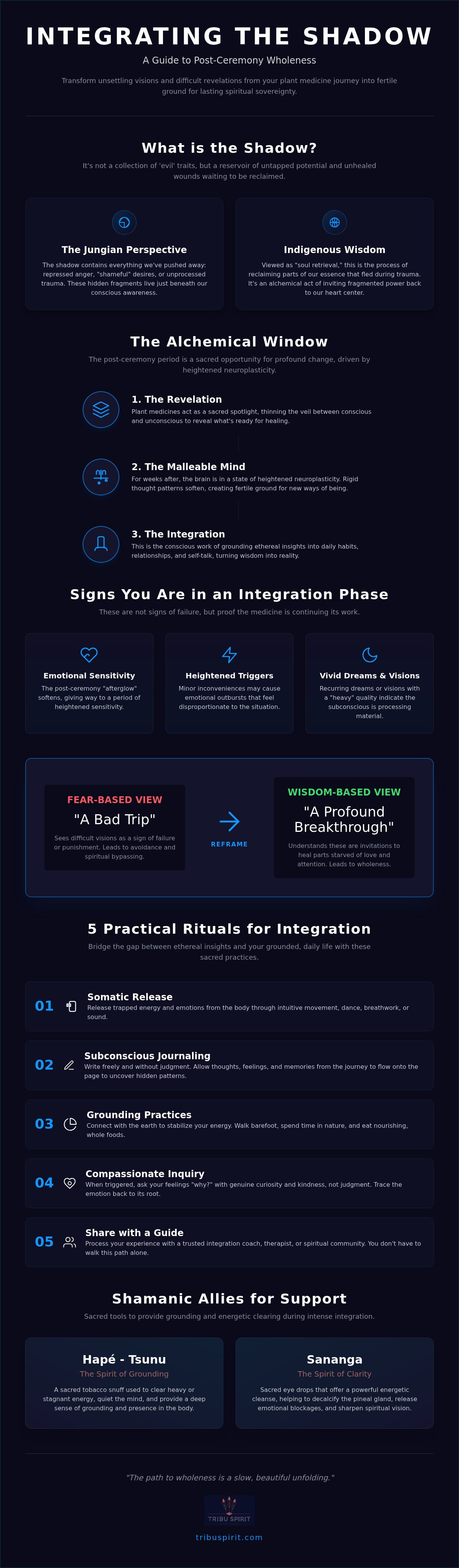
The shadow is the silent passenger of our psyche. It contains everything we have pushed away, such as the anger we weren't allowed to feel, the desires we deemed shameful, or the trauma we couldn't process. In analytical psychology, the Shadow (psychology) represents these hidden fragments that live just beneath the surface of our awareness. When we sit with plant medicines, the veil between the conscious and the unconscious thins. These sacred teachers act as a celestial spotlight, illuminating the dusty corners of our inner temple. They don't create the darkness. They simply reveal what was already there, waiting to be seen and embraced.
True integration is the bridge between the luminous ceremony space and the grounded 3D world. It's easy to stay in the "light" of the visions, but spiritual bypassing occurs when we use these high-vibrational experiences to avoid the messy work of human healing. Integrating shadow work after a plant medicine journey requires us to bring those difficult revelations into our daily habits, relationships, and self-talk. It's the courageous act of making the unconscious conscious. This process ensures the medicine's wisdom doesn't evaporate like a dream once you return to your routine.
The Jungian Shadow Meets Indigenous Wisdom
Modern psychology often mirrors what indigenous cultures have practiced for millennia through the lens of "soul retrieval." In the shamanic view, trauma causes parts of our essence to flee for survival, leaving us feeling fragmented. Shadow work is the alchemical process of reclaiming this lost power and inviting those fragments back into our heart center. The shadow isn't a collection of "evil" traits; it's a reservoir of untapped potential and unhealed wounds. When we face these parts with compassion, we turn leaden pain into the gold of spiritual sovereignty.
Signs You Are Moving Into a Shadow Integration Phase
When you begin integrating shadow work after a plant medicine journey, the first signs often manifest as a shift in your emotional landscape. The "afterglow" of a ceremony eventually softens, giving way to a period of intense emotional sensitivity. You might find yourself easily triggered by minor inconveniences or experiencing emotional outbursts that feel disproportionate to the situation. This isn't a sign of failure. It's the medicine continuing its work in the physical body. Vivid dreams or recurring visions that carry a "heavy" quality are common indicators that your subconscious is ready to process deeper material. As the honeymoon ends, the real work of transformation begins.
The Alchemical Window: Why Post-Journey Revelations Occur
The period following a sacred ceremony is often referred to as the "alchemical window." During these precious weeks, your brain exists in a state of heightened neuroplasticity, where the rigid, well-worn pathways of your daily consciousness are softened into a more malleable landscape. This isn't merely a biological shift; it's a profound spiritual opportunity. When the medicine begins to recede from your system, it leaves behind a fertile ground where new ways of being can take root. Medicines like Ayahuasca or Hapé work to dissolve the calcified layers of the ego, making integrating shadow work after a plant medicine journey an organic extension of the ceremony itself.
Your "Inner Master" knows exactly what you are ready to heal and precisely when you are ready to see it. Sometimes, this wisdom manifests as a "difficult" journey filled with shadows, heavy emotions, or unsettling visions. It's vital to remember that these experiences are often the most transformative. They are not punishments or signs of a "bad trip." Instead, they are invitations to look at the parts of yourself that have been starved of your own love and attention. By facing these shadows while your heart remains open and your ego's defenses are thin, you begin the process of deep, cellular realignment.
Breaking the Ego Barrier
The ego's primary job is survival, and it often achieves this by hiding the shadow behind walls of denial or distraction. It keeps your unhealed trauma and suppressed potential locked away to maintain a fragile sense of safety. Sacred plants temporarily suspend these filters, allowing you to view your life from a place of pure witness rather than victimhood. The "darkness" you might encounter is rarely an external threat; it's usually a reflection of a suppressed truth that is finally ready to be integrated into your light. This viewing is the first step toward reclaiming your lost power.
The Importance of the First 30 Days
The first month post-ceremony is a sacred container that requires gentle protection. It's a time for "dieting" the experience, which means being mindful of what you consume, from the food on your plate to the media you watch and the social circles you frequent. Avoid making impulsive, major life changes like quitting a career or ending a relationship immediately. Your perception is still shifting, and you need time to let the medicine's voice become clear. Silence is the most potent tool during this window. It allows the echoes of the ceremony to settle into your bones and provides the space for true wisdom to emerge. To support this delicate transition, many find that exploring the guided wisdom in the Tribu Spirit Academy offers the structure needed for a graceful and sustained integration.
Navigating the Dark: Overcoming the Fear of the Shadow
The most frequent question that arises after a deep ceremony is a simple, visceral one: "Is it safe to look at my darkness?" We often fear that by acknowledging our repressed parts, we might be consumed by them. This fear is natural. However, the shadow is not an external monster; it is a collection of your own exiled energies waiting to be brought home. Integrating shadow work after a plant medicine journey is the process of turning toward these fears with the heart of a curious observer rather than a judge. You are not exploring a void. You are exploring your own depth.
We must dismantle the myth of the "bad trip." Experiences that feel terrifying or overwhelming are often the most potent breakthroughs. They represent the moment your ego's defenses finally gave way to a truth you were previously unable to carry. Reframing terror as a profound opening allows you to move from a state of victimhood into one of spiritual sovereignty. It's essential, however, to distinguish between a spiritual emergence and a clinical crisis. A spiritual emergence feels like a chaotic but purposeful unravelling of identity. If you feel consistently unable to function or lose touch with shared reality, seeking professional shamanic or psychological support is an act of wisdom, not a sign of failure.
Community is your anchor. Attempting to process these deep waters in total isolation can lead to a sense of fragmentation. Sharing your experience in a safe, non-judgmental circle helps to ground the abstract visions into tangible human language. It reminds you that your "darkness" is a shared human experience. You are not alone in your unravelling.
Common Misconceptions About Shadow Integration
A common trap is believing you must "fix" or eradicate the shadow to be truly spiritual. This is a misunderstanding. Integration is about relationship, not elimination. You aren't trying to make the shadow go away. You're trying to stop it from running your life from the basement. Another pitfall is the urge to over-analyze every symbol from your journey. Sometimes, a vision is a feeling to be felt, not a puzzle to be solved. Let the medicine speak through your body, not just your intellect.
Creating a Safe Internal Container
To prevent emotional flooding, you must build a strong internal container. This starts with grounding. When the shadow material feels too heavy, return to the earth. Feel your feet on the soil. Use the power of sacred ritual to provide a rhythmic structure to your days. Ritual acts as a scaffold for the soul, holding you steady while you do the deep work of integrating shadow work after a plant medicine journey. If the waves feel too high, reach out to a guide who can help you navigate the currents. You don't have to walk the path alone.
5 Practical Rituals for Integrating Shadow Aspects
Successfully integrating shadow work after a plant medicine journey requires more than intellectual understanding; it demands a physical and ritualistic commitment. Rituals act as the bridge between the ethereal insights of the medicine and the tangible reality of your daily life. They provide a safe container for the shadow to be seen without being judged. By engaging in these practices, you transform abstract revelations into embodied wisdom.
- Journaling with the "Other Hand": To bypass the ego's logical filters, try writing questions with your dominant hand and answering with your non-dominant hand. This often allows the subconscious to speak more freely, revealing the raw truths that the shadow has been holding.
- Altar Work: Create a temporary space on your altar for a shadow aspect. Place an object there that represents the "darker" emotion you encountered. By giving it a physical place to exist, you acknowledge its right to be part of your wholeness.
- The "Empty Chair" Ceremony: Place a chair in front of you and imagine the shadow aspect sitting there. Speak your fears to it, then switch seats and listen to what that part of you needs to say.
- Nature Immersion: Spend time with the Earth. The ancient shamanic traditions teach us that the Earth can compost heavy energy, known as Hucha. Let the soil, the wind, and the water take the weight of your unravelling and turn it into fertile ground for growth.
The Power of Somatic Integration
The body is the library of the soul. While the mind might forget a difficult vision, the nervous system remembers every frequency encountered during the ceremony. Somatic release is essential because the body stores what the mind denies. Use conscious breathwork to move "stuck" ceremonial energy through your limbs. Dancing the shadow is another potent practice; let your body move intuitively to music that reflects the "heaviness" you feel. Don't try to make it look beautiful. Let it be raw, honest, and liberating.
Dialogue with the Unseen
The shadow is not an enemy to be defeated, but a messenger with a gift. When a difficult aspect surfaces, ask it directly: "What is the gift you are holding for me?" You'll often find that beneath the fear lies a hidden strength or a lost piece of your creativity. Giving a specific name to a shadow aspect, like "The Silent Witness" or "The Protector," immediately reduces its overwhelming power over your psyche. You can also use shamanic tools like hand-carved rattles to clear the energy field around your body when the shadow feels too dense. The sound of the rattle breaks up stagnant energy, allowing the light of awareness to penetrate the darkness. If you feel called to deepen your practice with authentic instruments, you can explore our sacred offerings to find the right companion for your journey.
Sustaining the Path: Shamanic Tools for Continuous Integration
The journey doesn't end when the ceremonial music fades; it merely shifts into a more subtle, daily rhythm. Maintaining the clarity gained in the medicine space requires allies that can anchor your spirit when the winds of the shadow blow most fiercely. Integrating shadow work after a plant medicine journey is often supported by sacred tools that help manage the energetic shifts that follow deep unravelling. Hapé - Tsunu is a primary ally for this purpose, known for its profound grounding force. When emotional turbulence threatens to pull you out of your center, the stabilizing energy of Tsunu helps you return to the present moment.
Beyond grounding, visual and energetic clarity are vital for long-term growth. Sananga eye drops serve to clear what the Huni Kuin call "Panema," which is a dense, negative energy that can cloud your perception. During the integration phase, Sananga helps you see the truth of your shadow aspects with sharp, unwavering focus. To protect your energy field during these sensitive periods, Mapacho acts as a powerful guardian. It creates a protective boundary, ensuring that you can process your internal revelations without being overwhelmed by external noise. For those seeking a deeper understanding of these lineages and the medicines they carry, the Tribu Spirit Academy offers structured resources to guide your evolution.
Hapé as an Integration Ally
The grounding force of Tsunu is particularly effective at anchoring high-vibrational insights into the physical body. By setting clear intentions with your Kuripe, you can direct the medicine specifically toward the shadow work you are currently navigating. Consistency is key. A daily or weekly ritual with Hapé creates a rhythmic pulse in your life, reminding you of your commitment to wholeness even when the path feels steep. This steady practice prevents the insights of the ceremony from evaporating into the busyness of modern life.
Walking the Path of Sovereignty
Healing is rarely a straight line. It's a lifelong spiral where you may revisit the same shadow aspects at deeper levels of awareness. Each time you face the darkness, you emerge with more of your essence intact. Remember that your path also ripples outward; every purchase at Tribu Spirit directly supports the indigenous guardians who have protected these medicines for generations. Your process of integrating shadow work after a plant medicine journey is an act of personal and collective reclamation. Your darkness is not a wall. It's the doorway to your brightest light.
Embodying the Wisdom of the Shadows
Reclaiming the hidden fragments of your psyche is the most sacred work you can perform for your soul's evolution. By understanding the alchemical window of neuroplasticity and engaging in somatic rituals, you transform difficult ceremonial revelations into the gold of spiritual sovereignty. Integrating shadow work after a plant medicine journey is not a destination, but a continuous spiral toward wholeness. It requires patience, presence, and the right allies to keep you anchored when the emotional tides run high.
For over five years, we've served the spiritual community by providing authentic tools and education through our Private Ministry Academy. Our medicines are ethically sourced from Amazonian tribes, ensuring that your path of healing also empowers the indigenous guardians of this wisdom. Whether you need the grounding force of Tsunu or a hand-carved rattle to clear your field, we are here to support your unravelling. Support your integration with our ethically sourced Hapé and Sacred Tools. Your journey is uniquely yours, but you never have to walk it alone. Trust the process. The light you seek is already within the darkness you've dared to face.
Frequently Asked Questions
What is the most important thing to do immediately after a plant medicine journey?
Prioritize silence and stillness to protect your sensitive energetic state. You're in a period of high neuroplasticity where the ego's filters are thin. Avoid making major life changes or engaging in loud, chaotic environments for at least the first week. This allows the medicine's frequency to settle into your cells without interference. Rest isn't just physical; it's a spiritual necessity for your unravelling.
How long does the integration process usually take?
Integration is a lifelong spiral rather than a linear task with a deadline. While the most intense alchemical window occurs in the first 30 days, the lessons often unfold over months or even years. You might find that a single insight from a ceremony reveals deeper layers each time you revisit it. Be patient with your progress. Healing happens in its own sacred rhythm, not on a human schedule.
Can I do shadow work alone or do I need a therapist?
You can certainly begin integrating shadow work after a plant medicine journey through personal rituals like journaling and somatic movement. However, if you encounter deep-seated trauma or feel consistently overwhelmed, seeking a shamanic practitioner or integration coach is wise. While we don't offer clinical psychotherapy, our Academy provides educational resources to help you build a strong internal container. Community support prevents the isolation that often stalls spiritual growth.
Why do I feel more depressed or anxious after a "healing" ceremony?
This post-ceremony dip often happens because the medicine has brought repressed emotions to the surface for clearing. When the initial afterglow fades, you're left to face the shadow material that was previously hidden. It's a sign that the healing is working, not that it failed. These feelings are the raw data of your subconscious. Facing them with compassion is the key to moving through this temporary emotional turbulence.
How can Hapé medicine help with difficult emotions during integration?
Hapé, particularly the Tsunu variety, serves as a powerful grounding ally when you feel emotionally unmoored. It helps to clear stagnant energy and brings your awareness back into your physical body. By using a Kuripe to administer the medicine with clear intention, you can anchor yourself during moments of anxiety. This ritual consistency provides a stable foundation, making the process of integrating shadow work after a plant medicine journey feel more manageable.
What should I do if I can’t make sense of the visions I had?
Don't rush to analyze every symbol with your logical mind. Some visions are meant to be felt as energetic shifts rather than understood as stories. If the meaning remains hidden, try somatic practices like intuitive dance or "other hand" journaling to let the subconscious speak. Sometimes the clarity you seek arrives weeks later during a quiet moment in nature. Trust that the wisdom is already within you.
Is it normal to feel disconnected from my old life after a journey?
It's completely normal to feel a sense of ontological shock as your internal vibration shifts. Your old habits, relationships, or career might suddenly feel out of alignment with your new awareness. This isn't a crisis; it's a recalibration. Use grounding tools like Mapacho to maintain a protective boundary while you decide which parts of your old life are worth keeping. Give yourself permission to evolve slowly.
How do I know if my shadow work is actually progressing?
Progress is marked by a shift in how you respond to your triggers. You'll notice that the things that used to cause an emotional outburst now only cause a brief moment of curiosity. Increased self-compassion and a decreased need to "fix" yourself are also clear signs of growth. When you can witness your own darkness without fear or judgment, you know you are walking the path of true spiritual sovereignty.