

What if the bridge between a cluttered mind and a grounded soul was as simple as a single, intentional breath? You've felt the call of the sacred ash, yet the physical act of application feels daunting. It's natural to feel a flicker of anxiety about inhaling too sharply or perhaps disrespecting the ancestral traditions of the Huni Kuin and Yawanawá tribes. You want to honor the medicine, but you also want to avoid the mess and the discomfort of improper technique. Learning how to use a kuripe is more than a mechanical skill; it's an initiation into self-directed healing and spiritual autonomy.
We're here to guide you through this transition from uncertainty to mastery. This ritual guide promises to help you master the art of Hapé self-application through a step-by-step process that honors both the medicine and your unique journey. We'll explore the physical precision of the Sopro, the delicate balance of finding your right dosage, and the specific breath styles that unlock different energetic states. By the end, you'll feel confident in your ability to create a grounded, prayer-infused experience every time you sit with your bamboo kuripe.
Key Takeaways
- Discover why the Kuripe serves as a vital bridge for spiritual autonomy, allowing you to lead your own healing journey with confidence and grace.
- Learn how to prepare a sacred environment and gather essential physical tools, ensuring your ceremony remains focused and free from distractions.
- Master the precise physical technique of how to use a kuripe, including the traditional sequence of application to honor indigenous wisdom and personal release.
- Explore the art of the Sopro, the intentional spirit-breath that carries the medicine, and learn which breath styles best suit specific Hapé blends.
- Understand the critical role of the Stillness Phase and proper integration techniques to fully anchor the grounding effects of your ritual.
Understanding the Kuripe: Your Bridge to Self-Directed Healing
The kuripe is a silent witness to your evolution, a sacred bridge between your internal world and the potent spirit of the forest. Traditionally, this V-shaped pipe serves as a self-applicator for Hapé, a finely ground shamanic snuff often crafted from Nicotiana rustica and sacred plant ashes. While a Tepi pipe requires a facilitator to blow the medicine into your nostrils, the kuripe empowers you to become your own healer. It's a call to sovereignty. This shift from receiving to self-applying marks a significant step in your spiritual journey. You aren't just learning how to use a kuripe; you're learning to direct your own transformation with intention and grace.
In the shamanic philosophy of the Amazon, self-application is a path to autonomy. It requires you to be fully present, balancing the physical act of blowing with the spiritual act of surrender. By using this tool, you're engaging in a dialogue with your own breath. The pipe isn't merely a delivery system; it's an extension of your prayer. It allows you to control the intensity, the timing, and the depth of your experience, fostering a deep sense of trust in your own intuition.
The Anatomy of a Sacred Applicator
Every curve and joint of this tool carries specific intention. Most practitioners begin their journey with bamboo because it's a vessel of life, carrying the whisper of the wind through its hollow core. Bamboo offers a smooth, natural airflow that feels gentle and organic. The V-angle is the most critical feature of the design. It must be crafted to align perfectly with your unique facial structure, ensuring the medicine reaches its destination without loss or discomfort. One end is shaped for the mouth, while the other is tapered for the nostril. Together, they form a conduit for the spirit-breath, or Sopro, to flow freely.
Choosing Your First Tool
Selecting your first applicator is a deeply personal process that mirrors your inner readiness. A Bamboo Kuripe is often the ideal choice for those just beginning. It provides a consistent "throw," which is the distance and speed at which the powder travels through the pipe. Shorter pipes often offer a more direct, intense experience, while longer ones allow the medicine to expand slightly before entry. Look for hand-carved aesthetics that resonate with your soul. Whether the design is minimalist or adorned with sacred symbols, your tool should reflect the quality of your intention. When you understand how to use a kuripe with reverence, the physical material becomes a sacred companion in your daily ritual.
By taking up the kuripe, you're stepping into a lineage of self-mastery. You're no longer a passive observer of your own growth. Instead, you're the architect of your own peace. The tool becomes an extension of your own lungs, a physical manifestation of the breath you're about to offer to the universe. This preparation is the foundation. It's the moment where you decide that your healing is worth your own undivided attention and care.
Preparing Your Sacred Space and Intention
When you're learning how to use a kuripe, the first lesson isn't about the breath, but about the space you inhabit. Your environment acts as the silent architect of your medicine journey. Before you begin, consider where you are. A cluttered or noisy room often mirrors a cluttered mind, making it difficult to find the stillness Hapé requires. The depth of your experience is directly tied to the container you create for yourself. This preparation isn't merely a preliminary step; it's the beginning of the ceremony itself. By consciously choosing your surroundings, you signal to your spirit that you're ready for deep work.
Practicality and spirituality walk hand in hand in this tradition. Ancient practices, documented in works like Tobacco and Shamanism in South America, emphasize the necessity of being physically prepared to allow the spirit of the plant to move freely. Keep a bottle of water nearby for grounding afterwards, and ensure you have tissues at your side. A purge bucket is also essential. While Hapé doesn't always cause a physical purge, having a dedicated vessel nearby removes the anxiety of what if, allowing you to surrender completely to the process.
Creating a Ritual Sanctuary
To truly drop into the heart, you must first clear the energetic air. You might find guidance on creating a sacred space helpful as you refine your personal practice. Many choose to use a hand-carved shamanic rattle to break up stagnant energy before they sit. Once the air feels clear, find your posture. Sit cross-legged on a cushion or upright in a chair with your feet flat on the earth. Grounding your physical body provides the stability needed for the spirit to soar.
Loading the Medicine with Prayer
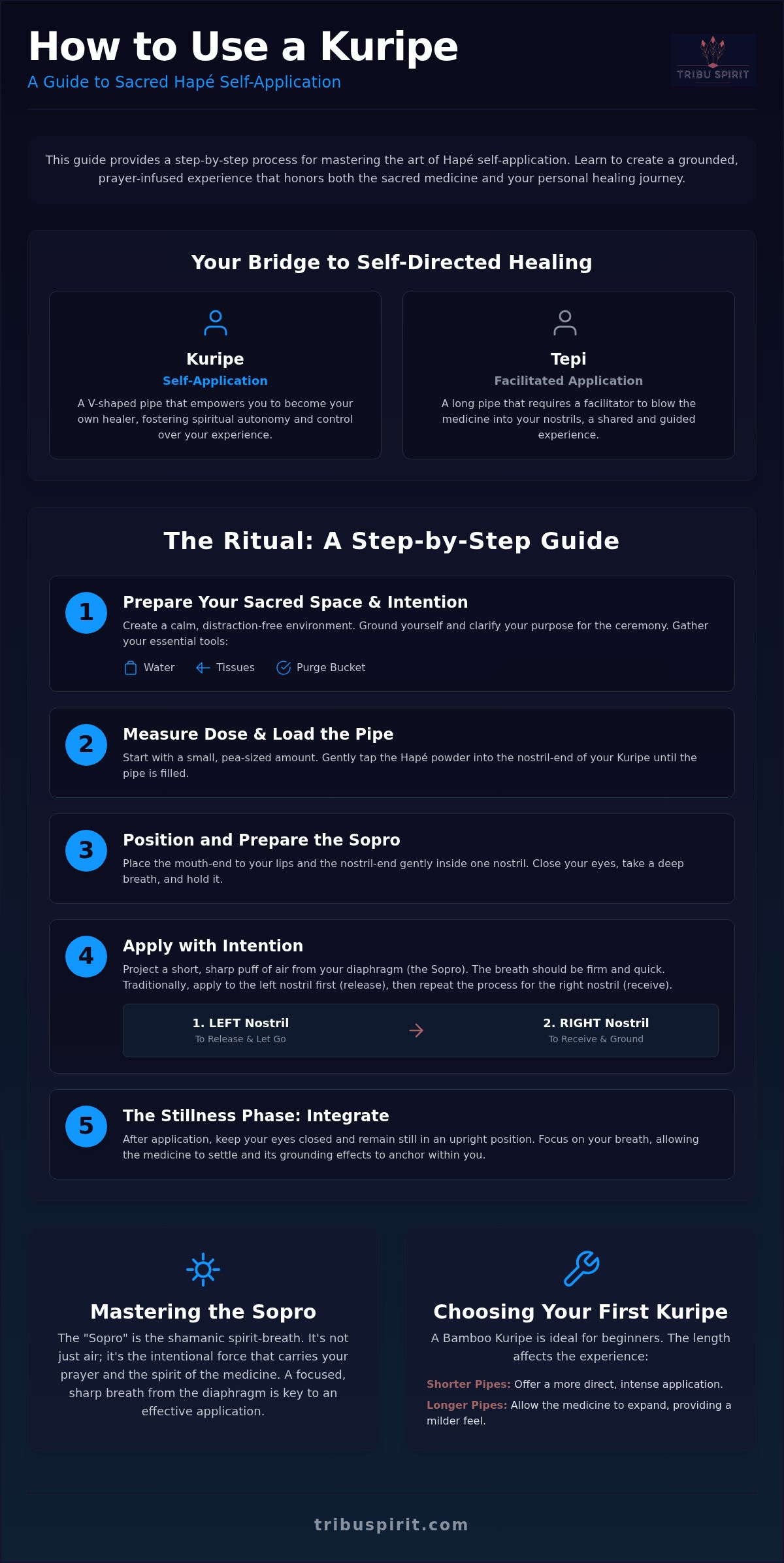
Precision is key when learning how to use a kuripe. Start by placing two pea-sized portions of Hapé onto your palm or a small wooden spoon. This amount is generally considered the standard dose for maintaining balance between the two nostrils. Use the nose-end of your pipe to scoop up the first portion. Gently tap the V-joint against your palm to ensure the powder is settled and won't fall out during application. As you do this, speak your intention into the pipe. Whether you're seeking clarity, release, or protection, infusing the medicine with your specific prayer ensures that the tool and the plant work in harmony with your soul's needs. If you're still looking for the perfect companion for your journey, exploring our collection of handcrafted bamboo tools can help you find a pipe that resonates with your unique energy.
How to Use a Kuripe: A Step-by-Step Ritual Guide
Mastering how to use a kuripe is a delicate dance between physical precision and spiritual surrender. Now that your space is cleared and your intention is set, you're ready to bridge the gap between the physical tool and the medicine's spirit. Hold the pipe with reverence, feeling the texture of the bamboo against your skin. This isn't just a delivery system; it's a conduit for your own life force. As you bring the pipe to your face, remember that the quality of your presence determines the quality of the journey. You're not just blowing powder; you're directing your own evolution through the power of the Sopro.
The Glottis Lock: Essential Safety
Before you load the medicine, you must master the glottis lock. This is the most critical safety step in learning how to use a kuripe properly. Close the back of your throat as if you're preparing to dive underwater or as if you're about to swallow but stop halfway. This physical barrier prevents the Hapé from traveling into your lungs or causing a sudden cough, which can disrupt the ritual and cause discomfort. Practice this lock with air only several times. Once you feel confident that your throat is sealed and your nasal passages are the only open channel, you're ready to proceed with the medicine.
The First Blow (The Left Side)
In the tradition of the forest, we almost always begin with the left nostril. The left side represents "death" or the past; it's the feminine channel where we release what no longer serves us. Place the mouth-end of the kuripe between your lips and carefully insert the nose-end into your left nostril. Take a deep, grounding breath through your nose, then hold it. Engage your glottis lock and deliver the Sopro. You'll feel a sharp, sudden sting and a rush of heat. Stay with it. Don't pull away. In these first thirty seconds, focus on your intention of letting go. Let the medicine scrub your energetic field clean of stagnant thoughts and old shadows.
The Second Blow (The Right Side)
The ritual is only half-complete until you address the right side. This nostril represents "life," the masculine, and the future; it's the channel of manifestation and rebirth. You must repeat the process immediately for the right nostril to maintain energetic balance. Leaving one side empty can result in a feeling of being "lopsided" or ungrounded. Load the second portion of Hapé and deliver the Sopro with the same focused intention. As the medicine enters, visualize what you're calling into your life. Once both sides are complete, close the ritual with a sharp "click" of the tongue or a final, intentional exhale. This signals to your body and the spirit of the plant that the active phase of the ceremony has concluded, and the integration has begun.
Mastering the Sopro: The Art of the Shamanic Breath
The physical act of learning how to use a kuripe is merely the foundation. To truly engage with the medicine, you must master the Sopro. In the indigenous traditions of the Amazon, the Sopro is the spirit-breath; it's the intentional force that carries your prayer into the medicine and eventually into your own being. It isn't just about moving air through a tube. It's about the velocity, the duration, and the soul you put behind the blow. Your breath acts as the steering wheel for the experience, determining whether the journey will be a gentle grounding or a sharp awakening.
Different blends of Hapé respond uniquely to different styles of Sopro. For instance, when working with Hapé - Parica, many practitioners prefer a "Short and Sharp" blow. This technique involves a quick, forceful burst of air that mirrors the medicine’s ability to slice through mental fog and provide immediate clarity. Conversely, the "Long and Slow" blow is often the key to unlocking the deep, earthy wisdom of Hapé - Tsunu. By extending the exhale, you allow the medicine to permeate your field slowly, anchoring your energy deep into the roots of the earth. There's also the "Ascending Blow," which begins as a soft whisper and ends with a sharp finish. This style is often used for "breakthrough" moments, where you need to gently peel back layers before firmly pushing through a spiritual blockage.
Matching the Breath to the Medicine
As you refine your understanding of how to use a kuripe, you'll begin to notice how the rhythm of your breath changes the energetic frequency of the ritual. When sitting with Hapé - Mulateiro during deep meditative states, a gentle, consistent blow often yields the most profound results. This softer approach respects the medicine's subtle nuances. Over time, don't be afraid to step away from rigid instructions. Listen to your body and find your own soul-rhythm. The medicine will often tell you exactly how it needs to be carried.
Common Blowing Mistakes to Avoid
Even seasoned practitioners can fall into habits that weaken the ritual’s impact. One common mistake is trailing off at the end of the blow. A weak finish can leave the medicine unsettled in the pipe or the nasal passage, dulling the intended effect. Maintain your focus until the very last drop of air has left your lungs. Another dangerous error is inhaling through the mouth mid-blow. This almost always leads to choking or coughing, which breaks your presence and can be physically distressing. Finally, avoid blowing too hard too soon if you're a beginner. Start with moderate pressure to understand your tolerance before attempting high-velocity Sopros. Precision always beats raw power in the sacred space.
Ready to deepen your practice with tools and medicines that honor these ancient traditions? Explore our collection of sacred tools at Tribu Spirit and find the perfect companion for your next ritual.
Post-Ritual Integration and Caring for Your Tool
The final Sopro has been delivered, but the ritual isn't over. One of the most overlooked aspects of learning how to use a kuripe is the Stillness Phase that follows the application. This is the moment where the medicine moves from your nasal passages into your energetic field. Sit in absolute silence for at least 10 to 15 minutes. Resist the urge to check your phone or move immediately into your day. This window of time is where the deep grounding occurs. It's the space where the prayers you whispered into the pipe begin to take root in your consciousness.
Physical integration requires a gentle touch. As the medicine begins to flow, you'll eventually need to clear your nose. Lean forward slightly and blow gently into a tissue. Avoid blowing too hard, as this can cause unnecessary pressure in your sinuses and disrupt the meditative state. Once the physical body feels settled, your focus should shift to your tool. A kuripe is a sacred extension of your own breath, and its hygiene reflects your respect for the medicine. Use a thin wire or a pipe cleaner to remove any Hapé buildup from the V-joint. This ensures a clear, consistent airflow for your next session. Beyond physical cleaning, consider the energetic signature of your pipe. Blowing Mapacho smoke through the pipe or using Palo Santo helps reset its energy, keeping the tool vibrant and pure.
The Art of Integration
True transformation happens in the hours and days following your ceremony. You might find our guide on integrating your ceremonial experience helpful as you navigate this process. Keep a journal nearby. Insights often arrive in flashes while the medicine is still active in your field. If you experience a heavy purge, whether physical or emotional, meet it with grace and gratitude. A purge isn't a sign of failure; it's a profound release of what no longer serves your highest good. Let it go without judgment.
Longevity for Your Shamanic Tools
Your kuripe is a living tool that absorbs the energy of your practice. Store it in a dry, sacred place, perhaps on your altar or in a dedicated cloth pouch. Avoid damp environments like bathrooms, which can warp the bamboo or encourage mold. A vital rule for maintaining energetic hygiene is to never share your kuripe. Your pipe carries your specific breath and prayer signature; introducing another person's energy can muddy the connection you've built with the tool. As you master how to use a kuripe and your practice evolves, you may feel a pull toward a new tool. Trust that intuition. Just as we grow, our tools sometimes reach a point of completion, signaling it's time to invite a new sacred companion into our ritual space.
Embarking on Your Path of Self-Mastery
Mastering the kuripe is a profound step toward spiritual autonomy and deep inner alignment. You've discovered that the physical technique, from the essential glottis lock to the varied styles of the Sopro, creates the foundation for a safe and expansive journey. True transformation, however, resides in the intentional stillness that follows and the reverence you show your sacred tools through proper care and energetic hygiene. By aligning your breath with your heart's highest intentions, you turn a simple ritual into a powerful gateway for self-directed healing.
Learning how to use a kuripe is more than just a mechanical skill; it's a sacred commitment to your own evolution and a way to honor the ancient wisdom of the Amazonian tribes. Each breath you offer is a prayer for your own growth and clarity. If you're ready to invite this practice into your life, begin your journey with a hand-carved Bamboo Kuripe from Tribu Spirit. Our tools are ethically sourced, tribe-approved, and meticulously handcrafted for perfect airflow. You can also join the Tribu Spirit Academy for deeper practitioner training to further anchor your practice. Trust your breath, honor the lineage, and step forward into your ritual with grace and confidence.
Frequently Asked Questions
Is it normal to feel a burning sensation when using a kuripe?
Yes, a temporary burning or stinging sensation is a standard part of the Hapé experience. This heat signals the medicine's interaction with your mucous membranes and the clearing of stagnant energy. While intense, the sensation usually peaks within the first thirty seconds and then subsides into a deep sense of presence. Focus on your breath and let the heat wash away mental clutter as you settle into the stillness. It's a purification process for the soul.
Can I use a kuripe if I have a cold or a blocked nose?
It's generally best to wait until your nasal passages are clear before engaging in a ritual. Hapé is a fine powder that requires open channels to move effectively through the sinus cavity. If you're congested, the medicine may not reach its destination, potentially causing discomfort or a messy application. Wait for your body to heal so you can fully receive the grounding benefits of the spirit-breath without physical obstruction.
How much Hapé should I put in my kuripe for the first time?
Begin with a small, pea-sized portion for each nostril to gauge your sensitivity. Understanding how to use a kuripe involves finding a personal balance between the medicine's potency and your body's response. A smaller dose allows you to focus on your breathing technique and the glottis lock without being overwhelmed by the physical rush. You can always increase the amount in future sessions as your relationship with the medicine deepens and your comfort grows.
What is the difference between a bamboo kuripe and a bone kuripe?
Bamboo pipes offer a lighter, more organic airflow that many beginners find gentle and inviting. They carry the flexible spirit of the forest and are excellent for daily grounding rituals. Bone applicators, often more dense, provide a sharper and more direct throw of the medicine. Choosing a material is ultimately about finding the energetic frequency that resonates with your personal spiritual journey. Bamboo remains a favorite for its natural, porous connection to the earth.
Do I always have to blow into both nostrils?
Yes, applying the medicine to both nostrils is essential for maintaining energetic and physical balance. The left side represents release and the past, while the right side symbolizes manifestation and the future. If you only apply Hapé to one side, you may feel ungrounded or lopsided. Completing the full ritual ensures that your feminine and masculine channels are equally cleared, allowing for a harmonious integration of the experience and a centered heart.
Can I use a kuripe by myself or do I need a facilitator?
The kuripe is specifically designed for self-application, granting you the autonomy to lead your own healing process. Unlike a facilitator-led pipe, the kuripe empowers you to control the intensity and timing of the Sopro. This self-directed approach fosters a deep sense of trust in your intuition. It transforms the practice into an intimate dialogue between your own breath and the spirit of the plant. You are your own guide in this sacred space.
How do I clean my kuripe if it gets clogged?
Use a thin, flexible wire or a specialized pipe cleaner to gently remove any compacted powder from the V-joint. Keeping your tool clear is vital for ensuring a smooth, consistent airflow during your ritual. Learning how to use a kuripe also involves maintaining its physical integrity. Once the passage is clear, blow through the pipe forcefully to ensure no residue remains. This simple act of care preserves the life and spirit of your sacred tool.
What should I do if I accidentally inhale the Hapé powder?
Stay calm and lean forward to let the powder drain naturally while focusing on slow, steady breaths through your mouth. Accidental inhalation usually happens when the glottis lock isn't fully engaged. If you feel a cough coming on, don't fight it; let your body clear the passage naturally. Drink a few sips of water to soothe your throat. Use this moment as a teacher to refine your technique and presence for future sessions.