

What if the bridge between a restless mind and the grounding wisdom of the forest was as simple as a single, intentional breath? Learning how to use a kuripe is more than a physical technique; it's a sacred dance of self-sovereignty. You might feel a flicker of anxiety about the right dosage or fear the discomfort of an improper blow. It's natural to worry about honoring indigenous traditions correctly while sitting in a modern space. We understand that this first step toward self-application can feel both beautiful and daunting. You seek connection, not a mess.
This guide promises to transform that uncertainty into a confident, ritualistic practice that honors your personal spiritual journey. You'll master the delicate art of the self-applicator, moving from a hesitant beginner to a practitioner who moves with grace and intention. We'll explore the physical mechanics of the bamboo tool, the importance of different sopro or breath styles, and the specific ways to prepare your space for a deep, meditative experience. By the end, you'll possess the knowledge to turn a simple powder into a profound tool for clarity and connection. Your path to inner stillness starts here.
Key Takeaways
- Discover how the Kuripe serves as a sacred bridge to self-sovereignty, allowing you to lead your own healing journey with autonomy and grace.
- Learn the essential steps for preparing a grounded environment and gathering the physical tools necessary for a focused, respectful ritual.
- Gain confidence in your technique with our detailed guide on how to use a kuripe, ensuring a clean and spiritually aligned application every time.
- Master the "Sopro," the intentional shamanic breath, and understand how different blowing styles can shift the energetic impact of your medicine.
- Explore the vital role of post-ritual stillness and learn the proper ways to integrate your experience while caring for your handcrafted bamboo instruments.
Understanding the Kuripe: Your Bridge to Self-Directed Healing
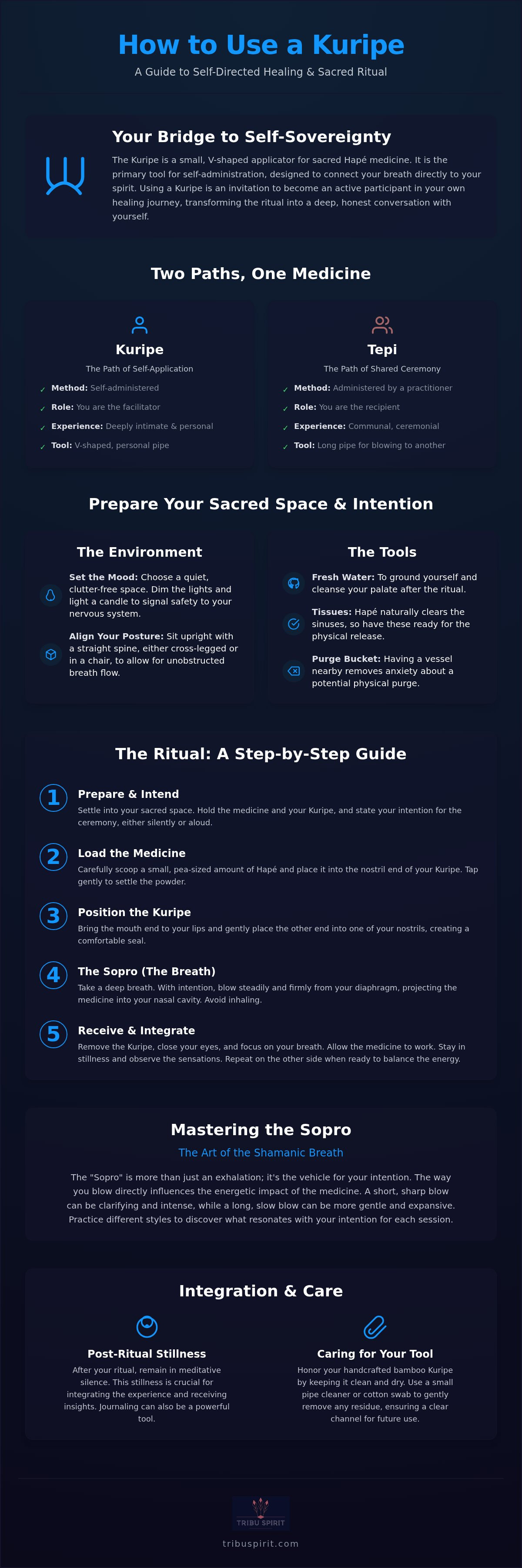
To hold a kuripe is to hold the possibility of your own transformation. This small, V-shaped applicator is the sacred bridge between the potent ashes of the forest and your own internal landscape. While many first encounter Hapé in a ceremonial circle, the kuripe invites you into a private sanctuary. It is the primary tool for self-administration, designed to connect your breath directly to your spirit. Learning how to use a kuripe is an invitation to become your own healer, moving away from a passive recipient to an active participant in your spiritual growth.
In shamanic philosophy, the shift toward self-application marks a significant milestone on the path of autonomy. When you use a kuripe, you aren't just a recipient; you are the facilitator. You choose the moment, the intention, and the strength of the blow. This autonomy transforms the ritual into a deep, honest conversation with yourself. Unlike the Tepi, which is a long pipe used by a practitioner to blow medicine into another person, the kuripe is deeply intimate. It is an extension of your own prayer, making the medicine's journey a direct reflection of your current internal state.
The medicine itself often contains Nicotiana rustica, a potent species of tobacco known for its grounding properties and high nicotine content. Because this botanical spirit is so powerful, the tool you use to carry it must be crafted with equal respect. When you master how to use a kuripe, you become the bridge for this ancient spirit to enter your energetic field with precision and grace.
The Anatomy of a Sacred Applicator
Bamboo remains the most revered material for these tools. It carries its own "spirit" and provides a natural, unobstructed airflow that synthetic materials cannot replicate. The V-shape is engineered for precision, ensuring the medicine moves from your mouth to your nostril with minimal loss of energy. You'll notice one end is slightly wider or shaped to fit comfortably between your lips; this is the mouth-end. The other, often more tapered, is the nose-end. Identifying these correctly is the first step toward a mess-free ritual.
Choosing Your First Tool
For those beginning this journey, a Bamboo Kuripe is often the most forgiving choice. It offers a smooth "throw," which is the distance and speed at which the medicine travels through the pipe. A shorter pipe provides a more immediate, sharp impact, while a longer throw can feel more gradual and controlled. Beyond the physical dimensions, look for a tool that resonates with your personal aesthetic. A hand-carved piece isn't just a product; it's a reflection of the intention you bring to your daily practice.
Preparing Your Sacred Space and Intention
The energy of your environment acts as the silent facilitator of your journey. Before the medicine ever touches your senses, the space around you must be tuned to the frequency of healing. A cluttered room often leads to a cluttered experience. When you're learning how to use a kuripe, remember that the external world mirrors your internal state. Choose a quiet corner where you won't be disturbed; dim the lights, and perhaps light a candle to symbolize the fire of transformation. This isn't just about aesthetics. It's about signaling to your nervous system that it's safe to surrender.
Physical preparedness is equally vital for a focused session. Having your tools ready prevents the mind from wandering during the ritual. Always keep these items within arm's reach:
- Fresh water: To ground yourself and cleanse the palate afterward.
- Tissues: Hapé naturally clears the sinuses; you'll need these for the physical release.
- A purge bucket: While not always necessary, having a small vessel nearby removes the anxiety of a potential physical purge.
Creating a Ritual Sanctuary
A true sanctuary is built through presence. You might find it helpful to follow a structured guide on creating a sacred space to deepen your connection to the practice. Use a shamanic rattle to break up stagnant energy and call in the supportive spirits of the directions. Your posture provides the foundation for the breath. Sit cross-legged on a cushion or upright in a chair with your feet flat on the earth. Keep your spine straight yet relaxed. This alignment allows the sopro to flow without obstruction, turning the act of learning how to use a kuripe into a seamless extension of your will.
Loading the Medicine with Prayer
The transition from preparation to application happens in the palm of your hand. Place a small amount of Hapé on your palm or use a small ritual spoon. A standard dose for a beginner is roughly two pea-sized portions; one for each nostril. Carefully scoop the first portion into the nose-end of the pipe. Give the kuripe a gentle tap against your wrist. This ensures the powder settles at the bottom and won't spill when you bring it to your face. Before you proceed, hold the tool to your heart. Infuse the powder with a specific prayer or intention. Whether you seek clarity, release, or protection, your words give the medicine its direction. For those seeking the highest quality ritual tools, exploring the ethically sourced collection at Tribu Spirit ensures your practice starts with pure intention.
How to Use a Kuripe: A Step-by-Step Ritual Guide
To engage with the medicine is to engage with the wind. Once your pipe is loaded and your intention is set, bring the mouth-end of the kuripe to your lips. It should rest comfortably but firmly. The nose-end then finds its home in your nostril. Most practitioners begin with the left side to honor the process of letting go. Before you release your breath, you must prepare your body for the sudden arrival of the medicine. Mastering how to use a kuripe requires a harmony between your physical posture and your internal focus.
The Glottis Lock: Essential Safety
Safety begins with the glottis. This is the small opening between your vocal cords. To close it, imagine you are about to dive underwater or hold your breath to lift something heavy. This lock prevents the fine powder from being inhaled into your lungs. Inhaling Hapé can cause intense coughing and discomfort, which pulls you out of your meditative state. Practice this closure with air alone. Blow a few times through the kuripe without medicine to ensure you can direct the force entirely through your nose while keeping your throat sealed. This sensory preparation ensures a smooth, mess-free experience.
The First Blow (The Left Side)
The left side is the portal of the past. It represents death in the sense of shedding what no longer serves you. Take a deep breath through your nose and hold it. Close your eyes. Place the nose-end into the left nostril and deliver the Sopro. The first 30 seconds are often the most intense. You may feel a sharp sting or a sudden rush of heat. Stay present. Don't pull away. This physical sensation is the medicine working to clear mental fog and emotional blockages. Keep your focus on your intention while the medicine settles. Learning how to use a kuripe means learning to sit with this initial intensity without judgment.
The Second Blow (The Right Side)
Balance is the law of the forest. You must always apply Hapé to both sides to maintain energetic equilibrium. The right side represents the future, rebirth, and the manifestation of your prayers. Reload your tool and repeat the process immediately. This second blow brings the life aspect to your ritual, grounding the release of the left side with the new energy of the right. If you stop after only one side, you may feel physically or energetically lopsided. Complete the cycle with a sharp exhale or a gentle click of the tongue. This signals to your spirit that the physical application is finished and the internal journey has begun.
Mastering the Sopro: The Art of the Shamanic Breath
The breath is the vehicle of the soul. In the Amazonian tradition, the "Sopro" is the intentional spirit-breath that carries the medicine from the pipe into your being. It's not merely a physical exhale; it's the energetic signature of your prayer. Understanding how to use a kuripe is essentially about mastering this wind. As you refine your technique, you'll notice that the medicine speaks differently depending on the force and rhythm of your breath. The Sopro dictates whether the experience will be a gentle grounding or a sharp awakening.
Different blends of Hapé respond best to specific breath styles. Mastering these three primary sopros will allow you to tailor your ritual to your current needs:
- The Short and Sharp Blow: Imagine a lightning strike or a sudden burst of wind. This technique is ideal for Hapé - Parica. It's designed to cut through mental fog, providing an immediate sense of clarity and focus by clearing the frontal cortex.
- The Long and Slow Blow: This is a steady, unwavering stream of air, like a deep river flowing through the forest. Use this with Hapé - Tsunu to achieve a state of deep grounding and emotional stability. It allows the medicine to permeate your field gradually.
- The Ascending Blow: Start with a soft, gentle whisper of air and end with a powerful, sharp finish. This "breakthrough" breath is used when you feel energetic blockages that require a more forceful shift to overcome.
Matching the Breath to the Medicine
When you are working with meditative blends like Hapé - Mulateiro, a gentle, sustained blow is often most effective. This encourages a slow descent into the heart space, where the medicine's subtle nuances can be fully felt. The rhythm of your breath changes the energetic frequency of the ritual. Don't rush. Over time, you'll find your own "soul-rhythm," a unique way of breathing that feels most resonant with your personal energy. To begin your practice with tools designed for this level of precision, explore our collection of handcrafted bamboo kuripes at Tribu Spirit.
Common Blowing Mistakes to Avoid
Precision is the key to a mess-free and effective application. One common error is trailing off at the end of the blow. If the breath weakens before the medicine is fully delivered, the impact is lost, and the powder may simply fall out. Another critical mistake is inhaling through the mouth mid-blow. This breaks the glottis lock we discussed earlier and can lead to choking. Finally, avoid blowing too hard too soon. Excessive force can cause unnecessary physical distress and nasal irritation. Let the breath be firm but controlled, always guided by your intention.
Post-Ritual Integration and Caring for Your Tool
The silence that follows the sopro is where the medicine truly speaks. Once the physical application is complete, you enter the Stillness Phase. This isn't a time to rush back into the noise of the world. Sit in quiet contemplation for at least 10 to 15 minutes. Let the energy settle into your bones. Mastering how to use a kuripe involves honoring this quietude as much as the blow itself. Your body needs this window to process the shift in your energetic field.
Physical integration requires a gentle touch. When you feel the need to clear your sinuses, lean your head forward. Don't blow your nose with excessive force. Let the release be natural and unhurried. This physical clearing is a symbolic extension of the mental release you've just invited into your life. Keep your tissues and water close, allowing the body to return to its center at its own pace.
Caring for your tool is an act of devotion. Over time, fine powder can accumulate inside the bamboo, affecting the airflow. Use a thin wire or a pipe cleaner to gently remove any buildup. To maintain the energetic purity of your pipe, use the smoke of Mapacho or Palo Santo to reset its vibration. This practice of energetic hygiene ensures that every time you pick up your tool, you're starting with a clean slate.
The Art of Integration
Integration is the bridge between the ritual and your daily life. You might find deep wisdom in our guide on integrating your ceremonial experience. Journaling your insights while the medicine is still active can capture fleeting whispers of intuition. If you experience a heavy purge, meet it with grace. It's a physical manifestation of a spiritual letting go. Thank the medicine for what it has taken away. This gratitude transforms a difficult moment into a powerful healing milestone.
Longevity for Your Shamanic Tools
Store your kuripe in a dry, sacred space. Avoid damp areas like bathrooms, as moisture can damage the bamboo and encourage mold. Your tool carries your unique energetic signature. For this reason, don't share your pipe with others. Keeping the energy pure is a vital part of knowing how to use a kuripe with integrity. As your practice evolves, you may feel called to a new tool that reflects your growth. Listen to that call. It's a sign of a deepening relationship with the spirit of the forest and your own inner guide.
Embracing the Path of Self-Sovereignty
Mastering the art of self-administration is a journey into the heart of your own autonomy. You've learned that the kuripe is more than a tool; it's a bridge to ancestral wisdom and a mirror of your own internal breath. By understanding how to use a kuripe with precision and prayer, you reclaim the power of your own healing process. From the initial setting of a heart-centered intention to the final, quiet moments of integration, every step is an act of devotion to your personal growth. This practice invites a profound slowing down, allowing the spirit of the forest to meet you in the stillness of your own home.
The path of the practitioner is one of constant refinement. To support this sacred work, you deserve instruments that carry the true spirit of the forest. Our tools are ethically sourced and tribe-approved, crafted with traditional techniques for perfect airflow. This ensures your ritual remains a seamless flow of energy and intention. For those called to even greater mastery, you can join the Tribu Spirit Academy for deeper practitioner training.
Begin your journey with a hand-carved Bamboo Kuripe from Tribu Spirit and discover the profound depth of your own inner landscape. Trust your breath, honor the medicine, and step forward with grace.
Frequently Asked Questions
Is it normal to feel a burning sensation when using a kuripe?
Yes, a sharp physical sensation or sting is a standard part of the experience. This feeling signifies the medicine’s work in clearing energetic and physical blockages. While it can be intense for the first 60 seconds, it usually gives way to a deep sense of clarity and stillness. Breathe through the sensation rather than resisting it, allowing the fire of the medicine to transform into a calm, grounded presence.
Can I use a kuripe if I have a cold or a blocked nose?
It is generally better to wait until your nasal passages are clear before a session. Hapé acts as a powerful decongestant, but applying it to a heavily blocked nose can be uncomfortable and may prevent the medicine from reaching the intended areas. If you have mild congestion, a gentle blow might help clear it; however, for a full cold, prioritize rest and let your body recover before returning to the ritual.
How much Hapé should I put in my kuripe for the first time?
A beginner should start with roughly two pea-sized portions, one for each nostril. This small amount allows you to learn how to use a kuripe without overwhelming your nervous system. As you become more familiar with the sopro and the specific effects of different blends, you can gradually adjust the dosage. It is always wiser to start with less and build your relationship with the medicine slowly over several sessions.
What is the difference between a bamboo kuripe and a bone kuripe?
Bamboo is the traditional choice for beginners because it offers a natural, smooth airflow and carries a light spirit. Bone kuripes are often more durable and provide a denser, sharper throw of the medicine. While bamboo feels organic and flexible, bone tools are prized for their longevity and the specific grounding weight they bring to the hand. Both materials are sacred; your choice should depend on which aesthetic resonates most with you.
Do I always have to blow into both nostrils?
Yes, you must always apply the medicine to both nostrils to maintain energetic balance. The left side typically represents release and the past, while the right side symbolizes rebirth and the future. Stopping after only one side can leave you feeling energetically lopsided or physically unsettled. Completing the full cycle ensures that the clearing work of the first blow is grounded by the manifesting energy of the second.
Can I use a kuripe by myself or do I need a facilitator?
A kuripe is specifically designed for self-application, giving you the autonomy to lead your own healing process. While a facilitator using a tepi can provide a powerful experience in a ceremonial setting, the kuripe is your tool for private practice and personal transformation. It allows you to control the timing and intensity of the ritual, fostering a deep sense of self-reliance and a direct connection to the medicine’s spirit.
How do I clean my kuripe if it gets clogged?
Clean your tool by gently using a pipe cleaner or a thin wire to remove any accumulated powder from the interior. Regular maintenance is essential to ensure the airflow remains unobstructed and the medicine travels efficiently. For energetic hygiene, you can also pass the pipe through the smoke of Mapacho or Palo Santo. This simple act of care keeps the physical and spiritual pathways of your instrument clear for your next session.
What should I do if I accidentally inhale the Hapé powder?
If you accidentally inhale the powder, stay calm and lean your head forward to let the physical sensation pass. This usually happens when the glottis lock is not fully engaged. You might experience coughing or temporary throat irritation, but it will subside within a few minutes. Drink some water and take a few deep, grounding breaths. Practicing your technique with air alone is a great way to refine how to use a kuripe safely.