
A weekend workshop and a bottle of sacred ash do not make someone a shaman. While the expansion of Hapé into the West has opened doors for profound healing, it has also invited a wave of practitioners who lack the deep, lineage-based training required to hold such a powerful energetic space. Knowing how to spot an untrained or unsafe hapé facilitator is the first step in honoring both the medicine and your own spirit. You seek this medicine to ground your soul and find clarity, but the vulnerability of a ceremony requires a container built on more than just good intentions. It's natural to feel a sense of hesitation when the person holding the pipe hasn't walked the long, disciplined path of traditional apprenticeship.
You deserve to feel completely secure in your surrender. This guide provides the clarity you need to choose a guide who respects the gravity of this ancient tradition and understands the physical risks involved. We will walk through the essential safety protocols, the vital importance of indigenous lineage, and the specific questions you must ask to protect your physical and energetic well-being. By understanding the difference between a sacred ritual and a casual encounter, you can step into your next ceremony with absolute confidence and peace of mind.
Key Takeaways
- Understand that a true facilitator acts as a humble bridge between the sacred medicine and your soul. They should never center the experience on their own ego or personal performance.
- Discover why thorough medical screening is a non-negotiable requirement for any safe practitioner. This protocol protects your cardiovascular health and physical well-being throughout the ceremony.
- Learn how to spot an untrained or unsafe hapé facilitator by evaluating their Sopro technique and their ability to hold a grounded, professional container.
- Master the specific interview questions regarding lineage and ethical sourcing. These answers distinguish a temporary trend seeker from a dedicated, lifelong student of the plant spirits.
The Rise of "Neo-Shamanism" and the Importance of Hapé Safety
The modern world is rediscovering the profound power of ancient Amazonian medicines, but this rapid expansion often outpaces the wisdom required to guide others safely. A Hapé facilitator is not a performer or a dealer of experiences; they are a bridge. They stand between the deep consciousness of the plant spirits and the participant's intent. Their role is to facilitate an opening, allowing the medicine to work its magic while maintaining the absolute integrity of the space. They don't control the journey; they protect it.
As interest grows, so does the "weekend shaman" phenomenon. This involves individuals who may have sat in a few ceremonies and felt a call to serve, yet lack the rigorous foundations of tradition. It is easy to underestimate Hapé because it is often described as "just tobacco." This is a dangerous misconception. Traditional Hapé is far removed from the recreational use of commercial cigarettes. Without proper guidance, the experience can become chaotic or physically overwhelming. Learning how to spot an untrained or unsafe hapé facilitator begins with recognizing whether they treat the medicine as a tool for healing or a recreational curiosity.
A true facilitator is often a dedicated student of a specific lineage, such as the Yawanawá or Huni Kuin tribes. They don't just "use" the medicine; they carry the permission and the energetic weight of their teachers. This distinction is vital. A lineage-holder understands that their primary job is to hold a "sacred container." This container is the energetic and physical boundary that keeps the participant safe while they are in a vulnerable state. If the container is weak, the experience can become ungrounded.
Why Training Matters for Sacred Tobacco
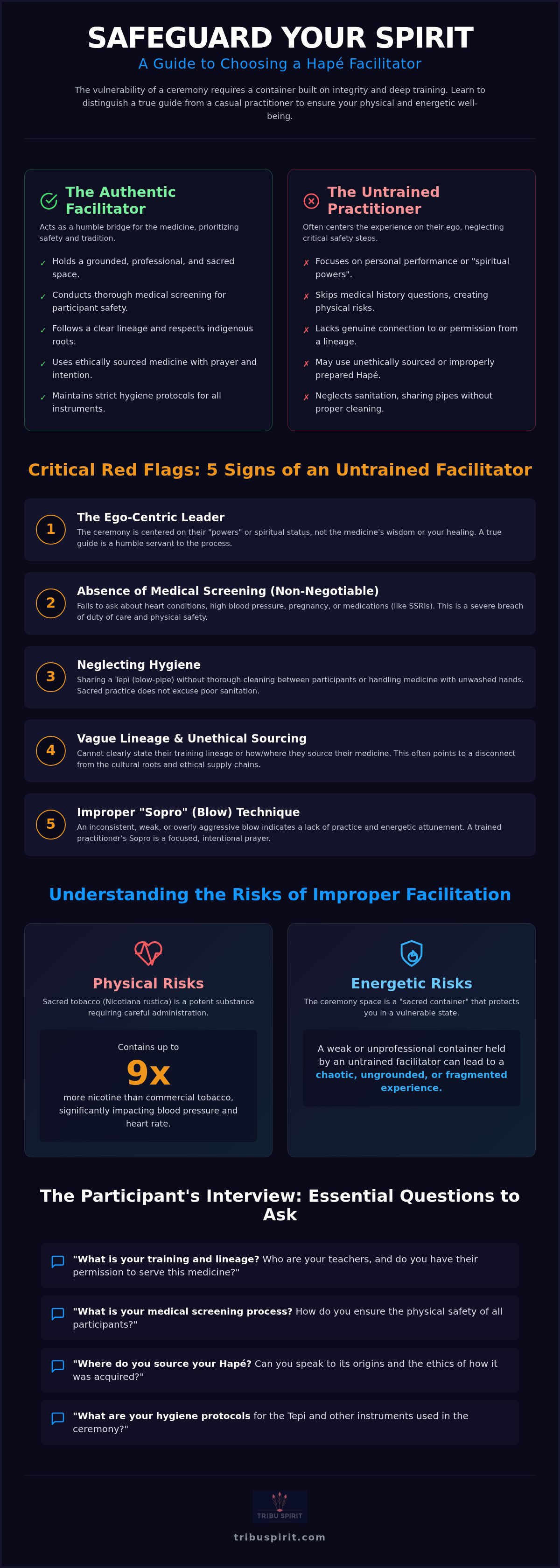
The tobacco used in Hapé is Nicotiana rustica, which contains up to nine times more nicotine than the Nicotiana tabacum found in commercial products. This potency demands respect. A trained practitioner has undergone "Dieta," a period of isolation and restriction, to build a personal relationship with the plants. They serve from a place of lived experience, not just theoretical knowledge. A safe container is a space where spiritual, emotional, and physical boundaries are non-negotiable.
The Ethics of Facilitation
Ethics and safety are inseparable. Untrained facilitators often bypass the cultural roots of the medicine, ignoring the indigenous sovereignty of the tribes who have protected these traditions for millennia. This lack of respect often leads to unethically sourced medicine that lacks the prayer and intention of authentic blends. To truly understand the depth of this practice, one must first explore what is Hapé? and the sacred history it carries. Knowing how to spot an untrained or unsafe hapé facilitator means looking for a guide who honors the source as much as the ceremony itself.
The Red Flag Checklist: 5 Signs of an Untrained Facilitator
Stepping into a ceremony requires a profound level of surrender. When you open your field to the spirit of the plants, you are entrusting your physical and energetic safety to the person holding the pipe. Discernment is your greatest ally. Knowing how to spot an untrained or unsafe hapé facilitator is not about judgment; it is about honoring your own journey and the sanctity of the medicine. If the foundation of the ceremony feels unstable, the healing process cannot fully bloom. Watch for these five critical warnings before you commit to a guide.
- The Ego-Centric Leader: A true practitioner acts as a hollow bone, a vessel for the medicine to move through. If a facilitator constantly centers the ceremony on their own "extraordinary powers" or spiritual status rather than the plant's wisdom, they are likely serving their ego. The focus should always remain on your healing and the spirit of the Hapé.
- Absence of Medical Screening: This is perhaps the most dangerous red flag. Because Hapé significantly impacts blood pressure and heart rate, a safe facilitator must ask about heart conditions, pregnancy, or current medications like SSRIs. If they offer you medicine without knowing your health history, they are neglecting their primary duty of care.
- Neglecting Hygiene: Sacred tradition does not excuse poor sanitation. Sharing a Tepi (blow-pipe) without proper cleaning between participants or handling the medicine with unwashed hands can spread illness. A professional container maintains physical cleanliness as a reflection of energetic purity.
- No Verifiable Lineage: Wisdom in this tradition is passed down through years of apprenticeship and "Dieta." If a facilitator claims they are "self-taught" or learned through digital videos, they lack the energetic protection and technical nuance that only a teacher can provide.
- Pressure and Boundary Crossing: Your "no" is sacred. An unsafe facilitator may pressure you into a higher dose than you feel comfortable with or ignore your requests to stop. Consent is the bedrock of any healing space.
Boundary Violations and Spiritual Bypass
Unsafe facilitators often use "spiritual bypass" to dismiss valid concerns. If you question a technique or express discomfort, and they respond by telling you that you are "resisting the medicine" or "stuck in your ego," they are avoiding accountability. This language is a tool for manipulation. During a vulnerable Hapé purge, you need a guide who maintains clear physical boundaries and provides a grounded presence, rather than someone who uses "love bombing" or excessive flattery to create an unhealthy emotional dependency.
The "Mystery Medicine" Problem
You have a right to know exactly what is entering your body. A safe practitioner can name the specific tribe and the primary ingredients of their blends, such as the grounding properties of a Tsunu Hapé Guide or the clarifying force of Mulateiro. If they cannot identify the source or simply call it a "special shamanic mix" without detail, it is a sign of poor training. For those seeking a deeper connection to authentic traditions, exploring the offerings at Tribu Spirit ensures you are working with medicines that are both ethically sourced and transparently crafted.
Physical and Energetic Safety Risks of Improper Facilitation
Hapé is a master medicine of the forest, a sacred blend of tobacco and tree ash that demands absolute physiological respect. While the experience is deeply spiritual, the physical effects on the body are immediate and intense. Understanding how to spot an untrained or unsafe hapé facilitator requires looking beyond the ritual's surface and into the physiological reality of the medicine. When served without precision, Hapé can shift from a tool of clarity to a source of physical distress.
One of the most significant risks is "over-serving." An inexperienced facilitator may not understand the potency of different blends or how they interact with an individual's unique constitution. This can lead to a sudden, severe drop in blood pressure, causing the participant to faint or lose motor control. A trained guide knows how to read your energy and adjust the dosage accordingly, ensuring the experience remains within a safe, manageable threshold.
The "Sopro," or sacred blow, is the bridge between the facilitator and your spirit. It is an art form that takes years to master. An improper blow technique—one that is too harsh, inconsistent, or poorly aimed—can cause physical damage to the delicate nasal passages or result in a jarring, ungrounded experience. Traditionally, it is also believed that a facilitator can pass their own "Panema," or heavy, stagnant energy, to the student through the breath. A guide who has not done their own deep inner work may inadvertently contaminate your energetic field during this vulnerable exchange.
Contraindications You Must Know
A safe facilitator is also a guardian of health. They must be aware that Hapé is a powerful vasodilator and must be respected as such. There are specific conditions where Hapé use is dangerous and requires extreme caution or complete avoidance:
- Cardiovascular Issues: High blood pressure, heart disease, or a history of stroke.
- Pregnancy: The high nicotine content can be harmful to both mother and child.
- Medication Interactions: Certain MAOIs or SSRIs can interact poorly with the alkaloids in specific blends.
- Sananga Interaction: A facilitator must understand how to time the use of Sananga eye drops alongside Hapé to prevent overwhelming the nervous system.
The Importance of Integration
The ceremony doesn't end when the tobacco leaves the pipe. Many untrained facilitators practice a "blow and go" style, leaving participants to navigate the intense after-effects alone. Knowing how to spot an untrained or unsafe hapé facilitator means looking for someone who stays present for the integration. A true practitioner provides the time and space needed for emotional breakthroughs to land softly. They understand that the medicine opens a door, but the guide must help you walk through it. For a deeper look at how to maintain this level of presence, explore The Art of Sacred Ritual and the discipline it requires.
The Participant’s Interview: Questions to Ask Your Facilitator
Stepping into the circle is an act of profound trust, but that trust must be earned through transparency and wisdom. A true practitioner welcomes your curiosity. They understand that a seeker who asks questions is a seeker who respects the medicine. Learning how to spot an untrained or unsafe hapé facilitator involves more than just observation; it requires an active dialogue before the ceremony begins. If a facilitator is hesitant to share their background, it is a clear sign that the container may lack the necessary depth.
Before you commit to a journey, consider these essential questions to gauge the facilitator's experience and integrity:
- "Who was your teacher, and how long have you been working with this medicine?" Look for specific names and lineages. Authentic training usually involves years of study and disciplined "Dieta" under the guidance of indigenous elders or established masters.
- "Where do you source your Hapé, and is it ethically acquired?" A safe guide should know the origin of their medicine. Ethically sourced Hapé supports indigenous sovereignty and ensures the blend was created with prayer rather than for mere profit.
- "What is your protocol for a medical emergency or an intense psychological reaction?" They must have a grounded plan for physical distress, such as fainting, or emotional overwhelm.
- "How do you clean your sacred tools between participants?" Physical hygiene is a reflection of spiritual care. Tepis must be sanitized to prevent the spread of illness.
- "Do you offer any follow-up or integration support?" Healing continues long after the ceremony ends. A professional guide remains available to help you process the experience.
Evaluating the Answers
Discernment lies in the energy behind the response. A humble student of the plants will answer with clarity and patience. They don't need to prove their worth because their training speaks for itself. Conversely, a defensive amateur may use "spiritual" excuses to avoid direct questions. If you hear "I am self-taught by the spirit," proceed with extreme caution. While the spirit is the ultimate teacher, the physical and energetic nuances of serving Hapé require human mentorship to ensure safety. Trust your intuition. If an answer feels "off" or evasive, the container is not safe for your surrender.
Preparing Your Own Sacred Space
Developing your own relationship with the medicine can help you identify a true pro. When you understand the purpose of essential shamanic tools, you can better appreciate the skill required to use them. A facilitator uses a Tepi to serve others, which requires a different energetic stance than using a Kuripe for self-application. If you are ready to deepen your own practice with integrity and learn from those who honor the old ways, explore the ethically sourced medicines and practitioner education at Tribu Spirit. Knowing the tools of the trade allows you to recognize when they are being handled with true mastery.
The Path of the Practitioner: Finding Authentic Training
There is a profound threshold between personal practice and the sacred duty of serving others. Using Hapé for your own grounding—often through a Kuripe—is a beautiful act of self-care. However, serving Hapé to another person is an entirely different commitment. It is a weight of responsibility that requires more than just a steady hand; it demands a deep, energetic alignment and a technical mastery of the Sopro. When you understand this distinction, you begin to see how to spot an untrained or unsafe hapé facilitator. A true practitioner doesn't just deliver a dose; they hold a lineage.
A hallmark of an authentic guide is their humility. They never claim to have reached the "end" of their training. In the traditional way, a practitioner remains a lifelong student of the plants, the forest, and their elders. This continuous learning ensures that the container they provide is always evolving and protected. If someone presents themselves as an absolute master without a teacher to answer to, they are likely operating outside the safety of a lineage. By prioritizing these educational foundations, you learn how to spot an untrained or unsafe hapé facilitator before ever entering a ceremony.
The Tribu Spirit Academy was created to bridge this gap, supporting the transition from a seeker to a responsible practitioner. By rooting modern healing in ancient indigenous wisdom, the Academy ensures that the next generation of facilitators carries the medicine with the respect it deserves. This path is not about a weekend certificate; it is about a deep, communal immersion into the spirit of the Amazon.
Education as Harm Reduction
Proper education is the most effective form of harm reduction. Many "shamanic accidents" occur simply because a facilitator lacked the technical knowledge to manage a physical purge or a psychological release. Through a community-based approach within our Private Membership Association, we provide a space where practitioners can learn the nuances of safety, ethics, and energetic protection. This collective wisdom prevents the misuse of these sacred tools. Explore the Tribu Spirit Academy for authentic practitioner training.
Sourcing Medicine with Integrity
The safety of a ceremony begins long before the first blow. A facilitator's integrity is reflected in the medicine they choose to serve. A safe practitioner only uses Hapé that gives back to the Amazonian tribes who created it. At Tribu Spirit, we focus on indigenous sovereignty through reforestation and tribal empowerment initiatives. Every time you work with medicine that honors its source, you strengthen the global container of healing. Browse our ethically sourced Hapé collections.
Honoring the Sacred Path of the Forest
Choosing a guide for your spiritual journey is an act of deep self-respect. True safety in a Hapé ceremony isn't found in aesthetic rituals alone, but in the rigorous discipline of medical screening and the quiet strength of a traditional lineage. By mastering the discernment required for how to spot an untrained or unsafe hapé facilitator, you protect the sanctity of your own healing process and honor the indigenous tribes who've carried this medicine for generations. A professional container is always built on transparency, physical hygiene, and a commitment to ethical sourcing.
If you feel called to carry this medicine yourself, the path begins with humble education. At Tribu Spirit, we bridge ancient wisdom with modern responsibility through our ministry-led academy. Our medicines are ethically sourced directly from Amazonian tribes, ensuring that every prayer supports reforestation and indigenous sovereignty. You can join the Tribu Spirit Academy to learn the sacred art of facilitation and become part of a global community dedicated to high-quality, spiritual practice. Step forward with clarity, knowing that your growth is supported by expertise and a deep reverence for the plants.
Frequently Asked Questions
Is Hapé legal to use in ceremonies?
Hapé is legal to possess and use in the United States, where it is generally classified and regulated as a tobacco product. As of early 2026, it remains unscheduled at the federal level. While legal, its use in a sacred ceremony is distinct from recreational tobacco use. A responsible guide ensures that the medicine is served within a private, respectful container that honors both local regulations and indigenous traditions.
Can a facilitator be "certified" in Hapé?
There are no official, government-mandated certification programs for Hapé facilitators in the Western world. Legitimacy is rooted in lineage, tradition, and long-term apprenticeship rather than a piece of paper. When researching how to spot an untrained or unsafe hapé facilitator, look for those who have trained deeply within tribes like the Yawanawá or Huni Kuin. Authentic training is a spiritual commitment, not a bureaucratic credential.
What should I do if I feel unsafe during a ceremony?
You have the absolute right to pause or stop your participation at any moment. If the energetic container feels unstable or the facilitator's conduct crosses your boundaries, trust your intuition immediately. A safe practitioner will respect your "no" without spiritual bypassing or pressure. Clearly communicate your need for space. If the environment remains uncomfortable, it is better to leave and ground yourself elsewhere than to continue in an unsafe space.
How much should a Hapé ceremony cost?
The cost of a ceremony varies depending on the location, the size of the group, and the experience level of the guide. Fees typically cover the facilitator's time, the sacred space, and the ethically sourced medicine used during the ritual. While some practitioners offer individual sessions, others facilitate larger community circles. It is common to see a range of prices across the industry, but the focus should always remain on the quality of the container.
Are there specific tribes known for the best Hapé training?
Several Amazonian lineages are renowned for their deep relationship with this medicine, including the Yawanawá, Huni Kuin, and Katukina tribes. These communities have preserved the sacred Sopro techniques for generations. While many Westerners now serve the medicine, the most grounded facilitators are those who have spent significant time in the forest, learning directly from these lineage holders. Their training involves strict diets and a profound surrender to the plant spirits.
Can I facilitate Hapé for myself using a Kuripe?
Yes, using a Kuripe for self-application is a beautiful way to develop a personal relationship with the medicine. It allows you to set your own pace and intention in a private, meditative space. However, serving others with a Tepi requires an entirely different level of training and energetic responsibility. Self-facilitation is a process of inner discovery, while serving others is a commitment to holding a safe, external container for someone else's vulnerability.
What are the most common physical side effects of Hapé?
Hapé often triggers a physical release known as a purge, which can manifest as sweating, nausea, or a temporary drop in blood pressure. Because it is a powerful vasodilator, you might experience a sudden rush of heat or lightheadedness. These effects are part of the clearing process, but they must be managed carefully. Knowing how to spot an untrained or unsafe hapé facilitator is crucial here, as an amateur may panic during an intense physical release.
How can I tell if the Hapé being used is high quality?
High-quality Hapé is characterized by an extremely fine, flour-like texture and a fresh, earthy scent. It should never feel gritty or damp. Authentic blends, such as Tsunu or Mulateiro, are prepared with specific prayers and tree ashes. A facilitator should be able to tell you exactly where the medicine was sourced and how it supports indigenous sovereignty. If the powder is clumpy or the origin is a mystery, the quality is likely compromised.