

What if your struggle with the sacred ash isn't a lack of devotion, but a subtle misunderstanding of the forest's ancient language? You've likely felt the call of the jungle, yet found yourself sidelined by the sharp sting of sinus pain or the heavy frustration of feeling spiritually blocked. It's a common crossroads. Many seekers encounter these common mistakes when using hapé, often mistaking physical discomfort or a lack of ritual etiquette for a personal failure. You aren't alone in wanting to honor the tribes while seeking a clear, grounding experience every time you sit with the medicine.
This guide serves as your invitation to refine your technique and deepen your alchemical bond with the plants. We'll explore the physical and spiritual pitfalls that hinder your progress, from improper blowing force to the neglect of sacred reciprocity. You'll learn how to move past the ego's desire for control and surrender to the wisdom of the forest. By the end, you'll possess the confidence to handle your kuripe with grace and the wisdom to approach the ritual with the integrity it deserves. Let's return to the heart of the practice.
Key Takeaways
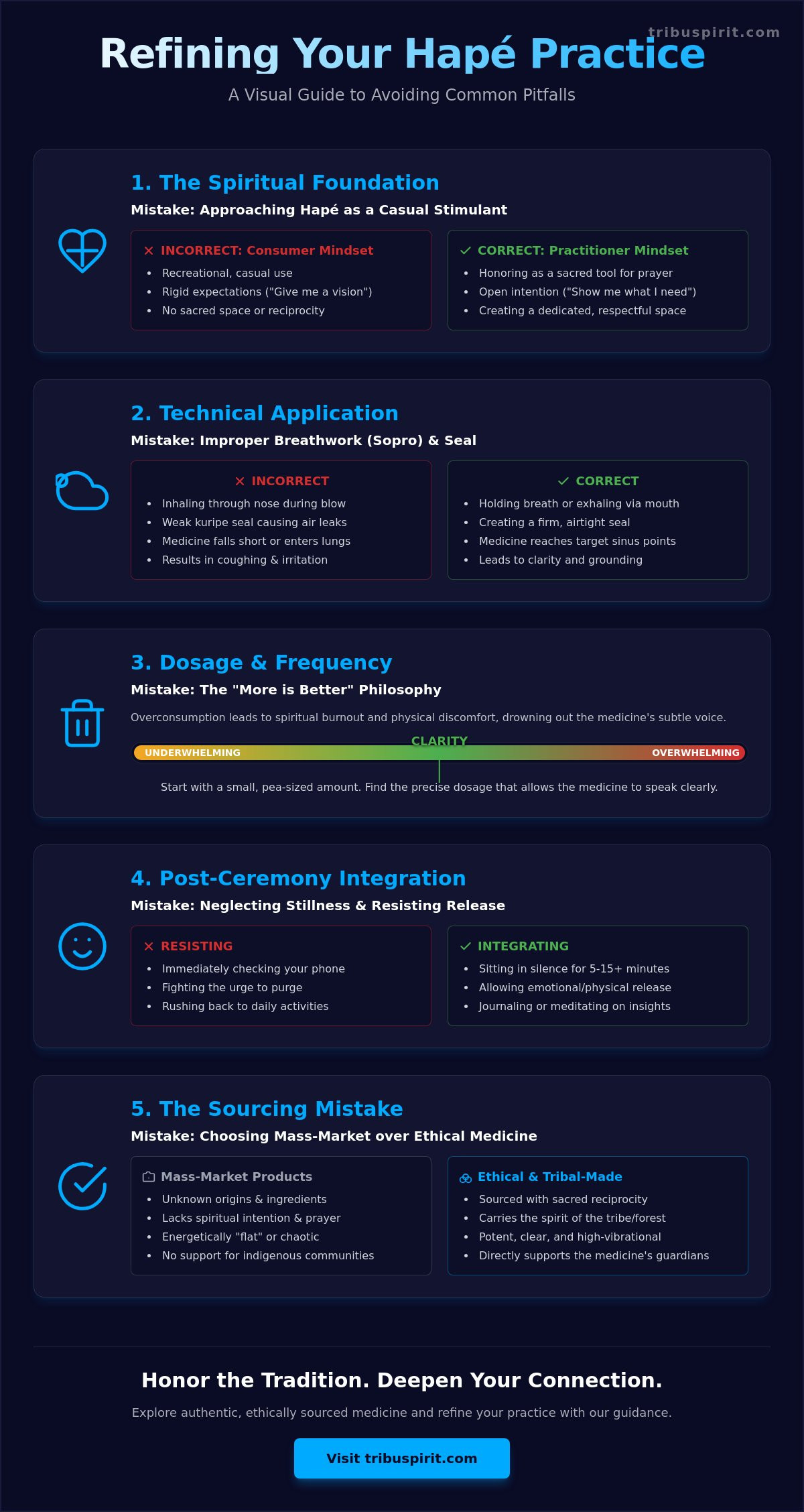
- Learn why approaching this medicine as a casual stimulant is one of the most common mistakes when using hapé and how to cultivate a foundation of sacred reciprocity instead.
- Master the art of the Sopro by understanding the nuances between sharp and gentle breaths, ensuring your physical application leads to clarity rather than sinus irritation.
- Discover why the "more is better" philosophy often leads to spiritual burnout and how to find the precise dosage that allows the medicine to speak clearly to your soul.
- Unlock the true healing potential of your ceremony by embracing post-application stillness and learning why resisting the purge can hinder your emotional release.
- Understand the profound energetic difference between mass-market products and ethically sourced, tribal-made medicine that honors the spirit of the Amazon.
The Spiritual Foundation: Why Intentionality Prevents Ritual Misalignment
To step into the world of Amazonian medicine is to enter a sacred dialogue with the forest itself. It isn't a one-way transaction. It's a relationship. When you approach this sacred dust with the same casual attitude you might bring to a morning cup of coffee, you miss the subtle whispers of the forest spirits. This misalignment often stems from a lack of foundational understanding, leading many to encounter unnecessary hurdles in their practice.
Sacred Reciprocity, or Ayni, is the heartbeat of this tradition. It's the energetic exchange that ensures the medicine's gifts are received with balance. One of the most significant common mistakes when using hapé is treating it as a product to be consumed rather than a spirit to be honored. Unlike synthetic substances, this sacred ash is primarily composed of Nicotiana rustica, which carries a potent vibrational frequency that demands profound respect. It's not a party drug or a casual stimulant; it's a tool for prayer and purification.
Treating the medicine recreationally creates mental noise rather than the clarity you seek. The Huni Kuin and Yawanawá lineages, who have guarded these traditions for centuries, teach us that the ritual space is a temple. When you use the medicine without a clear "why," the experience becomes hollow. You might feel the physical rush, but the spiritual connection remains just out of reach. The medicine reflects the energy you bring to it.
The Difference Between Intention and Expectation
Many practitioners confuse a specific desire for a true intention. If you force a vision or demand a certain feeling, you close the door to what the medicine actually wants to reveal. Transitioning from a consumer to a practitioner means letting go of the need for immediate results. Setting an open-ended intention sounds like "show me what I need to see" rather than "give me a life-changing epiphany right now." This surrender is how you avoid the spiritual blocks that frustrate so many beginners.
Creating a Sacred Container for the Medicine
Your environment is the soil in which your experience grows. Using hapé in a chaotic, loud, or disrespectful setting is another of the common mistakes when using hapé. It's nearly impossible to ground your energy when your external world is in turmoil. Establishing a dedicated space allows the medicine to anchor deeply within your system, turning a simple application into a transformative ceremony.
This pillar of sacred space is essential for anyone looking to deepen their practice. You can learn more about cultivating this presence in our guide to The Art of Sacred Ritual. By treating your surroundings with the same care you treat the medicine, you invite the forest's wisdom to take root in your daily life.
Technical Application Errors: Perfecting the Sopro and Posture
The physical act of applying the medicine is never just a mechanical gesture; it's a sacred conversation. While your intention provides the compass, your technique provides the vessel. Many seekers find themselves struggling with common mistakes when using hapé because they overlook the subtle physics of the blow. In traditional Amazonian medicine, the "sopro" or breath is viewed as the vehicle for the spirit of the plants. If the vehicle is broken, the spirit cannot travel where it's needed.
One of the most jarring errors is inhaling through the nose during the application. This isn't just uncomfortable; it's a disruption of the ritual's flow. When you inhale, you pull the fine ash into your lungs, which can cause coughing fits and lung irritation. Instead, you must learn to hold your breath or gently exhale through the mouth while the kuripe is in place. Similarly, a weak "mouth-to-kuripe" seal allows air to escape. This leak ruins the energetic pressure required for a clean application. Without that pressure, the medicine merely drifts into the nostrils rather than striking the points that trigger clarity.
Mastering the Sacred Breath (Sopro)
Different sopros serve different purposes. The "Turtle" blow is a long, steady stream of air that grounds your energy and pulls you into the present moment. It's patient and deep. The "Deer" blow, however, starts softly and concludes with a sharp, quick burst to awaken the mind. A frequent error among beginners is using too much force too soon. This aggressive approach can lead to unnecessary nausea or a "burning" sensation that makes it difficult to focus on your intention. Treat the breath as a delicate extension of your soul. It's a prayer exhaled through wood and bone.
Correct Posture for Energy Flow
Your physical alignment directly mirrors your spiritual receptivity. Slouching is one of the common mistakes when using hapé that most people don't realize they're making. When the spine is curved, you compress the Nadis, or energy channels, preventing the medicine's frequency from rising to the crown. Keep your back straight, your shoulders relaxed, and your chin slightly tucked. This creates a clear path for the energy to move. Avoid the temptation to lie down immediately. Staying upright allows the medicine to work through your system properly and prevents the "drip" from becoming a distraction.
Finding the right balance starts with the right instrument. You might find that a carefully crafted bamboo kuripe provides the consistent airflow you need to master these techniques and honor the medicine's power.
Dosage and Frequency: Avoiding the Trap of Over-Consumption
The path of the practitioner is one of subtlety and grace. It isn't a race toward the most intense experience possible. One of the most prevalent common mistakes when using hapé is the belief that a larger quantity leads to a deeper spiritual connection. In reality, the medicine is a master of precision. When you overwhelm your system with an excessive amount, you often trigger a physical defense mechanism that obscures the very clarity you seek.
A pea-sized amount, often cited in casual circles, is frequently too much for those who haven't yet built a nuanced relationship with the ash. This "more is better" myth can lead to unnecessary physical distress. Historical records in Native American Ethnobotany demonstrate that indigenous tribes have used these plants with immense care for centuries, understanding that the spirit of the plant requires an invitation, not an invasion. Starting with a portion no larger than a matchhead allows you to listen to the medicine's first whispers before it needs to shout.
Finding Your Personal Threshold
Every blend carries a unique signature and potency. A grounding blend like Tsunu may feel very different from the expansive energy of Mulateiro. You must learn to scale your dosage with sensitivity. For instance, understanding the nuances in our Mulateiro vs. Parica Comparison can help you decide how much to use based on your current energetic needs. Listen to your body; it's the ultimate guide in this alchemical process.
The Frequency Fallacy
It's easy to fall into the trap of using hapé as a quick fix for daily stress. This is another of the common mistakes when using hapé that can lead to spiritual stagnation. When you reach for the kuripe every time you feel a hint of anxiety, you aren't grounding yourself; you're escaping. Over-consumption can lead to "Hapé Burnout," where the medicine seemingly stops speaking to you. The vibrant insights fade into a dull routine.
To keep the relationship sacred, you must recognize when to take a "sacred break." This period of stillness allows your energy to integrate the lessons you've already received. Dieting the medicine means building a long-term bond based on quality, not quantity. It's about ensuring that every time you sit with the ash, it's a conscious choice made from a place of presence, not a habit born of avoidance.
Post-Ceremony Pitfalls: The Importance of Stillness and Integration
The moment the medicine settles in your system isn't the end of the journey; it's the beginning of the transformation. One of the most overlooked common mistakes when using hapé is the "rush to finish." We live in a world that demands constant movement, yet the forest asks for your silence. When you jump up immediately to return to your tasks, you sever the connection before the medicine can fully weave its wisdom into your energetic field. The gift of the plants is often found in the quiet stillness that follows the initial intensity.
The Art of Integration
The 30 minutes following your application are the most fertile. This is when the "Grandmother" spirit speaks most clearly. If you immediately check your phone or engage with digital noise, you drown out her subtle guidance. Instead, choose silence. Allow the medicine to ground you into the earth. Journaling can be a powerful tool here, helping you capture the fleeting insights that arise from the heart. Avoid the mistake of over-analyzing the experience with your mind. Stay in the feeling. Let the medicine move through your emotions rather than your logic.
Respecting the Purge (Physical and Emotional)
In our modern culture, we're often taught to suppress discomfort. However, in the context of sacred medicine, the purge is a profound success. Whether it manifests as a runny nose, tears, or a wave of nausea, these are signs of an energetic release. Resisting these processes is one of the common mistakes when using hapé that can lead to feeling "spiritually blocked." You aren't failing; you're clearing.
Support your body during this heavy clearing by staying present. If tears flow, let them. If the body needs to release, honor that movement. This physical and emotional cleansing creates the space necessary for new growth. To help ground your energy after a deep purge, you might find that the rhythmic sound of a hand-carved shamanic rattle helps anchor your spirit back into your physical form.
Finally, never neglect the closing of your ritual. A formal "thank you" to the plant spirits and the lineages of the Amazon seals the container of your ceremony. It acknowledges the reciprocity we discussed earlier and ensures you leave the space with integrity. By honoring the stillness, you turn a simple moment into a lasting transformation. This transition from the sacred space to the mundane world requires grace and patience.
The Sourcing Mistake: Why Ethical Reciprocity is a Technical Requirement
The final pillar of a successful practice isn't found in your technique or your posture, but in the very origin of the medicine you hold. Many practitioners view sourcing as a secondary concern, yet in the indigenous worldview, the "birth" of the medicine is inseparable from its power. One of the most critical common mistakes when using hapé is the assumption that all grey ash is created equal. When you purchase medicine from mass-market sites that prioritize profit over reforestation and tribal welfare, you receive a product that is energetically "quiet." The medicine carries the vibration of its journey; if that journey is rooted in exploitation, the spirit of the plants cannot sing.
The spirit of the maker is infused into every batch. Traditional hapé is prepared in a state of prayer, often taking weeks of patient grinding, sifting, and singing. This intentionality creates an energetic imprint that guides your ceremony. Commercial alternatives often lack this soul, leading to experiences that feel flat, purely physical, or spiritually "hollow." By choosing ethically, you participate in the cycle of Ayni, or sacred reciprocity. At Tribu Spirit, we act as a bridge, ensuring that the medicine you receive supports the very lineages that birthed this wisdom, turning your purchase into an act of forest preservation.
Identifying Authentic, Ethically Sourced Blends
Authenticity is found in the details. Knowing whether your blend was crafted by the Nukini, Katukina, or Yawanawá tribes allows you to align your intention with the specific "flavor" of their ancestral prayers. For those seeking a foundational experience, Tsunu remains the gold standard for grounding and clarity. It's a versatile medicine that helps clear the mental fog often caused by modern life. You can deepen your understanding of this specific lineage by exploring our Tsunu Hapé Guide, which details how to use this blend for maximum spiritual alignment.
Selecting the Right Tools (Kuripe and Tepi)
The tools you use are the extensions of your own breath. Another of the common mistakes when using hapé is using poorly made, synthetic, or plastic applicators. Plastic is a "dead" material; it doesn't breathe or hold the frequency of the ritual. Bamboo and bone are preferred because they're "living" materials that have grown from the earth. They provide the correct internal geometry to prevent air leaks, ensuring a consistent and powerful sopro every time. To truly honor the medicine, consider using hand-carved kuripes that have been crafted with the same integrity as the ash itself. When your tools and your medicine are in harmony, the ritual becomes effortless.
Deepening Your Sacred Connection
Refining your practice is a gentle journey of returning to the heart. We've explored how grounding your ritual in intentionality and mastering the subtle art of the sopro can transform your experience from a physical act into a spiritual dialogue. By avoiding the common mistakes when using hapé, such as neglecting the post-ceremony stillness or choosing unverified sources, you open the door to the profound clarity and healing the forest offers. Your integrity as a practitioner is reflected in the respect you show to the medicine and the lineages that carry it.
We invite you to deepen your ritual with ethically sourced Hapé and Sacred Tools at Tribu Spirit. Our Private Ministry and Academy are dedicated to supporting your growth with medicine sourced directly from the Yawanawá and Huni Kuin tribes. Every step you take with us also honors the earth, as 10% of proceeds support vital Amazonian reforestation. Trust your intuition, honor the silence, and let the ancient wisdom of the plants guide you toward a life of balanced presence and deep spiritual reciprocity.
Frequently Asked Questions
Why do I feel dizzy or nauseous after using hapé?
Dizziness or nausea often signals that the medicine is actively clearing energetic blockages or physical toxins from your system. However, these sensations can also arise if you've used an excessive dosage or applied the blow with too much aggression. If you feel overwhelmed, focus on deep, steady breathing and remain in an upright, seated position to help your energy ground into the earth.
Is it a mistake to use hapé every day?
Using the medicine every day can be a mistake because it often leads to spiritual stagnation and a physical tolerance that dulls the experience. One of the common mistakes when using hapé is relying on it as a daily "quick fix" for stress rather than a sacred ritual. It's better to use it intentionally and take regular breaks to fully integrate the wisdom you've received.
Can I use hapé if I have a cold or sinus infection?
Using hapé during an acute sinus infection can sometimes cause further irritation to already inflamed tissues. While the medicine is traditionaly known for its ability to clear mucus, the physical pressure of the blow might be uncomfortable when your passages are severely blocked. It's usually wiser to wait until the intense inflammation has subsided before you resume your ceremonial practice.
What should I do if the hapé gets stuck in my kuripe?
If the powder becomes lodged, use a thin wire or a small cleaning brush to gently clear the passage of your tool. This blockage often happens if the kuripe is damp or if the ash was not stored in a dry environment. To prevent this, always ensure your bamboo or bone applicator is completely dry and clear of any residue before you begin your ritual.
Why didn't I feel anything during my ceremony?
A lack of sensation may stem from a lack of clear intention or a chaotic environment that prevents you from noticing the medicine's subtle work. Sometimes, the spirit of the plant works on a deep, energetic level that isn't immediately obvious to the logical mind. Try to revisit your ritual space, quiet your thoughts, and ensure your focus is internal rather than expectant of a specific result.
How do I know if my hapé blend has 'gone bad' or lost its potency?
You'll know your blend has lost its potency if its characteristic earthy aroma fades or if the color becomes noticeably dull. Moisture is the primary enemy of the ash; if the powder feels clumpy or damp, it has likely lost its energetic "snap." Always store your medicine in airtight containers away from direct sunlight to preserve its life force and efficacy.
Is it okay to share my kuripe with others during a ceremony?
Sharing a kuripe is generally discouraged because the tool becomes a personal extension of your own breath and energy. In a ceremonial context, maintaining the integrity of your own instruments prevents the mixing of different energetic imprints. If you choose to share, it's vital to physically and energetically cleanse the tool between users to maintain the purity of the sacred container.
What is the biggest mistake beginners make with their first blow?
The most frequent error is inhaling through the nose during application, which is one of the most uncomfortable common mistakes when using hapé. This action pulls the fine ash into the lungs instead of the nasal passages, causing immediate coughing or irritation. You must remember to keep your mouth slightly open or gently exhale through your lips while the medicine is being delivered into your nose.