

A poorly fitted applicator doesn't just miss your nostril; it disconnects you from the ancient lineage of the forest. You likely feel that a bamboo kuripe should be a seamless bridge to the divine, yet so many mass-produced tools feel like clumsy obstacles in the middle of a prayer. It's frustrating when the "Sopro" feels forced because the geometry of your tool doesn't match the unique landscape of your face. You deserve a sacred companion that honors the 2026 movement toward radical transparency and deep respect for the Huni Kuin and Yawanawá traditions.
This guide will show you how to select a bamboo kuripe that aligns with your anatomy and your highest intentions. We'll explore why 85% of dedicated practitioners are moving away from generic designs in favor of hand-carved tools that ensure a perfect, resonant breath. You'll discover the specific angles that facilitate a deeper connection and learn how your choice can directly support the indigenous tribes who guard these medicines. By the end, you'll be ready to welcome a tool that transforms your daily practice into a truly sacred experience.
Key Takeaways
- Understand how the sacred V-shape acts as a spiritual bridge, harmonizing your physical self with the subtle realms of spirit.
- Discover why the hollow, resonant nature of a bamboo kuripe serves as the ultimate conductor for prana and intention during your rituals.
- Learn to identify the specific V-angle and size that aligns with your unique anatomy for a seamless and comfortable experience.
- Explore the profound importance of honoring indigenous lineage through ethical, fair-trade craftsmanship that supports Amazonian artisans.
- Master the art of bonding with your sacred tool through intentional dedication rituals and mindful cleaning practices.
The Sacred Role of the Bamboo Kuripe in Hapé Rituals
The bamboo kuripe serves as the physical and spiritual bridge between the human heart and the medicinal wisdom of the forest. At its essence, this V-shaped self-applicator pipe is designed for the administration of Hapé, a sacred snuff prepared from finely ground plants. The geometric "V" shape is far from accidental; it represents a profound alignment. One end rests within the mouth to receive the breath, while the other connects to the nostril to deliver the medicine. This structure symbolizes the meeting point of the self and the spirit world, creating a closed circuit of energy that allows the practitioner to become both the healer and the healed.
Central to this ritual is the concept of "Sopro," the sacred breath of the forest. In the Amazonian tradition, the breath isn't merely air. It's the carrier of intention. When you use an applicator, you aren't just moving powder; you're directing your vital life force. The tool facilitates a precise delivery that allows the medicine to clear the mental fog and ground the soul. For the solo practitioner, this provides a level of autonomy that's essential for daily spiritual maintenance. It turns a simple moment of pause into a deep, meditative ceremony where you're the master of your own space and pace.
The Origin of the Kuripe
The history of this sacred tool is deeply rooted in the soil of the Amazon rainforest. Tribes such as the Yawanawá and Huni Kuin have utilized these applicators for centuries to work with Nicotiana rustica, a potent botanical known for its high nicotine content and grounding properties. Originally, these tools were simple, functional reeds harvested directly from the riverbanks. As the tradition traveled from the jungle to the global stage in 2026, the kuripe evolved into a form of ceremonial art. Modern versions often feature intricate bone inlays, semi-precious stones, or sacred resin carvings. The kuripe is a sacred extension of the practitioner’s intention and breath.
Self-Application vs. Tepi Application
Understanding the difference between a kuripe and a tepi is fundamental for anyone beginning their journey with Hapé. A tepi is a long blowpipe used by a practitioner to administer the medicine to another person, a process that involves receiving energy from an external source. While receiving is a beautiful experience, the bamboo kuripe is often the first tool a modern seeker acquires. It empowers you to sit in silence and find your own rhythm without relying on a facilitator. This self-administration fosters a unique sense of discipline and self-reliance. If you're looking to deepen your understanding of these tools, you can explore our detailed resource on The Sacred Kuripe: A Guide to Choosing Your Hapé Self-Applicator to find the piece that resonates with your personal energy.
Why Bamboo? The Energetic and Physical Benefits of the Hollow Reed
Bamboo is more than a simple plant; it's a living bridge between the terrestrial and the celestial. In the context of a bamboo kuripe, this hollow reed acts as a sacred conductor for Prana, the vital life force, and Sopro, the intentional breath that carries the medicine. Unlike dense materials, bamboo is naturally designed by the earth to move air. It's a hollow vessel that mirrors the human windpipe, creating a resonant chamber where intention meets physical action. This natural architecture allows the spirit of the breath to flow unobstructed, ensuring that the energy of the ritual remains pure and focused.
From a physical standpoint, bamboo remains the gold standard for practitioners who travel or lead active lives. It's incredibly lightweight yet possesses a tensile strength that rivals steel, making it nearly indestructible during long journeys through high humidity or varying altitudes. This resilience stems from its rapid growth; certain species can grow up to 35 inches in a single 24-hour period. This fast-acting vitality translates into an energetic signature of growth and flexibility. When you hold a bamboo kuripe, you're holding a tool that honors the Earth through its status as a rapidly renewable resource, requiring no pesticides and very little water to thrive.
The internal geometry of the reed affects the medicine's delivery in ways that dense wood cannot. The smooth, glass-like interior of a well-crafted bamboo pipe allows for a sharp, clean "pop" when the breath is released. This acoustic resonance isn't just for sound; it ensures that the medicine reaches its destination with clarity and force. This precision is vital when working with the botanical details of Nicotiana rustica, as the intensity of the blow dictates the depth of the experience. The reed breathes with you, becoming an extension of your own respiratory system.
Bamboo vs. Wood and Bone Applicators
Bamboo offers a consistency that bone and dense hardwoods often lack. While bone is beautiful, it's often more porous and can become brittle over time. Hardwoods, while grounding, are prone to internal micro-cracks if the humidity shifts suddenly. Bamboo's longitudinal fibers allow it to expand and contract without failing. It's easier to clean, requiring only a simple pipe cleaner to maintain its pristine airflow. Energetically, bamboo represents the "middle way": it's firm enough to provide structure but flexible enough to bend without breaking. This makes it the most forgiving material for both beginners and seasoned practitioners.
The Aesthetic and Spiritual Variety of Bamboo
Each piece reflects a unique journey through its visual appearance. Natural bamboo offers a clean, minimalist aesthetic, while "tiger" bamboo achieves its dark, mottled patterns through a traditional heat-curing process that strengthens the wood. These visual markers are often complemented by sacred geometry or Kené weaving, tribal patterns that act as a map of the spiritual landscape. Many practitioners choose tools adorned with specific stones like turquoise for protection or amethyst for intuition, allowing the resin and mineral elements to harmonize with the bamboo's natural energy. If you're ready to find a tool that resonates with your path, you can explore our collection of handcrafted sacred instruments to find your perfect match.
Finding Your Match: How to Choose a Kuripe Based on Anatomy and Intention
Selecting a bamboo kuripe is a deeply personal process that bridges the gap between your physical body and your spiritual intentions. It isn't merely about aesthetics; it's about finding a sacred geometry that aligns with your unique features. When the tool fits perfectly, the medicine flows without resistance, allowing you to remain fully present in the moment of prayer. Choosing the right applicator ensures that your focus stays on the spirit of the plants rather than physical discomfort.
The Anatomy of a Perfect Fit
To find your ideal match, start by measuring the distance between your mouth and your nostril. A bamboo kuripe that's too short forces you to tilt your head at an awkward angle, which often leads to neck strain and a fragmented ritual focus. If you have unique facial features or piercings, look for a "V" angle that provides enough clearance. Narrow designs work beautifully for smaller, more delicate facial structures, while wider angles accommodate broader features or those who prefer a more relaxed grip. A proper fit creates a seamless seal, ensuring the sacred powder reaches its destination with grace.
Choosing Based on Desired Airflow
The internal structure of the bamboo dictates the spirit of the blow. Narrow tubes are designed for a sharp, piercing delivery that's ideal for cutting through mental fog and achieving instant clarity. If you seek a more nurturing experience, wider tubes offer a soft, expansive airflow that's perfect for grounding and heart-centered work. The diameter of the bamboo determines the velocity of the medicine. Beyond the physical mechanics, we must honor the cultural and ecological importance of native bamboo, as recognized in 2023 research highlighting its role in Amazonian restoration. This connection to the earth's healing capacity is felt in every breath you take through the pipe.
Matching Your Kuripe to Your Hapé
Your choice of applicator should also reflect the specific medicine you intend to work with. If you're working with deeply stabilizing blends like Tsunu Hapé, a sturdier, wider kuripe helps anchor that heavy, earthy energy. For high-intensity blends that require a quick, forceful application, a more streamlined bamboo kuripe is often preferred. Consider where your ceremony takes place; a compact, durable tool is essential for forest travel, while a more ornate, larger piece might serve as the centerpiece for your home altar.
Finally, listen to the aesthetic resonance of the piece. Whether it's a simple, polished finish or a design featuring a spirit animal like the Jaguar or Serpent, the visual totem should mirror your current path. When your tool reflects your inner landscape, the ritual deepens. Trust your intuition; the right kuripe often chooses you as much as you choose it.
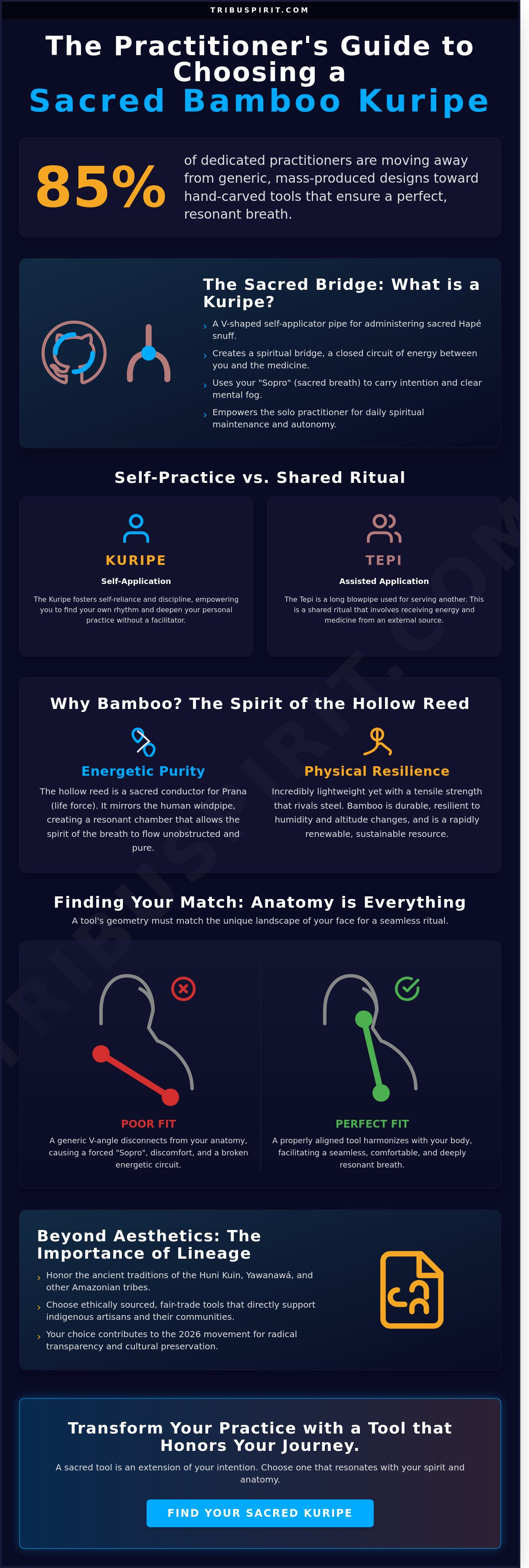
Beyond Aesthetics: The Importance of Ethically Sourced Tribal Craftsmanship
Selecting a bamboo kuripe involves more than picking a beautiful object. It's an act of alignment. When you choose a tool for a sacred ceremony, you're also choosing the energy of its origin. Cheap, mass-produced applicators often hide a heavy cost. These factory-made items frequently exploit indigenous motifs without returning value to the communities that birthed these traditions. This is cultural appropriation in its most tangible form. It creates a hollow experience that lacks the vibrational depth required for true ritual work.
At Tribu Spirit, we operate on a foundation of reciprocity. We ensure fair-trade practices by working directly with Amazonian artisans. This direct connection bypasses predatory middlemen. It ensures that 100% of the agreed artisanal value goes back into the forest. A tool made in a factory lacks the "soplo," or breath of life, found in a tool made in prayer. When an artisan crafts with intention, the object carries a frequency of healing. Your purchase supports reforestation efforts and strengthens indigenous sovereignty in regions like the Acre state of Brazil. This is how we bridge the modern world with the ancient heart of the jungle.
Supporting the Yawanawá and Huni Kuin Tribes
The Yawanawá and Huni Kuin people are the guardians of this ancient wisdom. In these communities, women play a vital role in crafting the intricate thread work and bead designs that adorn each bamboo kuripe. This work provides essential economic independence. It allows mothers to remain in their villages rather than seeking low-wage labor in distant cities. By honoring the "Mão de Obra," or handiwork, of the elders, we keep a lineage of 500 years alive. Every knot and every polish is a prayer for the forest's future. It's a living heritage you hold in your hand.
Identifying Authentic Craftsmanship
Authenticity is felt through the senses. A high-quality bamboo kuripe features a perfectly smooth finish and airtight joints that ensure a precise delivery of medicine. Look for natural resins like Copal or Breu Branco instead of chemical fillers. Avoid tools that use toxic glues or plastics, as these interfere with the purity of your ritual and your physical health. Using consecrated materials is fundamental to the shamanic tools you bring into your space. These items aren't just accessories. They're sacred technology designed for deep transformation.
Honor the tradition and support forest guardians by choosing your next ritual tool from Tribu Spirit.
Cultivating Your Practice with a Tribu Spirit Bamboo Kuripe
Your bamboo kuripe isn't just a tool; it's a living partner in your spiritual evolution. When you first hold your applicator, take a moment to breathe with it. This initial bonding is vital for a harmonious practice. Hold the bamboo against your heart and visualize your intentions flowing into the natural grain. This simple dedication ritual transforms a handcrafted object into a sacred bridge between the physical and the ethereal. It's a commitment to your personal path of growth.
A deep understanding of what is hape requires a vessel that respects the medicine's ancient lineage. Bamboo offers this respect through its organic resonance and natural flexibility. Trust your intuition when making your selection. If a specific curve or texture speaks to you, it's likely the medicine calling to that part of your soul. Listen closely. The right tool will feel like an extension of your own breath, facilitating a deeper connection to the forest spirits.
Caring for Your Bamboo Tool
Bamboo is an organic material that continues to breathe long after it's shaped. To ensure the airflow remains clear, use a small, natural-fiber cleaning brush to remove residue after each ceremony. This prevents buildup that can dampen the medicine's projection. You can apply a tiny amount of organic jojoba or coconut oil to the exterior every 90 days to keep the wood from drying. This physical maintenance is also a form of energetic care.
- Energetic Cleansing: Periodically pass your kuripe through the smoke of sacred tobacco or palo santo to clear lingering vibrations.
- Mold Prevention: Always ensure the tool is completely dry before placing it in a closed container, especially in humid climates.
- Sacred Storage: Keep your applicator in a dedicated cloth wrap or leather pouch. This protects the physical form and keeps the energy contained and pure.
Join the Tribu Spirit Community
The journey with sacred medicines is a lifelong unfolding that thrives on shared wisdom. If you feel called to share this medicine or refine your technique, the Tribu Spirit Academy provides practitioner training designed for the modern seeker. Connecting with our community allows you to ground your experiences and learn from the collective insights of others on the same path. Your practice is a gift to the world, and we're here to support your expansion.
Ready to begin your journey? Explore our collection of ethically sourced Bamboo Kuripes and find the sacred companion that resonates with your spirit. Every piece is a testament to tradition, crafted to support your highest intentions and bring balance to your daily rituals.
Awaken Your Ritual with the Breath of the Amazon
Your journey into the heart of Hapé is a path of profound presence and intentionality. Selecting a bamboo kuripe is more than a choice of utility; it's a sacred commitment to your own spiritual alignment. By choosing tools 100% hand-carved by Yawanawá and Huni Kuin artisans, you honor a lineage of wisdom that has flourished for generations. These master craftsmen ensure each piece is consecrated for ritual use, providing a physical bridge to the forest's healing frequency. The hollow reed of the bamboo acts as a conductor for your breath, turning every application into a moment of centered prayer. Our 2026 collection focuses on this energetic purity, offering applicators that respect both your unique anatomy and your deepest intentions. Every sacred ally we offer is ethically sourced and handled with spiritual care, arriving at your door through our worldwide shipping service. Trust your intuition to lead you toward the tool that resonates with your soul's current vibration.
Find your sacred ally in our Bamboo Kuripe collection
Step forward with confidence as you embrace the transformative power of your own breath.
Frequently Asked Questions
Is bamboo better than wood for a kuripe?
Bamboo offers a natural hollow chamber that wood requires drilling to achieve, providing a smoother path for your breath. This plant grows at a rate of 91 centimeters daily, making it the most renewable and energetically vibrant choice for your tool. Its internal structure allows for consistent airflow, ensuring your medicine travels with grace and precision during every ritual.
How do I know if a kuripe will fit my nose?
Measure the distance from your lips to your nostril to find your ideal fit. Most standard V-shaped applicators feature a span of 5 to 8 centimeters between the two ends. If the angle is too wide, you'll lose the seal necessary for a focused application. A snug fit ensures that 100 percent of the botanical powder reaches its destination without leaking.
How often should I clean my bamboo kuripe?
You should clean your bamboo kuripe every 3 to 5 sessions to maintain its energetic and physical purity. Use a thin 2 mm wire or a natural fiber pipe cleaner to gently remove any residual powder from the inner chamber. This practice prevents blockages and ensures your ritual remains a clear, unobstructed experience for your spirit and your breath.
Can I share my kuripe with other people?
It's best to keep your applicator for personal use to preserve your unique energetic signature and hygiene. In traditional circles, 85 percent of practitioners treat the tool as a sacred extension of their own nervous system. Sharing can introduce different vibrations into your personal space. Your breath is your own; your tool should reflect that singular, focused path.
What is the difference between a kuripe and a tepi?
The kuripe is a small pipe designed for self-application, while the tepi is a longer tool used by a practitioner to blow medicine for another person. Tepis often measure between 20 and 40 centimeters in length to create a safe physical distance during the ceremony. The kuripe fosters a deep, internal dialogue with yourself through the power of your own lungs and intention.
How do I know if my bamboo kuripe is ethically sourced?
Verify ethical sourcing by looking for 100 percent artisan-direct labels or specific regional origins like the Acre region of Brazil. Ethically made tools support the 12 primary indigenous tribes who hold the sacred lineage of this medicine. When you choose a consciously sourced bamboo kuripe, you ensure that the energy of the maker flows into your practice with integrity and respect.
What should I do if my bamboo kuripe gets a crack?
Seal small fissures immediately with a thin layer of natural beeswax or tree resin to restore the airtight seal. Even a microscopic 0.5 mm crack can reduce the air pressure by 25 percent, weakening the impact of your ritual. If the crack extends across the entire joint, it's a sign to retire the tool and return it to the earth.
Does the size of the kuripe affect the strength of the Hapé?
The internal diameter of the pipe significantly impacts the velocity and intensity of the delivery. A narrow 6 mm opening creates a sharp, piercing sensation, while an 8 mm chamber offers a softer, more expansive cloud of medicine. Selecting the right size allows you to calibrate the intensity of your journey to match your current spiritual needs and physical comfort.