
What if the most sacred part of your journey doesn't happen while the rattle is sounding, but in the quiet, ordinary moments of a Tuesday morning? You've likely felt that shimmering clarity after a ritual, only to watch it dissolve as you return to the noise of the modern world. It's frustrating to hold a profound truth in your heart while your hands struggle to weave it into your daily routine. You aren't alone in feeling that post-ceremony slump or the heavy silence when friends ask what you've learned. This delicate transition is known as ceremony integration; it's the vital process of grounding the ethereal into the earthly.
You deserve a sense of peace that doesn't evaporate the moment you leave the altar. In this guide, you'll learn the essential practices to ground your shamanic experiences and transform fleeting insights into lasting life changes. We'll explore practical tools for grounding, the importance of a like-minded community, and how to use physical anchors to keep your path clear. It's time to bridge the gap between the vision and the reality. Let's begin the work of bringing the medicine home.
Key Takeaways
- Discover why the 72-hour window following a ritual is a vital period for neuroplasticity and rewriting old behavioral patterns.
- Learn how ceremony integration acts as the essential somatic and spiritual alignment needed to turn fleeting peak experiences into permanent character traits.
- Explore specific grounding strategies for medicines like Hapé Tsunu to maintain your connection to the sacred during the transition back to daily life.
- Master the four pillars of a successful practice, focusing on somatic grounding and emotional processing to anchor your insights into the physical body.
- Understand how the Tribu Spirit Academy provides the educational framework and community necessary to support your long-term spiritual evolution.
Beyond the Sacred Space: What is Ceremony Integration?
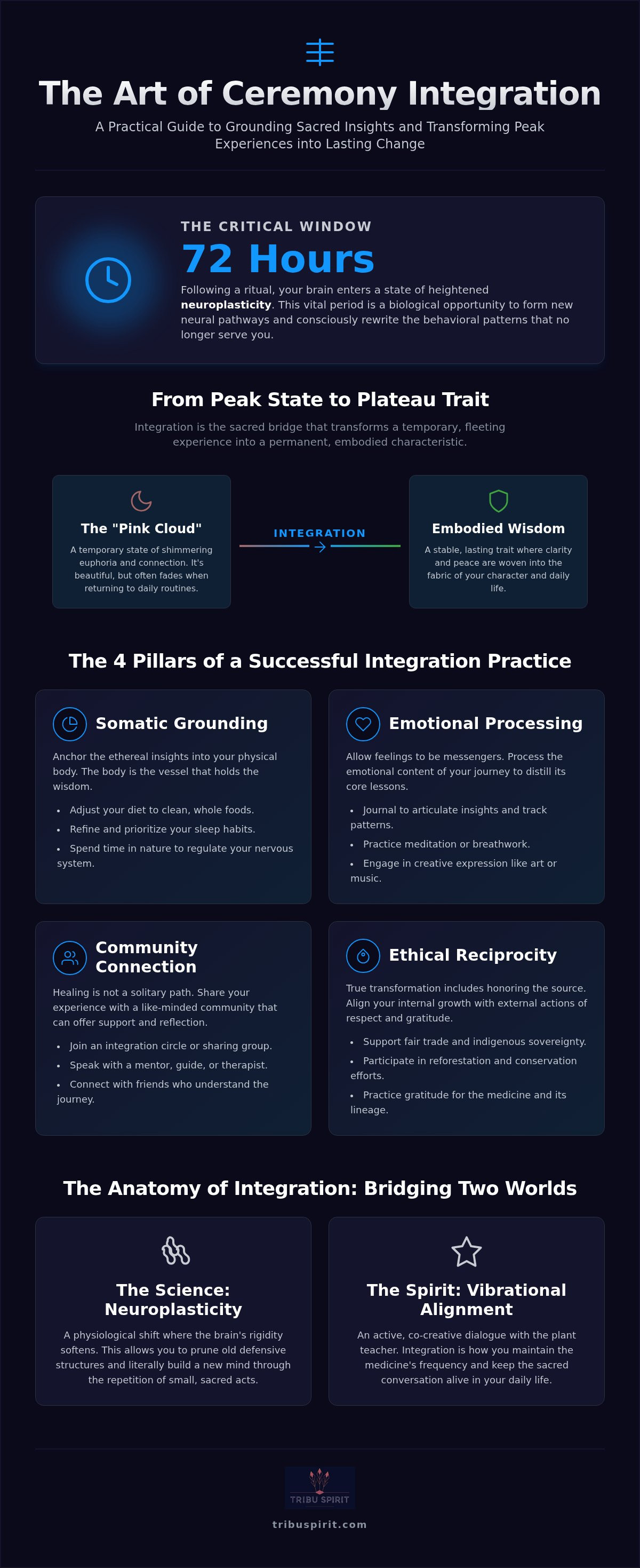
Ceremony integration is the intentional process of anchoring the profound insights gathered during a deep journey into the physical structure of your daily life. It's the sacred bridge that allows you to move from experiencing a "peak state" to embodying a "plateau trait." While a Psychedelic retreat or a deep session with Hapé can offer a glimpse into higher consciousness, the true work begins when the music stops. Science now confirms what indigenous wisdom has always known; the first 72 hours post-ceremony are a critical window for neuroplasticity. During this time, your brain is more receptive to forming new neural pathways. It's a biological opportunity to rewrite the scripts that no longer serve you.
The transition from the ritual space back to the modern world can feel jarring. You've touched the infinite, yet you still have to pay bills and answer emails. This is where the practice of integration becomes your most powerful tool. It isn't about holding onto the intensity of the experience. It's about distilling the essence of that wisdom into your character. We don't seek to live in the ceremony forever. We seek to bring the clarity of the ceremony into every breath we take.
The 'Pink Cloud' and the Reality Check
After a sacred ritual, many people enter what's often called the "Pink Cloud." This is a period of shimmering euphoria where everything feels connected, vibrant, and effortless. It's a beautiful state, but it's temporary. The real test of ceremony integration arrives when you return to high-stress environments or modern routines. You might feel a "crash" as the initial bliss fades. Don't fear this transition. Successful integration often starts with "cleaning up your act." This means adjusting your diet, refining your sleep habits, and setting boundaries. These small, grounded choices prove that you've truly heard the medicine's message. You're building a stable vessel for the light you've received.
Ethical Integration: Honoring the Source
Your personal healing journey doesn't exist in a vacuum. It's deeply entwined with the origin of the medicines you use. Ethical integration requires a commitment to reciprocity. If the medicine is sourced without respect for indigenous sovereignty, it carries an energetic dissonance that can hinder your growth. Supporting fair trade and reforestation efforts isn't just a moral choice; it strengthens your own spiritual foundation. When you honor the source, you close the ceremonial loop. You move from being a consumer to becoming a practitioner who respects the ancestral lineage of the tools you hold. This alignment between your internal growth and external actions is the heart of true transformation. It's how we walk the path with integrity.
The Anatomy of Integration: Bridging Spirit and Science
Ceremony integration is the intentional process of somatic, emotional, and spiritual alignment that allows a practitioner to embody the wisdom received during a journey. This isn't just a psychological exercise; it's a physiological shift. Research into Psychedelic-Assisted Therapy for PTSD highlights how these experiences can open a biological window where the brain's usual rigidity softens. In this state, the ego's defensive structures are momentarily lowered, making it possible to prune old behavioral patterns and plant the seeds of new, healthier habits. You're not just thinking differently; you're literally building a new mind.
From a spiritual perspective, this process is about maintaining the vibrational frequency of the medicine long after the ritual has concluded. You aren't simply a passive recipient of healing. You are an active participant in a co-creative dialogue with the plant teacher. The plant provides the insight, but you provide the action. Integration is the way you keep that conversation alive in your daily life. It's a partnership between your human will and the spirit of the medicine.
Neuroplasticity and Habit Change
Rewiring the brain doesn't require a radical, overnight transformation of your entire existence. In fact, the nervous system often rebels against massive changes, viewing them as a threat to its equilibrium. True ceremony integration thrives on the repetition of small, sacred acts. By consistently choosing a new response to an old trigger, you strengthen the neural pathways associated with your higher self. Many practitioners find that understanding what is hape helps them establish a grounding focal point for this daily neuroplasticity. Using a Kuripe and a small amount of Tsunu Hapé can act as a physical anchor, reminding the body of the peace found in the ceremony and reinforcing your commitment to change.
The Role of the Witness
Healing is rarely a solitary endeavor. While the deepest insights often occur in silence, they are solidified when they are witnessed by a safe, spiritual community. Sharing your journey allows you to move the unfathomable from the abstract realm of feeling into the concrete realm of understanding through storytelling and art. This isn't about seeking external validation or "likes" on social media. It's about sacred accountability. When you speak your truth to those who understand the shamanic path, you anchor that truth into reality. If you feel the call to deepen this connection, exploring the Tribu Spirit Academy can provide the community and structure needed to hold your evolution with grace.
Integration Strategies for Hapé, Sananga, and Visionary Medicines
While much of the modern dialogue around healing focuses on the seismic shifts of visionary journeys, true mastery lies in understanding the entire spectrum of ceremony integration. Not every sacred encounter requires a complete withdrawal from society. Some medicines whisper, while others roar; your integration must match the volume of the teaching received. Subtle medicines like Hapé, Mambe, and Ambil invite us into a lifestyle of continuous alignment, whereas high-intensity visionary experiences demand a more dedicated period of stillness and somatic processing. Recognizing which medicine requires which approach is the first step toward lasting change.
The academic community is beginning to mirror what indigenous lineages have practiced for millennia. The Center for Psychedelic Therapies and Research emphasizes that the educational and preparation phases are just as vital as the experience itself. This research supports the idea that integration isn't an afterthought. It's a deliberate continuation of the ritual. Whether you are clearing mental fog with Sananga or grounding a deep vision, the goal remains the same: to live the medicine rather than just remembering it.
Subtle Medicine Integration (Hapé, Mambe, Ambil)
Integration for subtle medicines is best practiced as a micro-ceremony. This isn't a one-time event but a rhythmic return to center throughout your day. Using a kuripe pipe serves as a daily physical anchor for your intentions, grounding the spirit back into the body whenever the mind begins to wander. When you work with hape tsunu, the integration focus should be on spiritual clarity and rooting. It's about taking that momentary stillness and carrying it into your next conversation. Breathwork acts as the vital fuel for this process, keeping the medicine’s presence alive in your nervous system and reinforcing your presence in the now.
Visionary Medicine Integration (Sananga, Ayahuasca, Kambo)
Deep dives with visionary medicines often involve a physical or emotional purge. Integration here involves honoring that release by maintaining a clean "dieta" for weeks afterward. This isn't just about the food on your plate. It's about what you consume through your senses; the music you hear, the people you see, and the environments you inhabit. Sananga plays a unique role in this phase, helping to clear residual mental fog and maintain the sharp spiritual focus needed to see your path clearly. If you feel heavy energy clinging after a session, Mapacho serves as a traditional tool for clearing the energetic field and sealing the work. There are times when integration means sitting in absolute silence, and times when it requires seeking professional support to navigate the complex emotional terrain that has been unearthed.
The 4 Pillars of a Successful Integration Practice
To ensure ceremony integration becomes a living reality, we must look beyond the mind. True transformation requires a multidimensional approach that engages the body, the heart, and the will. We simplify this journey into four essential pillars. These pillars act as the foundation for your new way of being, preventing the wisdom of the medicine from slipping through your fingers like sand. Without these pillars, even the most profound insight remains a distant memory rather than a present power.
Somatic Grounding and Nature
Your body is the sacred vessel for your spirit. If the vessel is ungrounded, the medicine cannot take root. Spending time in the natural world, specifically through "Earthing" or walking barefoot on the soil, allows the earth to pull excess intensity from your nervous system. You can also use shamanic rattles to stabilize your energy field; the rhythmic sound helps re-order the subtle body after it has been expanded. Movement practices like Yoga, Qi Gong, or intuitive dance are not just exercise. They are ways to physically digest the experience. Move your body. Let the wisdom settle into your bones.
Journaling and Creative Expression
Journaling crystallizes a fluid spiritual experience into a coherent narrative that the mind can finally grasp and apply. By putting pen to paper, you move from the abstract realm of feeling into the concrete realm of understanding. Use specific prompts to guide your reflection, such as "What did I release in the circle?" or "What am I calling into my life now?" If words feel too small for the vastness of your journey, turn to art, music, or altar-building. These non-verbal forms of integration honor the mystery without needing to solve it. They keep the channel open between you and the divine.
The Pillar of Sacred Action
An insight without action is just a beautiful daydream. To make the healing real, you must make one tangible change in your external world. This is the pillar of sacred action. Instead of trying to change everything at once, set "SMART" spiritual goals that are specific and achievable. The most important rule is the "First Step." Take a concrete action within 48 hours of your ceremony. Whether it's making a difficult phone call, changing a specific habit, or committing to a daily meditation, this action anchors the spirit into the physical world. It proves to the universe that you are ready to walk the talk.
Ready to anchor your journey? Explore our collection of hand-carved shamanic rattles and grounding tools to support your daily practice.
Deepening the Path: Resources for Continued Growth
The path of the soul isn't a straight line; it's a shimmering spiral that returns us to our center with deeper clarity each time we walk it. True ceremony integration is rarely a task that's finished in a few days. It's a lifelong conversation with the divine. As you move beyond the initial stages of healing, you'll likely feel a shift in your identity. You're no longer just a seeker looking for external answers. You're becoming a practitioner who embodies the wisdom they've received. This transition requires more than just a good memory. It requires a structured framework and a community that speaks the language of the spirit with both reverence and modern relevance.
Educational Pathways
The Tribu Spirit Academy was created to be the very bridge you need for this long-term evolution. Our educational modules focus on the subtle nuances of ceremony integration, providing you with the knowledge to handle the energetic shifts that follow deep work. By learning the traditional lineages and the proper, respectful use of medicines like Hapé and Sananga, you empower yourself to hold space for your own growth. You don't have to rely on others to find your center. When you understand the "why" behind the ritual, you become the master of your own daily practice, ensuring that the medicine's frequency remains a constant, stabilizing presence in your nervous system.
Tools as Anchors
Physical objects can hold the resonance of our highest intentions, serving as silent witnesses to our transformation. A hand-carved Kuripe is far more than a simple applicator; it's a sacred ally crafted with prayer and intention. When you work with high-quality shamanic tools, you're interacting with a lineage of ancestral wisdom. These tools serve as physical anchors in your home, reminding you of the peace you've cultivated during ritual. We also encourage the creation of a "living altar." This isn't a static display. It should evolve as your integration journey does, reflecting the parts of yourself you're currently nurturing. Knowing when to pick up your tools is vital, but so is knowing when to set them down and simply breathe in the silence you've created.
You don't have to walk this bridge alone. The Tribu Spirit community is a gathering of like-minded souls who understand the unique beauty and the specific challenges of the shamanic path. We invite you to join us, to share your unfolding story, and to find the ongoing support that makes this journey sustainable. Together, we turn the fleeting insights of the ceremony into the permanent foundation of a conscious life.
Walking the Path of the Integrated Soul
The journey from the ritual space back to the rhythm of daily life is where your true power resides. We've explored how the 72-hour window of neuroplasticity offers a rare chance to rewire old habits and how somatic grounding turns a fleeting vision into a permanent character trait. By using anchors like Hapé or a hand-carved Kuripe, you maintain the vibrational frequency of your experience long after the music fades. True ceremony integration isn't just a final step; it's a lifelong commitment to living with your heart wide open.
You don't have to navigate this transition alone. As a Private Ministry Association with deep indigenous ties, we've spent over five years providing spiritual education to seekers around the world. We offer ethically sourced, high-vibrational plant medicines and the guidance needed to use them with reverence. Explore the Tribu Spirit Academy and deepen your integration journey. Your path is unique, but it's supported by a lineage that honors the earth and your own inner wisdom. Walk forward with peace and presence.
Common Questions About the Integration Path
How long does ceremony integration typically take?
Integration is a lifelong process, though the most intensive phase usually lasts between three to six months. While the neuroplastic window is widest in the first 72 hours, the actual embodiment of insights requires consistent daily practice over several seasons to become a permanent part of your character. Don't rush the process; your soul moves at its own sacred pace.
What are the common signs of a spiritual emergency during integration?
A spiritual emergency often manifests as a profound sense of disorientation, intense emotional volatility, or a feeling of being unzipped and unable to function in daily life. You might experience persistent insomnia, hypersensitivity to sensory input, or a distressing loss of identity that feels overwhelming rather than liberating. These signs indicate that the energetic expansion has outpaced your current grounding capacity.
Can I use Hapé every day as part of my integration process?
Yes, you can use Hapé daily as a grounding anchor to maintain your connection to the sacred. Using a Kuripe and a small amount of Tsunu or Mulateiro Hapé helps stabilize your energy field and reinforces the intentions set during your journey. This simple act makes ceremony integration a tangible, rhythmic part of your morning routine rather than a distant memory.
What should I do if I feel more confused after a ceremony than before?
Confusion is a natural sign that your old mental constructs are breaking down to make room for a higher truth. Instead of rushing to fix the confusion, sit in the silence and focus on somatic grounding through nature walks or gentle movement. Trust that the clarity will emerge once your nervous system has fully processed the energetic expansion you've experienced.
How do I explain my ceremonial experience to friends and family?
You don't have to explain the entire experience; instead, share the tangible changes you're making in your life. Focus on the lessons rather than the visions by saying things like, "I've realized I need more stillness," or "I'm working on being more present." This approach keeps your experience sacred and protected while remaining relatable to those who haven't walked the path.
Is it normal to feel physically exhausted after a plant medicine ceremony?
Physical exhaustion is a very common response as the body processes deep emotional and energetic shifts. Your nervous system has undergone a significant recalibration, which requires substantial metabolic and spiritual energy to complete. Honor this fatigue by prioritizing deep rest, hydration, and high-quality nourishment for at least a week following your retreat.
What is the best way to handle unprocessed emotions that arise weeks later?
The best way to handle delayed emotions is to meet them with curiosity and somatic presence rather than judgment. These aftershocks are often the deeper layers of healing coming to the surface once you've returned to a stable environment. Use journaling or a shamanic rattle to move the energy through your body until it finds its natural, peaceful release.
Should I make big life changes immediately after a ceremony?
No, it's generally advised to wait at least 30 days before making any irreversible life decisions like quitting a job or ending a relationship. The initial euphoria can sometimes cloud your practical judgment. Allow the dust to settle and see if the desire for change remains once you've fully grounded your ceremony integration into your ordinary reality.